Sailboat Indra – Offer To Purchase

Sailboat Indra – Offer To Purchase

After reviewing all the pictures taken aboard Indra it was very evident she was not in a "ready to sail away" condition. Despite a nice outward appearance, there were numerous deficiencies aboard; she really was a "project" boat. Our review indicated Indra needed a haul out, a complete bottom job, all thru hulls needed to be replaced, all plumbing hoses needed to be replaced, the LPG system needed to be replaced, the standing rigging needed to be replaced, all the instruments were "dated and should be replaced, the batteries and electrical system needed to be replaced, some wood work needed to be replaced or re-varnished, etc. I still had many concerns about what remained "unknown" and the logistics of obtaining replacements and material from US suppliers. After conversations with Marilyn and Mary Ann, we decided to proceed to make an offer for purchase knowing full well it would take "some" time and significant funds to bring her up to standards.

On 11 March 2015 sent offer to purchase Indra for US $45,000.00.

Sailboat Indra – Review No. 3

Sailboat Indra – Review No. 3

Sailboat Indra - Review Continues


Continued the review of pictures from Indra's inspection, research on the internet, and development of the lists of issues with estimated repair costs.

On 25 February received email from Kim Brewer of Boat Sales Tasmania.

  • It is now two weeks since you inspected Indra and neither Margie or I have had an answer from you on whether you wish to proceed. I hope that you will do Margie the courtesy of replying to this email and indicate whether you are interested in buying "Indra" or not. You are aware of her present circumstances and I'm sure you would not wish to cause her further distress..


Maybe I took this email wrong, but felt they were insinuating that my lack of a quick purchase decision within their perceived allotment of time was a distressing factor.  This seemed like a ploy to appeal to my emotional feelings and instill a sense of guilt - I wasn't buying into this tactic and did not respond back.  I did not push the issue when my previous email questions and findings were not fully and truthfully addressed and answered.  Truthful - what do I mean? They were unaware that when I reviewed the paperwork found aboard Indra, I actually read "all" of it to include a dairy type journal. The missing head door that was answered as not on the boat when they purchased it was contradicted by a journal entry stating it was banging open and close while they were sailing in their early years and it was removed and stored in the V-berth.  The response "found her incredibly comfortable at sea" was contradicted numerous times, particularly on the trip from Taiwan where they stated they sailed monstrous seas and comfort was nonexistent. Lastly Indra's advertisement was a significant stretch of anything truthful, she was not even close to being seaworthy.  I could go on.  Could not fathom why they listed items on the advertisement, with full knowledge the item was broken, unserviceable, or date expired.  I found all this concerning, as I was growing more concerned of what I didn't have time to check on Indra. There was the very real possibility that significant other issues remained undetected, and if there were other problems, I knew it was not going to be freely and honestly disclosed - aka, the old cliche - buyer beware!

My daily internet searches on all things related to the True North sailboat design detected another similar sailboat listed for sell. It was a 1976 Noon Ocean 34 located in Penang, Malaysia; listed at US $55,000. Review of its specifications and pictures revealed it was in considerably better shape than Indra and was equipped with better and more modern equipment. Sent an inquiry to the broker who responded back stating it was no longer for sell, as the owners had departed and were cruising the waters of Thailand.  Not all was a loss, as I had another set of data on the True North sailboat design to add to my growing collection of information.

On 5 March received email from Terry Sargent that they had lowered the asking price on Indra.  Checked both the Boat Sales Tasmania and Terry's website VALHALLA.   The original Boat Sales Tasmania listed price of Australian $73,950 (US $57,138.20) was reduced to Australian $64,950 (US $50,184.26); while website VALHALLA original listed price of US $60,000 was reduced to US $49,990.

Additionally in Terry Sargent's email he informed us the sewing machine and SCUBA gear aboard Indra were removed from the offering.  I found this interesting as we had discussed these items while there. We had informed Terry that we already had a Sailrite sewing machine and the scuba tank and regulator aboard Indra wouldn't work for us due to their age, size, and out-of-certification status. The email did not state who was the recipient of the sewing machine and SCUBA gear, but gave the impression of vultures descending down upon Indra's carcass and picking her bones.

This price reduction did not motivate us to rush our review and submit an offer. I was aware that we were the only potential buyers that were actually serious enough to visit and inspect Indra onsite. I was not concerned if someone else submitted an offer to purchase her, if it happened, good for them - there are thousands of more boat candidates out there waiting.

I was almost complete with the review of Indra's pictures and had formed what I thought was a reasonable estimate of the work and materials needed to repair Indra - it was not going to be cheap and would take an extended time. I had formulated an opinion that Indra was not kept in a proper state; that maintenance and repairs were neglected; that previous installations and repairs were not competently accomplished both in people skills and in materials used; and that Indra was essentially in a state of neglect. I still had deep reservations that other issues remained unknown and undetected. Despite these issues, I was also of the opinion Indra was not a lost cause, could be brought up to basic standards, and was still in better condition than some of the other boats we had visited here in the Philippines. The review continued.


Sailboat Indra – Review No. 2

Sailboat Indra – Review No. 2

Sailboat Indra - Review Continues


On 11 February, turned the computer on early in the morning and discovered the USCG National Vessel Documentation Center had sent the requested title extract on Indra COD 600692.

The abstract of title, last entry, showed Indra was sold to Robert Jesson - this provided reliable traceability of ownership.  Sadly the abstract did not reveal the Hull Identification Number (HIN).

Prior to Australian registration, papers aboard Indra revealed that Robert Jesson in June 2004 had registered Indra with the United Kingdom Small Ships Registry under the name of a Andree Engene - the reason for this was assumed to be for tax purposes. Indra was assigned Official Number SSR111221 with Hull ID Number TN007AP78. This HIN number was not the required 12 characters in length so doubted its validity. Interpreted number TN007AP78 to mean:  TN - True North, 007 - Hull number 7, AP - Month APril, 78 - Year 1978. The USCG abstract of title indicated Indra was imported to the US by company Windships Marine. Per USCG boat builder and importer data list, the company Windships, was assigned Manufacturer Identification Code (MIC) - ZWT.

Based on the HIN format of another True North 34 sailboat; example hull number 6,  it had HIN WTN340060877; therefore could determine a guess as to what Indra's HIN number should be.  Using the "Straight Year Format" (see previous post) and the sketchy information obtained, Indra's HIN number might be ZWT340070478. Further research and a another search aboard Indra was needed to determine the real HIN, if it even existed.

Also received email question from Kim Brewer of Boat Sales Tasmania and later a phone call.

  • I hope you had an enjoyable weekend going over Indra. No doubt you now have a very clear and detailed picture of the boat and the equipment. I would be grateful for an indication of whether you wish to make an offer. Margie of course is keen to hear your thoughts.


On 12 February, sent the following email to Kim Brewer, Margie Jesson, and Terry Sargent.

  • Kim called today and wanted to know our intent after looking at Indra – told her we are still VERY interested in her but I’m still reviewing all the pics I took. Promised her an email with our observations and questions so what follows is what I have noted to date.
  • Excuse me for not responding swiftly but I have been reviewing pictures (took about 2K) of Indra and trying to determine her overall state – still have a lot left to review. Our impression of her is very favorably and both the wife and daughter have already voted yes. Terry and Rose went out of their way to help us and we had a great time with them, can’t thank them enough. My priorities were very simple Hull is #1 (boat no sink) and Mast #2 (don’t fall down). The hull from the inside appears ok and has evidence of a few water intrusion points that need to be sealed – I discovered three below water line thru hulls without seacocks. The mast is still bare aluminum with the usual corrosion present and is probably due a strip and paint job. Outside and inside Indra look very nice and there is a lot of stuff aboard – did not attempt to go through these – moved items around to access hull area, bulkhead tab joints, wiring, and plumbing routes as best as possible. As we informed Terry, we did not see the laptop, the tiller pilots, life vests, flares, etc – but we were not really looking for these. Also did not turn anything on or attempt to start the engine – not enough time for this. So far Indra is the best looking boat in this area we have looked at.
  • What follow below is notes as I review items with a few questions you might attempt to answer.
  • Requested and received Australian Register of Ships Title Extract for ON 858927 and on this it indicates “Brake Power 30 bhp” and under Particulars of Propulsion it lists: “No. and Type of Engines: One 3 cylinder, Yanmar 3QM30 (H) diesel, Serial Number: 7H1529.” Actually installed is a Yanmar 4JH5E Serial Number: E10533 MFG Date: Jan 2010 with Brake Power: 53.1 mhp (39.6 kW). In the US, normally an alteration of ship form with particulars is filed to update information on file resulting in a revised ship’s title/certificate. Does this affect the validity of the current title/certificate?
  • Inquiry to PPS Register indicated no encumbrances.
  • Requested and received USCG Abstract of Title for USCG Doc. No. 600692 yacht now named INDRA. Quite informative as it shows original build certificate in Taiwan and all changes of ownership/bills of sale until it was registered in Australia.


  • Observations:
  • The tiller handle is made from three pieces of wood laminated together with the middle piece showing significant wood rot. You already probably got notified of this from Terry who I informed of this issue.
  • The cockpit port and aft lazarette lids are not secured to the structure – they are just resting on top. The port cover does have hinges just missing screws, but the aft cover has no visible means of being secured. It looks like it was recently reworked – how was it secured previously?
  • In the port lazarette discovered a cockpit table with a stainless steel mount fitting but could not determine how it was previously mounted in the cockpit – how was this done previously?
  • The starboard side of the entry way hatch at the top is missing a piece of the wood trim. Might have been left off when they were working the headliner which looks really nice now.
  • The head entryway has indentations in the trim for hinges that indicates there was a door installed at one time. Is the door just not installed or removed/deleted?
  • The bow anchor/chain roller shaft is missing the installation of a cotter pin in the nut on the star board side – nut had worked itself loose almost to point of falling off – it was retightened but still needs to be pinned.
  • Starboard side mast intermediate shrouds deck plate is missing all screws and not bonded/sealed for water intrusion at the chain plate. Port side intermediate shroud swag fitting has evidence of hairline cracks. When was the last approximate time the standing rigging was replaced?
  • In the aft lazarette, the 3 inch exhaust hose is chaffing against the Whale 30 Gusher bilge pump where the inner wire support is exposed and rusting in one spot. Also saw the plastic inline shut off valve, but did not see the normally installed anti-syphon loop for this hose.
  • In the aft lazarette, there is a wood cover board right below the dive tank. When removed it showed a small cavity that has standing water present – this is much higher level than the bottom of the bilge. Not sure if there is a drain hole to the bilge and if so it might be clogged. The bilge had a small accumulation of water with some oil on the surface – did not determine its source. In the aft and sides of the lazarette on the hulls there are indications of water intrusion from some of the fittings/attachments (orange/rust streaks done the side.)
  • In the quarter berth area the fire extinguished no longer has the factory seals in place and indicates recharge needed. The forward fire extinguisher indicates green for charge but has significant surface corrosion. Would change both for safety.
  • The ACR EPIRB sticker indicates expired 9 July 2014. ACR P/N 2775 is a discontinued model and battery replacement and re-certification is probably not advisable as recent/new models are about the same cost.
  • The two cockpit drains are routed to thru hulls and double clamped but no seacocks are installed at these locations – this is below the water line.
  • The Isotherm skin fitting thru hull is not equipped with a seacock - this is also below the water line.
  • Did not locate flares but suspect if aboard, they are probably outdated and need replacement.
  • Observed under the sole in front of crew entry an unattached fuel line that goes to a 025-RAC In-line Gasoline Filter then to the ECCO 1LM12 fuel pump and then appears to be routed forward. Believe this might be the fuel input for the Dickerson heater and either the heater or engine fuel input must be switched manually depending on which item is to be used – is this assumption correct? Also ECCO 1LM12 fuel pump input line from fuel filter is detached from the housing assembly – appears it might be broke and need replacement?
  • Did not observe a barometric damper installed in the Dickerson heater flue pipe?
  • Did not get to check the bottom of the hull but the water is clear enough to see a scrub is needed due to the growth present. Was informed Indra has been back in the water for about 11 months.


On 13 February received the following email response from Margie Jesson.

  • Hi, I will try and answer your questions to the best of my recollection. Glad your wife and daughter liked Indra. She was our home since 2004 and we found her incredibly comfortable at sea and anchor.
  • The mast was pulled in 2004 when the rigging was replaced. We cleaned and polished the mast then, and decided against painting it.
  • Terry has found the computer and will install newer charts and sailing software on it. It has an external GPS. The tiller pilots are behind the stb settee. Don't know where the life vests are as we have not sailed since we reached Davao. They are manually inflated ones. Flares would be out of date and are in the grab bag in the cupboard behind the companionway ladder.
  • Ships title on Australian register is not effected by the new engine - it actually never occurred to me to update those details.
  • Tiller handle is being repaired.
  • Cockpit port and aft lazarette lids were resprayed while we were in NZ a few months ago, and Rob intended refitting new hinges and latches when he returned.
  • Stainless steel mounting for cockpit table used to go on the cockpit seat aft, but Rob built a new butt out for it to go on, but had not had time to reinstall it. The mounting allows you to rotate the table so you can sit down, The table was really useful.
  • The head entryway door was removed before we bought the boat.
  • Standing rigging replaced in 2004.
  • Ingress of water in aft compartment of cockpit was mostly from screws holding the cockpit coaming in place. We thought we had pulled these all and got rid of the leaks.
  • We did not put stopcocks on the cockpit drains, which were replace in early 2014 with larger ones. The previous drains had no stopcock either. The fridge sink drain was installed according to specs and they did not recommend a stopcock.


What I gleamed from this email:

  1. The standing rigging was at least 11 years old and coupled with the bowspirit bobstay whisker stays too short and both the forestay and inner forestay furling systems mounted improperly (see post) it was a good assumption that all the standing rigging was overdue replacement.
  2.  Admission that the flares were out of date confirmed the assessment that all the safety equipment was unserviceable and needed replacement.
  3.  Admission of knowledge of missing and not installed hardware confirmed findings discovered during inspection.
  4.  Admission of ingress of water in aft compartment of cockpit confirmed prior awareness of the issue and it must have existed for awhile based on the water intrusion and damage discovered during the inspection.
  5.  Admission and choice to not install the three missing seacocks - this answer defies common boat safety sense. It is 100% recommended by all knowledge boaters that seacocks are mandatory for any location that can be below the waterline.  The manufacture's installation manual for the fridge sink drain specifically advises the use and installation of a seacock; they even sell it as an additional item.


On 14 February received the additional email response from Margie Jesson.

  • To answer another couple of points you mentioned....
  • (Observed under the sole in front of crew entry an unattached fuel line that goes to a 025-RAC In-line Gasoline Filter then to the ECCO 1LM12 fuel pump and then appears to be routed forward. Believe this might be the fuel input for the Dickerson heater and either the heater or engine fuel input must be switched manually depending on which item is to be used – is this assumption correct? Also ECCO 1LM12 fuel pump input line from fuel filter is detached from the housing assembly – appears it might be broke and need replacement?)  -- When the new engine was installed, Rob used the fuel pump solely for the engine. So to use the Dickinson heater in the future, I think he intended to install another fuel pump (rather than use a T junction from the fuel tank) We ran the engine in October 2014, when Rob and I returned to the marina to say goodbye to Indra (and that was when he installed the new Racor fuel filters). We ran the engine for a couple of hours, and all was fine.
  • (Did not observe a barometric damper installed in the Dickerson heater flue pipe?) -- Not sure what you mean here, We used the Dickenson heater a lot in New Zealand and Japan. It was very efficient. There is a 12v fan in the heater that you switch on if it is windy outside, This establishes a good draft up the flue while the heater is warming up, and once it was hot, we usually turned the fan off.


What I gleamed from this email, not much.  Believe that since the heater was not in use the broken fuel pump was not a priority to fix to them as it was "intended" to be replaced. The Dickerson heater barometric damper was a required item to be installed in the system per the manufacture's installation instructions.

I still had considerable pictures to review and research to accomplish, but I already concluded that Indra's advertisement statements, “Indra is a 'step aboard and go cruising' opportunity" and "maintained and meticulously upgraded by knowledgeable owners" was far from reality. I did not respond back to these emails, as I was still in the review process and had not made a final decision.


Sailboat Indra – Review No. 1

Sailboat Indra – Review No. 1

Monday, 9 February, started with getting a still tired and worn-out Mary Ann off to school and Marilyn's sister departing for her home.  Luggage was unpacked and clothes washed. I downloaded the pictures and videos to the computer and plugged in the cameras and spare batteries to start charging.

Received an email from Terry Sargent, sent the previous night, notifying me that a guy named Jonathon Bentley-Stevens provided an estimate to repair Indra's tiller handle plagued with wood rot for US $45.00 and was waiting for Margie Jesson's approval to proceed with the repair.  I had discussed many of the issues discovered aboard Indra with Terry, it was interesting to know he had informed Margie Jesson of my opinions and findings.

Terry forwarded another email from Margie where she responded about other issues/questions, "The hull number is ON000092 or something like that,. It is on the inside of the hull where you lift up the floor between the bathroom and the wardrobe. That is full of paint and epoxy tins etc, so you'd have to pull all that out to see it. But is definitely there. The computer is a Toshiba, would have thought it would have been in the nav drawer, or maybe I put it in one of the clothes drawers in the forward berth area. It has OpenCPN and charts loaded and I have the portable hockey puck GPS with me and will bring it back."

There appeared to be some confusion on their part as what number I was unable to locate aboard Indra.  I had already discovered the number NO 600692 NET 9 under the floor boards in front of the head they referred to - this was not what I was looking for. I was looking for a Hull Identification Number (HIN).  Per the US Code of Federal Regulations 33 CFR 181.23, all boats manufactured or imported on or after November 1, 1972 must bear a primary and secondary HIN. A HIN is a 12 character serial number that uniquely identifies the boat, usually permanently affixed to the rear of the transom on the upper right corner and on another location on the interior of the boat.  Australia has a very similar requirement. See HIN example below.

At the Coast Guard Maritime Information Exchange (CGMIX) website performed a vessel search on number "600692" and the results below confirmed Indra was previously registered in the US.

Also performed another search on the NOAA Vessel Documentation Search website which provided the following results.

Based on these results downloaded from the USCG National Vessel Documentation Center website and submitted USCG Form CG-7043 request for Abstract of Title on ship Indra, Certificate of Documentation Number 600692. This was submitted electronically on a PDF document to email address "NVDC.PDF.FILING@uscg.mil" and cost US $25.00.

From the hundreds of pictures taken on Indra and recorded notes, started making a very detailed inventory list of "all" items aboard. As an item was identified and added, searched and downloaded from the internet any manufacture's manuals and literature that could be found. Determined if the item was still available for purchase, its price, and source.  In many cases, determined that the item was obsolete and no longer procurable. Reviewed the manufacture's installation documentation and compared it to Indra's pictures to determine if the item was actually installed correctly - in many cases they were not. Also identified manufacture's recommended preventative maintenance inspection and component replacement requirements and intervals.  These results were compiled into to different lists that made sense to me.  The goal of this effort was to determine what was wrong aboard and an estimate of what it would take to fix it and the cost associated.  This would take some time as each picture was magnified to scrutinize everything that was shown.

An example of this was most of Indra's thru hull seacocks were identified as Philmac ball valves. Downloaded the Philmac blue handled ball valve technical manual from the Philmac website. It revealed that these ball valves were not marine rated and were designed for use in the rural, irrigation and plumbing industries.  Further its chemical resistance table, shown below, identified these ball valves were NOT RECOMMENDED for use with brine liquids - brine is also defined as salt water. Indra had aboard a plastic container with five previously used Philmac ball valves.  These unserviceable ball valves all had barnacle encrustations on their interior surfaces and plastic balls - it appeared when the ball valve handle was attempted to be rotated, the plastic material gave way (split) since it was not hard enough to scrape off the concrete-hard barnacle encrustations.  Indra has nine thru hulls in its hull of which three were missing required seacocks. All the thru hulls were of plastic construction of unknown manufacture. Based on the use of non-marine rated seacocks, assumed it was just as likely the plastic thru hulls were also non-marine rated.  This meant that nine complete marine rated thru hulls and seacocks assemblies (to include new marine rated hoses and double clamps) were needed to correct these deficiencies - an expensive proposition in itself.

On 10 February, downloaded from the Australian Maritime Safety Authority (AMSA) Ship Registration website, Form AMSA 204 Application For Current Title Extract.  This was filled out using ship name Indra and Australian registration number ON 858927. It was submitted electronically on a PDF document to email address "sro@amsa.gov.au" and cost AUD $50.00 (US $39.13).

Surprise, about 3 hours later the AMSA title extract on Indra was received by email. The information on this title extract mirrored the Australian registration we had found and took pictures of aboard Indra.  This also confirmed the validity of the registration.

To verify Indra had no mortgages or liens outstanding performed a search on Australian Personal Properties Security Register (PPSR) website which cost AUD $4.00 (US $3.14). They issued a Search Certificate, shown below, which indicated no securities were recorded.

The review of Indra's pictures and internet researched continued.


Sailboat Indra – First Look Day 3

Sailboat Indra – First Look Day 3

After our complimentary breakfast at Precious Garden of Samal Hotel & Restaurant we explored the area around the hotel.  It had a fish pond, gardens, basketball courts, and a beach resort area - it was a shame we did not allocate time to enjoy this place.

Terry Sargent picked us up at around 0800 at Precious Garden of Samal Hotel & Restaurant to take us to Indra - he advised us to skip the hotel's bag lunches as he had different plans for us for lunch.

At Indra, I continued the interior inspections and took hundreds more pictures.  Mary Ann had other priorities, changed into a swim suit, and went swimming under the supervision of Marilyn.

While observing Mary Ann swimming, Marilyn met a nice lady named Glenda Bernaez and chatted about her boat life experiences and adventures for quite some time.  Glenda was with the yacht Helena captained by Eddy Huybs, right down the pier from Indra.

In the head, a manual Lavac toilet was installed. The head was missing its door - it was not found aboard. Spent time tracing all the hoses and determined the toilet was designed as a toilet direct overboard flush system.  The contents of the sink and shower were captured in a holding tank and then pumped overboard.  A direct pump overboard of the toilet contents is not a practical installation as there are a lot of areas designated as no discharge zones - this type of installation was not environmentally sound and could have legal implications. The intake and discharge thru hulls were located under the sink cabinet and both had plastic Philmac seacocks installed.  Both seacocks had single versus double hose clamps, both did not have a anti-syphon loop installed, both had clamps with corrosion present. The discharge thru hull had excessive gray sealant around its base giving the appearance that a leak had previously existed.

There were three fire extinguishers aboard; one located in the head, the hanging locker, and the quarter berth area. All three were old and not serviceable; one was extremely rusted while the other two were missing safety pins and seals.

The emergency beacon aboard (EPIRB) was not serviceable as its battery had expired March 2010 nearly five years past. All the other safety equipment aboard Indra was either not serviceable and/or date expired.

The front of the V berth was missing the door for the forward compartment - it was not located aboard.  The cushions and floor boards on the V berth were removed revealing another area with lots of stuff stored - sails, rope, etc., with the chain occupying the forward section of three storage sections. Found the windlass control box and toilet pump body in this area. More wire issues were observed.  Everything was return back to its location.

We discovered Terry Sargent has a regimented social routine and usually has Sunday lunch at the Bahay Kubo Restaurant and Bar on Samal Island operated by a Swiss couple, Jacqueline and Alphonse Laurent.  He usually invites along fellow cruisers at the HOV marina and uses his Ford Ranger pickup truck to ferry interested parties back and forth.  He extended the invitation to us and we graciously accepted his offer.  Around noon that day, we gathered our belongings, closed up and said goodbyes to Indra, and joined Terry and Rose for the drive south and across to the middle eastern side of Samal Island where the restaurant was located.

Here we met Mike and Gay Lewis of yacht Expeditus, who were also outfitting their yacht at HOV marina - they had lots of experiences and advice to share. Just like the previous night cruiser potluck/barbecue, most in attendance had wine - strange - what was this infatuation with wine and boating?  As the pictures below illustrate, the atmosphere, the food, and yes the wine was enjoyed.

Bahay Kubo Restaurant Participants - Top left - Mike Lewis and Mary. Top middle - Marilyn and Gay Lewis. Top right - Mary and Rose. Middle right - Damagnar and her friend. Middle right - Joe and Marilyn. Bottom right - Terry and Alphonse.


With lunch finished and the bill settled (3,900 pesos US $78.00), Terry returned us to the Precious Garden of Samal Hotel & Restaurant where we picked up our luggage and settled the hotel bill (4,700 pesos US $94.00).  He then drove us to the Davao airport and dropped us off with barely an hour left before departure time.  We expressed our deepest thanks to Terry for all he had provided to make the visit to Indra so much more than just a boat inspection.  We said our goodbyes and scurried off to make our departure check-in time.

The flight out of Davao was 2 ½ hours behind schedule due to “excess air traffic” in Manila.  After arriving at Mactan airport in Cebu, we loaded our bags in our Suzuki multi-cab truck, paid the 450 peso (US $9.00) parking fee, and headed south to our house in Naga City.  The traffic through Cebu City was heavy as usual and it took us over two hours to get home - this is two hours to travel about 30 kilometers (18.6 miles).

Marilyn's sister was happy to see us back.  The house, chickens, and pigs were all fine.  Mary Ann was straight off to bed as she had school in the morning. Marilyn paid her sister 2,500 pesos (US $50.00) for watching the house and she departed the next morning to return to her home.

The trip and visit to Indra seemed to have passed so quickly.  But what a trip and positive experience it was.

I had not decided on whether to purchase Indra as a review of the hundreds of pictures taken would take some time - Marilyn and Mary Ann had already decided in favor of buying her.

The review of pictures, research, and estimate of repairs and refit costs was the next task to be performed to aide in the decision to purchase or not.


Sailboat Indra – First Look Day 2

Sailboat Indra – First Look Day 2

On Saturday, 7 February 2015, we awoke early in the morning and had the complimentary breakfast at Precious Garden of Samal Hotel & Restaurant. The staff there also made us up bagged lunches with sandwiches and drinks.

Terry Sargent picked us up at around 0800 and dropped us at Holiday Oceanview Marina.

Like the exterior of Indra, it was obvious the interior had recently been thoroughly cleaned and surfaces shinned up to create a more favorable impression. Placed in multiple locations inside the boat were containers labeled MicroMagic Dehumidifier - they apparently worked pretty good based on the water level inside the containers and the lack of mold/mildew and its distinguished smell.

Marilyn and Mary Ann were tasked to sift through all the books and cabinets to locate any manuals, maintenance logs, and paperwork on Indra while I emptied the lazarette accessed through a hatch on the port side of the cockpit. There was a lot of stuff jammed into the lazarette.  Due to the lack of airflow in the confined lazarette space, the normal high humidity and heat of the Philippines, it was not long before I was thoroughly drenched in sweat - many rest breaks were needed.  With all the stuff removed, the plywood floor boards were pulled up and out exposing the aft portion of the engine and transmission, the bilge, and interior hull surfaces.

The bilge had standing water in it and a layer of blackish oil was present - not a good indication.  The aft most portion of the hull had a triangular plywood floor covering that when removed revealed a enclosed area with over a foot of standing water in it - there was no hole in this compartment to allow the water to drain down into the bilge.  Inspection of the exposed hull revealed numerous water and rust stains indicating leaks were present where hardware and wiring penetrated the hull.  The engine exhaust hose had a large plastic shut-off valve installed and its handle was extremely difficult to move. The exhaust thru hull mount bolts had water seepage indications as rust stains flowed down the hull from their location. The exhaust hose had indications of chaff where it contacted and rested against the manual bilge pump. The propeller shaft was routed through a traditional stuffing box that had a hose with wire reinforcement that had signs of rust along with its single instead of double securing clamps.

Inspection of wire runs revealed multiple areas with wires not connected to anything, just hanging free.

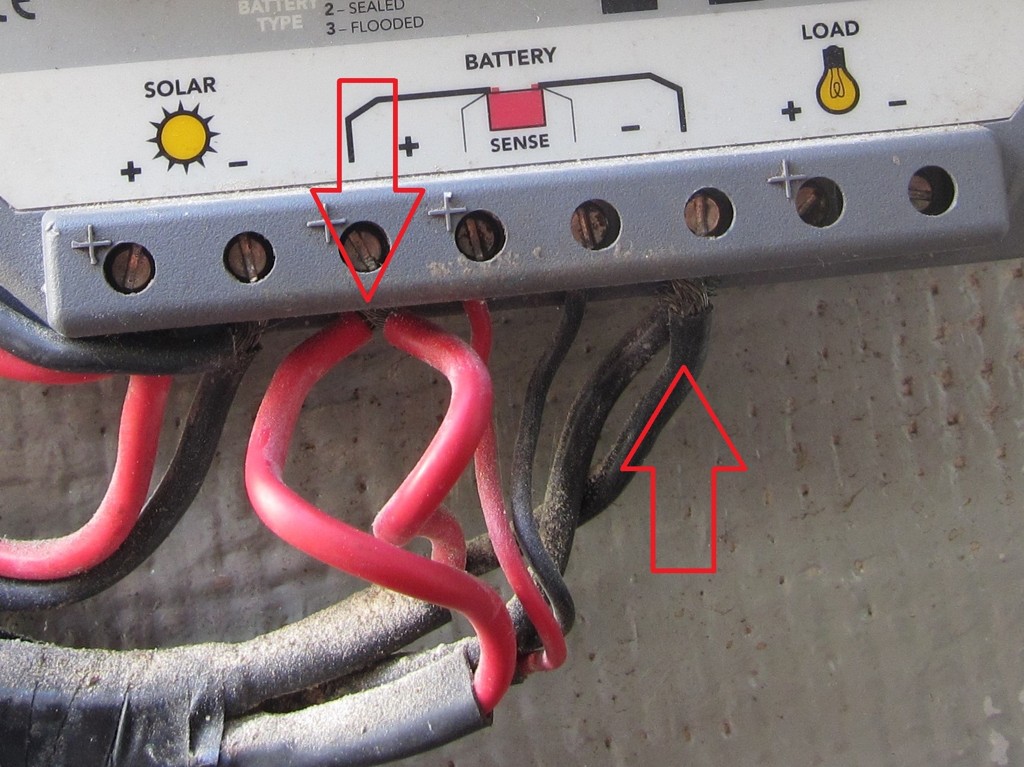
Wire connection terminals were mostly of cheap plastic instead of high quality marine rated terminals.  Most of the wiring had no labeling on the insulated jacket, so it was not quality marine rated wire. Instead of continuous runs of wire, found excessive use of cheap inline wire butt splices joining wires of different types and colors together - this was definitely not a quality or competent electrical installation.  On the positive side, the wire runs were securely attached to the boat surfaces. The solar controller used dual wires for both power and ground connections instead of a proper, single larger size gauge wire.  As these wires were twisted together to form a connection, they had started to work free as the exposed wire ends reveal below.

On the port side of the hull were three thru hulls for the manual and automatic bilge pumps, and a cockpit drain scupper. Two had seacocks and one had a straight hose connection. All these thru hulls should have had a seacock installed.   Not all the hoses were marine rated and most had a single versus double hose clamp.  Most clamps had evidence of corrosion present. The seacocks were a Philmac ball valve and did not appear to be marine rated or approved - further research on this was needed.

Reinstalled the plywood floor boards and returned all the stuff removed back into the aft lazarette.  It was time for a break and lunch.

Over lunch reviewed and took pictures of the paperwork Marilyn and Mary Ann had found.  The Australian registration certificate was laminated in plastic - strange - the engine details were not updated to reflect the current installed engine.  Found insurance papers from Northernreef Insurance Company that expired July 2013 that insured Indra at a hull and contents replacement value of NZ $214,000 (US $144,297) - later discovered this insurance company has a very unfavorable reputation.  A bound notebook containing parts inventory and inspection requirements was the closest thing to a maintenance log found - it had very skimpy information on what was done on Indra and when it was next due. They found two boxed style folders that contained manufacture's manuals for some items aboard - a manual for the current engine and transmission was not among them.

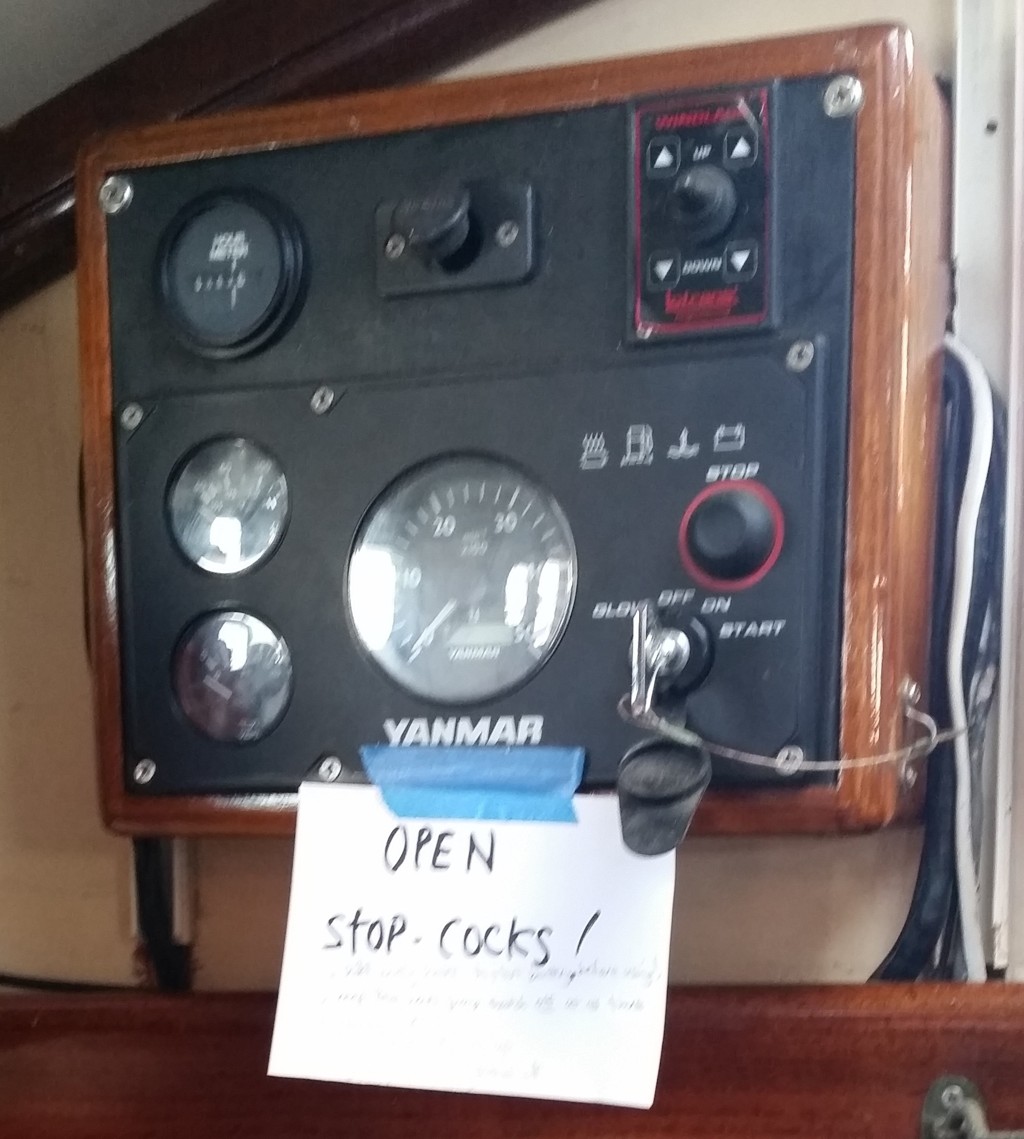
Inside the companionway entrance, starboard side, is the Yanmar engine control panel - strange - why was it not located within easy reach and in view from the cockpit?

On the aft starboard side is the quarter berth that was converted to a cabinet area with multiple drawers and shelves. The front side of this woodwork was painted off-white providing the woodwork some level of protection from the elements. Most of the drawers were difficult to slide out and open. Upon opening the middle drawer filled with hardware in plastic containers discovered why - a water leak was somewhere above the quarter berth, as the plastic container lid tops were full of water.  This water had migrated to the interior bare surfaces of the drawers and wood, swelling them, making the drawers difficult to open. Mold and mildew had already taken hold inside the bare, untreated interior wood surfaces.  The ceiling area above the quarter berth appeared as if it was the original wood panel installed when built and it too was also deteriorated due to water intrusion.

Removed the quarter berth floor boards which revealed the backside of the circuit breaker panel and the battery compartment.  The circuit breaker panel had the freshwater pump breaker taped in the off position since the water pump was broke and did not auto shut off.  Noticed two circuit breaker switch heads were broken off - circled in red below.  The DC Meter was very dim and hard to read, while the Tank Monitor displayed nothing. Momentarily placing each circuit breaker to the ON position revealed that not all the red LED "ON" indicator lights functioned.  At the same time, tried to power on the respective item powered by each circuit breaker.  Could only get some of the interior LED lights and fans to work.  At the navigation station only got the GPS unit and music radio to power on - the radio had four speakers but only one output sound - the three non-working speakers were later found to have no wires connected.  Also discovered later that all the electronic items at the navigation station had all their cables disconnected.

The aft side of the circuit breaker panel revealed a rat's nest of wiring - there were serious electrical issues here. An even more serious issue was the main protective fuse from the house batteries to the circuit breaker panel was replaced by a jumper wire - not a wise practice since it increases the chance of a boat fire.

The windlass circuit breaker bottom terminal had corroded completely in half and separated.

The engine start battery was a Philippine made 70 amp lead acid battery and was just sat in-place - it was not secured to the boat structure. The house battery bank consisted of four Gel type 220 amp batteries installed 14.03.09, 14 March 2009 - they most likely had little life left in them. Attached to the house battery bank with alligator style wire clamps was an automotive style lead acid battery charger which should never be used on Gel type batteries.  The house batteries were enclosed in a wooden box covered with a wooden lid that had absolutely no ventilation. Did not bring along an electrical meter to check the voltage or health of the batteries.

Removed the companionway steps and the floor boards it rested on to access the engine compartment.  The engine was a year 2010 Yanmar 4JH5E 53hp diesel engine with 757 hours on it - relatively new.  It appeared as if it too had been wiped clean as there was no dust on it and appeared shinny.  Did not notice anything visibly amiss and "assumed" it was ok.  The engine was not started and run.

The floor boards by the galley were opened up.  The engine intake thru hull seacock was marine rated as it was made by Forespar - the attached hose was not marine rated and the clamps were corroded. The top and back side of the diesel fuel tank had significant amounts of corrosion present.  The automatic bilge pump was visible under the engine; attempts to verify it operated failed.  Did not notice any oil or liquid leaks on the bottom of the engine - so where the oil in the standing bilge water originated from remained a mystery.  Found more dead ended wires and wire installation issues.  A small diesel fuel pump, not mounted to a surface, hanging freely, for the heater had its input fuel hose line capped off - this was actually a good thing as its input line plastic case was broken off.

Underneath the galley sink, the severely rusted freshwater pump was mounted to a sidewall, covered by a plastic sheet - it appeared this plastic sheet was to used to divert water off the pump from potential leaks of the galley sink above. Further aft in this compartment was the refrigerator compressor - did not attempt to verify its operation.  In the next cabinet, found the salt water intake and galley sink discharge thru hulls. The salt water intake thru had a plastic Philmac thru hull installed, while the galley sink drain hose was connected directly to the thru hull without a seacock - very ill advised.

The galley stove surfaces were recently shined and polished, but this did not conceal the corrosion on the metal seams and screw heads.  The LPG tanks installed on the boomkin were made of aluminum and had significant surface corrosion present.  The LPG tanks were not turned on to check if the galley stove was functional.

Marilyn had inventoried and took pictures of the galley and main cabin cabinetry contents and expressed if we did purchase this boat, most of the items would be discarded.  Numerous books were stacked in shelves and discovered lots of old power and hand tools of questionable serviceability as they too had signs of corrosion all over them. While there were numerous pictures displayed throughout the boat, Marilyn reiterated they too would all have to go.  She pointed out that numerous port light windows were missing the hardware to suspend the windows open.  The headliner in the cabin appeared to be newly installed. A quick look at the diesel heater in the main cabin only revealed that it most likely had not been used in a long time.

Opened the floor boards in front of the head and discovered three more thru hulls - they were for the depth and speed transducers, and one thru hull was capped and unused. A small holding tank and a plastic bottle to contain the diesel heater return fuel was also located here. After removal of numerous partially filled old paint cans and other stuff, noticed what look like a number in the bottom fiberglass. Used a rag and scrapper to remove the accumulated grunge covering the fiberglass and "NO 600692 NET9" was revealed. These numbers were most likely prior registration numbers - further research was needed.

It was getting late, as the skies were darkening up.  Closed up Indra for the night. Terry graciously provided transportation back to Precious Garden of Samal Hotel & Restaurant.  We all took a much needed shower and the hot water output ceased - we learned later the hotel has a solar water heating system and once that hot water is consumed, cold is all you get - this does not speak favorably for this hotel considering the rate they charge. Note: Our house in Naga City, Cebu only has cold water so we are not hot water wimps, but if we are paying premium for a hotel room, we should expect better.

After the showers, we had dinner at the hotel's restaurant - strange - we were the only customers.  Mary Ann ordered cheese pizza which she enjoyed immensely, Marilyn had some pasta dish, and I had fish & chips with tempura fried shrimps on the side.   While the food was not bad, it seemed to take a extremely long time (about 50 minutes) to get the food after it was ordered.

With dinner finished we returned to our room.  I downloaded all the pictures and videos from Marilyn's Samsung cell phone and my Cannon PowerShot D30 camera to our computer. Luckily I had brought along our plug adapters and extension cords, since they were needed to plug in the cameras and spare batteries for recharging.

Everyone slept soundly that night, maybe due to the sweltering heat and humidity experienced all day within the low airflow confines of the boat Indra.