
On Saturday, 7 February 2015, we awoke early in the morning and had the complimentary breakfast at Precious Garden of Samal Hotel & Restaurant. The staff there also made us up bagged lunches with sandwiches and drinks.

Terry Sargent picked us up at around 0800 and dropped us at Holiday Oceanview Marina.
Like the exterior of Indra, it was obvious the interior had recently been thoroughly cleaned and surfaces shinned up to create a more favorable impression. Placed in multiple locations inside the boat were containers labeled MicroMagic Dehumidifier - they apparently worked pretty good based on the water level inside the containers and the lack of mold/mildew and its distinguished smell.

Marilyn and Mary Ann were tasked to sift through all the books and cabinets to locate any manuals, maintenance logs, and paperwork on Indra while I emptied the lazarette accessed through a hatch on the port side of the cockpit. There was a lot of stuff jammed into the lazarette. Due to the lack of airflow in the confined lazarette space, the normal high humidity and heat of the Philippines, it was not long before I was thoroughly drenched in sweat - many rest breaks were needed. With all the stuff removed, the plywood floor boards were pulled up and out exposing the aft portion of the engine and transmission, the bilge, and interior hull surfaces.

The bilge had standing water in it and a layer of blackish oil was present - not a good indication. The aft most portion of the hull had a triangular plywood floor covering that when removed revealed a enclosed area with over a foot of standing water in it - there was no hole in this compartment to allow the water to drain down into the bilge. Inspection of the exposed hull revealed numerous water and rust stains indicating leaks were present where hardware and wiring penetrated the hull. The engine exhaust hose had a large plastic shut-off valve installed and its handle was extremely difficult to move. The exhaust thru hull mount bolts had water seepage indications as rust stains flowed down the hull from their location. The exhaust hose had indications of chaff where it contacted and rested against the manual bilge pump. The propeller shaft was routed through a traditional stuffing box that had a hose with wire reinforcement that had signs of rust along with its single instead of double securing clamps.
Inspection of wire runs revealed multiple areas with wires not connected to anything, just hanging free.

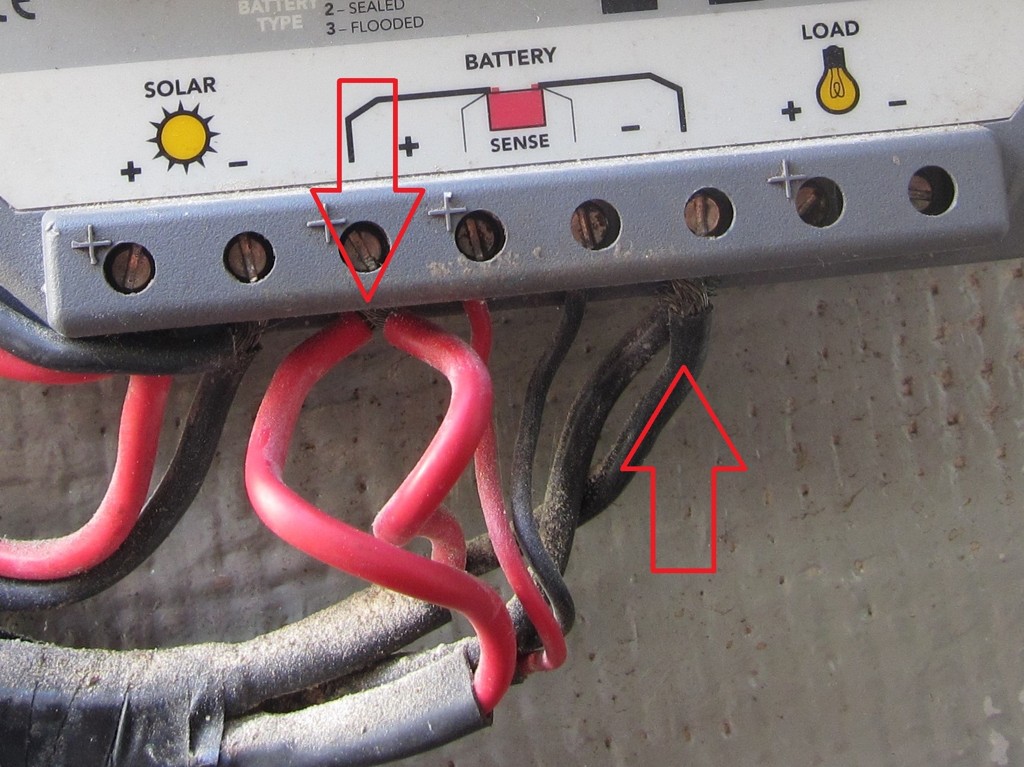
Wire connection terminals were mostly of cheap plastic instead of high quality marine rated terminals. Most of the wiring had no labeling on the insulated jacket, so it was not quality marine rated wire. Instead of continuous runs of wire, found excessive use of cheap inline wire butt splices joining wires of different types and colors together - this was definitely not a quality or competent electrical installation. On the positive side, the wire runs were securely attached to the boat surfaces. The solar controller used dual wires for both power and ground connections instead of a proper, single larger size gauge wire. As these wires were twisted together to form a connection, they had started to work free as the exposed wire ends reveal below.
On the port side of the hull were three thru hulls for the manual and automatic bilge pumps, and a cockpit drain scupper. Two had seacocks and one had a straight hose connection. All these thru hulls should have had a seacock installed. Not all the hoses were marine rated and most had a single versus double hose clamp. Most clamps had evidence of corrosion present. The seacocks were a Philmac ball valve and did not appear to be marine rated or approved - further research on this was needed.

Reinstalled the plywood floor boards and returned all the stuff removed back into the aft lazarette. It was time for a break and lunch.
Over lunch reviewed and took pictures of the paperwork Marilyn and Mary Ann had found. The Australian registration certificate was laminated in plastic - strange - the engine details were not updated to reflect the current installed engine. Found insurance papers from Northernreef Insurance Company that expired July 2013 that insured Indra at a hull and contents replacement value of NZ $214,000 (US $144,297) - later discovered this insurance company has a very unfavorable reputation. A bound notebook containing parts inventory and inspection requirements was the closest thing to a maintenance log found - it had very skimpy information on what was done on Indra and when it was next due. They found two boxed style folders that contained manufacture's manuals for some items aboard - a manual for the current engine and transmission was not among them.


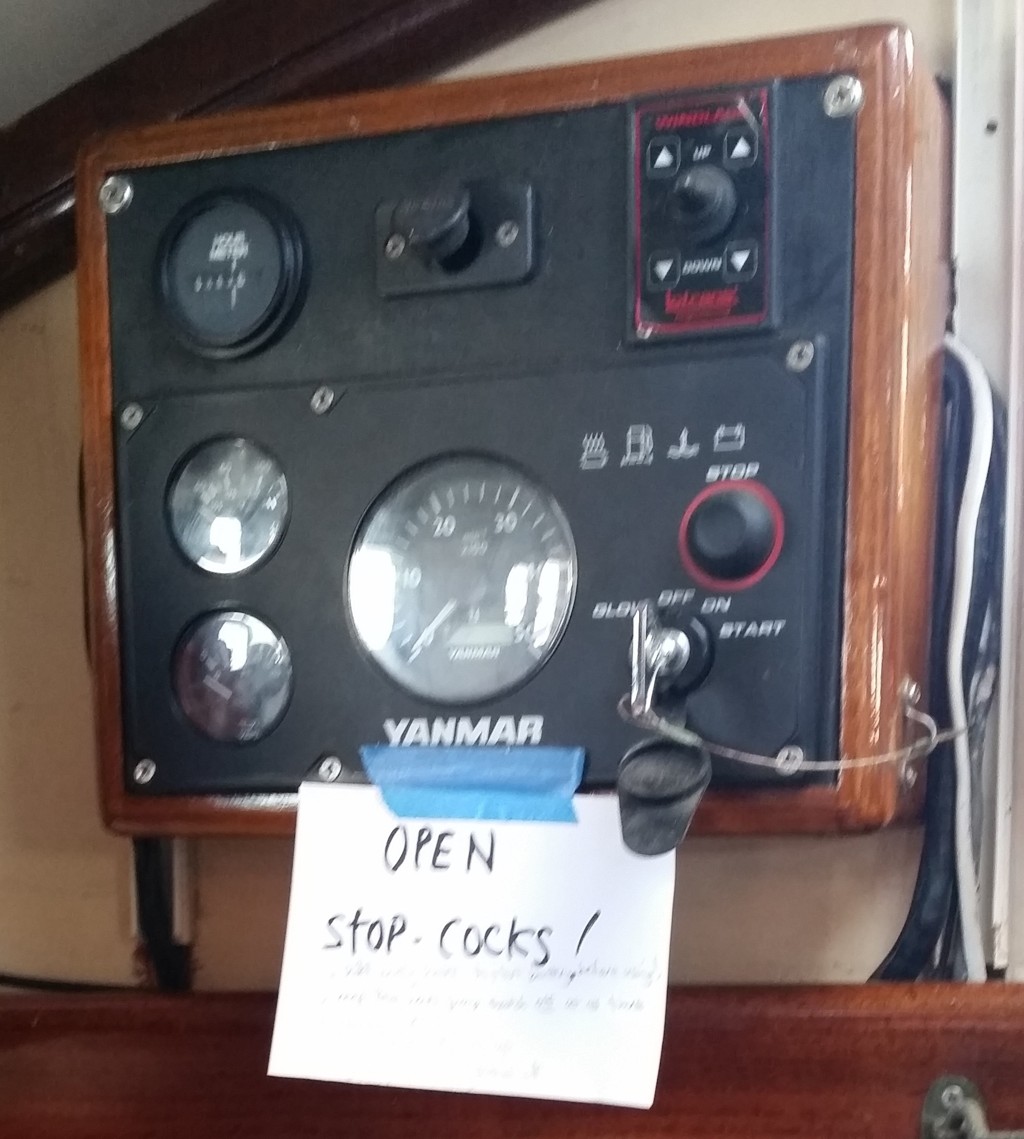
Inside the companionway entrance, starboard side, is the Yanmar engine control panel - strange - why was it not located within easy reach and in view from the cockpit?
On the aft starboard side is the quarter berth that was converted to a cabinet area with multiple drawers and shelves. The front side of this woodwork was painted off-white providing the woodwork some level of protection from the elements. Most of the drawers were difficult to slide out and open. Upon opening the middle drawer filled with hardware in plastic containers discovered why - a water leak was somewhere above the quarter berth, as the plastic container lid tops were full of water. This water had migrated to the interior bare surfaces of the drawers and wood, swelling them, making the drawers difficult to open. Mold and mildew had already taken hold inside the bare, untreated interior wood surfaces. The ceiling area above the quarter berth appeared as if it was the original wood panel installed when built and it too was also deteriorated due to water intrusion.
Removed the quarter berth floor boards which revealed the backside of the circuit breaker panel and the battery compartment. The circuit breaker panel had the freshwater pump breaker taped in the off position since the water pump was broke and did not auto shut off. Noticed two circuit breaker switch heads were broken off - circled in red below. The DC Meter was very dim and hard to read, while the Tank Monitor displayed nothing. Momentarily placing each circuit breaker to the ON position revealed that not all the red LED "ON" indicator lights functioned. At the same time, tried to power on the respective item powered by each circuit breaker. Could only get some of the interior LED lights and fans to work. At the navigation station only got the GPS unit and music radio to power on - the radio had four speakers but only one output sound - the three non-working speakers were later found to have no wires connected. Also discovered later that all the electronic items at the navigation station had all their cables disconnected.

The aft side of the circuit breaker panel revealed a rat's nest of wiring - there were serious electrical issues here. An even more serious issue was the main protective fuse from the house batteries to the circuit breaker panel was replaced by a jumper wire - not a wise practice since it increases the chance of a boat fire.

The windlass circuit breaker bottom terminal had corroded completely in half and separated.

The engine start battery was a Philippine made 70 amp lead acid battery and was just sat in-place - it was not secured to the boat structure. The house battery bank consisted of four Gel type 220 amp batteries installed 14.03.09, 14 March 2009 - they most likely had little life left in them. Attached to the house battery bank with alligator style wire clamps was an automotive style lead acid battery charger which should never be used on Gel type batteries. The house batteries were enclosed in a wooden box covered with a wooden lid that had absolutely no ventilation. Did not bring along an electrical meter to check the voltage or health of the batteries.

Removed the companionway steps and the floor boards it rested on to access the engine compartment. The engine was a year 2010 Yanmar 4JH5E 53hp diesel engine with 757 hours on it - relatively new. It appeared as if it too had been wiped clean as there was no dust on it and appeared shinny. Did not notice anything visibly amiss and "assumed" it was ok. The engine was not started and run.

The floor boards by the galley were opened up. The engine intake thru hull seacock was marine rated as it was made by Forespar - the attached hose was not marine rated and the clamps were corroded. The top and back side of the diesel fuel tank had significant amounts of corrosion present. The automatic bilge pump was visible under the engine; attempts to verify it operated failed. Did not notice any oil or liquid leaks on the bottom of the engine - so where the oil in the standing bilge water originated from remained a mystery. Found more dead ended wires and wire installation issues. A small diesel fuel pump, not mounted to a surface, hanging freely, for the heater had its input fuel hose line capped off - this was actually a good thing as its input line plastic case was broken off.

Underneath the galley sink, the severely rusted freshwater pump was mounted to a sidewall, covered by a plastic sheet - it appeared this plastic sheet was to used to divert water off the pump from potential leaks of the galley sink above. Further aft in this compartment was the refrigerator compressor - did not attempt to verify its operation. In the next cabinet, found the salt water intake and galley sink discharge thru hulls. The salt water intake thru had a plastic Philmac thru hull installed, while the galley sink drain hose was connected directly to the thru hull without a seacock - very ill advised.
The galley stove surfaces were recently shined and polished, but this did not conceal the corrosion on the metal seams and screw heads. The LPG tanks installed on the boomkin were made of aluminum and had significant surface corrosion present. The LPG tanks were not turned on to check if the galley stove was functional.
Marilyn had inventoried and took pictures of the galley and main cabin cabinetry contents and expressed if we did purchase this boat, most of the items would be discarded. Numerous books were stacked in shelves and discovered lots of old power and hand tools of questionable serviceability as they too had signs of corrosion all over them. While there were numerous pictures displayed throughout the boat, Marilyn reiterated they too would all have to go. She pointed out that numerous port light windows were missing the hardware to suspend the windows open. The headliner in the cabin appeared to be newly installed. A quick look at the diesel heater in the main cabin only revealed that it most likely had not been used in a long time.
Opened the floor boards in front of the head and discovered three more thru hulls - they were for the depth and speed transducers, and one thru hull was capped and unused. A small holding tank and a plastic bottle to contain the diesel heater return fuel was also located here. After removal of numerous partially filled old paint cans and other stuff, noticed what look like a number in the bottom fiberglass. Used a rag and scrapper to remove the accumulated grunge covering the fiberglass and "NO 600692 NET9" was revealed. These numbers were most likely prior registration numbers - further research was needed.

It was getting late, as the skies were darkening up. Closed up Indra for the night. Terry graciously provided transportation back to Precious Garden of Samal Hotel & Restaurant. We all took a much needed shower and the hot water output ceased - we learned later the hotel has a solar water heating system and once that hot water is consumed, cold is all you get - this does not speak favorably for this hotel considering the rate they charge. Note: Our house in Naga City, Cebu only has cold water so we are not hot water wimps, but if we are paying premium for a hotel room, we should expect better.
After the showers, we had dinner at the hotel's restaurant - strange - we were the only customers. Mary Ann ordered cheese pizza which she enjoyed immensely, Marilyn had some pasta dish, and I had fish & chips with tempura fried shrimps on the side. While the food was not bad, it seemed to take a extremely long time (about 50 minutes) to get the food after it was ordered.
With dinner finished we returned to our room. I downloaded all the pictures and videos from Marilyn's Samsung cell phone and my Cannon PowerShot D30 camera to our computer. Luckily I had brought along our plug adapters and extension cords, since they were needed to plug in the cameras and spare batteries for recharging.
Everyone slept soundly that night, maybe due to the sweltering heat and humidity experienced all day within the low airflow confines of the boat Indra.