Overhead LED Lights

  • Action: To Do List item A0245 - Inspect all light fixtures and wiring. Delete all plastic inline butt splices and solder connections. Connect wiring with crimped/mechanical connections.
  • Completed:
  • Cost: $


To get access to the overhead LED lights and wiring, four long teak rails, multiple wooden hatch and trim pieces, and all the overhead headliner panels had to be removed.  Due to the short-sighted method of their installation, they were not easily removable, and some items were damaged during the removal.  As the teak rails and trim pieces were removed, added to the To Do List item B0281, to sand and re-varnish the teak rails and hatch trim pieces.

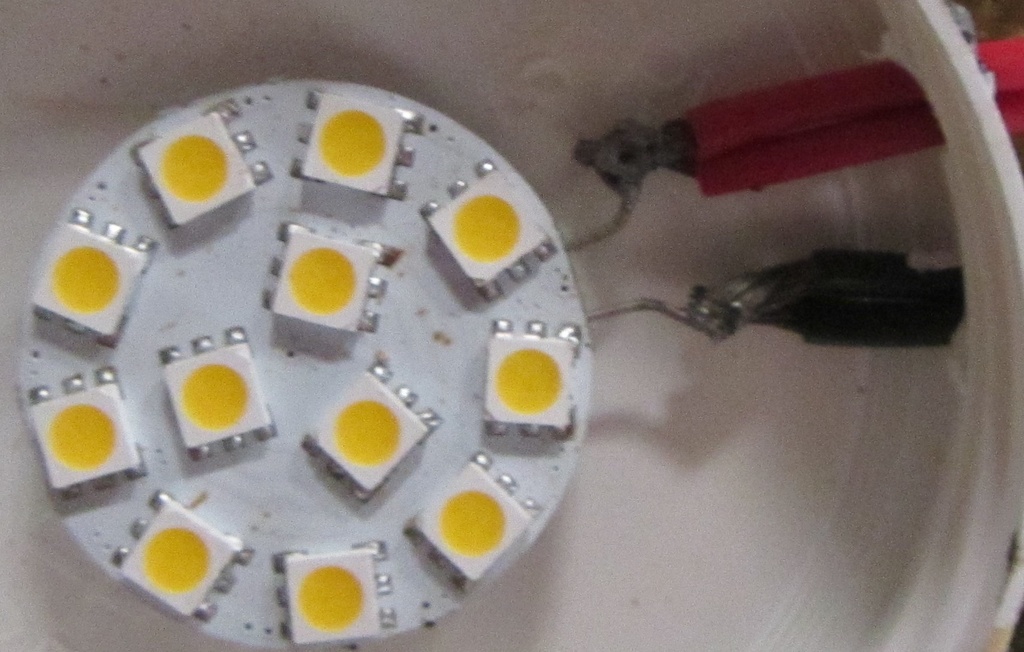
The defective overhead LED light wiring identified in LED Lights and Wiring page was just the beginning of a much larger issue - the more we looked at the wiring connections the worse and more hazardous the real situation became - it was a prudent decision that we disabled all electrical outputs from the 12 VDC circuit breaker panel to prevent a potential electrical short and fire hazard.  The following picture shows a defective solder connection where the soldered power wire (red) became dislodged and was shorted to the return connection - and no, the 15 amp magnetic circuit breaker did not trip.  The ABYC and NFPA recommendation of "Solder shall not be the sole means of mechanical connection in any circuit." is fully justified in this example.

    The following picture shows the solder connection was used to improperly connect two wires at the same time it is used to connected the wires to the G4 LED disc terminals.

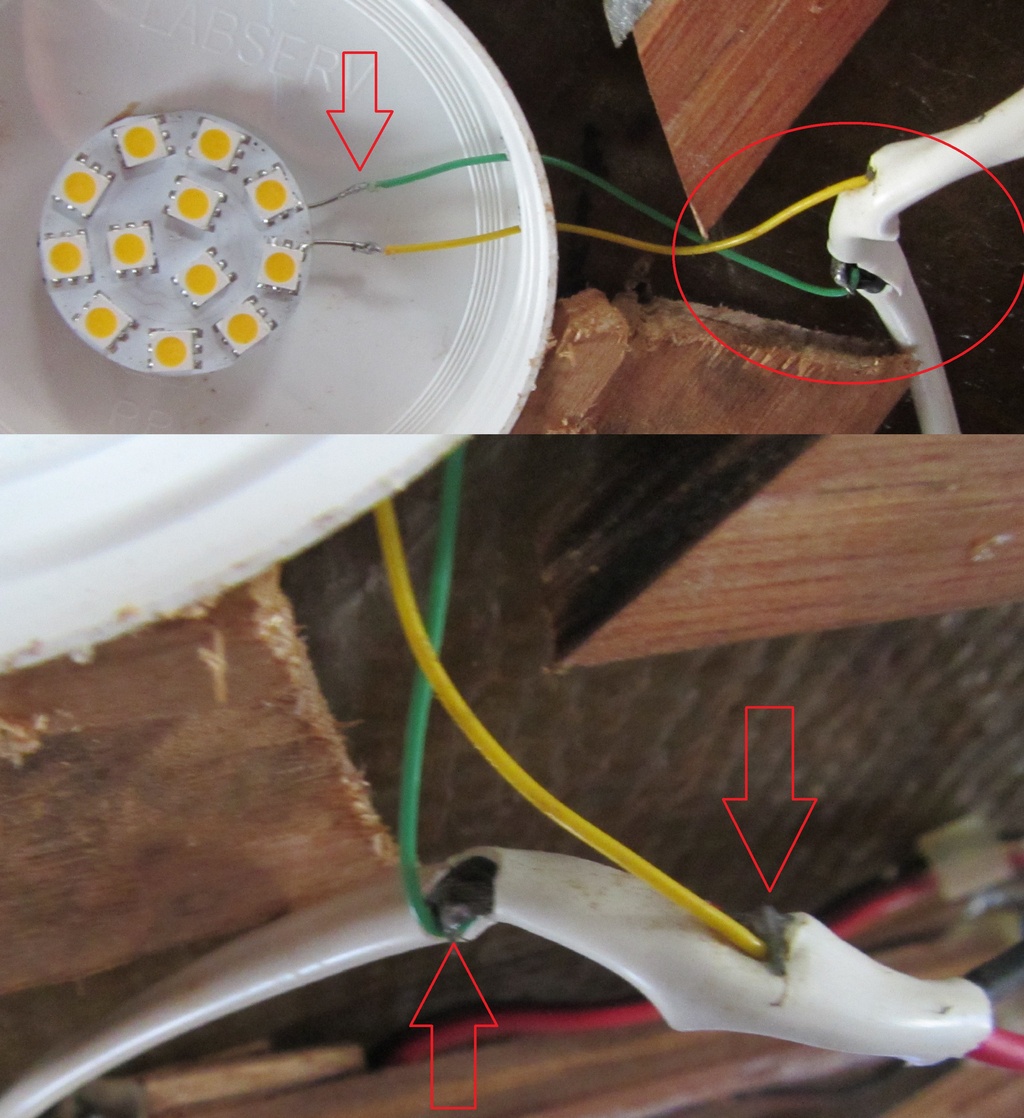
      The following picture shows the use of very small, 26 AWG wires, connected to the G4 LED disc terminal and then soldered to the main wire run by "nicking" the main wire insulation and soldering the small wires to the main wire without an insulation cover.  This improper style of connecting wires was repeated, again, and again, and again.

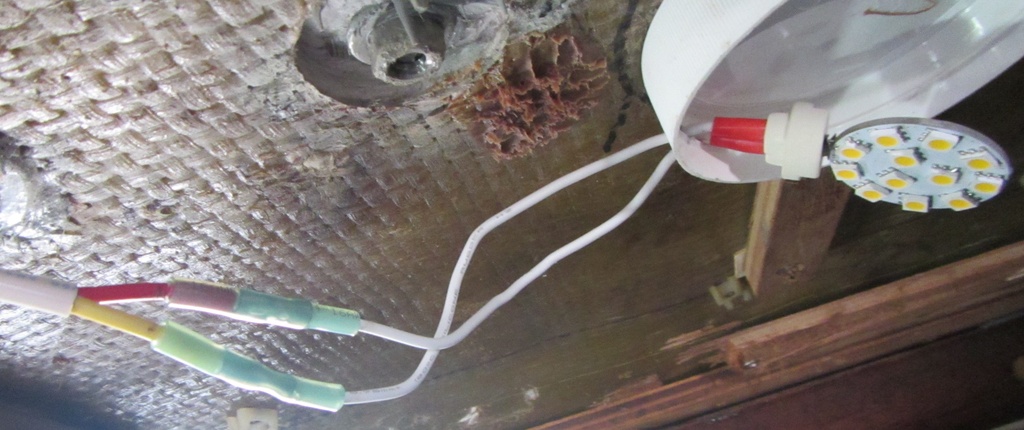
        The wires used to connect the LED lights were not all the same type.  In use were different wire sizes ranging from 16 to 26 AWG and multiple different colors. The following picture shows a red/black pair of wires connected to a short segment pair of white wires by a inappropriate non-marine rated plastic inline butt splice.  Both the white and red/black pair of wires lacked any type of wire identification printed on the insulation and therefore are not marine rated. Overall impression of the LED wiring installation appeared to indicate it was pieced together with whatever spare wire segments were available and joined together with excessive use of inline butt splices or connected by solder - it was a very amateurish and incompetent electrical installation.

          The following picture shows a nail used to attach a piece of wood trim penetrating a wire splice connection.

            When the reading lamp was removed from the bulkhead wall, was no longer surprised to discover the electrical connection was improperly done.  The wires were simply twisted together and a dab of solder applied - the green wire connection was left exposed - not insulated, while the black wire had a small piece of black insulating tape applied.  Both the green and black wires are suspected to be wires originally installed when Indra was first built.  They have no wire identification printed on the insulation, and are 7-stranded thick copper, Type 1 wiring - very stiff.  All the original wiring was deleted from use as part of this rework.

              As the overhead LED lighting circuit was composed of multiple different branches and operated by different switches, but powered from a single 15 amp circuit breaker, it was discovered that this circuit was wired counter to standard electrical practices.  To allow the uninterrupted flow of the positive 12 VDC to all the different switched circuits, the switch action applied a path to ground instead of breaking the positive conductor circuit. (ABYC E-11, 11.12.2.1 - If single pole switches are used in branch circuits they shall be installed in the positive conductor of the circuit.)

                The light switch assembly appears to be a New Zealand made, PDL 600-series, switch module, primarily used in residential and commercial buildings.  The rear of switch has contacts labeled: C - this was used for the input wire.  1 - this was used for the output wire - both contact C and 1 were connected with the rocker switched to the ON position.  2 - was unused and had a plastic piece covering its entrance - both contact C and 2 were connected with the rocker switched to the OFF position. LOOP - was unused and is not connected to contacts C, 1, or 2 - it is suspected to be used as a point to join separate wires - like a mechanical wire splice.  As the picture below illustrates, the set screw for each terminal contact, when tightened, puts pressure directly against the inserted wire.  This is counter to ABYC standard E-11, 11.14.3.5 - Connections may be made using a set-screw pressure type conductor connector, providing a means is used to prevent the set-screw from bearing directly on the conductor strands.  This recommendation is prudent as the Ground Return Wire depicted in the picture above had its wire strands flattened and had almost completely pulled out of the C contact terminal.

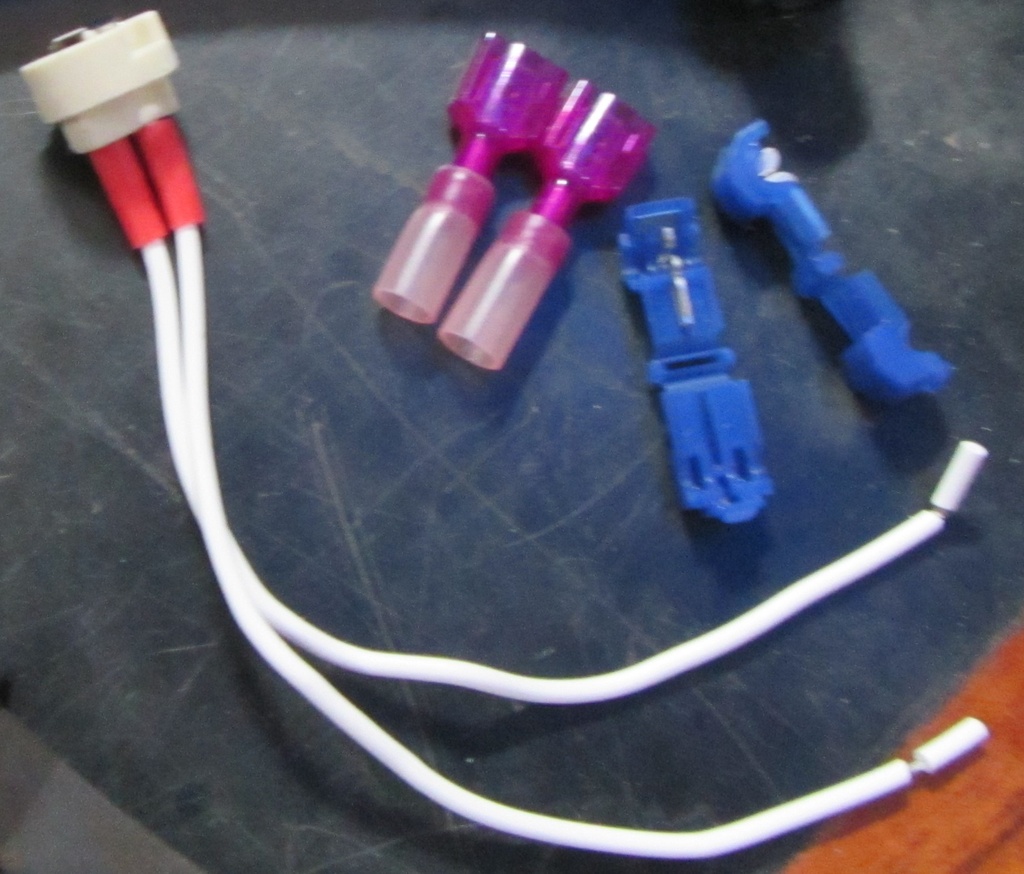
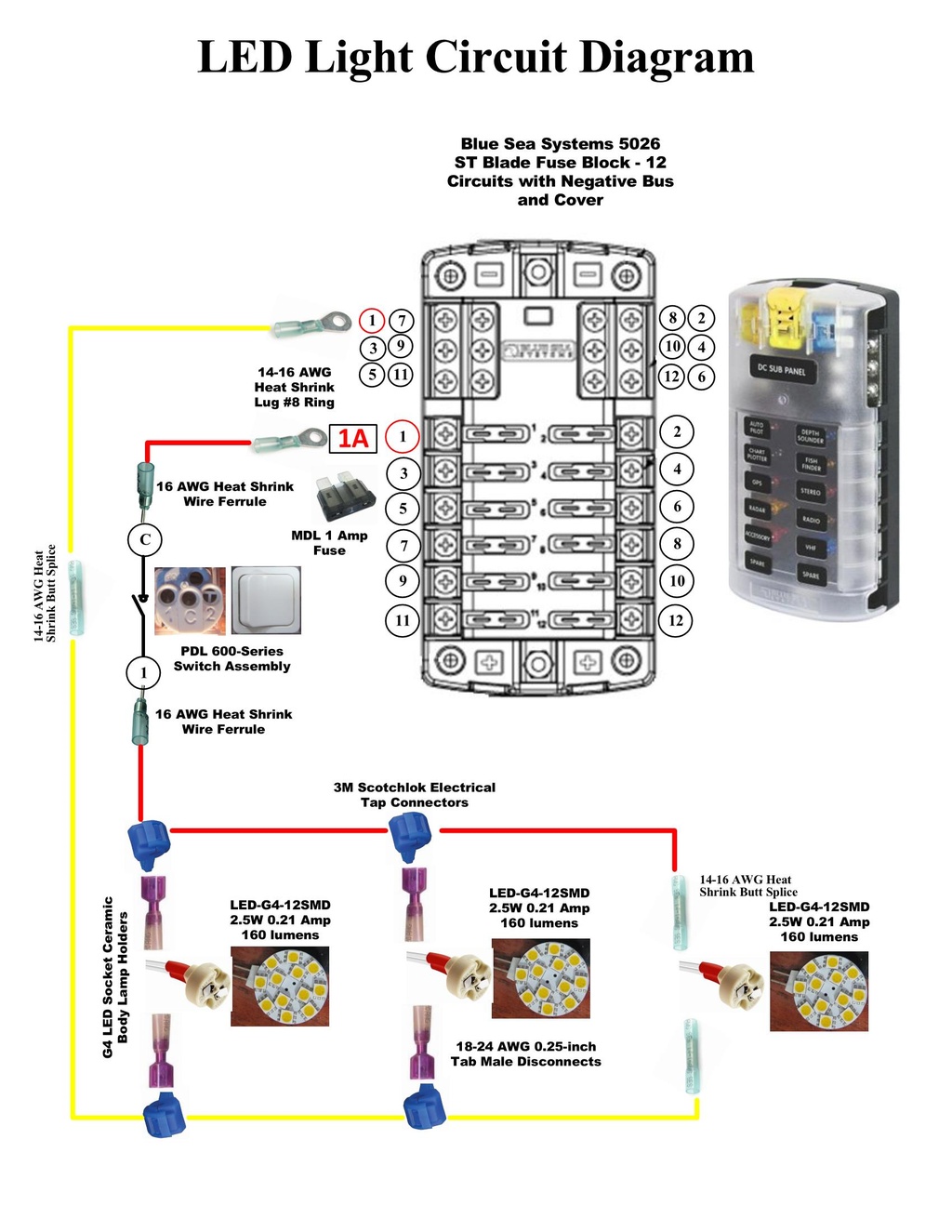
                  Instead of starting fresh with commercial recessed overhead LED light fixtures (which might have been a simpler and smarter solution - though significantly more expensive), decided to retain the existing plastic lid "fixtures" with G4 LED discs and fix the wiring and electrical connection problems.  Use of LED Socket Ceramic Body Lamp holders, 3M Scotchlok Self Stripping Electrical Tap Connectors, and 1/4-inch tab male disconnects would replace all the soldered connections as shown in picture below.  Marine rated 16/2 AWG duplex sheathed wiring would replace all the old wiring.

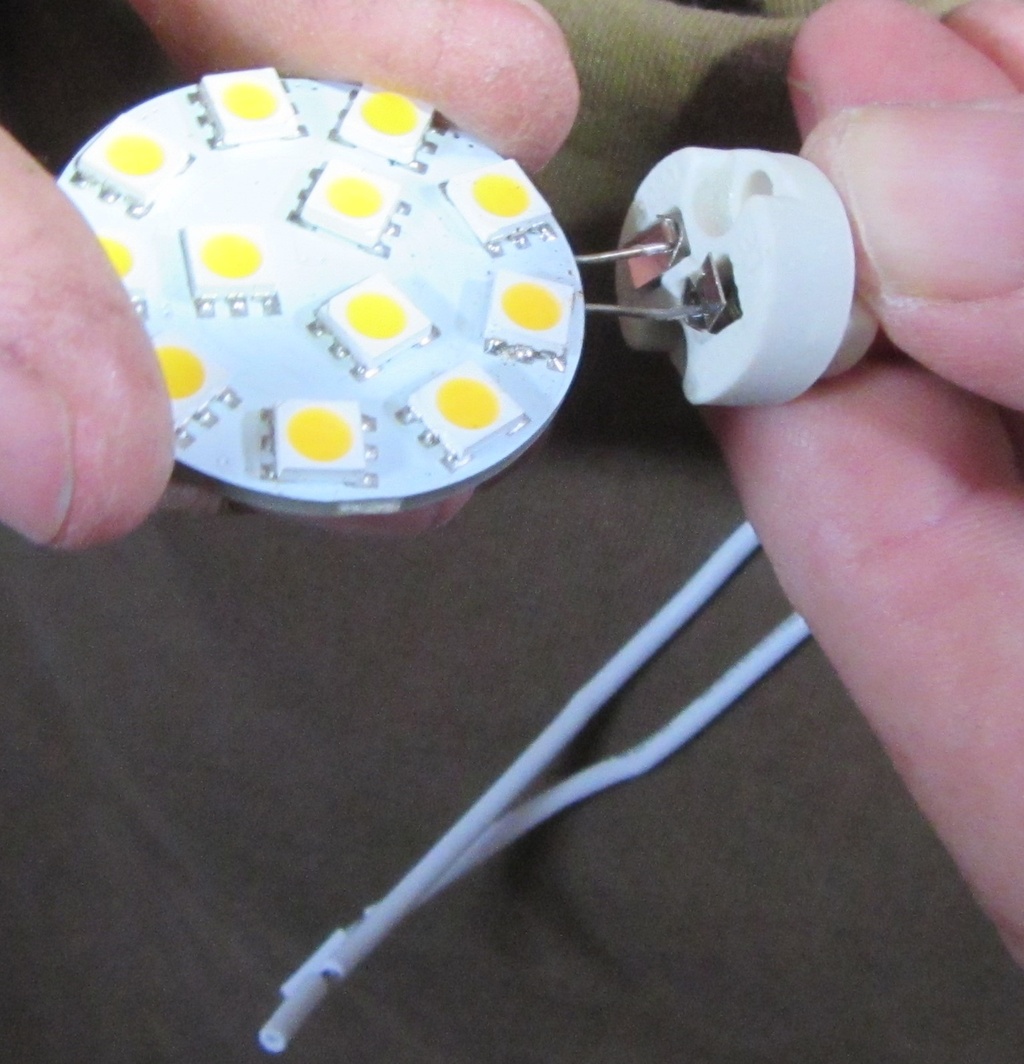
                    The process was very simple, but took time to accomplish.  First the existing G4 LED disc needed to be removed from it's glued in position on the plastic lid and all solder and wires removed from their terminals.  The G4 LED disc was then inserted into a ceramic body lamp holder, which securely held it in place with spring loaded metal tabs.  Use of this G4 LED disc ceramic body lamp holder also meant in the future the LED disc could be easily replaced if a failure occurred.

                      The first light fixture in the circuit had the G4 LED disc ceramic body lamp holder wires spliced to the 16/2 AWG duplex wiring with marine rated splices with heat shrinkable insulation.

                        A continuous, unbroken run of 16/2 AWG duplex wiring was routed by each successive LED light fixture to the switch location.  The next G4 LED disc ceramic body lamp holder wires had 1/4-inch tab male disconnects installed and these were attached to a small unsheathed portion of the 16/2 AWG duplex wiring with 3M Scotchlok Self Stripping Electrical Tap Connectors as the picture below illustrates.  This method resulted in fully sealed and insulated connections; and eliminated all previous improper soldered connections.  The G4 LED disc with ceramic body lamp holder was then reattached to the plastic light "fixture" lid with a dab of adhesive sealant only applied to the ceramic body lamp holder - leaving the G4 LED disc easily replaceable.

                          To correct the discrepancy of the bare wires inserted at the light switch, and compressed by the set screw, the use of wire ferrules with heat shrinkable insulation was used.

                            The G4 LED disc had a power consumption rating of 2.5 Watts which equates to about 0.21 amps at 12-volts DC.  The G4 LED disc ceramic body lamp holder wire size is 0.75mm or just a little smaller than 18 AWG, and had a current rating of 2 amps/100 Watts.  The 16/2 AWG duplex wiring had a free air ampacity rating of 22 amps. As there were multiple G4 LED disc lamps in each branched circuit, the protective fuse size of each branched circuit would be a little larger than the sum total of amps consumed by the number of G4 LED disc lamps in that circuit.  So, for a circuit with three G4 LED disc lamps (3 x 0.21 amps = 0.63 amps) a protective fuse of 1.0 amp should be sufficient.

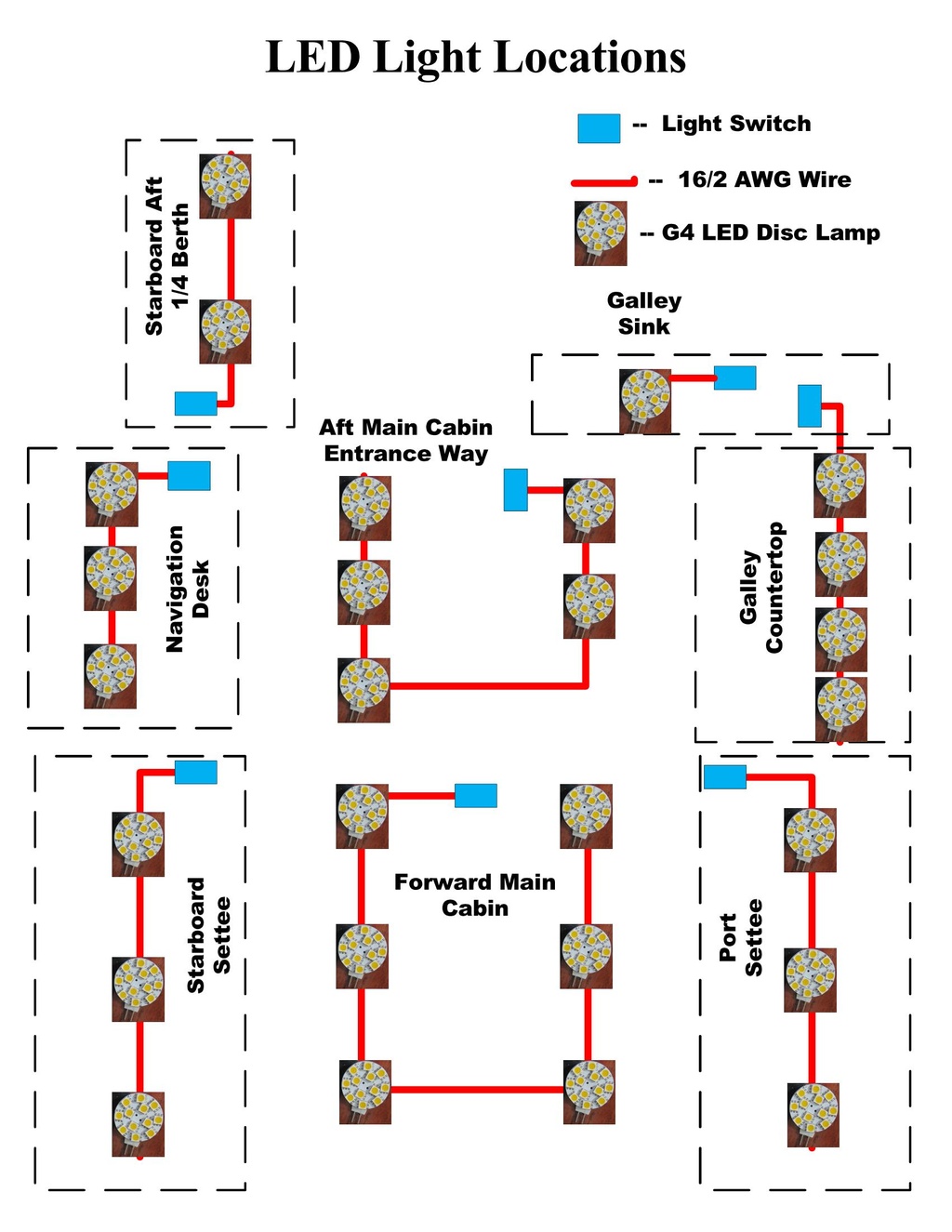
                              The original single lighting circuit was previously powered by one, 15 amp magnetic latch type circuit breaker.  This circuit was separated into 8 branched independent circuits determined by the ON/OFF switch location - as the picture below illustrates.

                                Individual fused protective power was routed to each ON/OFF switch location using 16/2 AWG duplex wiring from a Blue Sea Systems 5026 ST Blade Fuse Block - as the picture below illustrates.

                                  Next Step


                                  Boat Renamed DOVE

                                  Boat Renamed DOVE

                                  We renamed our True North 34 sailboat - DOVE. Why?

                                  After considerable time - 2015 through 2020, casual thought, and an epiphany, we decided the existing sailboat name INDRA was not suitable for our sailboat or us. Indra is the name of the ancient Hindu warrior god of the sky, is associated with the country India, and both the Hinduism and Buddhism religions. In Hindu Sanskrit, "indra" means "possessing drops of rain". The name INDRA has no commonality with anything about us, our beliefs, or values; so a name change is warranted.

                                  Why the name DOVE?

                                  The basic and simple answer is: it is very simple and one syllable - for radio call sign annunciation Delta-Oscar-Victor-Echo is short and simple.  The name DOVE has profound and deep meanings. And it was what we decided and like - after all it's our boat, our decision, and only our opinion matters. However, there was consideration given:

                                  A white Dove is a symbol for God, the Holy Spirit, Peace and Hope. During the Flood of Noah's time, the Dove returned to the Ark with a freshly-plucked olive leaf indicating the waters had subsided from the Earth (Genesis 8:11). The Dove is a symbol of love, purity, holiness and God - “the Spirit of God descending like a dove” (Matthew 3:16).

                                  The Dove skillfully navigates the oceans of air and utilizes the mighty Four Winds from the Four Corners of the Earth to sail in harmony with nature, leaving not a trace of its passage.

                                  The Dove is noted as a symbol of peace of the deepest and purest kind and is an ambassador of peace wherever it travels.

                                  As our sailboat has white topsides and large white sails it kind of mimics the body and wings of a Dove. The symbolism of the Dove is a trait worth emulating and the use of the name Dove is a worthy start.

                                  Searching the internet for the process  and procedures of renaming a boat discovered a little "strange" nautical folklore. The above illustration of the "Approved" name DOVE was inspired from the ceremonial script for this "official" nautical ceremony and the characters involved.

                                  In the nautical, time-honored tradition, a superstitious boat name purging and renaming ceremony is recommended so as to not incur the wrath of Poseidon, the god of the sea, whom maintains all vessel's names ever launched recorded in the Ledger of the Deep.

                                  Name Purging:

                                  The first step is to remove all traces of the existing boat's name. Then write the existing boat's name on a corrodible piece of metal.

                                  The ceremony begins by reciting the following aboard the boat: Oh mighty and great ruler of the seas and oceans, to whom all ships and we who venture upon your vast domain are required to pay homage, I implore you in your graciousness to expunge for all time from your records and recollection the name (mention the old boat name), which has ceased to be an entity in your kingdom. As proof thereof, we submit this ingot bearing her name, to be corrupted through your powers and forever be purged from the sea. Then the piece of metal with the existing boat's name on it is tossed into the water, some champagne/wine is poured into the water, from east to west, and the much more is consumed.

                                  Renaming:

                                  The ceremony continues  by reciting the following aboard the boat: Oh mighty and great ruler of the seas and oceans, to whom all ships and we who venture upon your vast domain are required to pay homage, I implore you in your graciousness to take unto your records and recollection this worthy vessel hereafter and for all time known as (say the name you’ve selected), guarding her with your mighty arm and trident and ensuring her of safe and rapid passage throughout her journeys within your realm. In appreciation of your munificence, dispensation, and in honor of your greatness, we offer these libations to your majesty and your court. Then pour some more champagne/wine into the water, from west to east, and consume a bit more.

                                  Oh mighty rulers of the winds, through whose power our frail vessels traverse the wild and faceless deep, we implore you to grant this worthy vessel (say your boat’s new name) the benefits and pleasures of your bounty, ensuring us of your gentle ministration according to our needs.

                                  Address each wind god individually. Pour champagne/wine into the water to the north as you say: Great Boreas, exalted ruler of the North Wind, grant us permission to use your mighty powers in the pursuit of our lawful endeavors, ever sparing us the overwhelming scourge of your frigid breath.

                                  Next pour champagne/wine into the water to the west, while saying: Great Zephyrus, exalted ruler of the West Wind, grant us permission to use your mighty powers in the pursuit of our lawful endeavors, ever sparing us the overwhelming scourge of your wild breath.

                                  Next pour champagne/wine into the water to the east, while saying: Great Eurus, exalted ruler of the East Wind, grant us permission to use your mighty powers in the pursuit of our lawful endeavors, ever sparing us the overwhelming scourge of your mighty breath.

                                  Lastly, pour champagne/wine into the water to the south, while saying: Great Notus, exalted ruler of the South Wind, grant us permission to use your mighty powers in the pursuit of our lawful endeavors, ever sparing us the overwhelming scourge of your scalding breath.

                                  Then consume more champagne/wine and party to excess.


                                  The Real Boat Renaming Process


                                  Deciding to rename our sailboat DOVE was a lot more involved then just picking a name and performing a superstitious ceremony, there are many formalities that also need to be accomplished. The boat renaming process we followed is described below.

                                  • Exchange of United States Coast Guard (USCG) Certificate of Documentation (COD)
                                  • Ships Name and Homeport Markings
                                  • FCC Radio Station Authorization Name Change
                                  • Emergency Position Indicating Radio Beacon (EPIRB) Name Change
                                  • Boat Stamp, Hats, Shirts
                                  • Email Addresses and Website
                                  • Data Verification


                                  Exchange of United States Coast Guard (USCG)

                                  Certificate of Documentation (COD)


                                  As our boat is federally registered, we first went to the National Vessel Documentation Center (NVDC) website and downloaded the following PDF files from the NVDC Instructions and Forms webpage.

                                  The instructions included with form CG-1258 Application For Initial Issue, Exchange, Or Replacement Of Certificate Of Documentation; Redocumentation, are easily understood. For renaming a boat, the instructions stated for Block A, Vessel Name, - If applying to change the vessel's name, insert the old vessel name in parenthesis - this is the only unique requirement for the change of a boat name, the rest of the form is filled out normally. This form required just a few minutes to fill out.

                                  As we wanted to also add the wife's name as joint owner with survivorship rights (a previous oversight), we also filled out form CG-1340 Bill of Sale which also included simple instructions. This form required an additional step, it needed to be notarized. To fulfill this notary requirement, we used an online notary service called OneNotary. It took about 15 minutes to get the form CG-1340 notarized and cost $25.00.

                                  We next filled out form the CG-7042 Credit Card Form. The total charge was $196.00 - CG-1258 with COD valid for one year - $84.00; CG-1340 one page - $8.00; and four (4) more years of COD validity - $104.00.

                                  Then each of the completed forms in PDF format were sent by email to NVDC.PDF.FILING@uscg.mil per the filing instructions provided on 27 February 2021. We almost immediately got a computerized generated reply acknowledging receipt of our submission. Based on the NVDC Case Processing Report located at the bottom of the National Vessel Documentation Center (NVDC) website home page we expected at least two months would pass before our submission was processed - the NVDC is notorious for inefficient bureaucracy and paperwork backlog. We verified our paperwork submission on the National Vessel Documentation Center Work Packet Status Inquiry page and the results are shown below.

                                  On 27 April 2021 our mail forwarding service, St. Brendan's Isle, received the NVDC letter containing our new USCG COD. They scan our received mail so we can view it online.

                                  On 28 April 2021 we had our mail forwarding service, St. Brendan's Isle, forward all our received mail items to our location in Naga City, Cebu, Philippines. This package was sent via DHL Worldwide Express and cost $65.27 with an forecasted delivery date of 11 May.

                                  On 10 May 2021 we received our DHL Worldwide Express mail envelope in Naga City, Cebu, Philippines. With initial submission for USCG COD on 27 February and reciept on 10 May, that means it took 73 days or 2 months and 14 days, to recieve our official USCG paperwork.

                                  Ships Name and Homeport Markings


                                  A change in a boat's name also means that the name must be physically changed on the boat's exterior hull per mandated legal requirements. The USCG requirement per 46CFR 67.123, (d) The markings required by paragraphs (a), (b), and (c) of this section, which may be made by the use of any means and materials which result in durable markings, must be made in clearly legible letters of the Latin alphabet or Arabic or Roman numerals not less than four inches in height. Ships name and hailing port clearly marked together on the hull (usually stern), minimum lettering 4 inches in height.

                                  As our sailboat has a canoe stern, we need to mark both sides of the boat's stern for proper visibility of the boat's name and homeport. We also decided to place the name DOVE, with a dove logo, on both sides of the bow due to it being a standard practice in many foreign countries for both commercial and personal boats.

                                  We selected an internet site called Do It Yourself Lettering to make customized self-adhesive vinyl lettering stickers - see below illustration. The two stickers with the dove carrying a olive branch logo are to be attached to both sides of the bow. Total cost was $186.39 including shipping to our ocean freight consolidator Manila Freight Corporation in California. It would be another two to three months before they would be delivered to our location in the Philippines. It is probably worthwhile to refurbish the hull's topsides paint before affixing the new name stickers.

                                  FCC Radio Station Authorization Name Change


                                  As our sailboat is assigned a Federal Communications Commission (FCC) Radio Station Authorization, it too needs to be updated for a boat name change. We logged onto the Federal Communications Commission (FCC) Universal Licensing System (ULS) and updated our ship's license information. There was no cost for this change as this was deemed an administrative update; it was reviewed and approved three days later. The updated Ship's Radio Station Authorization was available for download from our FCC account page.

                                  Emergency Position Indicating Radio Beacon (EPIRB) Name Change


                                  We have two Emergency Position Indicating Radio Beacons (EPIRB) aboard and their registration is identified by the FCC ship's name, radio call sign, and Maritime Mobile Service Identity (MMSI) number. A change in the boat's name means the EPIRB registration must also be updated at the National Oceanic and Atmosphere Administration (NOAA) Search and Rescue Satellite Aided Tracking website. We logged into our account and updated our EPIRBs registration. An updated NOAA certificate and sticker for each EPIRB was sent to our mail forwarding service, St. Brendan's Isle. There is no cost for this registration or updates to it, yet.

                                  Boat Stamp, Hats, Shirts


                                  An "official" boat stamp is a highly recommended item for clearing in/out of foreign ports, customs, immigration, and health offices. We obtained new boat stamps with the name DOVE at an internet site called Vistaprint; the boat stamps cost $24.00 each. As the Vistaprint site also does custom printing on hats, shirts, and multiple other items we decided to splurge and ordered a few hats and shirts with the Dove logo - the total order cost  $320.85 and was shipped to our ocean freight consolidator Manila Freight Corporation in California.

                                  Email Addresses and Website


                                  Our existing website was also based on our old boat's name Indra (sailingindra.com) and so were all our email addresses which we host ourselves on our website. As this old website's was just about due renewal at a higher monthly rate, we decided not to renew it, but instead create a new website. This was advantageous as our website host provider Bluehost was offering new personal websites at significantly reduced prices for multi-year term periods. Many of our preferred website domain names based on the Dove name were already taken; so we eventually decided on a a website domain name of dovefreespirit.com. For a three year term period our website hosting fee was $214.20. With a new website, we also decided to try a new website theme and selected a theme called Divi which cost $224.00. With these decisions made, considerable time and effort was expended updating  new email addresses on all our accounts - close to a hundred. Then the effort and fun (frustration) of porting website content began - and continues. Few realize the real implications of a "simple" change of a boat name.

                                  Data Verification


                                  One of the last steps of a boat's name change is to attempt to verify the paperwork submissions were actually implemented. A subset of your boat's information can be viewed on the USCG Port State Information eXchange (PSIX) Vessel Search web page which contains vessel specific information derived from the United States Coast Guard’s Marine Information Safety and Law Enforcement System (MISLE) - see example below. Another website to check, with a little more information, is the National Oceanic and Atmospheric Administration (NOAA) USCG Vessel Search website.

                                  Another website to check is the International Telecommunication Union (ITU) Maritime mobile Access and Retrieval System (MARS) Vessel Search website - see example below. An additional verification of vessel's data can be accomplished on websites like MarineTraffic.com, however there is usually a little delay in commercial entities updating their governmental provided vessel registration information. 

                                  Summary


                                  Deciding to rename our sailboat DOVE was definitely a lot more involved then just picking a name and performing a superstitious naming ceremony.

                                  One of the disappointments of this process is the excessive length of time to officially make the name change through the NVDC/USCG. In regards to the USCG COD, a notable legal requirement listed in the Electronic Code of Federal Regulations (e-CFR) is section 46 CFR 67.313 – “Requirement to have Certificate of Documentation on board. (a) The person in command of a documented vessel must have on board that vessel the original Certificate of Documentation currently in effect for that vessel.”  This legal requirement means if you do not have a VALID and ORIGINAL COD on board your vessel, you are prohibited by law from operating your vessel. This is why the extremely slow processing times by the NVDC/USCG is unacceptable.

                                  A summary of some of the costs involved revealed an approximate total cost for us of about $2,331.71.

                                  $196.00 - USCG Certificate of Documentation (COD)

                                  $25.00 - Notary fee

                                  $65.27 - DHL Worldwide Express mail fee

                                  $186.39 - Ships Name and Homeport Markings

                                  ~$1,100.00 - Hull's Topsides Paint Refresh

                                  $320.85 - Boat Stamp, Hats, Shirts

                                  $438.20 - Website Domain and Theme

                                  Well, this was the short version of our experience renaming our True North 34 sailboat DOVE. Was it worth it? I would have to say - YES - as we actually like the name Dove and its profound symbolism and meaning.


                                  Propeller Size Evaluation Part 3

                                  Propeller Size Evaluation Part 3

                                  In Part 1 of our search for the correct or optimum propeller size for Indra, we discovered what size propeller we had and the many "issues" with it. In Part 2 of our search we increased our knowledge of propellers enough to understand what pieces of information we needed for a propeller size calculation. In this post, Part 3, we discover a online propeller calculator and evaluate its methodology and recommendations.

                                  A internet search on boat propeller size calculator revealed a few potential candidates.

                                  • Boatdiesel.com - this website has a basic and advanced propeller size calculator but access is restricted to paid membership. Both propeller calculators appear to be based on the concepts and formulas in the Propeller Handbook by Dave Gerr and uses the Crouch or slip method to determine propeller recommendations.
                                  • Castle Marine Ltd - had a very outdated pitch calculator based on Windows XP/Vista software. Since this version of Windows is ancient history, we did not use this program.
                                  • Marine Propeller Calculator - they had a very rudimentary propeller calculator which did not consider any boat characteristic information.
                                  • PropExpert software - on website Hydrocomp, Inc. it offered for sale, PropExpert a propeller sizing and analysis software product. However, as it was intended for sale to commercial entities like propeller shops, distributors, and manufacturers it was not likely priced for purchase by the average boat owner.
                                  • Prop Scan software - on website Prop Scan it offers Prop Tools Propeller Sizing Software however this website is in the business of franchising the Prop Scan Business Opportunity and not selling software to the general public.
                                  • Recreational Boat Building Industry (RBBI) - they had a very rudimentary Boat Propeller Calculator which did not consider any boat characteristic information.
                                  • Surfbaud Freeware Propeller Calculator - on website Surfbaud Marine Propeller they have a Microsoft Excel spreadsheet called Propking in Excel and HTML formats that accepts user input to determine propeller size. Another smaller version of this Excel spreadsheet called propcalc.xls can be found by a search on the filename on the internet. This propeller calculator spreadsheet appears to be based on the concepts and formulas in the Propeller Handbook by Dave Gerr and uses the Crouch or slip method to determine propeller recommendations.
                                  • Victoria Propeller Calculator - on website Vic Prop they have a publicly available and free to us propeller size calculator for displacement/semi-displacement hulls. This propeller calculator appears to be based on the concepts and formulas in the Propeller Handbook by Dave Gerr and uses the Crouch or slip method to determine propeller recommendations.

                                  We selected the publicly available and free to use the Victoria Propeller Calculator to enter Indra's data and review its recommendations.

                                  We first ran Indra's current boat characteristics with the replaced old Yanmar 3QM30H 30 hp engine specifications. The calculation recommended a 17" diameter by 9" pitch propeller versus the existing 18" diameter by 13" pitch propeller. Next we reran the calculation with the same boat characteristics and the currently installed Yanmar 4JH5E 53.1 hp engine specifications. The calculation recommended a 20" diameter by 11" pitch propeller versus the existing 18" diameter by 13" pitch propeller. These differing propeller size results indicated that Indra's current propeller size was likely not the optimum size for either engine. These results required a more in-depth, detailed review and understanding of how these recommendations were derived with the goal of determining what propeller size is "best" for Indra. What follows below is our review and analysis of the propeller calculator data output and recommendations.

                                  We relied extensively on the methodology outlined in the Propeller Handbook by Dave Gerr to investigate the propeller selection question; it is important to note that we have different opinions on certain recommended methods put forth in the book. There is a revised 2018 second edition of this book, however, for reasons unknown, it was out-of-stock or out-of-print on each vendor site we located - the author and public would likely benefit if it was available as a electronic downloadable version (Kindle, etc.) instead of the current paperback edition format - in our opinion paper media does not fare well in the moist boat environment; we avoid it in most cases. To facilitate multiple test configuration scenarios we used Microsoft Excel to store equations and boat variables instead of using a basic calculator to repetitively perform the tedious manual entries and calculations.

                                  For Indra, we entered the following values into the propeller size calculator online form:

                                  • Waterline length of vessel: 31.24 Feet - True North 34 specifications state waterline length is 30.5 feet. The Actual Loaded Waterline Length is 31 ft 2.85 inches due to added displacement weight resulting in Indra resting lower in the water.
                                  • Beam at the waterline: 10.71 Feet - True North 34 specifications state beam is 11.0 feet. The Actual Beam Loaded Waterline Length is 10 ft 8.5 inches due to the curvature of the hull.
                                  • Molded hull draft (excluding keel): 3.89 Feet - True North 34 specifications state draft is 5.5 feet. Loaded draft is 5 ft 10.8 in. Loaded draft without keel is 3 ft 10.67 inches - we calculated this value from scaled drawings. Do not see a feasible method to physically and accurately measure this value other than from a scaled drawing.
                                  • Vessel displacement weight: 33500 Pounds - True North 34 specifications state displacement weight is 26,000 pounds. We used the actual indicated weight of a different, fully equipped True North 34 during its haul out as it hung in the travel lift's slings. This was about 32,500 lbs, however Indra has a larger engine, hardtop, wind vane, solar array, and likely more stuff aboard, so increased estimated weight to 33,500 pounds.
                                  • Number of engines (Shaft lines): 1 - Only one diesel engine installed.
                                  • Maximum rated horsepower of each engine: 53.1 hp - Obtained from Yanmar's 4JH5E engine specifications and installed engine identification plate - 39.6 kW = 53.1 hp.
                                  • Maximum rated engine R.P.M.: 3000 RPM - Obtained from Yanmar's 4JH5E engine specifications and installed engine identification plate - the min1 term is the same as RPM.
                                  • Gear ratio: 2.61 - Obtained from Yanmar's KM35P gearbox/transmission specifications and installed identification plate.
                                  • Number of shaft bearings between the gear box and the propeller: 1 - Indra has only one cutless bearing installed on the propeller shaft; did not increase to 2 for the stuffing box shaft gland as instructions stated not to.
                                  • Desired maximum speed: 6.5 Knots - As we already have a engine and Indra's speed is limited by her loaded waterline length this question was really not applicable.

                                  With the information filled in we clicked the Calculate button and the results were displayed. The Data Input box listed the same input values and calculated the maximum shaft RPM. As I intended to verify (scrutinize) the calculated results, I researched the likely equations in the Propeller Handbook and manually calculated the results to see how close they were.

                                  • Propeller Drive Shaft Revolutions Per Minute (RPM) = Maximum Engine Revolutions Per Minute (RPM) / Transmission Gear Reduction Ratio.
                                  • Maximum Propeller Drive Shaft RPM = 3,000 RPM / 2.61 Gear Ratio = 1,149.43 RPM - result closely matches the displayed value of 1149 RPM.

                                    The Horsepower Calculations box re-displayed the previously entered engine horsepower of 53.1 hp and calculated the total available torque ft/lbs at the engine.

                                    • Torque (T) in Ft/Lbs = (5,252 x Horsepower (hp)) / Revolutions Per Minute (RPM)
                                    • Torque (T) = (5252 x 53.1 hp) / 3000 RPM = 92.96 ft/lbs - result closely matches the displayed value of 93 ft/lbs.
                                    • The number 5,252 in the equation is a constant value derived from 1.0 hp = 550 Foot-Pounds per Second, which is then divided by the circumference of a circle 2π divided by 60 seconds per minute. The 5252 constant = 550 ft lbs/sec / (2π / 60 sec) = 5252.113.

                                      The total available torque of 92.96 ft/lbs at 3,000 rpm from the engine was compared to the Yanmar 4JH5E torque curve and it appeared to be reasonably close.

                                        The Horsepower Calculations box displayed 3% hp loss at gearbox and 1.5% hp loss at shaft bearing. The Propeller Handbook by Dave Gerr stated the same horsepower loss percentages for the gearbox and shaft bearing but did not elaborate on the rationale that determined these horsepower loss percentages.

                                        • Gearbox/Transmission Horsepower Loss = Fuel Stop Power Brake Horsepower x 3% = 53.1 hp x 0.03 = 1.593 hp - result closely matches the displayed value of 1.6 HP.
                                        • Shaft Bearing Horsepower Loss = Fuel Stop Power Brake Horsepower x 1.5% = 53.1 hp x 0.015 = 0.7965 hp - result closely matches the displayed value of 0.8 HP.

                                        So the total horsepower loss is 1.593 hp plus 0.7965 hp which equals 2.3895 hp.

                                        A review of the Yanmar engine specifications power curve (see below) revealed a dashed line that represents power loss and available power output at the propeller shaft. These power curves were likely based on the Yanmar 4JH5E engine as originally configured and tested with the originally equipped 80 Amp alternator. We replaced the original 80 Amp alternator with a 150 Amp alternator. The alternator manufacture estimated that for each 25 Amps it would require 1 hp of engine power. Therefore, 150 Amp minus 80 Amp then divided by 25 Amps per 1 hp yielded an additional horsepower loss of 2.8 hp not accounted for or asked for in the online calculation. Replacing a low-amperage alternator with a higher output amperage alternator is commonplace today amongst boat owners; propeller calculations should account for this item as the horsepower loss is significant the larger the alternator amperage size is. The online calculation also does not request input for other potential engine driven ancillary equipment that would reduce the total available horsepower to the propeller/shaft even further.

                                        The Yanmar engine specifications state the maximum horsepower output at the propeller when the engine is at its maximum rating is 50.96 hp indicating a loss of 2.14 hp by the gearbox. This gearbox loss of 2.14 hp is higher than the propeller calculation estimate at 3% of maximum rated engine horsepower which equals 1.593 hp. The gearbox loss of 2.14 hp is equivalent to 4.03% of maximum rated engine horsepower.

                                        So Indra's actual total horsepower loss is 5.74 hp based on 2.14 hp due to the gearbox, 2.8 hp due to the alternator, and 0.80 hp due to the cutless bearing. The actual total horsepower loss is 3.3505‬ hp higher than the propeller calculator estimates.

                                          The Horsepower Calculations box displayed the total horsepower available at the propeller.

                                          • Propeller Shaft Horsepower = Fuel Stop Power Brake Horsepower - Total Horsepower Losses (gearbox, bearing, alternator, etc.).
                                          • Propeller Shaft Horsepower = 53.1 hp - 1.593 hp - 0.7965 hp = 50.17 hp. The Horsepower Calculations box displayed 50.7 HP versus the manual calculation of 50.17 hp which indicates the calculation has induced rounding errors.
                                          • The corrected Propeller Shaft Horsepower with Indra's actual total horsepower losses is 53.1 hp - 5.74 hp = 47.36 hp - a notable difference from result of 50.7 HP.

                                          The Horsepower Calculations box displayed the total torque in ft/lbs available at the propeller.

                                          • Torque (T) in ft/lbs = (5,252 x Horsepower (hp)) / Maximum Propeller Drive Shaft RPM
                                          • Torque (T) in ft/lbs = (5252 x 50.17 hp) / 1149.43 RPM = 229.24 ft/lbs. The Horsepower Calculations box displayed 232 ft/lbs versus the manual calculation of 229.24 ft/lbs; the difference is likely due to induced rounding errors.
                                          • The corrected Torque with Indra's actual total horsepower losses is - Torque (T) in Ft/Lbs = (5252 x 47.36 hp) / 1149.43 RPM = 216.40 ft/lbs - a notable difference from result of 232 ft/lbs.

                                          The Speed & Power Calculations box displayed the estimated displacement hull speed.

                                          • Theoretical Maximum Hull Speed in Knots = Speed to Length Ratio x (Loaded Waterline Length in Feet)^0.5
                                          • Theoretical Maximum Hull Speed = 1.34 x (31.24 ft)^0.5 = 7.489 Knots - result closely matches the displayed value of 7.49 Knots.

                                            The Speed & Power Calculations box displayed the minimum horsepower required at the propeller for the theoretical maximum hull speed of 7.49 knots which has a Speed to Length Ratio of 1.34.

                                            • Theoretical Maximum Hull Speed Minimum Required Propeller Shaft Horsepower = Displacement in Pounds / (10.665 / Speed to Length Ratio)3
                                            • Minimum Required Propeller Shaft Horsepower = 33500 lbs / (10.665 / 1.34)^3 = 66.45 HP - a notable difference from result of 73.1 HP. The reason for the difference in values was not determined. As Indra's 53.1 hp engine will not support a speed of 7.49 knots, this difference is of no concern.

                                            The Speed & Power Calculations box displayed the HP required at the propeller for desired 6.5 knots speed.

                                            • Propeller Shaft Horsepower = Displacement in Pounds / (10.665 / (Hull Speed in Knots / (Loaded Waterline Length in Feet)^0.5))3
                                            • Propeller Shaft Horsepower = 33500 lbs / (10.665 / (6.5 kts / (31.24 ft)^0.5))^3 = 43.43 hp - result closely matches the displayed value of 43 HP.

                                            The Speed & Power Calculations box displayed the maximum speed in Knots with existing 53.1 horsepower.

                                            • Knots = (10.665 / (Displacement in Pounds / (Fuel Stop Power Brake Horsepower - Total Horsepower Losses)) ^1/3) x (Loaded Waterline Length in Feet)^0.5
                                            • Knots = (10.665 / (33500 / (53.1 hp - 2.3895 hp))^1/3) x (31.24 ft)^0.5 = 6.8445 - result closely matches the displayed value of 6.81 Knots.
                                            • The corrected Knots with Indra's actual total horsepower losses is = (10.665 / (33500 / (53.1 HP - 5.74 hp))^1/3) x (31.24 ft)^0.5 = 6.6902 Knots.

                                            The Speed & Power Calculations box Notes stated the propeller sizing calculations are based on 90% of full RPM to provide engine reserve power for variable loading in the vessel. It was recommended in the Propeller Handbook by Dave Gerr that propeller diameter be calculated at 100% of engine maximum RPM and propeller pitch be calculated at 90% of engine maximum RPM.

                                            The Propeller Size Calculations box calculated a recommended size in diameter and pitch for a 2, 3, and 4 blade propeller.

                                              Propeller Size Diameter Calculations based on 100% Engine Horsepower and RPMs:

                                              • Three Bladed Propeller Diameter in Inches = (632.7 x (Propeller Shaft Horsepower)^0.2) / Propeller Shaft Revolutions Per Minute (RPM)^0.6
                                              • Three Bladed Propeller Diameter = (632.7 x 50.17^0.2) / 1149.43^0.6 = 20.1835 Inches - result closely matches the displayed value of 20.4.
                                              • Corrected Three Bladed Propeller Diameter with Indra's actual total horsepower losses is = (632.7 x 47.36 hp^0.2) / 1149.43^0.6 = 19.9522 inches or standard propeller diameter size 20 Inch.
                                              • Two-Bladed Propeller Diameter = Three-Bladed Propeller Diameter x Two-Bladed Propeller Diameter Conversion Factor
                                              • Two-Bladed Propeller Diameter Conversion Factor is 1.05 - reference the Propeller Handbook by Dave Gerr, Table 5-2.
                                              • Two-Bladed Propeller Diameter = 20.1835 x 1.05 = 21.1927 Inches or standard propeller diameter size 21 Inch.
                                              • Four-Bladed Propeller Diameter = Three-Bladed Propeller Diameter x Four-Bladed Propeller Diameter Conversion Factor
                                              • Four-Bladed Propeller Diameter Conversion Factor is 0.94 - reference the Propeller Handbook by Dave Gerr, Table 5-2.
                                              • Four-Bladed Propeller Diameter = 20.1835 x 0.94 = 18.9725 Inches or standard propeller diameter size 19 Inch.

                                              Propeller Size Pitch Calculations based on 90% Engine Horsepower:

                                              1. 90% Engine Horsepower = 0.90 x (Fuel Stop Power Brake Horsepower - Total Horsepower Losses)
                                                1. 90% Engine Horsepower = 0.90 x (53.1 hp - 2.3895 hp) = 45.639 hp
                                              2. 90% Maximum Propeller Drive Shaft RPM = 0.90 x Maximum Propeller Drive Shaft RPM
                                                1. 90% Maximum Propeller Drive Shaft RPM = 0.90 x 1149.43 RPM = 1034.487‬ RPM
                                              3. Knots @ 90% = (10.665 / (Displacement in Pounds / (90% Engine Horsepower)) ^1/3) x (Loaded Waterline Length in Feet)^0.5
                                                1. Knots @ 90% = (10.665 / (33500 lbs / 45.639 hp)^1/3) x (31.24 ft)^0.5 = 6.608 Knots
                                              4. Propeller Slip = 1.4 / (Knots @ 90%)^0.57
                                                1. Propeller Slip = 1.4 / (6.608 kts)^0.57 =0.4772
                                              5. Three Bladed Propeller Pitch in Inches = (12 in/ft x (Knots @ 90%) x 101.3 kts/ft/min) / 90% Maximum Propeller Drive Shaft RPM) x (1.0 + Propeller Slip)
                                                1. Three Bladed Propeller Pitch in Inches = (12 in/ft x (6.608 kts) x 101.3 kts/ft/min) / 1034.487 RPM) x (1.0 + 0.4772) = 11.4703 Inches or standard propeller pitch size of 11 Inch.
                                                2. Pitch values should be rounded down unless the decimal is 0.7 or greater.
                                              • Two-Bladed Propeller Pitch = Three-Bladed Propeller Pitch x Two-Bladed Propeller Pitch Conversion Factor
                                              • Two-Bladed Propeller Pitch Conversion Factor is 1.01 - reference the Propeller Handbook by Dave Gerr, Table 5-2.
                                              • Two-Bladed Propeller Pitch = 11.4703 Inches x 1.01 = 11.585 Inches or standard propeller pitch size of 11 Inch.
                                              • Four-Bladed Propeller Pitch = Three-Bladed Propeller Pitch x Four-Bladed Propeller Pitch Conversion Factor
                                              • Four-Bladed Propeller Pitch Conversion Factor is 0.98 - reference the Propeller Handbook by Dave Gerr, Table 5-2.
                                              • Four-Bladed Propeller Pitch = 11.4703 Inches x 0.98 = 11.2409 Inches or standard propeller pitch size of 11 Inch.

                                              Propeller Size Pitch Calculations based on 90% Engine Horsepower with Indra's actual total horsepower losses:

                                              1. 90% Engine Horsepower = 0.90 x (Fuel Stop Power Brake Horsepower - Total Horsepower Losses)
                                                1. 90% Engine Horsepower = 0.90 x (53.1 hp - 5.74 hp) = 42.624 hp
                                              2. 90% Maximum Propeller Drive Shaft RPM = 0.90 x Maximum Propeller Drive Shaft RPM
                                                1. 90% Maximum Propeller Drive Shaft RPM = 0.90 x 1149.43 RPM = 1034.487‬ RPM
                                              3. Knots @ 90% = (10.665 / (Displacement in Pounds / (90% Engine Horsepower)) ^1/3) x (Loaded Waterline Length in Feet)^0.5
                                                1. Knots @ 90% = (10.665 / (33500 lbs / 42.624 hp)^1/3) x (31.24 ft)^0.5 = 6.4593 Knots
                                              4. Propeller Slip = 1.4 / (Knots @ 90%)^0.57
                                                1. Propeller Slip = 1.4 / (6.4593 kts)^0.57 =0.4834
                                              5. Three Bladed Propeller Pitch in Inches = (12 in/ft x (Knots @ 90%) x 101.3 kts/ft/min) / 90% Maximum Propeller Drive Shaft RPM) x (1.0 + Propeller Slip)
                                                1. Three Bladed Propeller Pitch in Inches = (12 in/ft x (6.4593 kts) x 101.3 kts/ft/min) / 1034.487 RPM) x (1.0 + 0.4834) = 11.2592 Inches or standard propeller pitch size of 11 Inch.
                                                2. Pitch values should be rounded down unless the decimal is 0.7 or greater.

                                              So to summarize the results, both the Propeller Handbook by Dave Geer and the Victoria Propeller Ltd online propeller size calculator recommended for Indra a 20" diameter by 11" pitch three blade propeller. Despite the difference in total horsepower calculation and some minor numerical rounding errors, the end result was the same size propeller recommendation. The important item to realize is the method of pitch calculation is based on 90% of maximum horsepower/RPM and this methodology favors a slightly over pitched propeller. The other contention we have with this method, besides total horsepower calculation, is the overall basis for calculations is based on 100% of the engine's maximum ratings which is limited to 5% of engine operational time. We are of the opinion that calculations should be based on the other 95% factor which equates to the normal engine range for everyday use. Whether this difference in opinion results in a different size propeller is what the next post, Part 4, will try to determine.


                                              Propeller Size Evaluation Part 3

                                              Propeller Size Evaluation Part 2

                                              In the first part of our search for the correct or optimum propeller size for Indra, we discovered Indra had a right hand rotation, 18" diameter by 13" pitch propeller sized for a 1.25 inch propeller shaft. We also discovered a lot of issues with the current propeller and propeller shaft, but still had no idea of what was the right size propeller, nor did we know how to determine it.

                                              As we tinkered around on Indra located on a patch of concrete at Holiday Oceanview Marina, Samal Island, Davao, Philippines, a few of the other boat owners would stop by and chat. On the subject of propeller size, most really did not have a clue what size propeller was on their own boat or how to determine the correct size, and the best advice given was to ask an expert, like a propeller manufacture. A few had feathering props but based on their comments, they purchased it not on practicality, but as a "ego" item to boast about and increase their prestige perception. A significant number of boats there had engine issues and most opted to replace the engine; only one pulled his engine for a rebuild which took over 2 years to complete. The reason for most folks engine replacement was pretty much the same: after hard use and the passage of time the engine was worn out, corroded, lost power, was smoking excessively, consuming or leaking oil, and unreliable. Not one person that changed an engine out changed their propeller. I was informed that the engine they selected as a replacement was chosen to "drop right in" without the need to change the propeller, the propeller shaft, shaft couplings, exhaust hose, or other impacts. Most engine replacements had a higher horsepower rating. I was often told that there is very little reliable wind in South East Asia and you'll use your engine more than your sails - so it better work reliably.

                                              As time availed, we researched the internet and found an abundance of generalized information, many unique terms, and facets related to propeller design and selection. It became very clear that selection of a properly sized propeller was dependent upon a lot of variables - most, if not all, manufactures/sellers used a computerized tool to narrow the selection process down. A few manufactures of propellers offered a free analysis by inputting your boats information into an online form, click submit, and wait for a response. We did this on multiple websites and many never responded back, even after follow-up inquiries. A few examples follow:

                                              • On website Accutech Marine we filled in and submitted their "Application Engineering Sizing Form" and received a quick response. They stated their sizing analysis and recommendation costs $250.00 and is refundable upon the purchase of a propeller. This sticker shock drove us away from even considering their services. In the spirit of public transparency and disclosure they should have stated their exuberant fee on their propeller analysis form.
                                              • On website Michigan Wheel we tried their Prop-It-Now Inboard Propeller Size Calculator and it recommended a 3 blade, 23" diameter by 15" pitch propeller - this was way too large to fit on Indra. Their Prop-It-Now Inboard Propeller Size Calculator did not ask for any boat characteristic data which means their recommendation is really nothing more than a WAG (Wild Ass Guess) - very disappointing as they should have put up a disclaimer notice as to the results. We submitted their "Request a Propeller Sizing Analysis" on their Prop-It-Right Analysis web page with a maximum diameter limit of 19-inches. In a few minutes we received a computer generated email confirming the submittal of our request and that one of their representatives would contact us shortly - we never heard anything back from them. The Michigan Wheel manufacture has franchised out their Propeller Sizing Analysis and it can be found on the Propeller Depot website, Deep Blue Yacht Supply website, and many others.
                                              • On website VEEM Propellers we filled in and submitted their propeller quote form. It did not ask for displacement weight, beam, or draft and the smallest shaft size was 1.5-inch. Had the general impression their propellers were for planning hulls verses displacement hulls. A computer generated email response was received and recommended a VEEMLoadstar 4-blade, 20" diameter by 14" pitch propeller with a blade area ratio of 55%. The quoted cost of over $2K was well over what we anticipated. In many cases, the same diameter propeller for a 4-blade propeller pitch is reduced by 1-inch compared to the 3 blade propeller - so for a 3 blade propeller this would likely equate to 20" diameter by 15" pitch propeller or a 19" diameter by 18" pitch propeller.
                                              • On website West By North they offered a propeller called the Campbell Sailer, a more efficient, airfoil shaped, narrow fixed blade propeller with substantially reduced drag under sail due to a slim blade design. We filled in and submitted their Propeller Recommendation Form and received a response within a week. They recommended a 3-blade RH 18.0" diameter x 12.0" pitch propeller at a cost of US $850.00.

                                              Reviewed many articles, research papers, and books found via the internet. We discovered a very good informative book about propellers, especially for those who know nothing or very little about propellers like us, called the Propeller Handbook, The Complete Reference for Choosing, Installing and Understanding Boat Propellers, Dave Gerr, 1989, 2001.

                                              The general consensus by "experts" was that all propeller size recommendations were scientific estimates, or best guesses, due to variables that could not be accounted for or changed under many varying circumstances. However, the common sense advice to achieve the optimum propeller size estimate was to determine as realistically and accurately the variables or boat/engine characteristics that a propeller size estimate was to be based on. Equally important was to determine what propeller performance goal was most important. As Indra was a True North 34, a heavy and (very) slow cruiser, our basic performance criteria was a propeller design that maximized a slow speed with fuel efficiency. The characteristics of a True North 34 ruled out the use of modern feathering or pitch adjusting propellers as the return on cost expended would not achieve any significant improvements in performance; besides these type of propellers would not fit Indra's enclosed propeller aperture area.

                                              As a result of our newly found basic propeller knowledge we knew what information we needed. The minimum boat characteristic information needed for propeller size calculations was Loaded Waterline Length in Feet, Beam Loaded Waterline Length in Feet, Loaded Draft Without Keel in Feet, and Actual Displacement in Pounds. We determined all the pertinent boat characteristic information, both design and actual, as we had other uses for this information.

                                              The design specifications for a True North 34 were obtained from website Sailboatdata.com. The design specification values are not the values to be used to determine propeller size, the values needed are actual current measured values. We intended to use the design specifications as a baseline to compare with actual valves to reveal differences in Indra's performance measures.

                                              As we have scaled boat drawings, we imported them into Microsoft Visio and calculated hull length/beam and draft measurements by use of numerical ratios that should be very close. We compared our Visio measured values to design values and they were dead on. As we had taken exterior pictures of Indra, in the water the first time we visited her, it was very easy to determine how far down she was on her 8-inch waterline boot stripe - the water level was just above the middle of the boot stripe. Indra's displacement weight was estimated by using the actual travel lift weight measurement of another fully equipped and loaded True North 34 and adding additional weight based on observable differences - a 7,500 pound increase over the original 26,000 pound design specification. Recording the weight of your boat during a haul out should be on everyone's list to do if you’re lucky enough to be lifted by a machine with weight scales. Indra was not so lucky on our current haul out, it was by rail system so she was pulled out, not lifted.

                                              Another pertinent measurement is the size of the propeller aperture area. It is important to know the largest diameter propeller size that fits within the recommended clearance of 15-20% of the propeller diameter size. Indra's propeller aperture vertically is about 2-feet; so the largest diameter size propeller is about 19 inches with 20% clearance. ( 24 inches x 0.80 = 19.2 inches )

                                              Next, we determined Indra's engine characteristics. The minimum engine characteristic information needed for propeller size calculations was Maximum Propeller Shaft Horsepower and Maximum Propeller Shaft Revolutions Per Minute. Just like the boat information, we determined and recorded all the unique engine characteristic data - some of the information was needed to determine the values of propeller horsepower and RPM.

                                              STOP!!! Can you read critically and recognize the inconsistencies as you review the engine specifications below?

                                              We downloaded the most current manual for the Yanmar 4JH5E engine from Yanmar's website. We then verified that the information contained on the engine identification plate matched the Yanmar manual we were using - if it did not match we had older Yanmar manual versions we could have used. The min1 term in the picture below has the same meaning as the term RPM (Revolutions Per Minute).

                                              The pertinent engine information from the Yanmar 4JH5E Operators Manual is shown below. The Yanmar manual had multiple Warnings and Cautions about not overloading or over speeding the engine as it could reduce vessel performance, lead to increased smoke levels, or cause permanent damage to the engine. The emission of black exhaust smoke was stated as a symptom of overloading which shortens engine life. A cause of overloading was stated to be improper propeller matching - a over pitched propeller.

                                              The engine specifications stated in the Yanmar manual needed to be converted from metric to imperial values for use in the propeller calculations.

                                              • Item #1 is the maximum horsepower the engine is rated at: 39.6 kW (53.8 hp metric)/3000 min−1 converts to 53.1 hp at 3,000 RPM. In item #6, operation at the maximum rating is limited to less than 5% of engine operation time.
                                              • Item #2 identifies the gearbox/transmission; the KM35P model is installed aboard Indra.
                                              • Item #3 identifies the maximum horsepower output at the propeller when the engine is at its maximum rating. This propeller horsepower value is less than the maximum engine horsepower rating due to horsepower losses thru the gearbox. The 38.0 kW (51.7 hp metric)/3000 min−1 converts to 50.96 hp at 3,000 RPM indicating a loss of 2.14 hp by the gearbox. The 50.96 hp value is the intersection point of the engine performance power curves shown below. In item #6, operation at the this maximum rating is limited to less than 5% of engine operation time.
                                              • Item #4 identifies the continuous rating the engine should be operated within and per Item #6 this is for 90% of operating time at 2,800 RPMs or less. The 36.0 kW (48.9 hp metric) /2907 min−1 converts to 48.28 hp at 2,907 RPM. This continuous rating is considered the normal top operating hp/RPM range and should normally not be exceeded for any extended time period. The horsepower available to the propeller is 48.28 hp minus the gearbox horsepower loss of 2.14 hp which equals 46.14 hp at 2,907 RPM. This means only 87% of the 53.1 hp maximum rating of the engine is actually available to the propeller to generate thrust under normal operating conditions. Note: The 46.14 horsepower available to the propeller is optimistic, in reality there are additional horsepower losses that reduce the total available horsepower to the propeller further.
                                              • Item #5 is Yanmar's guidance on the criteria a propeller should be propped or sized for: 200 RPM above max RPM or 3,200 RPM. This minor increase in RPM is considered a engine over-speed condition and for a propeller to match this criteria it would need to be slightly under pitched.

                                              The pertinent KM35P gearbox information from the Yanmar 4JH5E Operators Manual is shown below.

                                              • Item #1 identifies the gear reduction ratio of the KM35P gearbox - the 2.61 number is the most significant. The red arrow points at the 2.61 gear ratio number on the gearbox identification plate - the only real way to identify what ratio the gearbox has.
                                              • Item #2 identifies the forward speed of the propeller and shaft rotation at the maximum continuous rated horsepower. This number is determined by dividing the maximum continuous engine RPM of 2,907 by the 2.61 gear ratio which equals 1,113.79 RPM.

                                              The Yanmar 4JH5E engine performance curves provided a visual representation of these engine specifications. The power curve shows the maximum horsepower output at the propeller shaft (black dashed line) intersecting the propeller power curve (lower blue line) at 3,000 RPM. This intersect point is the value 50.96 hp described in the engine specifications above, Item #3 - maximum rated horsepower minus inherent gearbox horsepower loss. The propeller power curve (lower blue line) represents the theoretical optimum propeller size for the amount of horsepower available.

                                                So, what use are all these horsepower values at a stated RPM good for? The end intent is to form the basis for an "informed and educated" propeller size selection. Common sense dictates that engine horsepower is not the most important factor; what is, is the amount of usable horsepower at the propeller that can be effectively converted into thrust and make the boat move forward. Another common sense factor is the heavier a boat is the more horsepower is needed and the lighter a boat is the less horsepower is needed to achieve the same result. This is also true for the boat's resistance in the water and why it's advocated to have a "clean" verses "fouled" hull. All the engine specifications and power curves shown above DO NOT take into account the boat's displacement/water resistance; you are the one that's supposed to know what your boat's weight and other characteristics are and make that informed determination. Be extremely cautious of online or in-person propeller "experts" that do not considered the boat's displacement/water resistance in their "knowledgeable", "expert" and "experienced" propeller size recommendations.

                                                The two primary indications on any boat underway on engine power is speed in knots and engine RPMs. Other observable indications are feel-vibrations, sounds, sight and smell of engine exhaust. It has been stated by many that unusual vibrations, unusual sounds, and exhaust smoke are indicators of engine problems which again is common sense. Another subtle clue is if the engine's throttle is fully advanced at its maximum setting and the indicated engine's RPMs are below the engine's maximum rated RPMs, it is likely the engine is overloaded - the propeller is likely over pitched. The opposite is equally significant, if the engine's throttle is fully advanced at its maximum setting and the indicated engine's RPM are above the engine's maximum rated RPMs, it is likely the engine is under loaded - the propeller is likely under pitched. Then a desirable goal is to achieve the optimum propeller pitch that results in the engine's maximum rated RPMs being closely displayed with the throttle at maximum - this goal is beneficial to engine longevity and is in line with Yanmar's recommendations. A propeller that is pitched for maximum thrust at a reduced engine RPM in an attempt to achieve a faster speed with reduced fuel consumption might have increased fuel economy, but it is gained at the expense of a overloaded engine that likely shortens engine longevity.

                                                The goal of engine longevity versus fuel efficiency was a controversial discussion point on a few website discussions - individual decisions were different, often based on perceptions and not the true impact of all the facts. Look at this issue from a different perspective. Consider two identical boats with the same proper maintenance routines - the only difference is the propeller on boat #1 is pitched for optimum engine longevity and the propeller on boat #2 is pitched at 70% RPM for maximum thrust at that lower RPM to achieve fuel efficiency. The owner of boat #2 boasts he saved $2.00 in fuel costs every hour of engine operation at his cruising speed of 70% of maximum RPM. Both boats have 5,000 hours of engine operation use. Which boat would you buy knowing this information?

                                                It is very likely the engine on boat #2 will need to be replaced, sooner rather than later compared to boat #1, due to the increased wear on the engine operating in a overloaded state due to the propeller being over pitched. If the cost of a replacement engine and its installation costs $15,000.00 and it occurs at 6,000 hour of engine use the total cost per hour of use is increased by the cost of engine replacement - $15,000/6,000 hours = $2.50 per hour. So boat #2 might have saved $2.00 in fuel cost per hour, but the added cost of engine wear cost $2.50 per hour; the difference is minus $0.50 per hour compared to boat #1. So over time, boat #2's operational cost for 6,000 hours totals $3,000.00 more than boat #1. While this is a simple example to emphasize a point, reality is most engine replacement costs are significantly higher and the boat owners that replaced engines at our location had significantly less than 6,000 hours on their worn out engines. Another factor at our location in the Philippines is shipping costs and import duties - figure about $1,500.00 in shipping costs and import tariff at 100% of value. That $15,000.00 replacement engine now costs $31,500.00. I know why Indra's previous engine was replaced at Kudat, Malaysia - zero import duties for a yacht in transit, unlike the Philippines. The internet abounds in stories of boats having engine problems in very remote places with repair expenses beyond comprehension. As to the issue of engine longevity versus fuel efficiency in propeller size selection - decide for yourself, but choose wisely.

                                                Oh, our answer to the question of: Which boat would you buy knowing this information? We would select boat #1. If we were to put an offer on boat #2, we would subtract a high percentage of the cost of a engine replacement from boat #2's asking price. Next time you see a boat for sale listing or a marine surveyor's pre-purchase survey, don't be surprised if this type of information is missing - ask yourself why?

                                                Did you recognize any inconsistencies as you read the engine specifications?

                                                • Item #6 in engine specifications states engine use at 5% of maximum hp/RPMs and 90% at continuous hp/RPMs. Where is the remaining 5% of engine use time? Believe the 90% value should likely be 95%.
                                                • Item #5 in engine specifications recommends the propeller be propped at 100-200 RPM above the maximum engine rating of 3,000 RPM - an engine over speed condition. Yet the manual has multiple Warnings and Cautions about damaging the engine if over speeding the engine occurs. If this is the optimum recommendation for propeller sizing why does the Power Curve diagram not show the 3,200 RPM range and the intersection of the propeller power curve at that 3,200 RPM range?
                                                • In engine specifications it states maximum continuous hp/RPM as 2,907 RPM; and then in Item #6 it states 90% use at 2,800 RPM or less. Why was the continuous rating reduced from 2,907 to 2,800 RPM? Is 2,907 RPM not really a continuous rating? Or is the RPM range above 2,800 and below 3,000 RPM the missing 5% number?
                                                • In engine specifications it states maximum power values for engine hp/RPM and the maximum power value for output at the propeller shaft, then it states the propeller rotational speed in the gearbox section based on continuous hp/RPM without informing of the rating it was derived from.
                                                • All the engine's Performance Curves are based on maximum engine hp/RPM which is restricted for use to 5% of engine operation. Common sense dictates that you don't select the optimum propeller size for a 5% use condition, but the condition it will be used the most in - the 95% condition is what the propeller size selection should be based on for optimum performance.

                                                We now know realistic boat characteristics and engine performance values for propeller size calculations, but there is another value needed - total engine horsepower loss. It is common in the boating community to add high output alternators, a second alternator, generators, hydraulic pumps, air conditioning pumps, or water maker pumps driven by the existing engine. These additions should be accounted for in total horsepower loss as this directly reduces available horsepower output to the propeller. We have reviewed many websites of "experience" cruisers that boasted of their engine driven modifications for increased self-reliance and comfort, but not one emphasized the potential impacts of horsepower loss on propeller performance and the need to re-evaluate the propeller size to optimize their speed, fuel economy, or engine longevity. Additionally, many cruisers have elaborated on their social media about their deeper waterlines as over time they accumulated more stuff and added modifications to their boat - again these changes impact the amount of power needed to move the boat, but none mentioned that propeller size should be re-evaluated. The point - everyone should evaluate their propeller size for their boat's current characteristics - it is very likely this has been over looked by many due to this subject being seldom mentioned on social media. Strangely, not one website, propeller calculator, or propeller "expert" asked about additional engine horsepower losses in their propeller sizing estimates - they all advocate that total propeller shaft horsepower is the most significant factor in estimates, but don't ask the common sense question about additional horsepower losses, why?

                                                Indra's Yanmar 4JH5E engine came stock with a 80 amp alternator that we replaced with a 150 amp alternator. The Yanmar engine specifications accounted for the horsepower loss of the 80 amp alternator in their engine power curve and specifications. We included the additional horsepower loss due to the increase of 70 amps caused by the new 150 amp alternator at 1 hp for each 25 amp increase as this ratio was specified by the alternator manufacture. The increase of 70 amps equates to an additional loss of 2.8 hp. It is important to consider that the alternator has its own power curve and the highest output of the alternator occurs close to the Yanmar's engine maximum rated 3,000 RPM.

                                                  An additional horsepower loss item is the propeller shaft cutless bearing. The standard for bearing loss is 1.5% of the 53.1 maximum engine rated horsepower which equals 0.7965 or rounded 0.80 hp.

                                                  So Indra's total horsepower loss is 5.74 hp - 2.14 hp due to the gearbox, - 2.8 hp due to alternator, and - 0.80 hp due to the cutless bearing.

                                                  Some would advocate to subtract the 5.74 hp total horsepower loss from the 53.1 maximum engine rated horsepower for propeller size calculation, however the use of the engine at its maximum rating is limited to 5% of operational use - as 5% of use is not realistic for engine operation we don't subscribe to this advice. Instead we subtracted the 5.74 hp total horsepower loss from the 48.28 continuous maximum engine rated horsepower for propeller size calculation as it represents the specified normal operational range of the engine. This results in the more accurate value of 42.54 total horsepower available at the propeller shaft and propeller to make the boat move forward. This means that only 80.1% of the 53.1 maximum engine rated horsepower is actually available to the propeller during normal day-to-day engine use.

                                                  The following power curve chart illustrates the differences in points of horsepower selections for propeller calculations.

                                                    The upper red line is the original engine power curve for the maximum rating at 53.1 hp at 3,000 RPM - it is extended further to intersect the 3,200 RPM line and its intersection point is estimated at 53.6 hp.

                                                    The red arrow points at the original intersection point of 50.96 hp at 3,000 RPM. The black dashed line represents the 53.1 maximum engine hp rating minus the 2.14 hp horsepower loss by the gearbox - it is the same shape and parallel to the red line just lower by 2.14 hp. The dark blue solid line that intersects the black dashed line at the 50.96 hp point is the propeller power curve. These lines and the intersection point at 50.96 hp are unrealistic representations for a propeller calculation as 50.96 hp is not realistically available to the propeller under any condition.

                                                    The yellow arrow points at the intersection of the maximum engine rating estimated at 53.6 hp at 3,200 RPM, minus Indra's calculated 5.74 total horsepower loss, making the intersection point at 47.86 hp at 3,200 RPM. The 3,200 RPM value is based on Yanmar's recommended criteria for propeller size selection - see above engine specifications Item #5. The solid yellow line is the propeller power curve that intersects at the 47.86 hp point. As this is the lowest angled propeller power curve, it reflects the lowest pitched propeller when compared to the other propeller power curves. As Yanmar restricts engine operation at 3,000 RPM for 5% of engine operation, see above engine specifications Item #6, and 3,200 RPM is essentially a minor engine over speed condition that should be avoided, this intersection point is not realistic for propeller calculation. This intersect point can be considered Yanmar's subtle preference to operate the engine under slightly less loaded conditions than the maximum capability of the engine, maybe in the interest of engine longevity - the propeller for this condition would be considered slightly under pitched.

                                                    The green arrow points at the intersection of the green dashed line that represents the maximum continuous rating of the engine of 48.28 hp (line not shown) minus Indra's calculated 5.74 total horsepower loss, making the intersection point at 42.54 hp at 2,907 RPM. The 42.54 hp value more accurately represents the horsepower available to the propeller for propeller calculations. The solid green line that intersects the green dashed line at 42.54 hp represents the propeller power curve. A propeller sized to emulate this power curve has slightly more pitch than the Yanmar's recommendation represented by the solid yellow propeller curve. The 42.54 hp value is what we will use for propeller size calculations as it is more accurate and reflects normal engine day-to-day operations.

                                                    The blue arrow points at the intersection of the green dashed line that represents the maximum continuous rating of the engine of 48.28 hp (line not shown) minus Indra's calculated 5.74 total horsepower loss, making the intersection point at estimated 34 hp at 2,100 RPM. The 2,100 RPM value is derived by taking 70% of the maximum rating of 3,000 RPM and this represents a desired cruising speed of 70% of the engine's rating. The solid blue line represents the propeller power curve where the propeller would be over pitched to achieve the maximum potential speed as if it intersected the total available continuous horsepower of 42.54 hp - this represents the position of advocates to over pitch their propeller to increase fuel efficiency and lower fuel costs.

                                                    The actual cruising speed of a boat is determined by the total horsepower available to the propeller not the maximum horsepower rating of the engine. The average cruising speed selection varies from about 70% to 85% of the engine's rating determined by the decision of the boat owner. In engine specifications Item #6, Yanmar states cruising speed as 2,800 RPM or less - this is 93.3% of maximum rated RPM or less. Using the information pointed to by the blue arrow, what might Indra's cursing speed be?

                                                    Some assert that the term "hull speed" is the real speed of the boat, it is not. The equation for "hull speed" is: Theoretical Maximum Hull Speed in Knots = 1.34 x (Loaded Waterline Length in Feet)^0.5. Inserting Indra's values into this equation results in a hull speed of 7.49 knots (= 1.34 x (31.24 feet)^0.5). For Indra to achieve a speed of 7.49 knots the minimum horsepower available to the propeller would need to be 66.46 hp which is determined by the equation, followed by Indra's values: Propeller Shaft Horsepower = Displacement in Pounds / (10.665 / (Knots / (Loaded Waterline Length in Feet)^1/2))^3 = 33,500 Pounds / (10.665 / (7.49 knots / (31.24 feet)^1/2))^3 = 66.4570 hp. A potential engine size with a ~10% increase above the minimum horsepower available to the propeller of 66.46 hp would be close to 80 hp - Indra's 53.1 hp engine does not have enough horsepower to achieve the theoretical hull speed of 7.49 knots.

                                                    Indra's 53.1 hp engine can provide a continuous maximum horsepower rating of 42.54 hp to the propeller. The 42.54 hp equates to a maximum speed of 6.46 knots which is determined by the equation, followed by Indra's values: Knots = (Loaded Waterline Length in Feet)^1/2 x (10.665 / (Displacement in Pounds / Propeller Shaft Horsepower)^1/3) = (31.24 feet)^1/2 x (10.665 / (33,500 Pounds / 42.54 hp)^1/3) = 6.4551 knots. As we selected the cruising speed based on 70% of the engines maximum RPM rating which is 2,100 RPM the speed in knots at this RPM is approximately 5.6 knots for a non-over-pitched propeller, but the intent is to over pitch the propeller to achieve the same thrust needed for 6.46 knot at the 2,100 RPM setting. What is the difference in diesel cost for these two conditions? With an over pitched propeller, if 6.46 knots is achieved at 2,100 RPM the fuel consumption curve indicates 0.7 gallons/hour at 2,100 RPM - if a gallon of diesel cost $4.00 the cost of fuel consumed is $2.80. With a non-over pitched propeller, to travel the same distance of 6.46 knots at a speed of 5.6 knots at 2,100 RPM requires 1.15 hours at 0.7 gallons/hour, the cost of fuel consumed is $4.60. So fuel cost for the over pitched condition is $2.80 versus $4.60 for non-over pitched condition - a savings of $1.80 per engine hour is realized. The potential cost savings is what appeals to advocates of propeller over pitch but this puts the engine into a over loaded condition that causes eventual internal wear of the engine - as this cost to the engine's longevity is paid at a future date, the attitude of out-of-sight, out-of-mind denial is prevalent.

                                                    So the original point of this post was to gather the information needed for propeller size calculations, we actually collected more than we needed. We entered this information into an Excel spreadsheet and in Part 3, we evaluate an online propeller size calculation tool.

                                                    Propeller Size Evaluation Part 3

                                                    Propeller Size Evaluation Part 1

                                                    Indra’s propeller had “issues”. We discovered it had galvanic corrosion and dezincification caused by lack of zinc anode protection and no protective paint coating. While we cleaned it up, sanded it, applied protective paint, and installed a zinc anode on the shaft, the lingering question remained – was this propeller the proper size or "optimum" for Indra?  We wanted to know the answer to this question as a replacement or spare propeller was warranted due to the "minor" degradation of the original propeller.

                                                    To answer this question we first had to determine what size propeller was installed and the potential rationale as to why it was chosen.

                                                    What size propeller was installed? We initially discovered the size by accident as a result of cleaning and sanding the propeller. Visible on the bare metal surface was a series of numbers. Note the reddish-pinkish spots - that's indications of dezincification.

                                                    The numbers displayed were:

                                                    • D 18 - Diameter 18 inches.
                                                    • P 13 - Pitch 13 inches.
                                                    • SN 00052 - Serial Number 00052
                                                    • 32 - 22 - Internal metric taper of the propeller shaft bore hole. Forward side 32 mm tapered down to 22 mm on the aft side.


                                                    We later discovered an old receipt aboard - the propeller was second hand, of brass construction, size 18-inch diameter by 13-inch pitch, Right Hand (RH) rotation, for a 1 1/4-inch propeller shaft. The shipment address and date of the receipt - 7/12/2010 - coincided with the same time frame that Indra's diesel engine was being replaced by the previous owners while located at Kudat Industrial Estate, Kudat, Malaysia.

                                                    STOP!!! Reread the above information critically - did you notice the discrepancy?

                                                    A review of the then, newly installed 2010 Yanmar Model 4JH5E inboard diesel engine manufacture's manuals did not reveal specific propeller size recommendations. However, review of the previously installed and replaced Yanmar Model 3QM30H inboard diesel engine manufacture's manuals and specification sheets stated a specific propeller size - 18" diameter by 13" pitch.

                                                    Also discovered aboard Indra was a year 2004 stern gear assembly drawing that identified the same Yanmar Model 3QM30H inboard diesel engine and stated propeller size of 18.1" diameter by 13" pitch. The gear assembly drawing initially "appeared" to have been drafted by a "knowledgeable" individual.

                                                    So Indra's current propeller size, 18" diameter by 13" pitch, selection was based on the old Yanmar Model 3QM30H inboard diesel engine rated at 30 horsepower and was NOT reevaluated for the newly installed 2010 Yanmar Model 4JH5E inboard diesel engine rated at 53.1 horsepower. It also meant that Indra's physical boat characteristics were not considered in the propeller size selection but based solely on information contained in the Yanmar manuals. This meant that the currently installed 18" diameter by 13" pitch propeller was most likely the wrong, or not the optimum size in diameter and/or pitch for either diesel engines.

                                                    So, did you notice the discrepancy? The propeller was stamped in its brass metal surface 32 - 22, a metric measurement, but the receipt stated it was for a 1 1/4-inch propeller shaft, an imperial (US) measurement. Basic common sense dictates you don't mix and match items of different measurement systems.

                                                    To understand and evaluate the impact of this discrepancy we first confirmed the propeller shaft size using a caliper - it measured 1.251 inch. Additionally, the Stern Tube Drawing above stipulates a shaft size of 1.25 inch made of type 2205 stainless steel. Indra's propeller shaft was definitely 1.25 inch in diameter. If you reviewed the Stern Tube Drawing you should have noticed the drafter mixed both metric and imperial measurements - a very inconsistent and amateurish practice. We later discovered that the currently installed 18" diameter by 13" pitch propeller was undoubtedly the incorrect size, which infers the supposedly "knowledgeable" individual that drafted the Stern Tube Drawing above was incompetent in the methodology of proper propeller selection. 

                                                    Research on the internet revealed that propeller shafts and the bore hole in propellers are stipulated by standards, and there are different specification standards for the metric and imperial systems - no surprise here. The imperial (US) standard is stipulated by the Society of Automotive Engineers (SAE) standard J755, Marine Propeller-Shaft Ends and Hubs. Review of this standard indicated that the small end bore hole size in the propeller hub should be in the range of 1.015-inch minimum to 1.017-inch maximum for a 1.25-inch shaft. The 22 mm number on Indra's propeller converts to 0.866 inch - definitely outside the required tolerances for a 1.25-inch propeller shaft. If you were observant, you likely noticed the Stern Tube Drawing above stipulates a 30.73 mm maximum size for the large end of the propeller hub bore hole, instead of the 32 mm stamped on the propeller.

                                                    We now know the propeller bore hole is the incorrect size for a 1.25-inch shaft, but did it cause any problems? Pragmatically the answer is no - it didn't come loose or fall off; and it was firmly attached to the shaft, as the propeller was extremely difficult to remove from the shaft. However, after removing the propeller from the shaft and cleaning the surfaces up, there was something strange looking - see picture below.

                                                    The picture reveals concentric circles etched in the metal of the shaft. The green arrows point to an area where the concentric circles are lighter and the orange arrows point to an area where the concentric circles are darker. The red arrow points a "dent" in the machined surface. These concentric circles imply the propeller rotated around the shaft but that seemed not very likely as the metal key would prevent that.

                                                    A search on the internet revealed the concentric circles are likely caused by a process called lap-fitting the propeller to the shaft in an attempt to achieve a "perfect" fit between the tapered shaft and the tapered propeller bore hole. The differences in color of the concentric circles reveals high and low spots indicating a perfect fit was not achieved. Notice the color gets darker toward the end of the shaft. This is a reasonable explanation as the taper of a metric sized propeller bore hole is slightly different than one based on imperial standards. The propeller lap-fitting process uses a grinding compound that removes metal from the mating surface areas as the propeller is rotated on the shaft - this rotational "sanding or grinding" of the propeller against the shaft caused the concentric circles. The impact of lap-fitting a metric sized propeller bore hole to the 1.25-inch shaft is more material is needed to be removed to fit the smaller metric size propeller bore hole - the small hole on the metric propeller is 0.866-inch compared to the larger imperial minimum size of 1.015-inch. The red area in the following picture illustrates the material likely removed by the lap-fitting process - whether more material was removed from the internal side of the propeller hub or the exterior surface of the propeller shaft was not determined due to our inability to obtain a reliable measurement on the angled surfaces.

                                                    The likely implication of this is a new propeller of imperial standards will not fit properly on this shaft due to the excessive amount of material remove to accommodate the metric propeller. When a new propeller is ordered, this means it would be prudent to order a new propeller shaft. This minor error is going to significantly increase the cost for what was originally envisioned as just a "simple" propeller replacement.

                                                    Lesson: Don't mix and match items of different measurement systems.

                                                    So now we know that Indra's propeller size is right hand rotation, 18" diameter by 13" pitch, and the propeller shaft size is 1.25 inch. We also know that the current propeller bore hole is the incorrect size for the 1.25 inch propeller shaft. We know the propeller diameter and pitch size was not evaluated for the increase of available horsepower for the current engine. We know that Indra's displacement and waterline lengths were not considered for proper propeller size calculations. We know if we replace the propeller, we should replace the propeller shaft at the same time.

                                                    We still do not know what size propeller is correct or optimum for Indra.  The quest for the answer continues............in Part 2.

                                                    Seven Seas Cruising Association (SSCA) – Been There, Done That – But, No Thanks!

                                                    Seven Seas Cruising Association (SSCA) – Been There, Done That – But, No Thanks!

                                                    As we purchased an old, but new to us, sailboat in 2011, a 1978 Perry 47 ketch, we by pure chance (the internet) became aware of an organization called the Seven Seas Cruising Association (SSCA). After a brief cursory review on the internet about the SSCA, we decided it might be worthwhile and subscribed online at the SSCA website for a one year membership.  We became “official” SSCA Associate members in February 2012 – our names are posted in the "Welcome New Members" section of the SSCA's April 2012 Commodores’ Bulletin.

                                                    Our boat Rainbow was located in Kemah, Texas right on the Clear Lake channel as we worked on fixing her up. We experienced the wake of all that transited back and forth from Clear Lake to Galveston Bay; and yes the heat and humidity was intense. At night, since I was a SSCA member, I downloaded and reviewed every Commodores’ Bulletin they had on their website, the oldest one online was January 2008 – never figured out what happened to the other Commodores’ Bulletin since 1952 through 2007 - it would have been really interesting to review the first and earlier bulletins.  I reviewed all the website pages and forums, became thoroughly versed in the origins and tenants of the SSCA. Also downloaded and reviewed the “Complete History of the SSCA” which was compiled and written by a Ted Anderson in 2004. Found it a little strange that this SSCA history was not continually updated to current times as it was now about eight years behind the times.  The history revealed that from its humble beginnings, the SSCA became organized, rule based, and very political; contrary to its original conceptional ideas. Significant in fighting, personality clashes, and political squabbles were documented – I found this a little difficult to understand as this was supposedly a voluntary organization based on a common purpose with mutual respect and deep regard for each other – but each time these petty clashes occurred membership usually declined, sometimes significantly. It was very apparent that the original concepts of the SSCA had changed dramatically; as many members stated a strongly held perception of elitism existed in the small ranks of the Commodores and the Associate designation, with no vote or say, was contentious as they were perceived as second-class members even though they were in the majority.


                                                    As the documented history was very brief about the “founders” and the SSCA’s beginnings, decide to query the internet to find some more information.

                                                    • The January 2001 issue of Cruising World, had a very informative article, “Growing Up At Sea” by Tere Batham (original article on her website), about Jack and Ruthie Carstarphen – Jack Carstarphen is stated to have had the original concept for the SSCA. This article has good information on the beginnings of the organization.  A noteworthy quote that reflects Jack's Carstarphen attitude, "There is no such thing as security, Teré. It's all lost in the end. So don't live your life like there is."
                                                    • The November 2010 issue of Cruising World, had an informative article, “Committed to Cruisers” by Dan Spurr, about Ginny (Osterholt) Filiatrault who really managed and kept the SSCA alive in its early years.
                                                    • The May 1991 issue of Yachting magazine “Sailing the Seas Around” by Carleton Mitchell provided additional insight into the "attitude" of the SSCA.  The SSCA was a “disorganization” for live-aboards that share cruising information and good fellowship. It had anti-establishment beginnings - where every man – and woman, too – would be a Commodore. It highlighted that some folks were not SSCA members since they did not live full-time aboard their own boat and others since they were owners of a motorboat. It provides a good summary of the SSCA organization and structure in the early 90’s.
                                                    • The book, “Cruising Japan to New Zealand: The Voyage of the Sea Quest” by By Tere Batham (daughter of Jack and Ruthie Carstarphen) had a little more information in the introduction section.
                                                    • Eric Forsyth stated on his website, “The Carstarphens were founder members of the Seven Seas Cruising Club, along with a bunch of ‘liveaboards’ in San Diego. They felt they were not getting enough respect from local yacht clubs so they decided all members would be ‘Commodores’.
                                                    • Found a few other pieces of information as I searched on the names of the founders and their boats, mainly it focused on charter operations in the Caribbean.


                                                    The six SSCA founders’ names and boats:

                                                    Jack and Ruthie Carstarphen Shellback - 39’ Block Island Ketch
                                                    Pat and Leo Miner Tropic Bird - 40’ Flush-Deck Block Island Ketch
                                                    Bill and Marion Rumsey Black Dolphin - 40’ Flush-Deck A-40 Angelman Ketch
                                                    Walter and Katie Maertins Evening Star - 45’ Ketch
                                                    Johnny and Betty Nissen Norwind - 46’ Canoe-Stern Ketch
                                                    Jack and Dee Slasor Stardust - 34’ Gaff-Rigged Gulfweed Ketch


                                                    The limited information gleamed from internet research revealed, some “founders” eventually cruised southward to Mexico and returned to southern California. Some cruised southward along the Mexican coast , down to Central America and to Panama. Some visited the Galápagos Islands and returned to Panama. After a Panama canal transit, some sailed the Caribbean, with some ending up at the Virgin Islands starting tourist charter businesses. The Carstarphens' and Miners' cruised together and both ended up in the charter boat business (see picture below).

                                                    The Black Dolphin sailed offshore to Hawaii and is one of the few ships still around today, now based in Hong Kong as a sailing school vessel. Most were not affluent and had breaks in their sailing stints to replenish funds or "refill the cruising kitty" as they termed their monetary savings. There were mentions of long periods being dock bound and discovered no claims of worldwide cruising or circumnavigation - it was a "big deal" at the time to just coastal cruise southward and leave the US mainland. At the time, there were other seafaring individuals, couples, and families more adventurous, as many had crossed oceans and travel round the world long before the advent of the SSCA.

                                                    The true origin of the name of this organization, Seven Seas Cruising Association, was never stated or discovered in the research on the internet. On the SSCA website it states:

                                                    "What are the Seven Seas?  The old Clipper Ship tea route from China to England was the longest trade route under sail, and included the South China Sea, the Celebes Sea, the Timor Sea, the Banda Sea, the Flores Sea, the Java Sea, and the Sulu Sea. Our name reflects the water over which those who passed before us crossed when they dropped dock lines and headed out to sea."

                                                    Research on the phrase "the old Clipper Ship tea route from China to England" yielded the most plausible source of this was "The Great Tea Race of 1866". It was the last and probably most famous race by clipper cargo ships under sail. It signified an "end-to-the-sailing-era" as the tea clipper sailing ships were replaced by the faster coal powered cargo steamships.

                                                    What are the seven seas is controversial and there is no substantial agreement on what exact seas make up the seven. The number "7" has many meanings and is considered good luck by some, some say the number "7" represents Neptune.  The term "sail the seven seas" generally means to sail the oceans of the world. The SSCA designation of the Seven Seas being comprised of the South China Sea, the Celebes Sea, the Timor Sea, the Banda Sea, the Flores Sea, the Java Sea, and the Sulu Sea; does not make logical sense as the route of the Great Tea Race of 1866 did not traverse all of them and none of the "founders" sailed these seas "over which those who passed before us crossed". However, if one attempts to mimic the free-spirited, romantic, adventurous, anti-establishment, and contempt of formal yacht clubs mind-set, mixed with a little humorous sense of nautical knowledge of signals of distress [for hundreds of years inverted national flags were commonly used as distress signals] - an inverted number "7' placed on this area of a nautical map kinda does intersect the seven seas designated - maybe this too was a jest, a joke, like the term Commodore was intended to be. Maybe an inverted number "7', a signal of distress or unlucky, over the geographical site where "real sailing" met it demise to advances in technology was their true intent to portray the symbolic state of sailing, but who really knows?

                                                    It is interesting to note that Jack and Ruthie Carstarphen, named their daughter after the Tahiti Ketch Teré owned by Louis Valier. That Ruth Carstarphen penned an article in Yachting News about the Coronado Yacht Club’s third seasonal Cove party held on Saturday 22 July 1943 where Vice-Commodore Edmund Bailey’s wife arrived aboard the “Seven Seas” skippered by Charlie Kempff. This was the first Cove party cruise that Jack Carstarphen and first mate Ruth attended at anchor aboard their 34-foot wooden cutter “Te Tiki”. That the first "home" of the newly formed SSCA called Outstretched Palms was at the Coronado Boat House, the prior home of the Coronado and San Diego Yacht Clubs - that Eric Forsyth noted they felt they were not getting enough respect from local yacht clubs.  Is it possible that as they named their daughter after a boat, that the name of the organization, “Seven Seas” originated from a Coronado Yacht Club Commodore's boat named “Seven Seas” to once again in jest insinuate their disdain of formal yacht clubs, just as they had in jest coined the term Commodore?  The pieces fit the attitude that they held of formal yacht clubs, but one can only speculate.


                                                    The SSCA history states:

                                                    • The SSCA, “a disorganization of sailboat liver-aboarders,” was born, “not as a club, with no official clubhouse, roster of officials, constitution, nor ‘bored’ meetings, but based on a single idea -- that liver-aboarders, both local and abroad, enjoy hearing from and about each other and that their experiences and discoveries can benefit all.”
                                                    • The requirements for entry into this loose-knit association were simple: “Ownership and residence aboard a sailing vessel in as much as said vessel is the home of the owner, and full acceptance by the Association.” Upon attaining membership, “all members become Commodores with full privileges of the flag” (a tongue in cheek gesture toward overdone club officialdom which at times so alters yacht clubs that the yacht is no longer important and only the club remains).
                                                    • The intention to go cruising, whether locally or worldwide, was extremely important to the membership.
                                                    • The term SSCA Commodore was essentially a title in jest, a joke, in derogatory reference to formal yacht clubs. The Commodore title is no longer a joke title, but a title with privileges to vote and scrutinize entry into the rank of Commodore, a select fraternity.


                                                    What is currently expected of all members and the traditions of the SSCA were iterated on their website and restated in many Commodores’ Bulletins.

                                                    All members

                                                    • Are expected to volunteer to help SSCA to remain the vibrant and valuable organization that it is.
                                                    • Acknowledge that all SSCA publications are for the personal use of its members and will not use them otherwise.
                                                    • Agree that violation of the traditions and clean wake motto of the SSCA could cause the non-renewal of membership in accordance with the SSCA bylaws.


                                                    SSCA Traditions

                                                    Common Bond We are a caring and supportive family of kindred spirits: individuals who share a unique lifestyle and who reach out with international friendship, goodwill and camaraderie. We willingly assist a fellow sailor, regardless of which flag his vessel flies.
                                                     Commitment We live a cruising lifestyle aboard our own ocean-going vessels, which are our homes, and conduct ourselves with independence and responsibility in an honorable and self-reliant manner. As a result, we assure the safety of ourselves and our crew, and the safety, comfort and convenience of vessels nearby.
                                                     Clean Wake We always leave a clean wake by treating others and our environment with respect and deep regard, so that those who follow in our wake will be welcome. We know and follow maritime rules, including the Rules of the Road, no-discharge zones and waste management. We respect the local laws, customs and beliefs of any country we visit, even when we may feel that others are in the wrong. We are courteous and respectful without compromising our personal standards.
                                                     Bulletin We share our cruising experiences and information, provide inspiration and advice, and support our traditions through the letters we write.
                                                     Sponsorship We help new members along the path of cruiserhood, and sponsor those who qualify to be Commodores.
                                                     Burgee We proudly fly our SSCA burgee and display our shield; find each other in anchorages worldwide; meet, help one another and enjoy the camaraderie.
                                                     Non-Profit We contribute to our Bulletin and volunteer our time and energy to help SSCA.


                                                    While the traditions and clean wake motto of the SSCA are noble in design, we soon discovered that in reality they are really paper-based ideas not fully embraced and assimilated by many members of the organization.  This discovery was not a surprise, as membership in the SSCA is entirely voluntary and so is compliance with the "rules". Most members who own a boat harbor a strong sense of independence and self-reliance; and are most likely to not concede or conform easily to an authoritative establishment organization. It is inherently difficult to achieve mutual consensus on anything when mostly all members are "Captains" of their own ship and abhor the concept of being "crew" even to the greater ship designated the SSCA. The insights of the original founders recognized this fallacy of a formal authoritative association and emphasized their disdain for it when they "disorganized" on mutual friendship and respect for each other - all were equal and all assumed the jest title of Commodore in a fellowship without hierarchy.


                                                    With this familiarization of the SSCA, we attended our first (and last) Cruisers Luncheon/“social” event in the Houston area, held at a nearby marina yacht club. Even though we were warmly welcomed, it was perceptible the "surprise" of our attendance. The few members present (about 7 couples) appeared to be a "clique" as they appeared to know each other extremely well and weren't expecting others as another table and chairs had to be set up for us - wife, very young daughter, and me.  There was a distinct age gap of more than 20 years as they were all in their 60s/70s.  Lunch was simple club sandwiches followed quickly with ample "cocktails" - we stuck with sodas which accentuated our differences. Our young daughter had already signaled her desire for us to leave, but we remained a little longer. We exchanged casual information about the boats each owned, and as our boat was located on the channel entrance - many were aware of it as a "project" boat, as it had been there a long time with a visible for sale sign. Their boats were all docked, close together, right outside and visible through the windows in the room we were seated in.

                                                    An elderly gent stated he needed to retrieve an item from his yacht and asked us if we would like to take a quick look at his "baby", we accepted.  His boat appeared almost new (it was maybe 5 years old), ketch like ours but much larger, and immaculately cleaned and polished. We declined the tour inside and admired its outsides from the dock. As it had no markings on the bow, and the ships name and home port were affixed to the stern, I tried to appear knowledgeable when I asked if he was USCG registered and if he had just recently arrived here.  He indicated that he was USCG registered, the only option for a "real sailor of experience", and no, he had been here about 7 months since he departed Florida where he was previously for over a year. He queried as to why I thought he had recently arrived. I informed him his bow had no Texas registration or Marine Sanitation stickers and it is required after 90 days in Texas waters. Also stated that Texas registration also applied to his outboard equipped dingy. His astonished response was, that's B.S.!!! I then assured him it really was Texas law and it shouldn't be a surprise, as he had been in Florida previously for over a year and Florida has the same requirements. It was very apparent he did not want to converse further on this subject as he stated he had to get the item he came for and return to his friends, as he disappeared into his boat. We returned to the yacht club ahead of him. As we past what we believed were the other members boats, we noticed only one had the required Texas stickers and did not see a SSCA burgee flying anywhere in the marina.

                                                    As we re-entered the meeting room, where cocktails were abundantly being consumed and stories were being told. Another one of their friends had just arrived carrying a newly bought fire extinguisher. He boasted he bought it at the local large hardware store at a bargain, instead of at the nearby West Marine where it was outrageously priced - most there complimented him on his "score".  Apparently I made a mistake when I identified his newly bought fire extinguisher had no USCG approval markings and really would not meet the legal carriage requirements aboard a boat, as the conversation level significantly decreased.  We said our thanks and departed as you could feel the animosity in the air. As we drove back to our boat, both the wife and daughter stated their desire to not attend something like this again, I agreed with them.

                                                    As we continued our repair efforts on our boat, each month we would download and review the latest Commodores’ Bulletin. It was a marginally interesting newsletter with some subjects of interest, most did not really state much about sailing as they mainly focused on land-based tourist sites; eating and drinking establishments, and best stores to buy stuff at. When our time for renewal came due we opted to not renew as we found very little benefit to do so. Additionally, based on our past research of the original founders and their very anti-establishment and anti-authority attitude, we figured they would not be part of an organization that the SSCA had now become, so why should we.


                                                    Well considerable time had passed (2013 to 2019) and we have another old, but new to us, sailboat by the name of Indra; and by the magic of Facebook and the “Friends” you have, a posting about the SSCA appeared in our Facebook news feed around the 1st of February 2019. It was from a Facebook site called “Lilly M Service" and titled "SSCA PHOENIX (An open letter to the SSCA from Tom and Lilly aboard TIGER LILLY)" - this post was later deleted from their site. Basically they stated their extreme discontent with the SSCA President and Board of Directors, the Commodore's malaise, opposition for Associate members right to vote, opposition for power-boater membership, that the SSCA had deteriorated from an international sailing organization to a Southern Florida boater's club and would likely soon cease to exist if changes were not made.  Their solution was to eliminate the live-aboard requirement, add a new voting membership level called Cruiser required to a own sailboat, elimination of the Home Base administrative services, and no more power-boater members. The commentary identified other issues were in play and the SSCA had a public Facebook presence - we were not aware of this and join it around 15 February since it was free, with the intent to discover/learn more.

                                                    Initial review of the public SSCA Facebook site revealed a controversy and clash of personalities was in full effect. A member had used the SSCA Membership database to send emails to members announcing a new un-moderated, by the SSCA admins or members of the board, website. This resulted in a "official" SSCA email to all SSCA members. A initial key post to this rouge website was a slightly modified version of the original “Lilly M Service" post about the demise of the SSCA (later it too was deleted). A vicious discourse about the SSCA president and members of the boards versus a small group of Commodores had folks picking sides. Despite the "rules" of the SSCA Facebook public group prohibiting discussions about SSCA "business", new posts and divisive commentary reappeared to only be deleted by site moderators which further fueled the animosity and discourse.  As an outside observer familiar of the written SSCA traditions, it was very clear that both sides were undignified, not courteous, and not respectful proving again that the much "revered" SSCA traditions are really just paper-based ideas. Due to a fluke in Facebook "protocols", I gained admittance to the rogue, un-moderated Facebook SSCA Members Only Group.  Here the debate was equally contentious, discourteous, and disrespectful - and though un-moderated, the first controversy I read was censorship and moderation of a rogue members comments - many folks expressed their frustration with each other, both Facebook sites, and the SSCA management and stated they were "dropping" out of anything related to the SSCA. There is almost no record of the divisive commentary as on both Facebook sites there were deletions - on the public SSCA Facebook site all traces were deleted and awareness of the feud is only known by those who witnessed and observed it - I captured and recorded a subset of these conversations before their deletions. A poll of How Important is a SSCA Member Only Group was started on the public Facebook group but its constructive but divisive comments were also deleted.  When the "dust" of the feud subsided a bit, the final outcome was a few members had their SSCA membership terminated by SSCA management, but the "wound" was still open, as some other members stated they were done and not renewing their subscription.

                                                    Part of the heated controversy was about the unsanctioned creation of a rogue SSCA Members Only Group using a SSCA logo by a bonafide SSCA member without official SSCA management approval. It's ironic that this same action of creating a unsanctioned SSCA Facebook "page" had been done before and still exists, and nary a discontenting word was ever raised. What site is this? The Seven Seas Cruising Association Facebook page created November 11, 2015 and administered solely by Barbara Hart. We almost joined this site as we initially confused it with the "official and sanctioned" public SSCA Facebook site.


                                                    Déjà vu? Has this political struggle happened before? [Those who cannot remember the past are condemned to repeat it (George Santayana).]

                                                    Excerpts from the SSCA pages of history:

                                                    • 1991 - 2003 Struggling with a Larger Organization - Due to the trials and tribulations inherent in managing a 6000-member distributed volunteer organization, SSCA has struggled organizationally.  Much of this tumult occurred during the early 1990s and recently in 2003. The staff turnover was pretty much continuous throughout the 1990s, but has been stable for the most recent four or five years. During this period, the Boards had many heated debates about complaints by Commodores and Associates concerning the requirements for Commodore and the strongly held perception of elitism. Some Directors resigned as a consequence of these debates.
                                                    • Dec 91. Board for 1992; Tom Service-P, Jim Johnston-VP, Don Goodman (A)-Treas, Chuck Kanter-Sec, John Beeson, Allen Nightingale, & Tom Winkler.
                                                    • Jan 92. Message from the President, Tom Service: Introductory letter which cites his personal obligation to SSCA and his perception that "the future of SSCA is in jeopardy as a result of mismanagement and weak leadership by the board.”
                                                    • May 92. A positive letter from Rear Commodore Phil Tworoger, who was in Ft Lauderdale for 5 months, describes Tom Service as an ex-Navy Officer who needs to learn not to just give orders, refers to a few good board members, inferring most were bad, and proposed two motions for the ballot;
                                                    • Jun 92. Message from your Pres Tom Service. talks about "politics within the SSCA," and the need for straight forward communications between the members and the leadership.
                                                    • Feb 93. Board meeting of 8/22/92.* By a 5-2 vote, Tom Service was removed from the President's chair.* Jim Johnston is the new Pres, Pat Harris the new VP
                                                    • Oct 92. Message from your Pres, Jim Johnston. Discusses why Tom Service was deposed as President for making important decisions without consulting the board.
                                                    • Nov 95. The President tried in vain to get Commodores Runge, Service, and Cheatham to withdraw their ballot motions at the 7/15/95 board meeting
                                                    • Jan 96. 1995 ballot results:
                                                      • Amendment to create Cruising Associate failed.
                                                      • Amendment to provide voting rights for Cruising Associate failed.
                                                      • Amendment to create an alternate Cruising Associate failed.


                                                    The similarity of Tom Service's current proposed solutions to those proposed in 1995 are uncanny. The SSCA history also reflects the current membership turbulence was essentially the same as what occurred in the past, as many members departed the SSCA. What had happened before in the past was now happening again, but no one realized it; Déjà vu. By no coincidence one single individual, Thomas B. Service, was common in almost all the disruptive events and the instigation of visceral animosity amongst members resulting in a negative impact on SSCA public status and declining membership.


                                                    In the mist of this turmoil, had an idea, why not try to help and see if a positive change could be made - decided we give it a one month try.  First went on the official SSCA website and reviewed their pages and content. By just reading and clicking the provided text links found complete and unfettered access to their Membership Directory and one link gave file level access to their server completely bypassing the website interface and non-existent security protocols. Their Membership Directory was wide open to anyone with internet access. From the data that was freely accessible converted it into pictorial charts that provided an understanding of membership and boat composition. From the data I also learned the geographical breakdown of their membership and location of their cruising host station members.  The SSCA was and IS primarily US based, highest memberships in Florida and California, mono-hull sailboats were still the largest entity but declining, and comparison to numbers stated in the SSCA history to current membership numbers, was in a state of membership decline. The Associate membership greatly outnumbered the Commodore ranks which was reported to have had only 17% participation in the last election. As the Commodore ranks have the only vote and "say" in the course of the SSCA's direction, it would be foolhardy to have faith in this group to steer the helm, based on their demonstrated "malaise"  past performance in not only voting but in the fundamental traditions of the SSCA like volunteerism, lack of respect and deep regard in the divisive commentary, etc. As many Rear and Lifetime Commodores gave up their sailboats and moved ashore, or to motorized vessels it is reasonable to assume a decrease or cessation of their activities in the SSCA organization - the facts or  "malaise" bears this out - but due to the "rules" they retain a right to vote without a vested interest or commitment to the sailing lifestyle, go figure.

                                                    Due to the serious nature of the lack of security on their website, I notified them by email (read this) of this breach plus other problem issues, in a slightly humorous but constructive way. It was disappointing that it took many more conversations to fix the simple defective text link to allow public download of the text labeled “Sample Commodores' Bulletin" but this highlighted the inexperience of whoever was maintaining the website. I sent many more issues to them to include recommended changes to their Contact Us page, but as many suggestions were not being implemented I ceased to provide inputs, even though the remaining list of problems was very long and growing as I continued to review their website, until a positive change could be observed - sadly it did not happened.

                                                    During this period I reviewed each new post to the SSCA Facebook group and discovered many were not compliant with the posted rules - the moderators apparently were not catching them or allowing them at their discretion. Quite a few posts had an ulterior motive to draw SSCA site members to their personal social media sites in an attempt to become one of their Youtube subscribers, join their website or Facebook group, become a Patreon, and/or eventually sell them something - the rules allow for one (1) post of this type per month - this was and is still being abused as the frequency of posts was multiple times a month and/or weekly or more often.  I would inform the "offending party" and a moderator of this infraction and in each case where they could not post a link back to their social media, as they had in the past, they ceased to post anything more on the SSCA Facebook site. Some even stated the moderators had approved of their actions even though they knew it broke the site rules (see picture below).

                                                    Other new posts to the SSCA Facebook group that were within the rules I checked for the "principal of reciprocity" of the SSCA website - in almost all cases this did not exist.  So in these cases, I posted a reciprocal comment on their website mentioning the SSCA and providing the link for a free sample Commodores' Bulletin (this was why I needed the broken links on the SSCA website fixed).

                                                    As no one was promoting the SSCA organization or website on social media, I figured it was worth a try to provide examples of how to possibly do this.  Each of the following video and pictures, was posted to the SSCA Facebook Group public site in a "share" ready format post; sadly they got a few "thumbs ups" but no shares and few to no comments. I even posted a nice video made by SSCA President Ed Kelly in a "share" ready format post, but it too was not shared out to other social media sites. Out of 12,000-plus members of the public group - not one person was willing to share to their own Facebook account with their friends or on other sites that they might be members of the SSCA.  The "malaise" that was mentioned in the “Lilly M Service" post was more widespread than I thought possible or were people that shy or embarrassed to be associated with the SSCA, I never determined the answer.

                                                    It was during this time frame that the SSCA Home Base staff finally realized I was not a SSCA member and when asked, I confirmed their suspicions. I had stated that I was a general public member in the first email I sent them; they must have not read or comprehended that part. They could not understand why I was voluntarily providing website corrections and all these promotional inputs.  Shortly after this awareness, I received a few private messages (PMs) from some Commodores who politely advised that my efforts were really SSCA organizational business issues not suited (and prohibited by the rules) for the public SSCA Facebook Group and especially from a non-member. I did not argue or debate. I ceased my efforts and deleted each and every promotional post I had made from the day I joined the public SSCA Facebook Group - this includes every reciprocal post I made to other websites. The following was another share ready promotional post that did not get posted to the public SSCA Facebook Group as it would have violated the "rules".


                                                    ☘️☘️☘️☘️ 𝙏𝙝𝙚 𝙎𝙚𝙫𝙚𝙣 𝙎𝙚𝙖𝙨 𝘾𝙧𝙪𝙞𝙨𝙞𝙣𝙜 𝘼𝙨𝙨𝙤𝙘𝙞𝙖𝙩𝙞𝙤𝙣 (𝙎𝙎𝘾𝘼) 𝙒𝙞𝙨𝙝𝙚𝙨 𝙔𝙤𝙪 𝙃𝙖𝙥𝙥𝙮 𝙎𝙩 𝙋𝙖𝙩𝙧𝙞𝙘𝙠’𝙨 𝘿𝙖𝙮! 🍀🍀🍀🍀

                                                    .
                                                    𝕋𝕙𝕖𝕣𝕖 𝕒𝕣𝕖 𝕘𝕠𝕠𝕕 𝕤𝕙𝕚𝕡𝕤, 𝕒𝕟𝕕 𝕥𝕙𝕖𝕣𝕖 𝕒𝕣𝕖 𝕨𝕠𝕠𝕕 𝕤𝕙𝕚𝕡𝕤,
                                                    𝕋𝕙𝕖 𝕤𝕙𝕚𝕡𝕤 𝕥𝕙𝕒𝕥 𝕤𝕒𝕚𝕝 𝕥𝕙𝕖 𝕤𝕖𝕒.
                                                    𝔹𝕦𝕥 𝕥𝕙𝕖 𝕓𝕖𝕤𝕥 𝕤𝕙𝕚𝕡𝕤 𝕒𝕣𝕖 𝕗𝕣𝕚𝕖𝕟𝕕𝕤𝕙𝕚𝕡𝕤,
                                                    𝔸𝕟𝕕 𝕞𝕒𝕪 𝕥𝕙𝕖𝕪 𝕒𝕝𝕨𝕒𝕪𝕤 𝕓𝕖.

                                                    🌈💰 𝙔𝙤𝙪 𝙘𝙖𝙣 𝙜𝙚𝙩 𝙮𝙤𝙪𝙧 𝙛𝙧𝙚𝙚 ‘𝙇𝙪𝙘𝙠𝙮’ 𝙘𝙤𝙥𝙮 𝙤𝙛 𝙩𝙝𝙚 𝙎𝙎𝘾𝘼 𝘾𝙤𝙢𝙢𝙤𝙙𝙤𝙧𝙚’𝙨 𝘽𝙪𝙡𝙡𝙚𝙩𝙞𝙣 𝙖𝙩 ( https://www.ssca.org/docs.ashx?id=469521 ) 🌈💰


                                                    As a non-SSCA member to the SSCA Facebook Public Group I made a few more constructive posts but some drew the fire of others and their foul adverse responses resulted in their deletions. A few of the other posts on this website are a direct result of those deleted subjects. The picture below shows another "constructive" comment that was deleted on another post. The recommendation to change the email address was suggested earlier when the changes were submitted on the SSCA Contact US website page - the recommended change to the individual's email address on the letter or SSCA website were never made.

                                                    An individual was posting weekly on the public SSCA Facebook Group providing links to two Facebook Groups, “Cuba, Land and Sea” and “Bahamas, Land and Sea” which violated the SSCA Facebook Group "rules".  I researched this to attempt to understand the motivation. The poster was the creator and administrator/moderator on both sites, the Cuba site had a longer existence, the Bahama site was newly established at the same time of the passage of US travel restrictions to Cuba, the promotion of both sites was clearly geared to increasing their membership as this same post was shared to many other websites. The poster had past affiliations with the SSCA, some of the SSCA management (BOD) were new members on Bahama site and were also promoting it, but both these sites did not adhere to the "principal of reciprocity" of promoting the SSCA. As both the poster's sites promote and provide information about Cuba and the Bahamas as a sailing destination it initially appeared the poster's motivation was innocent and solely geared for the benefit of others. However, a internet searched revealed the poster was the Waterway Guide Media’s Cruising Editor for Cuba and the Bahamas; and coauthor of the Waterway Guide guidebooks for Cuba and the Bahamas.  It made sense now; both the Cuba and Bahama Facebook Groups could serve to not only disseminate information and promote travel to these locations, but also gather pertinent information for annual updates to the guidebooks, and serve as a vehicle to discreetly promote the guidebook sales - very creative, smart, and shrewd - nothing wrong with this even though it is not disclosed or transparent. I further researched this and discovered the Waterway Guide is a sponsor of the SSCA (look at very bottom of their home page for the SSCA logo reciprocal link) and is a SSCA sponsor and listed on the SSCA Partners page with a reciprocal link back to the Waterway Guide website.

                                                    With this background knowledge I made the comment below to his post.

                                                    The response was very eloquently stated - he stated he was unaware of any "rules" as he was never informed, he was paying it forward for the benefit of others, and the response did not address the issues raised but side-skipped and bypassed them.  I made another response back, "Very eloquently stated, but it did not address the issues raised.  The SSCA site has published rules, but they don’t appear to apply – as an admin of other websites you publish rules and enforce them. As I’m aware of your past association with the SSCA, the principal of reciprocity or equally promoting the SSCA does not seem to be a consideration, I don’t quite fathom why? It’s a matter of integrity………..". I do not have a copy or picture of the rest of the conversation, as it was soon deleted. His post remained and despite a clear understanding of the rules, time passed and another weekly post was posted to the public SSCA Facebook Group.  This was what I had expected to occur based on the "feel" I've developed observing the moderation of this website - it is their website and really they have the final say on "anything". As rule 9 states, "Admins may remove or shut down comments on any post at any time. ". There were other recent posts that also violated the "rules" and used a similar technique for the fulfillment of their own personal agenda but they slid under the watchful blind eyes of the mods.

                                                    As the last words of my last comment were, "It’s a matter of integrity………..", I decided to leave the group. And in the true spirit of the original "founders" of the SSCA and “Clean Wake Moto”, I deleted each and every post, all comments, all FB Like statuses I had ever made on their site, leaving behind only the slight insignificant ripple of my presence that will quickly fade into oblivion.


                                                    Update:


                                                    The SSCA controversy is far from over and probably never will be as everyone has an "opinion".  There was a another opinion post, which was deleted again, about the upcoming SSCA ballot/elections on website “Lilly M Service"; this post even made its way onto the Cruisers Forum website. In the comment section of their post they state the SSCA Board of Directors have placed them on probation pending review for membership termination due to their "mutinous' actions.

                                                    Even though the website “Lilly M Service" deleted this previous post, they can't refrain from 'fighting the fight" and have added another new post titled the "The Swahili Flip-Flop Man". This title is very appropriate as they themselves seem to "Flip-Flop" in their stance as witnessed by stating a position in a post and then deleting it. Their constant output of controversial posts followed in short time with their deletion appears to portray a lack of steadfast commitment to the cause they claim to champion.  Vacillating like a sail luffing in a constantly shifting wind of indeterminate direction, the direction they aspire for the SSCA appears to be fraught with dilly-dallying aimlessly and indecision that will achieve no meaningful end but instill animosity and discontent in the remaining SSCA elites and proletariats. In the comment section of this new post they state they finally decided to resign their SSCA membership - who says Old Salty Dogs can't learn new tricks.


                                                    The SSCA held their 2019 elections resulting in the election of some new Board members, their Commodores’ Bulletin name being changed to the Cruiser's Bulletin - another tradition of the original SSCA resigned to Davy Jones' Locker, and the other proposed measures failed again. The SSCA Facebook site had a post that indiscreetly referred to the actions of  “Lilly M Service" in a tone of ill repute.

                                                    As a cursory note, as I scanned the SSCA Facebook site I noticed another compliant by one of the members about nineteen posts in one month from another member that were in clear violation of the site's rules. A SSCA Facebook moderator posted the following "reminder".  Sadly, the site moderators do not enforce their own rules as the multiple posting of off-site links continues.


                                                    Regardless of OUR opinions and experiences, YOU are the Captain of your own ship and should evaluate the SSCA for yourself - never know, YOU might like it.

                                                    Oh, and if you weren't aware, there are many other sailing clubs out there looking for new cash-paying members. Or, if you feel passionately enough, like the original SSCA founders, you can start your own sailing association, club, or group of like-minded associates - it costs nothing, as the tools on the internet to do this are free.

                                                    As far as OUR final opinion on the Seven Seas Cruising Association (SSCA) – Been There, Done That – But, No Thanks!