

But the Comforter, which is the Holy Ghost, whom the Father will send in my name, he shall teach you all things, and bring all things to your remembrance, whatsoever I have said unto you. (John 14:26)
STOP!!! READ YOUR BIBLE
Before proceeding any further, read of the Passover of Moses's time (Exodus 12) and then read of the Passover of Jesus's time (Matthew 26-27, Mark 14-15, Luke 22-23, John 13-19). Evaluate both Moses's and Jesus's Passover events and formulate your own "inspired" understanding. Understand it matters not what others believe or promote, only your validated understanding and beliefs count - remember: “Prove all things; hold fast that which is good”. (1Thessalonians 5:21).
Did you recognize that both Moses's and Jesus's Passovers were on the fourteenth day of the first month of the year? Did you recognize that for both Moses's and Jesus's Passovers, the 24-hour day began at "even", sunset, and ended 24 hours later at "even", sunset? Do you understand the basic Biblical concepts of a Day, a Week, a Month, a Year? Can you determine on Man's modern day Gregorian calendar when the Biblical fourteenth day of the first month of the year is? The texts mentioned "feast of the Lord", "holy convocation", "sabbath", do you know of these and their meaning?
The texts revealed during Moses's Passover "at midnight the Lord smote all the firstborn" (Exodus 12:29) and during Jesus's Passover, the crucifixion of the firstborn Son of God, "when the sixth hour was come, there was darkness over the whole land" (Mark 15:33) where "the sixth hour" is midday or noon. Did you recognize the 12-hour difference in time of the beginning of the deaths of the firstborn? Do you know where the 12-hour difference in time originated within the Biblical texts? Do you know where the 12-hour difference in time was reset within the Biblical texts? Do you know why the 12-hour difference in time was inserted into the timeline and then reset?
Passover 12-Hour Difference – Why?
Did you recognize the 12-hour difference in time
of the beginning of the deaths of the firstborn?
The 12-hour difference between Moses's and Jesus's Passover events is plainly visible for ALL to read and recognize. The 12-hour difference is as obvious as Midnight is to Midday, Night is to Day, Darkness is to Light, yet the ability to discern and understand the significance of the 12-hour difference eludes detection by most, if not All. WHY?
The verses of Matthew 12:38-40 state:
38 Then certain of the scribes and of the Pharisees answered, saying, Master, we would see a sign from thee.
39 But he answered and said unto them, An evil and adulterous generation seeketh after a sign; and there shall no sign be given to it, but the sign of the prophet Jonas:
40 For as Jonas was three days and three nights in the whale’s belly; so shall the Son of man be three days and three nights in the heart of the earth.
Matthew 12:39 clearly states “there shall no sign be given to it” “An evil and adulterous generation” “but the sign of the prophet Jonas“. That no sign is given to an evil and adulterous generation applies to the whole of mankind, unto the present. Most cannot discern what “the sign of the prophet Jonas“ actually is.
There are many and varied interpretations by Man of the meaning of the verses of Matthew 12:38-40 as it relates to Jesus's crucifixion and resurrection and "the sign of the prophet Jonas". Of significant contention is "three days and three nights" and the actual amount of time it represents and the meaning of the "heart of the earth". Jesus stated "three days and three nights" (Matthew 12:40), "three days" (John 2:19), and "third day" (Mark 10:34 and many others) specifically quantifying the amount of time from His death until His resurrection.
First, one needs to reconcile do you believe that Jesus knows a Day consists of 24 hours; that Jesus knows "three days and three nights" is equivalent to 72 hours? That the vividly clear example stated in Genesis 1:13, "And the evening and the morning were the third day.", really means three days or 72 hours. Or do you subscribe to so many of Man's constructions and deceptions that Jesus does not know, is ignorant of, that a Day consists of 24 hours; that "three days and three nights" is just a "figure of speech", that portions of a day were meant to be counted as whole days and nights; that "three days and three nights" is really a day and a half, 36 hours, as promoted by Man?

It should be known without doubt, that Jesus chooses His words purposely and speaks honestly and truthfully. That just like you or me, Jesus knows a full day consists of 24 hours, that "three days and three nights", "three days", and the "third day" is the equivalent of 72 hours. (Example: "Jesus answered, Are there not twelve hours in the day?" (John 11:9)) To come to any other conclusion or interpretation is to deny the Truth of Jesus, to be deceived, to be the instrument of deception for others, and as Jesus stated to be part of “An evil and adulterous generation”. Man has been unable to fit 72 hours in their interpretation of the time between Jesus's crucifixion and resurrection and has rationalized and contrived many falsehoods, clearly demonstrating that the words Jesus spoke in Matthew 16:2-4 are True:
2 He answered and said unto them, When it is evening, ye say, It will be fair weather: for the sky is red.
3 And in the morning, It will be foul weather to day: for the sky is red and lowering. O ye hypocrites, ye can discern the face of the sky; but can ye not discern the signs of the times?
4 A wicked and adulterous generation seeketh after a sign; and there shall no sign be given unto it, but the sign of the prophet Jonas. And he left them, and departed.
Jesus further emphasized the state of Mankind in Matthew 15:14, "they be blind leaders of the blind. And if the blind lead the blind, both shall fall into the ditch."
The meaning of the phrase "heart of the earth" is often interpreted by Man to represent "hell {sheol (Jonah 2:2)}", "grave", "center of the Earth", "underworld", "purgatory", etc. Until Man realizes the Passover 12-hour difference and reconciles the Truth of the "72 hours", "three days and three nights", Man will remain blind to its True meaning as viewed from God's perspective, as only God "knoweth the secrets of the heart" (Psalm 44:21).
The Word of God reveals the lack of faith, the lack of belief, the deception of All mankind in John 5:46-47:
46 For had ye believed Moses, ye would have believed me; for he wrote of me.
47 But if ye believe not his writings, how shall ye believe my words?
The Word of God reveals how ALL of mankind, devoid of divine guidance, is incapable of comprehending its revealed Truth:
Hear now this, O foolish people, and without understanding; which have eyes, and see not; which have ears, and hear not: (Jeremiah 5:21)
But the natural man receiveth not the things of the Spirit of God: for they are foolishness unto him: neither can he know them, because they are spiritually discerned. (1 Cor 2:14)
And in them is fulfilled the prophecy of Esaias, which saith, By hearing ye shall hear, and shall not understand; and seeing ye shall see, and shall not perceive: (Matthew 13:14)
For verily I say unto you, That many prophets and righteous men have desired to see those things which ye see, and have not seen them; and to hear those things which ye hear, and have not heard them. (Matthew 13:17)

Paschal Lamb - Lamb of God
The phrase "lamb shall be without blemish" in Moses's Passover (Exodus 12:5) is synonymous, one and the same, to Jesus as indicated by verse, "Behold the Lamb of God, which taketh away the sin of the world." (John 1:29)

In Moses's Passover, an unblemished lamb was killed in the early evening, at the beginning of the fourteenth day of the month; its blood was struck on the two side posts and on the upper door post of the houses as a token to be passed over by the Lord's destroyer, avoiding the the tenth plague: the Death of the Firstborn. (Exodus 12:1-14 Exodus 12:21-24)
And they shall take of the blood, and strike it on the two side posts and on the upper door post of the houses (Exodus 12:7)
And ye shall take a bunch of hyssop, and dip it in the blood that is in the bason, and strike the lintel and the two side posts with the blood that is in the bason; and none of you shall go out at the door of his house until the morning. (Exodus 12:22)
For the Lord will pass through to smite the Egyptians; and when he seeth the blood upon the lintel, and on the two side posts, the Lord will pass over the door, and will not suffer the destroyer to come in unto your houses to smite you. (Exodus 12:23)
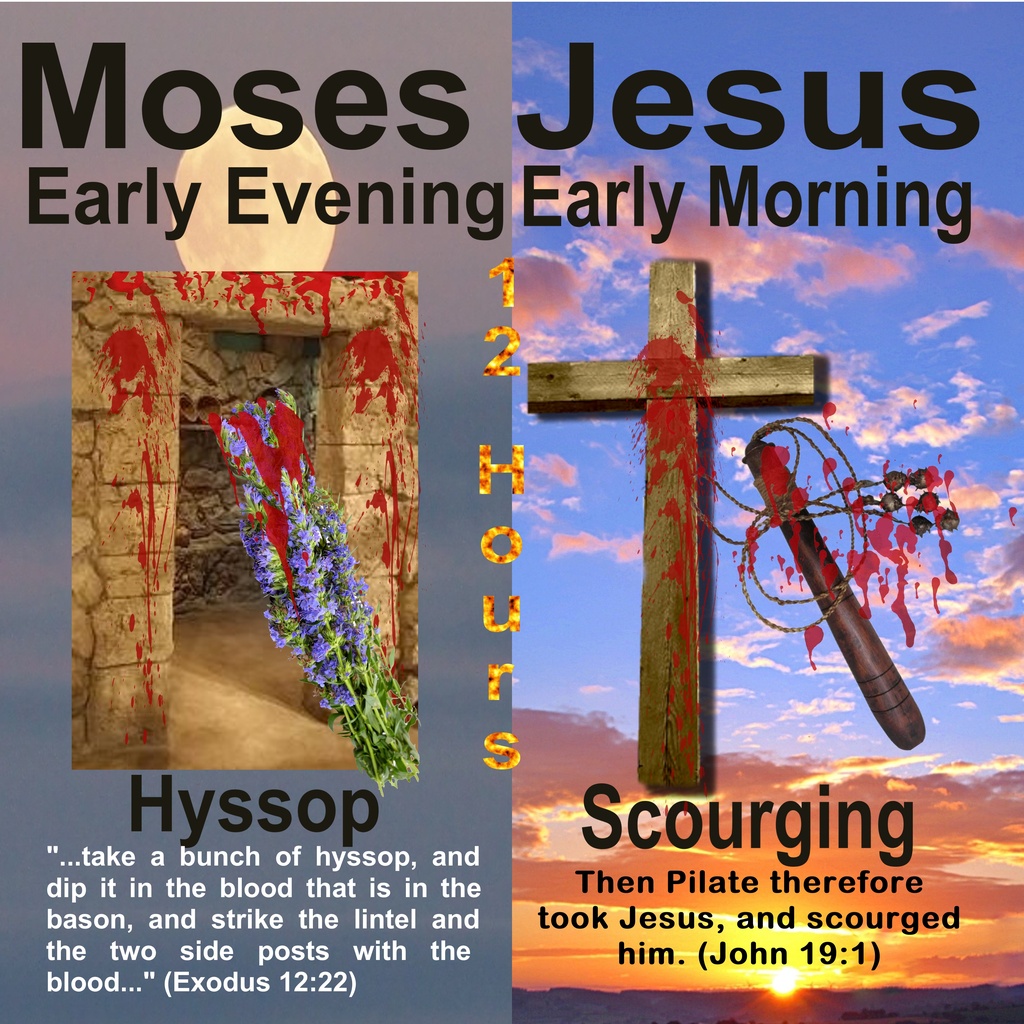
In Jesus's Passover, offset by 12 hours, this period of time would have been in the early morning hours, just after sunrise on the fourteenth day of the first month, when he was delivered to Pontius Pilate (Matthew 27:2).
Then Pilate therefore took Jesus, and scourged him. (John 19:1)
"...when he had scourged Jesus, he delivered him to be crucified." (Matthew 27:26)
"...and delivered Jesus, when he had scourged him, to be crucified." (Mark 15:15)
And they spit upon him, and took the reed, and smote him on the head. (Matthew 27:30)
Just as the people of Moses's time struck the hyssops soaked in innocent blood on their doorways; Jesus was struck, whipped, scourged, flogged shredding his flesh and splattering his innocent blood so that Death may pass by. Jesus is the way, the path, the door, the gate, to eternal life and none shall pass except those He judges worthy.
Jesus saith unto him, I am the way, the truth, and the life: no man cometh unto the Father, but by me. (John 14:6)
He restoreth my soul: he leadeth me in the paths of righteousness for his name's sake. (Psalm 23:3)
I am the door: by me if any man enter in, he shall be saved, and shall go in and out, and find pasture. (John 10:9)
Because strait is the gate, and narrow is the way, which leadeth unto life, and few there be that find it. (Matthew 7:14)
The Roman Empire's use of flogging was a common form of torture that preceded execution. The severe destruction of the body's flesh and loss of blood usually resulted in a faster death once crucified; if the condemned survived the flogging - many did not.
Jesus was brutally struck, whipped, scourged, flogged by Romans corrupted of a malevolent, cruel, and sadistic demeanor. The Roman's involved and many observers feasted on the misery and brutality inflicted on the innocent and defenseless mutilated and bloody flesh in view. They savored the sounds of the whip's impact and the pungent acidic aroma of the splattered blood with an insatiable appetite. Jesus's essence was depleted and drained, the splattered blood visible to All. His physical state was so degraded, (barely able to walk) they "led him away to crucify him.” (Matthew 27:31 Mark 15:20). Unable to carry the cross, “a man of Cyrene, Simon by name: him they compelled to bear his cross” (Matthew 27:32 Mark 15:21).
But he was wounded for our transgressions, he was bruised for our iniquities: the chastisement of our peace was upon him; and with his stripes we are healed. (Isaiah 53:5)
Who his own self bare our sins in his own body on the tree, that we, being dead to sins, should live unto righteousness: by whose stripes ye were healed. (1 Peter 2:24)

From Moses's Passover:
And it came to pass, that at midnight the Lord smote all the firstborn in the land of Egypt, from the firstborn of Pharaoh that sat on his throne unto the firstborn of the captive that was in the dungeon; and all the firstborn of cattle. (Exodus 12:29)
From Jesus's Passover {sixth hour is midday - 12:00 noon, ninth hour is about 3:00PM in the afternoon}:
Now from the sixth hour there was darkness over all the land unto the ninth hour. (Matthew 27:45)
And when the sixth hour was come, there was darkness over the whole land until the ninth hour. (Mark 15:33)
And it was about the sixth hour, and there was a darkness over all the earth until the ninth hour. (Luke 23:44)
The Lord's destroyer (Exodus 12:23) came at midnight during Moses's Passover to fulfill the tenth plague: the Death of the Firstborn. As Moses wrote of Jesus (John 5:46-47), the Lord's destroyer came at midday during Jesus's Passover represented by the "darkness over all the land". As Jesus's mutilated and bloodied body was already nailed to the cross, with death a certainty, WHY was the Lord's destroyer sent?
The self-evident answer is to fulfill the prophecy of the Death of the Firstborn. But the Truth is revealed in the meaning of "death".
For the wages of sin is death; but the gift of God is eternal life through Jesus Christ our Lord. (Romans 6:23)
If the "wages of sin is death", are the wages of sin paid in full by an earthly death of the human flesh? NO!!
"And as it is appointed unto men once to die, but after this the judgment:" (Hebrews 9:27)
"...resurrection of the dead, and of eternal judgment..." (Hebrews 6:2)
The Lord knoweth how to deliver the godly out of temptations, and to reserve the unjust unto the day of judgment to be punished: (2 Peter 2:9)
The Word of God reveals All of mankind will die a physical death, All will be resurrected on the appointed day, and All will face judgement.
For the Father judgeth no man, but hath committed all judgment unto the Son: (John 5:22)
For we must all appear before the judgment seat of Christ; that every one may receive the things done in his body, according to that he hath done, whether it be good or bad. (2 Corinthians 5:10)
But I say unto you, That every idle word that men shall speak, they shall give account thereof in the day of judgment. (Matthew 12:36)
Judgement has two possibilities, spiritual life or spiritual death.
And he is the propitiation for our sins: and not for ours only, but also for the sins of the whole world. (1 John 2:2)
For Christ also hath once suffered for sins, the just for the unjust, that he might bring us to God, being put to death in the flesh, but quickened by the Spirit: (1 Pet. 3:18)
For God sent not his Son into the world to condemn the world; but that the world through him might be saved. (John 3:17)
He that believeth on him is not condemned: but he that believeth not is condemned already, because he hath not believed in the name of the only begotten Son of God. (John 3:18)
Spiritual death as a result of Judgement is the second death. The "wages of sin is death" (Romans 6:23) - the wages of sin is the second death.
But the fearful, and unbelieving, and the abominable, and murderers, and whoremongers, and sorcerers, and idolaters, and all liars, shall have their part in the lake which burneth with fire and brimstone: which is the second death. (Revelation 21:8)
This is the second death. (Rev. 20:13-15)
Jesus was "put to death in the flesh" on the cross in full payment for the "wages of sin is death". Jesus suffered both the physical death of the flesh and a spiritual death - the second death for the wages of All sin. Jesus sacrificed himself, of His own free will, out of His immeasurable love and grace, for All of us. This is reflected in John 10:15-18:
15 As the Father knoweth me, even so know I the Father: and I lay down my life for the sheep.
16 And other sheep I have, which are not of this fold: them also I must bring, and they shall hear my voice; and there shall be one fold, and one shepherd.
17 Therefore doth my Father love me, because I lay down my life, that I might take it again.
18 No man taketh it from me, but I lay it down of myself. I have power to lay it down, and I have power to take it again. This commandment have I received of my Father.
Mankind could not kill Jesus. Jesus freely choose to relinquish His life to fulfill the will of God, and die by "the sword of the Spirit, which is the word of God" (Ephesians 6:17).
(Yea, a sword shall pierce through thy own soul also,) that the thoughts of many hearts may be revealed. (Luke 2:35)
But one of the soldiers with a spear pierced his side, and forthwith came there out blood and water. (John 19:34)
The "blood and water" signified certainty of Death; "blood" the physical human death, "water" the spiritual death, as those devoid of the fountain of the water of life incur the second death - Revelation 21:5-8:
5 And he that sat upon the throne said, Behold, I make all things new. And he said unto me, Write: for these words are true and faithful.
6 And he said unto me, It is done. I am Alpha and Omega, the beginning and the end. I will give unto him that is athirst of the fountain of the water of life freely.
7 He that overcometh shall inherit all things; and I will be his God, and he shall be my son.
8 But the fearful, and unbelieving, and the abominable, and murderers, and whoremongers, and sorcerers, and idolaters, and all liars, shall have their part in the lake which burneth with fire and brimstone: which is the second death.
The fulfilment of the will of God in Jesus's crucifixion and death is signified in "It is done." Jesus is the "Alpha and Omega": The "Alpha"- the first to face judgement and the second death; and the "Omega" - the last and only one worthy to be resurrected from the second death.

Passover 12-Hour Difference – Why?
Do you know where the 12-hour difference
in time originated within the Biblical texts?
The Word of God reveals two events involving direct intervention with time: Joshua 10:12-14 and 2 Kings 20:8-11. These two events resulted in a 12-hour shift to the prophetic timeline line represented by the easily recognizable 12-hour difference between Moses's and Jesus's Passover. Few, if any, have discerned the meaning or attempted to answer the unanswered question that Jesus asked, "Are there not twelve hours in the day?" (John 11:9)
As stated in Joshua 10:12-14:
12 Then spake Joshua to the Lord in the day when the Lord delivered up the Amorites before the children of Israel, and he said in the sight of Israel, Sun, stand thou still upon Gibeon; and thou, Moon, in the valley of Ajalon.
13 And the sun stood still, and the moon stayed, until the people had avenged themselves upon their enemies. Is not this written in the book of Jasher? So the sun stood still in the midst of heaven, and hasted not to go down about a whole day.
14 And there was no day like that before it or after it, that the Lord hearkened unto the voice of a man: for the Lord fought for Israel.
As stated in 2 Kings 20:8-11:
8 And Hezekiah said unto Isaiah, What shall be the sign that the Lord will heal me, and that I shall go up into the house of the Lord the third day?
9 And Isaiah said, This sign shalt thou have of the Lord, that the Lord will do the thing that he hath spoken: shall the shadow go forward ten degrees, or go back ten degrees?
10 And Hezekiah answered, It is a light thing for the shadow to go down ten degrees: nay, but let the shadow return backward ten degrees.
11 And Isaiah the prophet cried unto the Lord: and he brought the shadow ten degrees backward, by which it had gone down in the dial of Ahaz.
Joshua's Long Day
The length of the period of daylight for Jerusalem, Israel varies from approximately 14 hours and 20 minutes for the summer solstice (June 20 or 21) the longest day of the year and 10 hours and 4 minutes for the winter solstice (December 21 or 22) the shortest day of the year. In Joshua 10:13 it is stated the sun "hasted not to go down about a whole day", which infers a period of daylight of about 24 hours comprised of the normal daylight period for that specific day and the additional amount of daylight period to total about 24 hours. The month and day of Joshua's Long Day is not stated in the Bible, however specific events and times are provided prior to it.
In Joshua 4:19 it reveals that on the "tenth day of the first month" they encamped in Gilgal, in the east border of Jericho. In Joshua 5:10 it reveals that on the "fourteenth day of the month at even" while encamped in Gilgal they observed Passover. The Book of Jasher Chapter 88:14 reveals "it was in the second month, on the first day of the month" when Joshua began the 7-day siege and conquest of Jericho bearing the ark and sounding the seven trumpets of rams' horns (Joshua 6) and later conquered the City of Ai (Joshua 8:1-29). In "the third month" (Exodus 19:1) "on the third day in the morning" (Exodus 19:16) as Moses did, Joshua built an altar unto the Lord God of Israel in Mount Ebal and read all the words of the law, the blessings and cursings, according to all that is written in the book of the law (Joshua 8:30-35) fulfilling Deuteronomy 11:29, 27, 28. Joshua then returned to their camp at Gilgal, made a league with inhabitants of Gibeon and learned "three days" (Joshua 9:16) later they were beguiled by them, and then journeyed to their cities Gibeon, and Chephirah, and Beeroth, and Kirjathjearim on the "third day" (Joshua 9:17-27); they later returned to their camp at Gilgal.

Joshua's Long Day likely occurred in the Biblical Forth Month at the end of the third week or beginning of the forth week of the Month. Why? The Moon had to be visible in the sky during the daylight period in the westward direction of the "valley of Ajalon" as viewed from the city of Gibeon - this is only possible when the Moon is in the last quarter or waning crescent phase. The textual information that provides these characteristics are as follows:
"Sun, stand thou still upon Gibeon; and thou, Moon, in the valley of Ajalon." (Joshua 10:12) "And the sun stood still, and the moon stayed.....So the sun stood still in the midst of heaven, and hasted not to go down about a whole day." (Joshua 10:13)
A geographical perspective of the location of the city of Gibeon and the valley of Ajalon assists in understanding: The ancient city of Gibeon is located at the present day location of the village of Al Jib, about ten kilometers northwest of Jerusalem. The valley of Ajalon is located westward of the city of Gibeon, near the former site of the village of Yalo which is now contained in the Israel National Park called Ayalon or Canada Park.

The visibility of the Moon in the westward direction of the valley of Ajalon is unlikely on the day of the Last Quarter Moon since moonset is at 12:42 and the middle of the day is at 12:45 - (using year 2022 as example). The day after the Last Quarter Moon is more likely a candidate for Joshua's Long Day as it has moonset at 13:41 with a luminosity of 44% and is at an attitude of 10-degrees above the horizon - meaning the Moon would be likely visible as viewed from the city of Gibeon at 12:45, the middle of the day, looking westward towards the valley of Ajalon.

The day after the day of the Last Quarter Moon has a daylight period of about 13 hours and 55 minutes. On Joshua's Long Day about an additional 10 hours and 5 minutes would need to occur to be added to the normal daylight period of 13 hours and 55 minutes to total "about a whole day" (Joshua 10:13) of daylight, 24-hours.
If an additional 10 hours and 5 minutes of daylight was added to the normal daylight period on Joshua's Long Day, this amount subtracted from the 12-hour difference between Moses's and Jesus's Passover events, leaves about 1 hour and 55 minutes unaccounted for.

Hezekiah's Dial of Ahaz or Stairway of Ahaz
Using a literal reading of 2 Kings 20:8-11 (KJV), an approximate date is not given when "he brought the shadow ten degrees backward" on Hezekiah's "dial of Ahaz"; the amount of time represented by "ten degrees" can only be estimated. If an average day consists of 12 hours (720 minutes) of daylight, divided by a east-west horizon of 180 degrees, multiplied by ten degrees backwards, 40 minutes is derived. It is noteworthy that a sundial's major divisions of time identify solar time in hours, by measuring the hour angle of the sun, at a rate of 15-degrees per hour. Both primitive and modern sundials do not designate hourly divisions by 10-degrees - read more about sundials here.
Closer scrutiny of 2 Kings 20:8-11 in the King James Version (KJV) reveals that both the words "degrees" and "dial" in the Strong's Concordance is lexicon word H4609: "מַעֲלָה, ma‛ălâh, mah-al-aw'; Feminine of H4608; elevation, that is, the act (literally a journey to a higher place, figuratively a thought arising), or (concretely) the condition (literally a step or grade mark, figuratively a superiority of station); specifically a climactic progression (in certain Psalms): - things that come up, (high) degree, deal, go up, stair, step, story". In this case, a journey to a higher place using stairs or steps appears more appropriate then the use of degrees of a sundial. It is notable to understand the earliest documented use of a primitive sundial is from around 1500 BC discovered in Egypt's Valley of the Kings, well before Hezekiah (741-687 BC) reign as the 13th king of Judah.
The New American Standard Bible (NASB) version of 2 Kings 20:8-11 reads as follows:
8 Now Hezekiah said to Isaiah, “What will be the sign that the Lord will heal me, and that I will go up to the house of the Lord on the third day?” 9 Isaiah said, “This shall be the sign to you from the Lord, that the Lord will perform the word that He has spoken: shall the shadow go forward ten steps or go back ten steps?” 10 So Hezekiah said, “It is easy for the shadow to decline ten steps; no, but have the shadow turn backward ten steps.” 11 Then Isaiah the prophet called out to the Lord, and He brought the shadow on the [a]stairway back ten steps by which it had gone down on the [b]stairway of Ahaz.
Additional context can be found in Isaiah 38:8 (NASB):
8 Behold, I will make the shadow on the stairway, which has gone down with the sun on the stairway of Ahaz, go back ten steps.” So the sun’s shadow went back ten steps on the stairway on which it had gone down.
The Antiquities of the Jews by Flavius Josephus, Book X, Chapter 2 states:
“And God sent Isaiah the prophet, and commanded him to inform Hezekiah, that within three days' time he should get clear of his distemper, and should survive it fifteen years, and that he should have children also. Now, upon the prophet's saying this, as God had commanded him, he could hardly believe it, both on account of the distemper he was under, which was very sore, and by reason of the surprising nature of what was told him; so he desired that Isaiah would give him some sign or wonder, that he might believe him in what he had said, and be sensible that he came from God; for things that are beyond expectation, and greater than our hopes, are made credible by actions of the like nature. And when Isaiah had asked him what sign he desired to be exhibited, he desired that he would make the shadow of the sun, which he had already made to go down ten steps [or degrees] in his house, to return again to the same place, and to make it as it was before. And when the prophet prayed to God to exhibit this sign to the king, he saw what he desired to see, and was freed from his distemper, and went up to the temple, where he worshipped God, and made vows to him.”
The texts reveal that the time of day was after the middle of the day and prior to sunset as the "shadow....has gone down with the sun" (Isaiah 38:8), very likely in the mid-afternoon as the option to have the shadow extend ten steps was also offered. The natural characteristics of a shadow between the middle of the day and sunset is to lengthen, it is worth noting the shadow covers more distance in an hour as sunset approaches. The length of a shadow is longest at the Winter Solstice (December 21/22) and shortest at the Summer Solstice (June 20/21).
The sun rises in the east and casts a shadow westward in the morning and will cast a shadow eastward in the afternoon as it sets in the west. At solar noon, when the sun transits on the local meridian, the shadow will be aligned with the north-south axis. The short video below is reflective of a sundial located in the City of David, Jerusalem in the month of October and depicts realistically the behavior of a shadow cast by the sun on a sundial - note the increasing divisions between the hour marks for the time of day.
As the setting sun casts a shadow eastward, this means the steps, stairs, or stairway had to be aligned in an east-west direction, with the steps declining in the eastward direction - “It is easy for the shadow to decline ten steps." (2 Kings 20:10 NASB). The number of steps or stairs had to exceed twenty based on the choices offered - "...shall the shadow go forward ten steps or go back ten steps?" (2 Kings 20:9 NASB). King Hezekiah likely observed the shadow on the steps, stairs, or stairway from an elevated location within his palace as it had a courtyard, "...even before Isaiah had left the middle courtyard" (2 Kings 20:4 NASB). It is unknown exactly where King Hezekiah's palace was located or if he occupied the previously built house of King David (1 Chronicles 14:1) or King Solomon (2 Chronicles 8:1) when he viewed the steps, stairs, or "stairway of Ahaz" (2 Kings 20:11 NASB) whose location are also unknown.
There is a structure in the City of David purported to be below where the house of King David was located (read here), that is oriented in a east-west direction, descends eastward, and has more than twenty steps; it is a large terraced retaining wall consisting of stone steps called the Millo. The Millo was known to and fortified by King David (2 Samuel 5:9, 1 Chronicles 11:8), King Solomon (1 Kings 9:15, 1 Kings 9:24, 1 Kings 11:27), and King Hezekiah (2 Chronicles 32:5). To gain perspective, a view of the Stepped Stone Structure, the Millo, might help - see here.
The following picture shows a shadow cast in an eastward direction from a covered area east of the Millo - Large Stepped Stone structure; envision a structure, palace, or courtyard wall atop the Millo and the shadow it would cast on the stepped stones with a setting sun.

As it cannot be known with certainty the Millo or Stepped Stone Structure is Hezekiah's Dial of Ahaz or Stairway of Ahaz; it also cannot be reliably estimated the amount of time that "the sun’s shadow went back ten steps on the stairway on which it had gone down" (Isaiah 38:8 NASB) might represent as the height of a structure above the Millo that could cast a shadow is also unknown. There are many artistic renderings of what Jerusalem might have look like that depict the prominence of the Millo or Stepped Stone Structure - see picture here, here, here, here, here, etc.
In 2 Chronicles 32:31 it states, "Howbeit in the business of the ambassadors of the princes of Babylon, who sent unto him to enquire of the wonder that was done in the land, God left him, to try him, that he might know all that was in his heart." Understand that when the "the sun’s shadow went back ten steps on the stairway on which it had gone down" (Isaiah 38:8 NASB) it represented a significant amount of time that it was observed in Babylon as ambassadors of Babylon were sent to King Hezekiah to "enquire of the wonder that was done in the land".
As stated above: If an additional 10 hours and 5 minutes of daylight was added to the normal daylight period on Joshua's Long Day, this amount subtracted from the 12-hour difference between Moses's and Jesus's Passover events, leaves about 1 hour and 55 minutes unaccounted for. This unaccounted for 1 hour and 55 minutes is likely the amount of time represented of when "the sun’s shadow went back ten steps on the stairway on which it had gone down" (Isaiah 38:8 NASB).
Passover 12-Hour Difference – Why?
Do you know where the 12-hour difference
in time was reset within the Biblical texts?
When Jesus freely choose to relinquish His life to fulfill the will of God and died on the cross on Passover Day, at about 3:00 in the afternoon on the fourteenth day of the first Biblical month of the Year, in full payment for the "wages of sin is death" (Romans 6:23), for the remission of sins, the Bible reveals in Matthew 27:50-51:
50 Jesus, when he had cried again with a loud voice, yielded up the ghost.
51 And, behold, the veil of the temple was rent in twain from the top to the bottom; and the earth did quake, and the rocks rent;
Most have or will experience the loss of a loved one and know of the anguish and grief that accompanies that loss; the Bible is silent on when the Father witnessed the death of His "beloved Son" (Matthew 3:17, Matthew 17:5).
As in Moses's time when the Lord descended upon Mount Sinai, "the whole mount quaked greatly" (Exodus 19:18); when Elijah ascended Mount Horeb the presence of God was manifested by "rent the mountains, and brake in pieces the rocks...and an earthquake" (1 Kings 19:11); at Jesus's death "the earth did quake, and the rocks rent" (Matthew 27:51) indicates the presence of God. But unlike Moses's or Elijah's time, their is no mention of the presence of God or His interaction with anyone - the passage of earthly time stopped for a full 12 hours unknown to Mankind, while the prophetic timeline continued. The hours inserted during Joshua's Long Day and King Hezekiah's retracted shadow on the 10 steps, were reclaimed. The time between Jesus's death and resurrection was exactly as Jesus stated, "three days and three nights", "three days", and "third day" -- the equivalent of 72 hours, but 12 hours where unknown to Mankind. Jesus stated this clearly about His return; "But of that day and that hour knoweth no man, no, not the angels which are in heaven, neither the Son, but the Father." (Mark 13:32).
Their is no mention of a witness of when the Temple's veil was ripped from top to bottom and how it occurred, it just happened instantly, was seen - "behold". The ripped veil exposed the "empty" inner Temple area called the Holy of Holies, which previously contained the Ark of the Covenant containing the two tablets of stone (2 Chronicles 5:10) upon which was written the ten commandments; "written with the finger of God" (Exodus 31:18).
The ripped veil occurring with Jesus's death signifies the end of animal sacrifices for the atonement of sins; as Jesus stated, "For this is my blood of the new testament, which is shed for many for the remission of sins." (Matthew 26:28) The ripped veil also signifies the beginning of direct personal access to God through the Holy Ghost, if one so chooses; no longer is a mediator, a Man, a religious leader between YOU and God. "For there is one God, and one mediator between God and men, the man Christ Jesus" (1 Timothy 2:5). This was initially fulfilled on the day of Pentecost when those gathered were filled with the Holy Ghost (Acts 2:1-4).
When Jesus died at about about 3:00 in the afternoon on the fourteenth day of the first Biblical month of the Year, the Lord's Destroyer departed. As Moses wrote of Jesus (John 5:46-47), the events of Jesus's time mirrors the events of Moses's time. After the firstborn of Pharaoh was "smote" by the Lord (Exodus 12:29), Moses was called by the Pharaoh "by night" (Exodus 12:31), despite being instructed "none of you shall go out at the door of his house until the morning" (Exodus 12:22). It is revealed that Moses was not harmed as the Lord's Destroyer had departed (after the death of the firstborn of Pharaoh), offset by 12 hours, at about 3:00 in the morning on the fourteenth day of the first Biblical month of the Year.
Passover 12-Hour Difference – Why?
Do you know why the 12-hour difference in time
was inserted into the timeline and then reset?
During Moses's Passover, the Lord's destroyer (Exodus 12:23) came at midnight to fulfill the tenth plague: the Death of the Firstborn. During Jesus's Passover, the Lord's destroyer came as "darkness" (Matthew 27:45) at midday, the "sixth hour", to fulfill the Death of the Firstborn.
The 12-hour shift in time is not a coincident, it was a prerequisite, as the Roman Empire's very public display of capital punishment served as a demonstration of Roman power, authority, and as a deterrent to all observers; and was conducted during daylight hours for maximum influence and effect.
The 12-hour shift in time was inserted to fulfill the prophecies exactly as God willed. Without the 12-hour shift in time, Jesus would have needed to been crucified at midnight and died at about 3:00AM in the morning for the prophecies to match, be fulfilled, and mirror the timeline of Moses's Passover.
The 12-hour shift in time was reset when Jesus died on the cross (Matthew 27:50-51) and was unknown to Mankind. This is demonstrated as Man has been unable to fit 72 hours in their interpretations of the time between Jesus's crucifixion and resurrection; Man has rationalized and contrived many falsehoods, clearly demonstrating that the words Jesus spoke in Matthew 16:2-4 are True.
If one reads and discerns the Truth of Jesus's crucifixion and resurrection, the understanding of how 72 hours fits between Jesus's crucifixion and resurrection, is by inspiration and discernment provided by the Holy Spirit (John 14:26). Understand that all of Jesus's twelve apostles and His many followers did NOT believe that He would "be killed, and after three days rise again." (Mark 8:31); and that only by Jesus's intercession did they understand and believe -- "Then opened he their understanding, that they might understand" (Luke 24:45) and become witnesses (Luke 24:44-48). For further insight on the Passover and Resurrection of Jesus read this post.

Jesus was risen on the first day of the week early in the morning (Luke 24:1-3). On the first day of the week, God said, "Let there be light: and there was light" and "God divided the light from the darkness" (Genesis 1:3-5). God resurrected Jesus from the darkness of Death on the first day of the week; Jesus is the light of the world and those that followeth Him shall not walk in darkness, but shall have the light of life (John 8:12).
Jesus was risen on the third day (Luke 24:46). Jesus was risen on the third day, the third day of the Feast of Unleavened Bread (Leviticus 23:6-8).
Jesus was risen after the Sabbath day and became the firstfruits (1 Corinthians 15:20). Jesus was risen on the morrow after the Sabbath, the day of the wave offering of the Firstfruits (Leviticus 23:10-11).
When Jesus spoke of the "sign of thy coming" (Matthew 24:3), He stated, "But of that day and hour knoweth no man, no, not the angels of heaven, but my Father only." (Matthew 24:36) and this Truth applies to both His resurrection and His imminent return.
The total of 12 hours inserted during Joshua's Long Day and Hezekiah's Stairway of Ahaz had shifted the earthly timeline by +12 hours when Jesus was born in the evening as the shepherds were abiding in the field, keeping watch over their flock by night (Luke 2:7-8). The wise men from the east scanned the heavenly skies also offset by +12 hours and observed a "star" at that same time and prepared to travel to worship "he that is born King of the Jews" (Matthew 2:1-7). {Its is notable that Daniel who prophesied the time of the Messiah (Daniel 9:24-27), was also made governor over all the "wise men" of Babylon and possessed "many great gifts" (Daniel 2:48); and by the gifts of the wise men did Joseph, Mary, and Jesus have the means to escape, travel to, and abide in Egypt (Matthew 2:11-13).}
I am the root and the offspring of David,
and the bright and morning star.
The Bible reveals that Jesus is the "bright and morning star". "For as the lightning cometh out of the east, and shineth even unto the west; so shall also the coming of the Son of man be". (Matthew 24:27). Is not the Sun the only star in our solar system and when it rises above the Earth's horizon in the morning it shines forth its light from the east in a westerly direction? Would not the sun appeared darkened (Matthew 24:29) when the Son of man comes in the clouds of heaven with power and great glory (Matthew 24:30) as the "bright and morning star" (Revelation 22:16) on the "day of the Lord" (Joel 2:1, Isaiah 13:9) or the "Lord's day" (Revelation 1:10) at the sound of the "trumpet"? Do not the stars fall from heaven and from sight with the rising of the Sun? (Matthew 24:29)
Does not the moon, God's "faithful witness in heaven" (Psalm 89:37), "not give her light" (Matthew 24:29) prior to revealing the sliver of the crescent moon signifying the beginning of a new Biblical month? "For the Lord himself shall descend from heaven with a shout, with the voice of the archangel, and with the trump of God" (1 Thessalonians 4:16). Is not the first day of the seventh month, a day of "blowing of trumpets", a sabbath, a holy convocation in which no servile work shall be performed? (Leviticus 23:24, Numbers 29:1)
Jesus was born in the evening on God's declared holy day on first day of the seventh month, offset by the +12 hours inserted into the earthly timeline. A day that is “holy unto the Lord your God” (Nehemiah 8:9); yet the specific reason for it is not directly disclosed. A day to “to eat, and to drink, and to send portions, and to make great mirth” (Nehemiah 8:12).
As the +12 hours inserted into the earthly timeline were reclaimed when Jesus was crucified and died, Jesus's second coming, the "day of the Lord" (Joel 2:1, Isaiah 13:9), will be at the same instant of His birth, but now in the morning prior to the first day of the seventh month as the "bright and morning star" (Revelation 22:16). Jesus first came as the "Lamb of God" (John 1:36) and will return as the "Lion of Judah" (Revelation 5:5) with the "wrath of Almighty God" (Revelation 19:15).

This shift in time is a prerequisite, as the first day of the seventh month is God's declared holy day, the Feast of Trumpets, a sabbath, a holy convocation in which no servile work shall be performed (Leviticus 23:24, Numbers 29:1) and God/Jesus honor Their commandment. This shift in time is a prerequisite, as the "day of the Lord" begins in the morning, 12 hours prior to the annual sabbath of the Feast of Trumpets and many things are to be accomplished.
Remember Jesus asked, "Are there not twelve hours in the day?" (John 11:9). Using year 2022 as an example, the first day of the Biblical Seventh Month, the Feast of Trumpets, as observed from Jerusalem, Israel, was from sunset on 27 September to the sunset on 28 September 2022. Ironically the period of day light is almost exactly 12 hours….

Sign of the Prophet Jonah
What was the sign of the prophet Jonah to Nineveh? "Yet forty days, and Nineveh shall be overthrown." (Jonah 3:4). Jonah preached the "word of the Lord" (Jonah 1:1, Jonah 3:1) of the impending Judgement of God. The Judgement of God upon Nineveh was averted not by the prophet Jonah, but by the freewill choice of the people of Nineveh to believe in God, recognize and turn from their evil ways and violence, and repent (Jonah 3:5-10). The sign of the prophet Jonah was simply the "word of the Lord" of the forthcoming Judgement of God.
Jesus said in Matthew 12:39, "But he answered and said unto them, An evil and adulterous generation seeketh after a sign; and there shall no sign be given to it, but the sign of the prophet Jonas:" The sign of the forthcoming Judgement of God upon ALL of Mankind is elaborated in detail throughout the Bible, particularly in the Book of Revelation - "The Revelation of Jesus Christ" (Revelation 1:1). Like the people of Nineveh and the "evil and adulterous generation" of past eras and today, ALL have the freewill choice to not believe or believe in God, Jesus, the Word, and repent of their transgressions/sins. Regardless, the Judgement of God upon ALL of Mankind draws nearer with each passing day.
For God so loved the world, that he gave his only begotten Son, that whosoever believeth in him should not perish, but have everlasting life. (John 3:16)
Just like the sign of the prophet Jonah, Jesus proclaimed the "word of the Lord" of the forthcoming Judgement of God:
"Repent: for the kingdom of heaven is at hand."
(Matthew 4:17)
A Choice is YOURS to freely make. May God guide and inspire your decision.


0 Comments