Navigation Instruments – Raymarine EV-1 Sensor Core

Navigation Instruments – Raymarine EV-1 Sensor Core

Navigation Instruments - Raymarine EV-1 Sensor Core


  • Action: To Do List item A0253 - Install Raymarine EV-1 Sensor Core in forward center-line of dodger hardtop.
  • Completed:  15 March 2018
  • Cost: $561.98


The Raymarine EV-1 Sensor Core installation manual recommended mount requirements allowed for above or below deck installation; and horizontal or vertical mounting. The key criteria that needed to be met was the unit must be level within 5º of pitch and 5º of roll and must be mounted with the LED ‘arrow’ on the top of the unit pointing towards the vessel’s bow and must be in parallel alignment with the longitudinal axis (centerline) of the vessel.  The only practical mount location on Indra was the forward center-line of the dodger hardtop.

While the supplied horizontal mounting template identified the locations to drill the mount screws, it did not identify the recommended location of the 7/8-inch hole to drill for the SeaTalkng cable pass through.  When we drilled the hole for the SeaTalkng cable it was not exactly centered and therefore we had to elongate the hole for the cable to fit through the hole.

As the wood chips in the picture below reveals, the dodger hardtop at the location the cable hole was drilled was made of less than 1/2-inch plywood, coated both sides with an unknown white paint - was surprised and disappointed not to discover a layer of fiberglass cloth or epoxy resin.  The newly installed dodger hardtop by the POs was not as robustly built as assumed.

The SeaTalkng cable was passed through the hole and routed aft to the overhead navigational instruments location where the cable connected to the SeaTalkng communication bus.

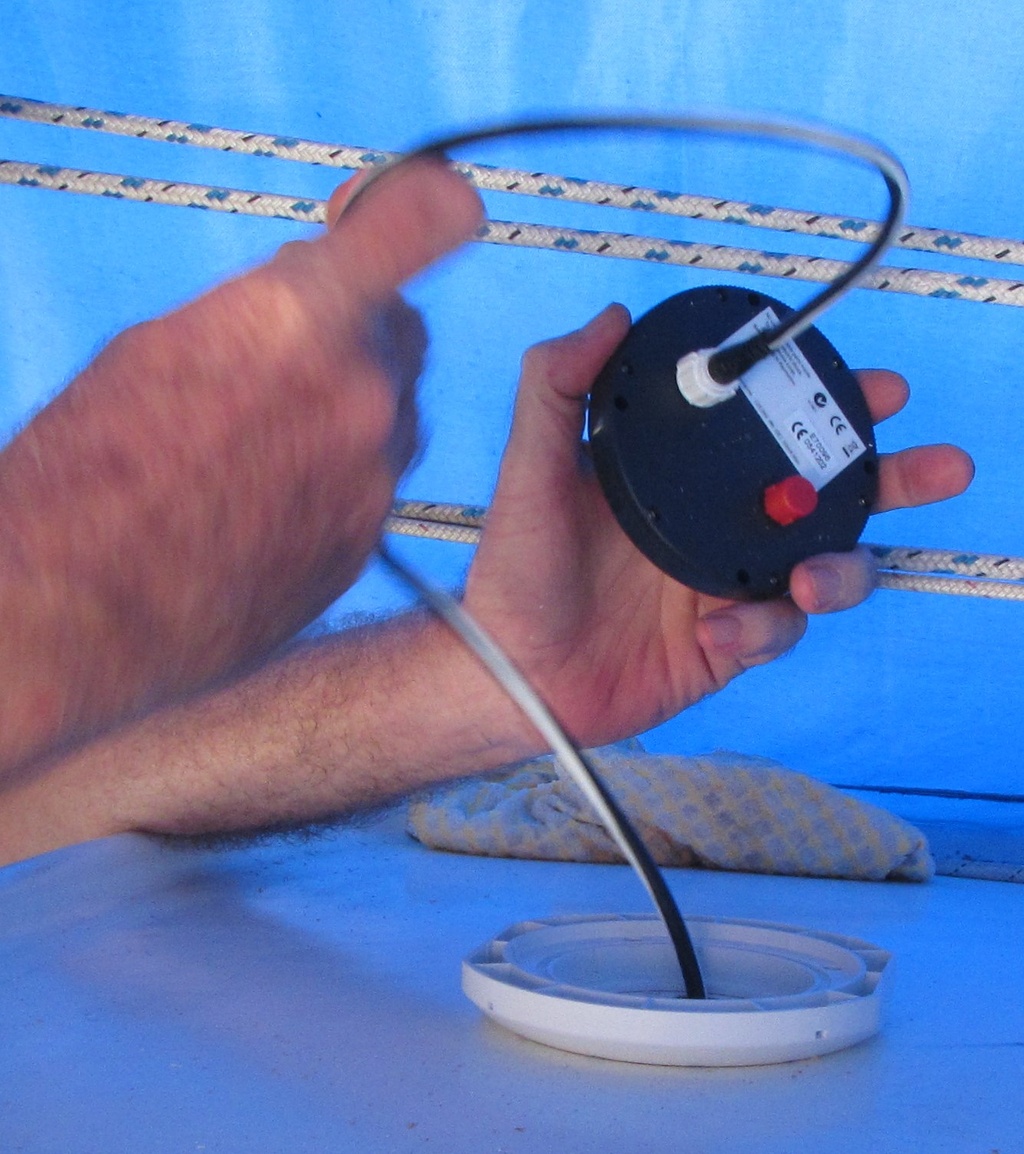
The Raymarine EV-1 Sensor Core part number E70096 serial number 0541202 ($532.99)  is shown mounted in the dodger's hardtop and was attached to a 1-meter SeaTalkng spur cable part number A06039 ($28.99).

Ritchie SuperSport SS-2000 Compass LED Light Replacement

Ritchie SuperSport SS-2000 Compass LED Light Replacement

  • Action: To Do List item A0219 – Obtain replacement LED assembly and mount gasket for Ritchie SuperSport SS-2000 compass.
  • Action: To Do List item A0220 – Rewire Ritchie SuperSport SS-2000 compass 12-volt night lighting to include 1 amp protective fuse.
  • Completed: 15 March 2018
  • Cost: $77.84


On 9 December 2017, from the Ritchie Navigation website, ordered an CS-0025 LED Kit 12V Green NV ($22.22), SH-0176 XSP LED 12V Green GL & NV ($27.66), and a NV-0175 Mounting Gasket ($8.00) with shipping charge of $9.96 to our Los Angeles, California ocean freight consolidator.  We received this in Naga City, Cebu on 23 February 2018.


With receipt of the ordered items discovered that CS-0025 LED Kit had a mount bracket and screws, that SH-0176 XSP LED Kit did not - the CS-0025 LED Kit is also cheaper by $5.44.  The instructions that came with the LED kit clearly cautioned and recommended the use of a 1 amp protective circuit fuse. As the LED wire leads appeared to be 24 AWG, with a free air ampacity rating of 3.5 amps maximum, this seemed a reasonable fuse value. We would use a 1 amp protective circuit fuse which would correct the previous ill advised connection to the 12 VDC panel circuit breaker rated at 10 amps.

In March 2018, when we returned to Indra at Holiday Oceanview Marina, we removed the compass and its sunshade cover. The wires for the LED light needed to be cut to remove the compass. Could not access the enclosed area in front of the cockpit well where the old wiring was installed, so cut both exposed ends of the wiring and removed all the rest of the old wires.

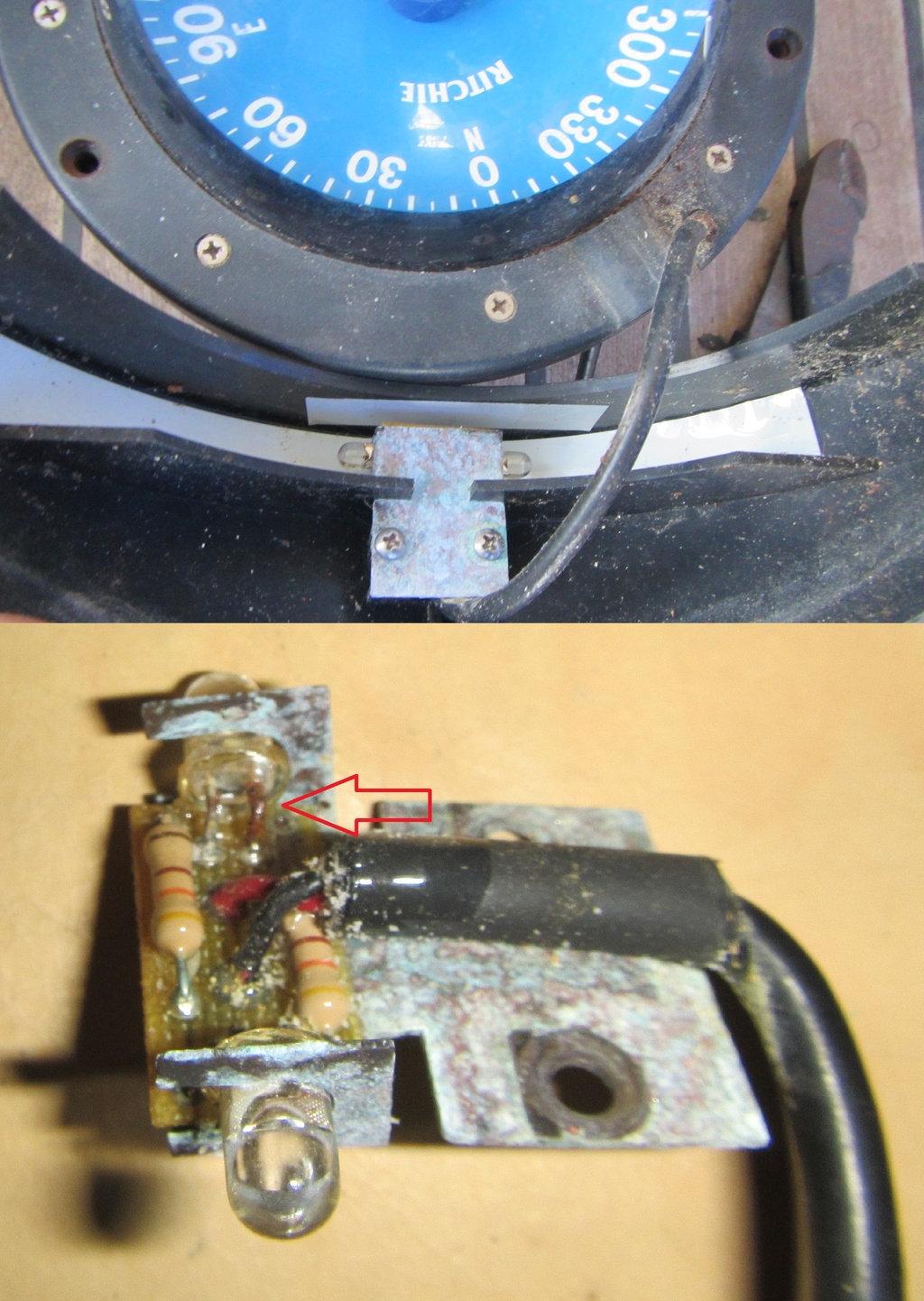
The LED light assembly had corrosion all over it. Verified the old LED light was inoperative by connecting 12 VDC power to it. It appeared the corrosion on the LED bulb leads might be the root cause as to why it failed.

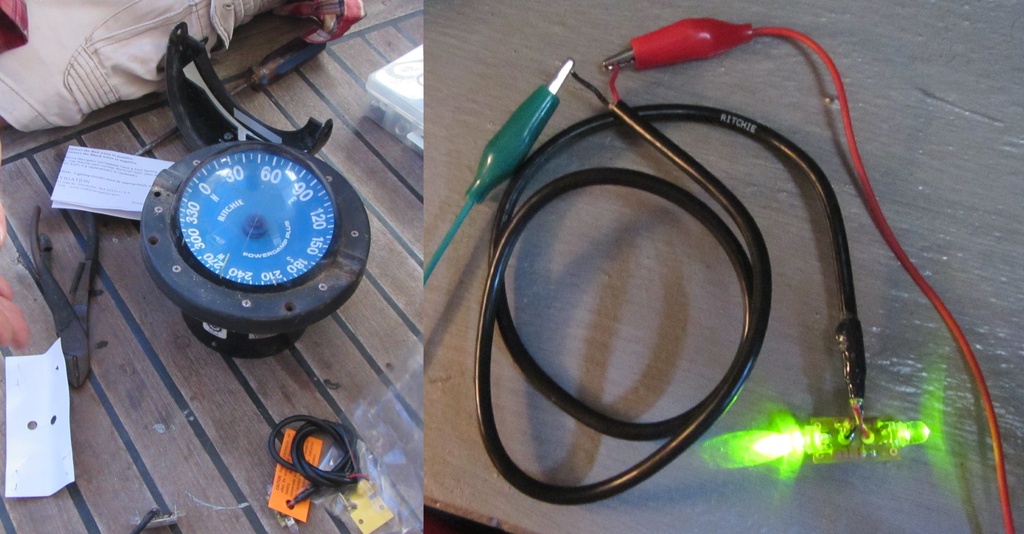
Before installing the new LED light assembly in the compass sunshade cover, we verified the new replacement LED lights illuminated ok.

New 16/2 AWG duplex sheathed wiring was run from the newly installed 12 VDC panel and negative bus bar at the navigation desk to the compass location in the forward side of the cockpit well.  About 15 feet of 16/2 AWG duplex wiring ($6.00) was installed and connected with marine rated splices and connectors ($4.00) with heat shrink coverings.  A 1 amp protective AGC glass fuse was installed in the 12 VDC panel for this circuit output.  The following diagram depicts the compass wiring circuit.

The new gasket was used when the compass was installed.  Retained the old gasket and place it and the SH-0176 XSP LED Kit into the spares kit.

LPG Tank Warning/Safety Labels

LPG Tank Warning/Safety Labels

  • Action: To Do List item A0224 - Order and install LPG tank warning/safety labels.
  • Completed: 12 March 2018
  • Cost: $15.74


After researching LPG tank labeling requirements, on 8 December 2017 ordered a 25-pack of LPG labels from MySafetyLabels.com for $8.75 with $6.99 shipping charges to our ocean freight consolidator in Los Angles, California.  These labels were received in Naga City, Cebu on 23 February 2018.


    We installed the LPG labels on the tanks, on both the front and backside of the cylinders.


    Holiday Oceanview Marina – March 2018 Trip

    Holiday Oceanview Marina – March 2018 Trip

    Holiday Oceanview Marina - March 2018 Trip


    With the receipt of five balikbayan boxes on 23 Feburary, daughter's doctors and dentists appointments complete, we packed up the Ford Ranger and departed Naga City, Cebu on 10 March bound for yet another trip to Holiday Oceanview Marina, Samal Island, Mindanao to visit/work on our boat Indra.

    We left our rental duplex (red circle in picture below) in Oceanside Subdivision, South Poblacion, Naga City, Cebu at 04:30 on 10 March 2018.  We left early in the morning in an attempt to avoid the traffic congestion of Cebu City.  Also, 10 March is a Saturday - weekend travel in the Philippines is our preference since there are less road blocks erected for school crossings, multiple police and army checkpoints, and the never ending road construction/repair activities.

    We headed to the Republic Drydock and Port Facilities, , Danao City, Cebu where we would board an E. B. Aznar Shipping Corporation RoRo (roll-on roll-off) ferry.

    We made it to the RoRo ferry at around 06:30 and it was scheduled to depart at 07:30.


    The cost breakdown for the RoRo ferry bound to Isabel, Leyete RoRo port is as follows:

    Ford Ranger Freight Charge - 2,840.00
    Passenger Fare - truck driver - free
    - one adult - 270.00
    - one child - 135.00
    Terminal Fee - 130.00
    Coast Guard Fee (no receipt) - 50.00
    Port Authority Wharfage Fee - 112.00
    Danao Harbor Fee - 220.00
    ____________________________
    Total Fees:  3,757.00 pesos (about US $73.67)

    The RoRo ferry was on time/schedule this day, so we drove the Ford Ranger aboard.

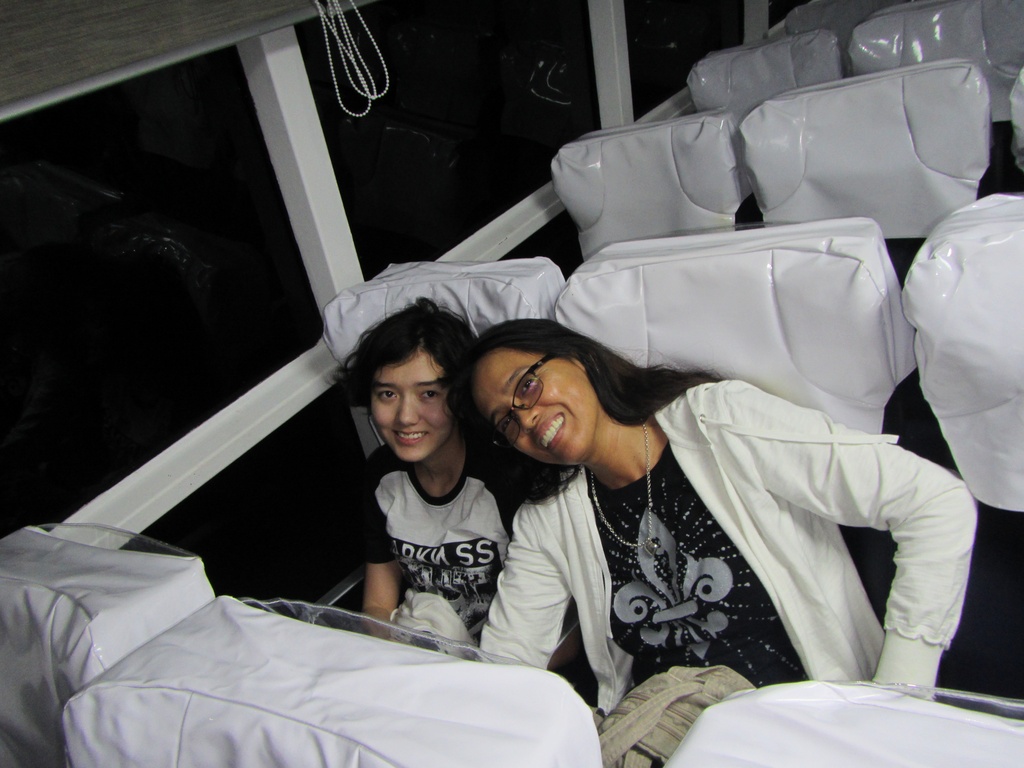
    The accommodations aboard were simple rows of plastic seats.

    Even the crew on the RoRo Ferry LCT Melrivic 2 were in good spirits and posed for a picture!

    We departed Danao Port at around 09:25 bound for Isabel RoRo Port, Leyte about 37 miles away.

    We arrived at Isabel RoRo Port, Leyte around 13:10 - total time for the trip was about 3 hours and 45 minutes. Here we had to pay an additional wharfage fee of 112.00 pesos to exit the port area.

    Next we drove from Isabel to Liloan Ferry Terminal, Leyte, with a quick stop for lunch at Jollibee (750.00 pesos) in Ormoc, Leyte.

    The cost breakdown for the FastCat RoRo ferry bound to Lipata Ferry Terminal, Surigao CityMindanao is as follows:

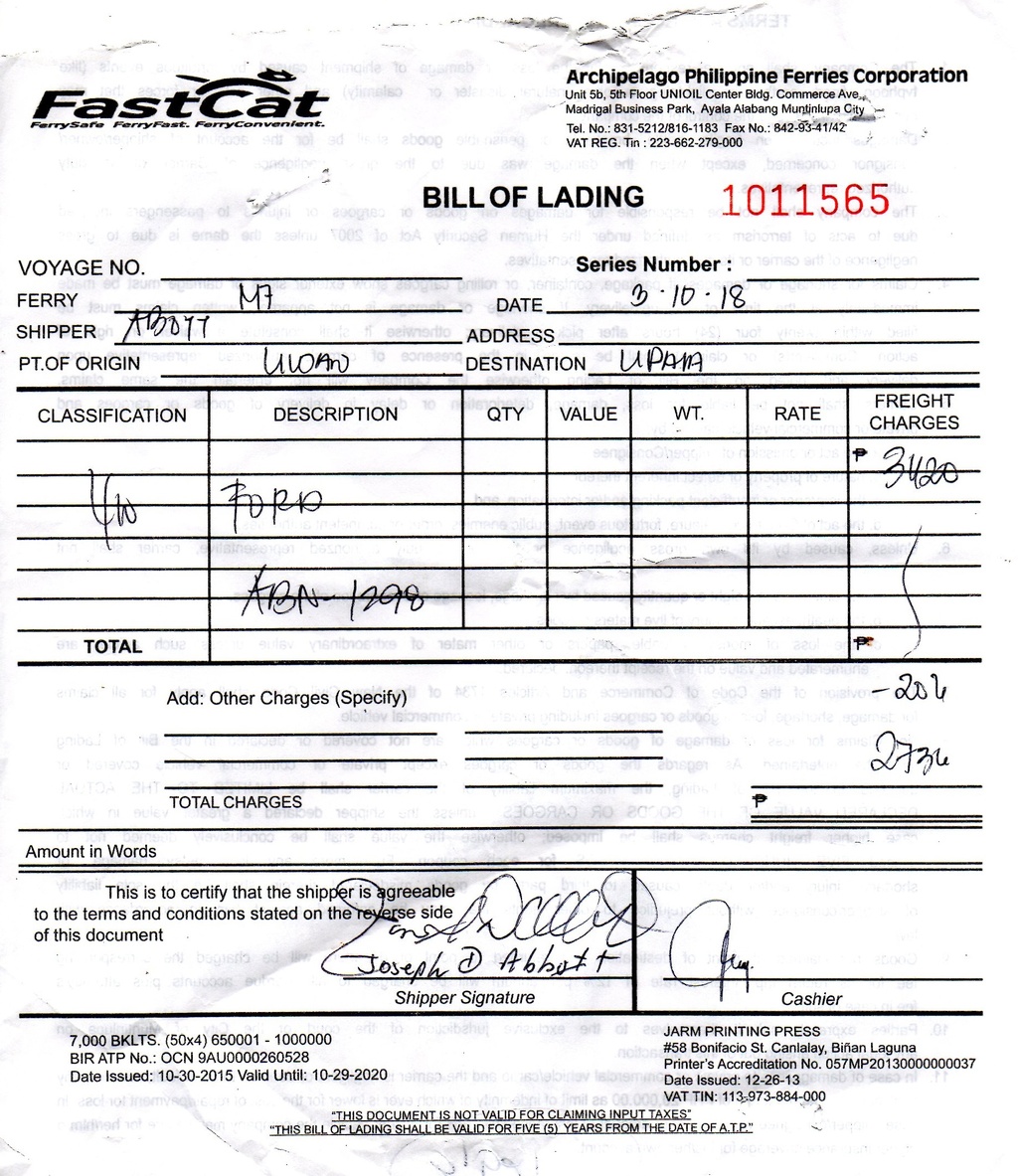
    Ford Ranger Freight Charge - 2,736.00
    Passenger Fare - truck driver - 300.00
    - one adult - 330.00
    - one child - 330.00
    Terminal Fee - 48.00
    Terminal Weight Fee - 80.00
    Port Authority Wharfage Fee - 129.00
    Harbor Fee - 90.00
    ____________________________
    Total Fees:  4,043.00 pesos (about US $79.27)

    Next, we drove and parked the Ford Ranger aboard the FastCat.

    The accommodations aboard were rows of plastic-cloth covered seats.

    We departed Liloan Port at around 20:10 bound for Lipata Ferry Terminal, Surigao CityMindanao about 39 miles away and arrived about two hours later at 22:00.

    From the Lipata Ferry Terminal we drove a very short distance to the Almont Beach Resort to spend the night (room 2,450.00 pesos)

    We had complimentary breakfast at the Almont Beach Resort before beginning the drive further south.

    We departed Suriago City at around 07:00 and drove through the mountains of Mindanao. It was a partially rainy day, the roads overall were in a good state - but numerous areas had construction in progress due to landslides. We stopped for lunch at McDonald's (680.00 pesos) in the city of San Francisco.

    We arrived at the Samal Ferry Wharf, Sasa Barge Road, Buhangin, Davao City, around 15:30. We paid the 200.00 peso ferry fee and took the short 1.5 mile trip across the bay to the Samal Ferry Terminal, Babak, Island Garden City of Samal, Davao del Norte.

    From the Samal Ferry Terminal we drove north to Holiday Oceanview Marina, Samal Island, Mindanao arriving at about 16:30.

    Indra was still here and just as we previously left her - now the work/fun begins, again!

    The total cost for the trip from Naga City, Cebu to Holiday Oceanview Marina, Samal Island was about 14,792 pesos (about US $290.00) and took two days to complete.

    Danao RoRo Ferry fees - 3,757.00
    Isabel RoRo Port wharfage fee - 112.00
    Jollibee Ormoc, Leyte - 750.00
    Liloan Port FastCat RoRo Ferry fees - 4,043.00
    Almont Beach Resort room fee - 2,450.00
    McDonald's San Francisco - 680.00
    Samal Ferry Wharf Ferry fee - 200.00
    Diesel Fuel - 2,800.00


    Lesson – Sudden Steering Failure

    Lesson – Sudden Steering Failure

    While scanning the internet sailing blog sites, my interest was aroused when one of the articles stated "lost our steering".  The story in short: a link of chain broke (see illustration below) in their steering system due to stainless steel crevice corrosion. It was temporarily repaired by splicing a length of Dyneema rope to the last chain link and using the Dyneema rope to replace the entire length of wire steering cable back to the quadrant.

    The readers comments to their post were the typical accolades and admiration of their heroic resourcefulness and skill. They stated they had inspected the chain about a year earlier, under magnification, and it appeared serviceable.  They also referenced another loss of steering failure four years earlier that was caused by an eye bolt that sheered in half (see illustration below) that attaches the wire cable to the steering quadrant - they temporarily fixed this with a loop of Dyneema and at a later date replaced the broken eye bolt.  Other pertinent items: Steering system manufacture is not identified. Boat was built in 1982 and ownership began around mid 2007.  Boat has principally been located/operated in tropical/equatorial zones. Crew experience level rated high based on ten-plus years actively sailing/full time live-a-boards, soon to claim title as circumnavigators, and are published authors.

    What was not covered in the article was what could have been done to prevent the loss of steering failure, if anything.


    This is probably the most relevant piece of information missing from so many sailing blog failure-type of stories I have read - the real root cause of failure and the lesson to be learned. Sometimes the truth of this revelation is humbling and therefore not freely disclosed - just as the name of this boat and crew are purposely not disclosed because it is not important, the lesson is.

    As our boat has tiller steering (very simple and reliable), I am therefore definitely not an expert on wire and chain steering systems.  However, I believe nothing is really complicated and anyone can read and comprehend manufacture's literature on any subject matter.  In this case as the steering manufacture was not disclosed, I reviewed the steering system information located on Edson Marine website:  EB381 - Edson Chain & Wire Steering System Planning, Installation and Maintenance Guide and EB372 - Edson Chain & Wire Rope Steering Inspection Checklist (PDF). The information provided by Edson Marine is very comprehensive and detailed.  Also performed some internet searches and discovered loss of steering on chain and wire systems was not uncommon and a temporary fix with a length of rope or wire was utilized in most cases. 

    An article by Don Casey summarized the most likely cause of this loss of steering failure, “..... a chain-and-wire system will not tolerate indifferent maintenance, and if it’s not properly maintained, it will fail suddenly and completely. The only thing you won’t know is when that will happen."  As a previous dirt-bike motorcycle owner, I am familiar with the requirements of chain cleaning, lubrication, and maintenance.  So based on this research, the initial assumption as to the cause of this failure is the lack of proper maintenance, but what specific actions could have prevented this failure?

    First, a look at the broken chain.  The red arrows in the picture below show where three different chain link plates broke directly in the area of a chain pin. The probability that all three chain link plates broke simultaneously is low (due to different elongation of the link plate pin holes) and it is likely they broke separately over a unknown period of time.  With the picture zoomed in close, the surfaces of the chain link plates reveals discoloration (reddish brown spots) indicating the presence of rust/corrosion.  The yellow arrows point out areas with black grime indicating the chain is dirty; it is in need of cleaning.

    One of the first things I usually want to know, is there a replacement interval recommended by the manufacture?


    Edson Marine recommends the steering chain and wire assembly be replaced every 5 to 7 years; and replaced more frequently if in tropical/equatorial zones. This recommendation is very similar to the standing rigging replacement recommendations in tropical environments, so it is not unreasonable and unfounded. Edson Marine offers complete chain and wire assembly kits that if used, replace not only the chain and wire, but all the interconnecting hardware - this is prudent as all the items in this assembly are subjected to the same stresses and environmental conditions.


    The loss of steering blog site article does not reveal if the steering chain and wire assembly was replaced as recommended by the manufacture. However, it did referenced another loss of steering failure four years earlier that was caused by an eye bolt that sheered in half and they indicated they replaced "only" the sheered eye bolt. It was also not disclosed if the eye bolt sheered in half due to corrosion, but it is a reasonable possibility. Per articles on their blog site, their boat has principally been cruising the tropical zones which should have resulted in the consideration of a more frequent replacement and inspection interval. Regretfully with the scant information provided, this leads to the assumption that it is most likely that the steering chain and wire assembly was installed as part of the original boat construction in 1982, 36 years past. This assumption is not without merit, as many cost-conscious cruisers foster the common attitude, "if it is not broke, don't fix it", in lieu of sound preventive maintenance practices. Ironically, sound preventive maintenance practices tend to be cheaper in the long run and result in less dramatic and catastrophic failures.

    Knowledge of this replacement interval should result in additional considerations:

    • You should know the date of installation of the existing system/parts and forecast a scheduled date of replacement.  Document this in writing on a tracking list that makes sense to you.
    • You should have a copy of all available manufacture's documentation, manuals, drawings, etc., pertaining to this system and associated parts.
    • You should determine and document the part number(s), cost, and a supplier of the replacement assembly/parts.
    • You should decide if this item should be included in your spares kit. On a multi-year round the world voyage such as this boat was on, this item probably should have been included in the spares kit.


    One of the next things I usually want to know, what is the recommended inspection interval and criteria?

    Per excerpts from Edson Marine documentation the inspection interval should be:

    ".... it is important that all boats fitted with Edson Steering Systems get an annual inspection of the critical system parts and that routine maintenance guidelines are followed."

    "Make note of your inspection date and schedule your next inspection. Once to twice a season is a bare minimum - racing boats and heavily sailed cruising boats should consider more frequent inspections. An aggressive maintenance schedule needs to be followed if sailing in the Caribbean or other equatorial level locations."

    "CAUTION: When the equipment is in the tropics or in charter service, the maintenance schedule must be speeded up."

    "CAUTION: On extended voyages your steering system should be inspected each day and lubricated weekly. Carefully inspect your steering system at least once a week before a vacation cruise to avoid last minute maintenance."

    Per excerpts from Edson Marine documentation the inspection criteria for the chain should be:

    "Inspect the chain from one end to the other. There should be no sign of rust on it, especially where the pins are peened over as they come thru the link plates. Rust is a sign of crevice corrosion and your chain should be replaced immediately. Steering chain should literally drip over your finger. When crevice corrosion sets in it freezes the links in place. So, when the chain passes over the sprocket, it doesn’t want to bend. This causes failure of the link plate, and ultimately the chain."
    .
    The loss of steering blog site article stated they had inspected the chain about a year earlier, under magnification, and it appeared serviceable.  While this appears in line with the manufacture's annual inspection recommendation, it does not comply with the cautionary inspection criteria for the tropics or the extended voyage they were undertaking.  As they stated they performed an inspection a year earlier, than it is reasonable to conclude it was "due" inspection around the time of failure.  Also the picture above showing the broken chain reveals a significant accumulation of black grime on the chain; it is hard to imagine that it accumulated to this extent in less than a year in the closed protected confines of the binnacle enclosure if proper maintenance was performed.  It would be extremely challenging to properly visually inspect a chain with this black grime present, without first cleaning the chain thoroughly and removing all this residue.
    .
    It is worthwhile to note that after the steering failure occurred and was temporarily fixed with a length of Dyneema rope, they instituted a daily inspection regime to monitor the Dyneema rope for chaff issues and security; they had to occasionally adjust the tension to accommodate for rope creep .   It would have been beneficial if the same level of attentiveness existed before the failure occurred.  A few experienced sailing reader's comments to their blog article proclaimed they had permanently replaced all their steering wire/cable with Dyneema rope when they experienced similar steering failures.  So there is the possibility that this temporary fix with Dyneema rope could become the permanent fix, disregarding the other steering components that are probably also degraded due to "indifferent maintenance".  One can only hope these experienced cruisers realize that there is a difference between the groove in a synthetic-rope sheave versus a steel wire-rope sheave, and the implications it presents.
    .
    Knowledge of the recommended inspection interval should result in additional considerations:
    • You should document, track, and forecast the inspection interval on a list that makes sense to you.


    One of the other things I usually want to know, what is the maintenance requirements?

    Edson Marine provides a very comprehensive Steering Inspection Checklist that details what to look for and what specific maintenance action to perform for the entire system.  As for chain maintenance requirements, it is actually very simple: clean it, inspect it, lubricate it, and verify proper tension.

    The importance of cleaning the chain should not be under estimated. A complete and thorough cleaning removes the build up of old gummy oil and dirt that provides a surface for corrosive particles to accumulate, accelerating corrosion.  A clean chain allows the oil lubricant to penetrate easier into the chain rollers and bushings, retarding corrosion. Based on my prior experience with dirt-bike motorcycles, to properly clean a chain it would require it's removal so it could be immersed it in a cleaning solvent bath to loosen up the grunge. Scrubbing with a stiff bristle brush would aide the removal of stubborn grime. Bathe, scrub, rinse, and repeat until spotless. After allowing the cleaning solvent to dry off/disperse, then soak (completely immerse) the chain in a container with 30 weight oil - this is the only sure way to get oil into all the crevices between the pins, rollers, and bushings.  Suspend the chain above the oil container and allow the excess oil to drip off.  Next, it is ready to be reinstalled.  This entire process should take less than 10-15 minutes to complete; oh, my error - it is a boat - multiple time estimate by 3 or 4.

    The picture above showing the broken chain reveals a significant accumulation of black grime indicating the chain had not been properly cleaned.  With the picture zoomed in close, was unable to detect the glisten/shine of the presence of oil - the black grime areas also appear to be almost dry.  Its is reasonable to conclude this chain needs to be cleaned and lubricated.

    Knowledge of the recommended maintenance requirements should result in additional considerations:

    • You should compile a list of "all" items necessary to perform the required recommended maintenance and maintain an adequate stock level aboard.
    • You should determine what additional miscellaneous pieces of hardware should be carried aboard.  Stripped screw head, dropped bolt/nut, lost chain spring clip, etc. are a few potential candidates.


    So what was the most likely root cause of failure and the lesson to be learned?


    Based on the limited information provided and pictorial evidence, it appears the failure can be reasonably attributed to non-compliance with manufacture's maintenance recommendations.  Both the broken chain and sheered eye bolt most likely occurred due to the effects of corrosion.  Replacement of the steering chain and wire assembly in a time frame of less than five years due to operation in a tropical environment as stipulated by the manufacture would have significantly reduced the possibility of this type of failure occurring.  Additionally, adherence to the manufacture's inspection and maintenance requirements for tropical environments and extended voyages, should have resulted in early detection of any degradation and enabled the appropriate repair action, eliminating almost to zero any chance of these failures occurring.  The probability that the rest of their steering system maintenance requirements has been neglected is most likely - time will tell.

    Lesson: Read and follow all manufacture's recommendations. Convert the recommendations to actionable lists: replacement date, inspection dates, parts list, consumable lists, pre-departure inspection checklist, etc. Do this for each and every item aboard, and your more likely to have less drama and more enjoyment aboard.

    Note: As we were genuinely concerned we posted a comment to their article. Was not surprised that our comment to their article was not well received and we were deemed “ignorant”. What surprised us was the disdain stated about “preventative maintenance”; but that professed attitude was the likely cause of the lack of steering system “preventative maintenance” that resulted in the failure jeopardizing his boat – but each is the captain of their own ship. Our further response resulted in no further discussions as shown below:

    • The SailFeed article that this post is based on was published at https://www.sailfeed.com/2018/02/suddenly-without-steering-in-the-caribbean-sea/ but has since been deleted. The original story can be read here.


    Update - Saw a Facebook and website post, November 21, 2018, where they announced that the failed chain was finally replaced and they inspected and replaced steerage pins and bearings after 36 years of use – confirmation that manufacture and maintenance recommendations were not adhered to – really no "big deal' as they “only” experienced two dramatic steerage breakdowns.  Interesting, they retained the use of the Dyneema rope and original wire sheaves, despite the differences in a rope sheave (full groove) and a wire sheave (v-groove) and its implications.


    Update - November 1, 2021 – article in Cruising World, “Safety at Sea: Mental Preparations Contribute to Positive Outcomes”.  Of interest was the statement, “The weak link in the steering chain was a fault I could’ve caught in a steering inspection done about six months earlier. Corrosion was hidden under the master link plate. I missed it, but it sure was obvious when busted. Try as we might to avoid it, unpredictability is a feature of cruising. Training up is the answer.” "Training up" is NOT the answer but adherence to a proper inspection interval and parts replacement regime as specified by the manufacture and sound common sense prudence.

    The author had previously stated in their Sail magazine SailFeed article and website post “Jamie inspected the system just a year ago (with 7x magnifying glass), but as is often the case with stainless steel, you cannot see all of the surfaces where a sign of pending doom may lurk.” Amazing how the inspection interval has deceptively changed from originally "a year ago" to now "six months earlier". The only solid truth here is the inspection interval was deficient and non-compliant to manufacture's recommendation. Sadly and very dishonestly, a comment pointing out this blatant mistruth with references was posted to the article in Cruising World was deleted and ALL future comments to this article was closed off. Their article mentioned on their Facebook feed garnered accolades from their uniformed readership. Another opportunity to pass on sound sailing inspection practices and part replacement strategies was missed again due to blatant dishonesty. It is a sad state of affairs when so many accept stories at face value and are unable to discern the real truth, but that is the modern world of deceptions and lies.


    Update: It happens again!

    July 2018 - Philippines. And it happens again; this time not as dramatic as the boat was at anchor – these folks were extremely “lucky”. As this boat has extended time in the tropics, was the recommended inspections and maintenance performed – the picture and the incident provide the answer.

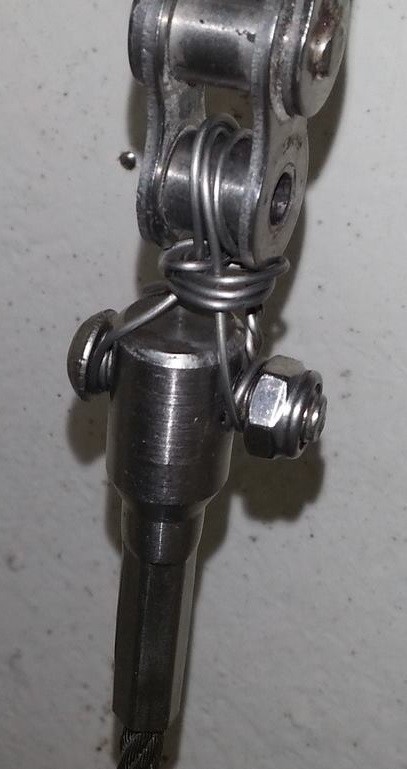
      The end fitting that connects the steering chain to the steering cable just "unexpectedly" broke. The picture reveals it broke on the end with the circ-clip, but it was the solid link that broke off – see red circle in picture above.  The picture above also reveals the chain has significant indications of corrosion – see brownish spots and red arrows. Interesting, the picture also reveals a chain lacking any evidence of the required lubrication.

      The temporary solution was innovative – just as the above use of Dyneema rope – until a compatible replacement link was obtained from a local motorcycle shop.

        Update: It happens again with tragic results - boat shipwrecked and total loss!

        February 2019 - Columbia. This time a boat with wheel and pedestal steering, that uses a chain-and-wire system, lost steering. It ran aground and was a total loss. See post here.


        Brass Oil Lamp

        Brass Oil Lamp


        • ActionTo Do List item A0222 – Polish oil lamp and obtain fuel oil and wicks.
        • Completed: 19 October 2017
        • Cost: $26.48


        Mounted on Indra's dinette forward bulkhead wall was a gimbal brass oil lamp with smoke bell.  It had a vintage appearance as it was extremely tarnished.

        Was not able to determine the make or manufacture of the oil lamp as no markings were visible on it.  Research on the internet revealed it was similar to a Weems & Plath #718 Brass Atlantic Gimbal Lamp with Smoke Bell that listed for $165.99 (no longer produced).  We added lamp fuel oil and wicks to items to be ordered and a clean and polish to the To Do List.

        We removed the lamp, smoke bell, and mounting fixtures for cleaning.  The lamp was disassembled and cleaned-out about two ounces of old congealed fuel from the fuel reservoir.  Used some metal polish cleaner ($2.00) and it quickly revealed the shinny brass layer underneath the oxidized tarnish.

        With a little more rubbing and polishing the lamp was looking as good as new!

        Installed a new wick ($8.49) and added some Weems & Plath Liquid Paraffin Lamp Fuel ($15.99).  Reassembled the lamp and mounted it back on the dinette forward bulkhead wall.  It lighted successfully and the fuel oil proved to be virtually smokeless as claimed.

        Prefer the shinny brass appearance versus the tarnished vintage look, now to keep it that way through routine clean-ups.

        Added to the To Do List:

        • A0222 – Polish oil lamp and obtain fuel oil and wicks.