
While scanning the internet sailing blog sites, my interest was aroused when one of the articles stated "lost our steering". The story in short: a link of chain broke (see illustration below) in their steering system due to stainless steel crevice corrosion. It was temporarily repaired by splicing a length of Dyneema rope to the last chain link and using the Dyneema rope to replace the entire length of wire steering cable back to the quadrant.

The readers comments to their post were the typical accolades and admiration of their heroic resourcefulness and skill. They stated they had inspected the chain about a year earlier, under magnification, and it appeared serviceable. They also referenced another loss of steering failure four years earlier that was caused by an eye bolt that sheered in half (see illustration below) that attaches the wire cable to the steering quadrant - they temporarily fixed this with a loop of Dyneema and at a later date replaced the broken eye bolt. Other pertinent items: Steering system manufacture is not identified. Boat was built in 1982 and ownership began around mid 2007. Boat has principally been located/operated in tropical/equatorial zones. Crew experience level rated high based on ten-plus years actively sailing/full time live-a-boards, soon to claim title as circumnavigators, and are published authors.

What was not covered in the article was what could have been done to prevent the loss of steering failure, if anything.
This is probably the most relevant piece of information missing from so many sailing blog failure-type of stories I have read - the real root cause of failure and the lesson to be learned. Sometimes the truth of this revelation is humbling and therefore not freely disclosed - just as the name of this boat and crew are purposely not disclosed because it is not important, the lesson is.
As our boat has tiller steering (very simple and reliable), I am therefore definitely not an expert on wire and chain steering systems. However, I believe nothing is really complicated and anyone can read and comprehend manufacture's literature on any subject matter. In this case as the steering manufacture was not disclosed, I reviewed the steering system information located on Edson Marine website: EB381 - Edson Chain & Wire Steering System Planning, Installation and Maintenance Guide and EB372 - Edson Chain & Wire Rope Steering Inspection Checklist (PDF). The information provided by Edson Marine is very comprehensive and detailed. Also performed some internet searches and discovered loss of steering on chain and wire systems was not uncommon and a temporary fix with a length of rope or wire was utilized in most cases.
An article by Don Casey summarized the most likely cause of this loss of steering failure, “..... a chain-and-wire system will not tolerate indifferent maintenance, and if it’s not properly maintained, it will fail suddenly and completely. The only thing you won’t know is when that will happen." As a previous dirt-bike motorcycle owner, I am familiar with the requirements of chain cleaning, lubrication, and maintenance. So based on this research, the initial assumption as to the cause of this failure is the lack of proper maintenance, but what specific actions could have prevented this failure?
First, a look at the broken chain. The red arrows in the picture below show where three different chain link plates broke directly in the area of a chain pin. The probability that all three chain link plates broke simultaneously is low (due to different elongation of the link plate pin holes) and it is likely they broke separately over a unknown period of time. With the picture zoomed in close, the surfaces of the chain link plates reveals discoloration (reddish brown spots) indicating the presence of rust/corrosion. The yellow arrows point out areas with black grime indicating the chain is dirty; it is in need of cleaning.

One of the first things I usually want to know, is there a replacement interval recommended by the manufacture?
Edson Marine recommends the steering chain and wire assembly be replaced every 5 to 7 years; and replaced more frequently if in tropical/equatorial zones. This recommendation is very similar to the standing rigging replacement recommendations in tropical environments, so it is not unreasonable and unfounded. Edson Marine offers complete chain and wire assembly kits that if used, replace not only the chain and wire, but all the interconnecting hardware - this is prudent as all the items in this assembly are subjected to the same stresses and environmental conditions.
The loss of steering blog site article does not reveal if the steering chain and wire assembly was replaced as recommended by the manufacture. However, it did referenced another loss of steering failure four years earlier that was caused by an eye bolt that sheered in half and they indicated they replaced "only" the sheered eye bolt. It was also not disclosed if the eye bolt sheered in half due to corrosion, but it is a reasonable possibility. Per articles on their blog site, their boat has principally been cruising the tropical zones which should have resulted in the consideration of a more frequent replacement and inspection interval. Regretfully with the scant information provided, this leads to the assumption that it is most likely that the steering chain and wire assembly was installed as part of the original boat construction in 1982, 36 years past. This assumption is not without merit, as many cost-conscious cruisers foster the common attitude, "if it is not broke, don't fix it", in lieu of sound preventive maintenance practices. Ironically, sound preventive maintenance practices tend to be cheaper in the long run and result in less dramatic and catastrophic failures.
Knowledge of this replacement interval should result in additional considerations:
- You should know the date of installation of the existing system/parts and forecast a scheduled date of replacement. Document this in writing on a tracking list that makes sense to you.
- You should have a copy of all available manufacture's documentation, manuals, drawings, etc., pertaining to this system and associated parts.
- You should determine and document the part number(s), cost, and a supplier of the replacement assembly/parts.
- You should decide if this item should be included in your spares kit. On a multi-year round the world voyage such as this boat was on, this item probably should have been included in the spares kit.
One of the next things I usually want to know, what is the recommended inspection interval and criteria?
Per excerpts from Edson Marine documentation the inspection interval should be:
".... it is important that all boats fitted with Edson Steering Systems get an annual inspection of the critical system parts and that routine maintenance guidelines are followed."
"Make note of your inspection date and schedule your next inspection. Once to twice a season is a bare minimum - racing boats and heavily sailed cruising boats should consider more frequent inspections. An aggressive maintenance schedule needs to be followed if sailing in the Caribbean or other equatorial level locations."
"CAUTION: When the equipment is in the tropics or in charter service, the maintenance schedule must be speeded up."
"CAUTION: On extended voyages your steering system should be inspected each day and lubricated weekly. Carefully inspect your steering system at least once a week before a vacation cruise to avoid last minute maintenance."
Per excerpts from Edson Marine documentation the inspection criteria for the chain should be:
- You should document, track, and forecast the inspection interval on a list that makes sense to you.
One of the other things I usually want to know, what is the maintenance requirements?
Edson Marine provides a very comprehensive Steering Inspection Checklist that details what to look for and what specific maintenance action to perform for the entire system. As for chain maintenance requirements, it is actually very simple: clean it, inspect it, lubricate it, and verify proper tension.
The importance of cleaning the chain should not be under estimated. A complete and thorough cleaning removes the build up of old gummy oil and dirt that provides a surface for corrosive particles to accumulate, accelerating corrosion. A clean chain allows the oil lubricant to penetrate easier into the chain rollers and bushings, retarding corrosion. Based on my prior experience with dirt-bike motorcycles, to properly clean a chain it would require it's removal so it could be immersed it in a cleaning solvent bath to loosen up the grunge. Scrubbing with a stiff bristle brush would aide the removal of stubborn grime. Bathe, scrub, rinse, and repeat until spotless. After allowing the cleaning solvent to dry off/disperse, then soak (completely immerse) the chain in a container with 30 weight oil - this is the only sure way to get oil into all the crevices between the pins, rollers, and bushings. Suspend the chain above the oil container and allow the excess oil to drip off. Next, it is ready to be reinstalled. This entire process should take less than 10-15 minutes to complete; oh, my error - it is a boat - multiple time estimate by 3 or 4.
The picture above showing the broken chain reveals a significant accumulation of black grime indicating the chain had not been properly cleaned. With the picture zoomed in close, was unable to detect the glisten/shine of the presence of oil - the black grime areas also appear to be almost dry. Its is reasonable to conclude this chain needs to be cleaned and lubricated.
Knowledge of the recommended maintenance requirements should result in additional considerations:
- You should compile a list of "all" items necessary to perform the required recommended maintenance and maintain an adequate stock level aboard.
- You should determine what additional miscellaneous pieces of hardware should be carried aboard. Stripped screw head, dropped bolt/nut, lost chain spring clip, etc. are a few potential candidates.
So what was the most likely root cause of failure and the lesson to be learned?
Based on the limited information provided and pictorial evidence, it appears the failure can be reasonably attributed to non-compliance with manufacture's maintenance recommendations. Both the broken chain and sheered eye bolt most likely occurred due to the effects of corrosion. Replacement of the steering chain and wire assembly in a time frame of less than five years due to operation in a tropical environment as stipulated by the manufacture would have significantly reduced the possibility of this type of failure occurring. Additionally, adherence to the manufacture's inspection and maintenance requirements for tropical environments and extended voyages, should have resulted in early detection of any degradation and enabled the appropriate repair action, eliminating almost to zero any chance of these failures occurring. The probability that the rest of their steering system maintenance requirements has been neglected is most likely - time will tell.
Lesson: Read and follow all manufacture's recommendations. Convert the recommendations to actionable lists: replacement date, inspection dates, parts list, consumable lists, pre-departure inspection checklist, etc. Do this for each and every item aboard, and your more likely to have less drama and more enjoyment aboard.
Note: As we were genuinely concerned we posted a comment to their article. Was not surprised that our comment to their article was not well received and we were deemed “ignorant”. What surprised us was the disdain stated about “preventative maintenance”; but that professed attitude was the likely cause of the lack of steering system “preventative maintenance” that resulted in the failure jeopardizing his boat – but each is the captain of their own ship. Our further response resulted in no further discussions as shown below:

- The SailFeed article that this post is based on was published at https://www.sailfeed.com/2018/02/suddenly-without-steering-in-the-caribbean-sea/ but has since been deleted. The original story can be read here.
Update - Saw a Facebook and website post, November 21, 2018, where they announced that the failed chain was finally replaced and they inspected and replaced steerage pins and bearings after 36 years of use – confirmation that manufacture and maintenance recommendations were not adhered to – really no "big deal' as they “only” experienced two dramatic steerage breakdowns. Interesting, they retained the use of the Dyneema rope and original wire sheaves, despite the differences in a rope sheave (full groove) and a wire sheave (v-groove) and its implications.
Update - November 1, 2021 – article in Cruising World, “Safety at Sea: Mental Preparations Contribute to Positive Outcomes”. Of interest was the statement, “The weak link in the steering chain was a fault I could’ve caught in a steering inspection done about six months earlier. Corrosion was hidden under the master link plate. I missed it, but it sure was obvious when busted. Try as we might to avoid it, unpredictability is a feature of cruising. Training up is the answer.” "Training up" is NOT the answer but adherence to a proper inspection interval and parts replacement regime as specified by the manufacture and sound common sense prudence.
The author had previously stated in their Sail magazine SailFeed article and website post “Jamie inspected the system just a year ago (with 7x magnifying glass), but as is often the case with stainless steel, you cannot see all of the surfaces where a sign of pending doom may lurk.” Amazing how the inspection interval has deceptively changed from originally "a year ago" to now "six months earlier". The only solid truth here is the inspection interval was deficient and non-compliant to manufacture's recommendation. Sadly and very dishonestly, a comment pointing out this blatant mistruth with references was posted to the article in Cruising World was deleted and ALL future comments to this article was closed off. Their article mentioned on their Facebook feed garnered accolades from their uniformed readership. Another opportunity to pass on sound sailing inspection practices and part replacement strategies was missed again due to blatant dishonesty. It is a sad state of affairs when so many accept stories at face value and are unable to discern the real truth, but that is the modern world of deceptions and lies.
Update: It happens again!
July 2018 - Philippines. And it happens again; this time not as dramatic as the boat was at anchor – these folks were extremely “lucky”. As this boat has extended time in the tropics, was the recommended inspections and maintenance performed – the picture and the incident provide the answer.

The end fitting that connects the steering chain to the steering cable just "unexpectedly" broke. The picture reveals it broke on the end with the circ-clip, but it was the solid link that broke off – see red circle in picture above. The picture above also reveals the chain has significant indications of corrosion – see brownish spots and red arrows. Interesting, the picture also reveals a chain lacking any evidence of the required lubrication.
The temporary solution was innovative – just as the above use of Dyneema rope – until a compatible replacement link was obtained from a local motorcycle shop.
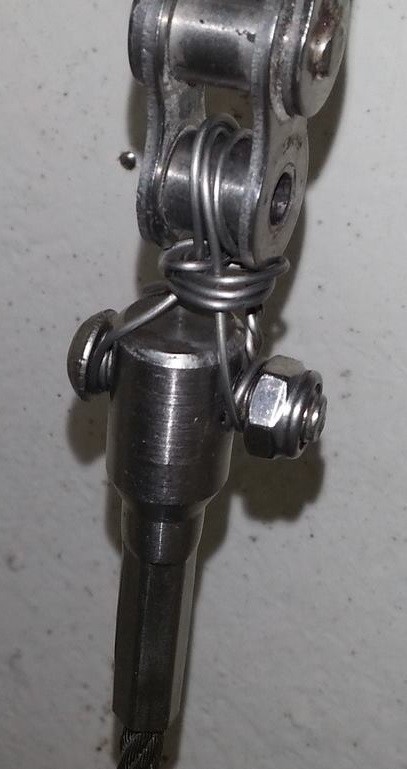
Update: It happens again with tragic results - boat shipwrecked and total loss!
February 2019 - Columbia. This time a boat with wheel and pedestal steering, that uses a chain-and-wire system, lost steering. It ran aground and was a total loss. See post here.