LPG Tank Mount Modification

LPG Tank Mount Modification

  • Action: To Do List item A0211 - Modify existing LPG tank strap/mount installation to support a tank with a 298mm or 11.73 inch diameter.
  • Completed:  24 November 2017
  • Cost: $23.00


A side-by-side comparison of the new Alucyl 10KG LPG tank and the old LPG tank showed they were very similar, but the new tank was slightly larger and taller. 

    We hired two Filipino workers to grind/cut the stainless steel tank restraining band off the vertical stainless steel tube.  They also ground down the stainless steel base mount to fit inside the new LPG tank's bottom cavity.  The restraining band and a new tank was taken to their shop where they modified the strap to fit the larger diameter of the new tank.  They returned the next day with their welding equipment and reattached the tank restraining band on the vertical stainless steel tube.  They then used their grinders with buffing pads and paste to polish up the metal.  The cost for time and materials was 1,150.00 pesos (US $23.00).


      Fit check of the new LPG tanks revealed no issues and the tank restraining bands firmly secured them in place.


      Engine Seawater Anti Syphon Loop

      Engine Seawater Anti Syphon Loop

      • Action: To Do List item A0135 - Replace all engine seawater coolant anti syphon loop T connection plastic components with marine rated components.
      • Action: To Do List item A0136 - Replace all engine seawater coolant anti syphon loop hoses and clamps.
      • Completed:  22 November 2017
      • Cost: $205.52


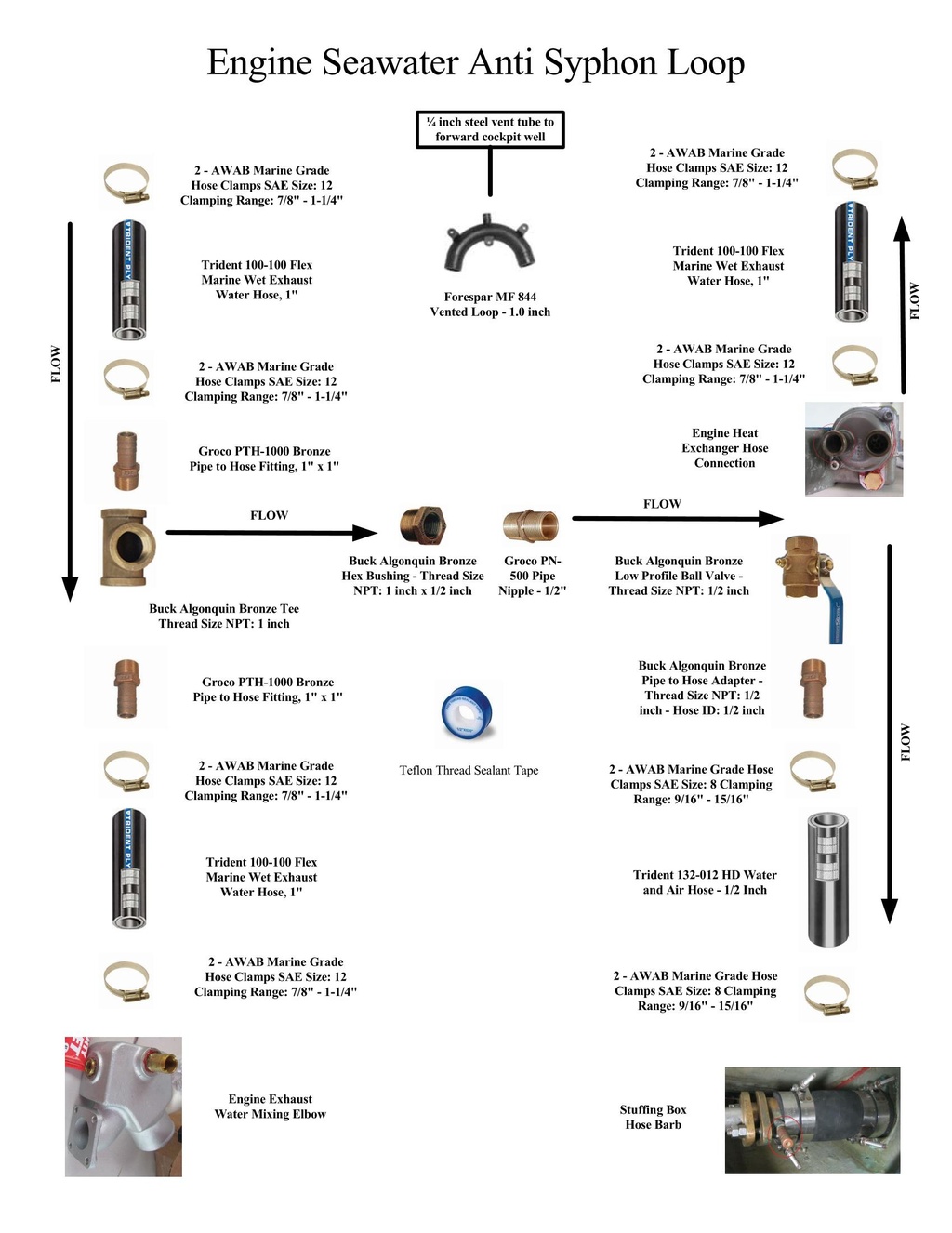
      A pictorial diagram depicting the complete new system installed was created to identify and illustrated the parts and material needed.

      The following items were ordered and received by ocean freight shipment.


      P/N Item Q Each Total
      PTH-1000 Bronze Pipe to Hose Fitting, 1" x 1" 2 $7.64 $15.28
      00106100T Buck Algonquin Bronze Tee Thread Size NPT: 1 inch 1 $18.99 $18.99
      00BBV50LP Buck Algonquin Bronze Low Profile Ball Valve - Thread Size NPT: 1/2 inch 1 $15.99 $15.99
      00HN50 Buck Algonquin Bronze Pipe to Hose Adapter - Thread Size NPT: 1/2 inch - Hose ID: 1/2 inch 1 $7.99 $7.99
      00114100050 Buck Algonquin Bronze Hex Bushing - Thread Size NPT: 1 inch x 1/2 inch 1 $6.99 $6.99
      PN-500 Groco PN-Series Pipe Nipples - 1/2" 1 $6.49 $6.49
      100-100 Trident Engine Intake Water & Heater Hose - 1 Inch 10 $7.19 $71.90
      132-012 Trident HD Water and Air Hose - 1/2 Inch 10 $1.88 $18.80
      316024 AWAB Marine Grade Hose Clamps SAE Size: 8 Clamping Range: 9/16" - 15/16" 4 $2.33 $9.32
      316032 AWAB Marine Grade Smooth Band Hose Clamp Band Width: 1/2", Clamping Range: 7/8" - 1-1/4" SAE size 12 12 $2.59 $31.08
      S520 Teflon Thread Sealant Tape 1 $2.69 $2.69
              $205.52


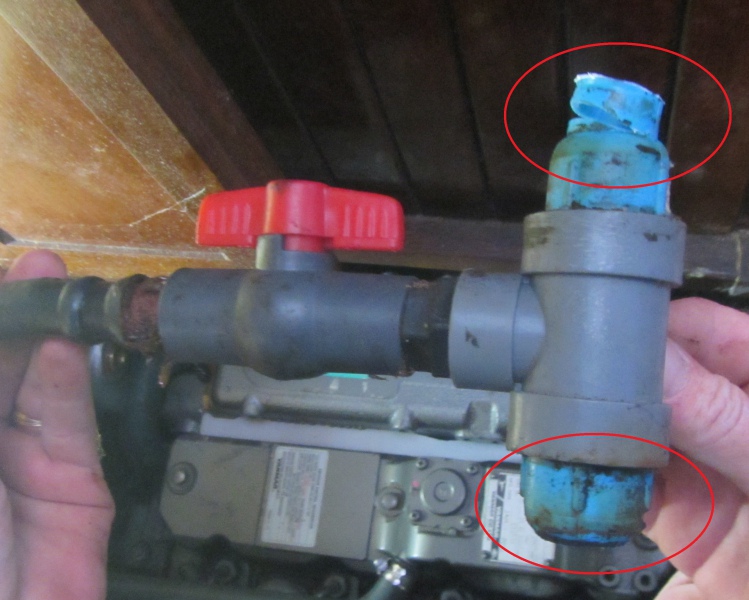
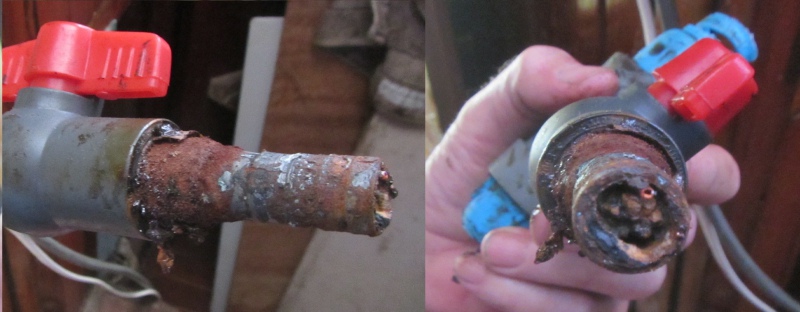
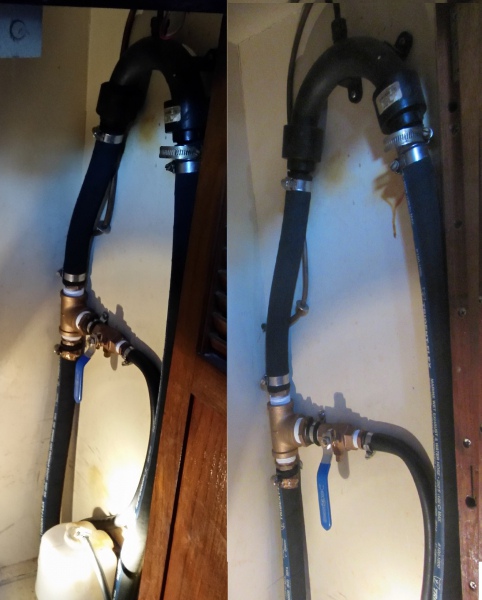
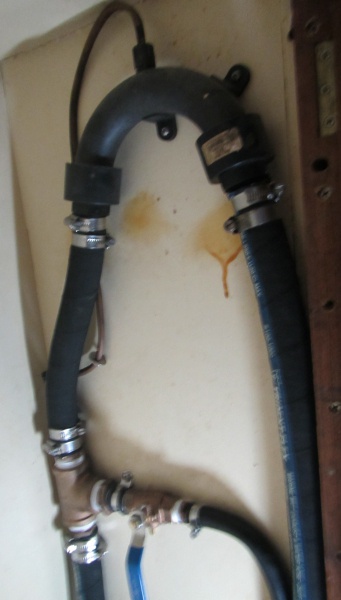
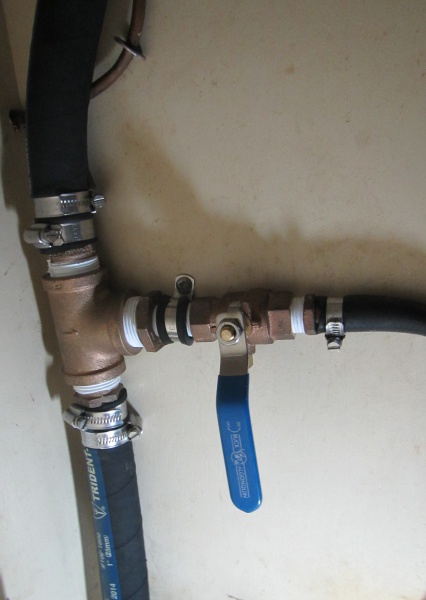
      As the pictures below depict: The existing plastic engine seawater coolant anti syphon loop T connection was removed and discovered that not only was the bottom plastic hose barb broken, the top plastic hose barb was also broken.  Also discovered that the outlet hose barb that is suppose to route water to the stuffing box to lubricate the packing gland was completely blocked with what appeared to be rusted metal flakes and other unknown material - whatever it was, it was concrete-like-hard and was not able to be removed.  Might explain why the stuffing box packing glands were found to be burnt black and glass-like hard.

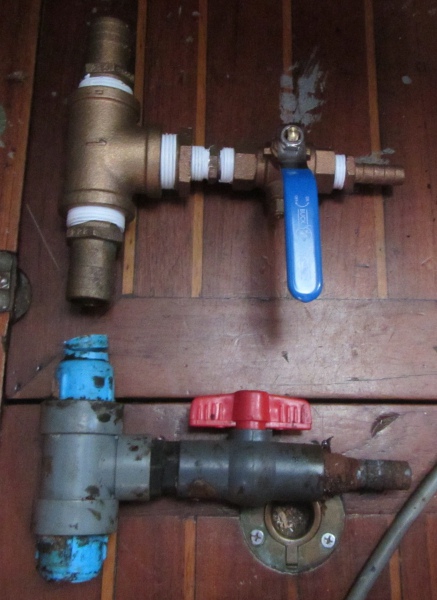
      The new bronze anti syphon loop T connection is shown with the original broken plastic anti syphon loop T connection for comparison.  The new components and hoses were installed as depicted in the above diagram.  Additional holes were cut in the wood floor to accommodate the new hoses and not violate the hose bend radius.  A steel rubber cushioned clamp was placed around the bronze pipe nipple on the new T connection and secured with a screw to the side wall.  The 1/2-inch outlet hose was connected to the stuffing box hose barb and secured with two clamps.

      Exhaust Discharge Fitting

      Exhaust Discharge Fitting

      • Action: To Do List item A0086 - Replace exhaust discharge connection with a exhaust discharge fitting equipped with a flapper valve.
      • Completed:  17 November 2017
      • Cost: $80.64


      The existing Vetus model TRC75 3-inch steel transom exhaust connection was removed and it's hull hole closed out.  A 3-inch Centek Thru Hull Exhaust Fitting ($58.49) was ordered and received. This fitting has a weighted rubber flap that helps to prevent the backflow of water.

      The new Vetus NLPG Gooseneck Muffler was connected to the 3-inch engine exhaust hose to test fit the installation and determine where the new exhaust fitting hole would need to be drilled.  A 3 1/8-inch hole and four mount bolt holes was drilled in the aft port side hull.

      The new Centek exhaust fitting was installed and sealed in place with a tube of 3M 4200 Marine Adhesive ($22.15).

      After the sealant had cured, the excess sealant was trimmed off with a razor blade.

      Solar Controller Rewire

      Solar Controller Rewire

      • Action: To Do List item A0193 - Install proper gauged wire with fuse protection for solar controller output.
      • Completed: 14 November 2017
      • Cost: $126.46


      Downloaded and reviewed the ProStar solar controller Installation, Operation, and Maintenance Manual from the Morningstar website.  In the manual it essentially did not recommend the ProStar 15 solar controller for use in a marine environment: Paragraph 6.1, "The ProStar uses stainless steel fasteners, an anodized heat sink, and conformal coating to protect from harsh conditions. However, for acceptable service life extreme temperatures and marine environments should be avoided."

      The ProStar PS-15 solar controller installed uses a technique called Pulse Width Modulation (PWM) to convert solar energy to 12-volts.  More efficient and generally with higher output of 10-15 percent, is a MPPT (Maximum Power Point Tracking) solar charge controllers.  As the installed ProStar PS-15 solar controller was maxed out with the existing solar panels, any increase in solar capability would result in its deletion and replacement.  Many factors and options to consider.  As a desired improvement added to the To Do List item B0288, Upgrade solar output, replace and/or add additional solar panels/controllers.

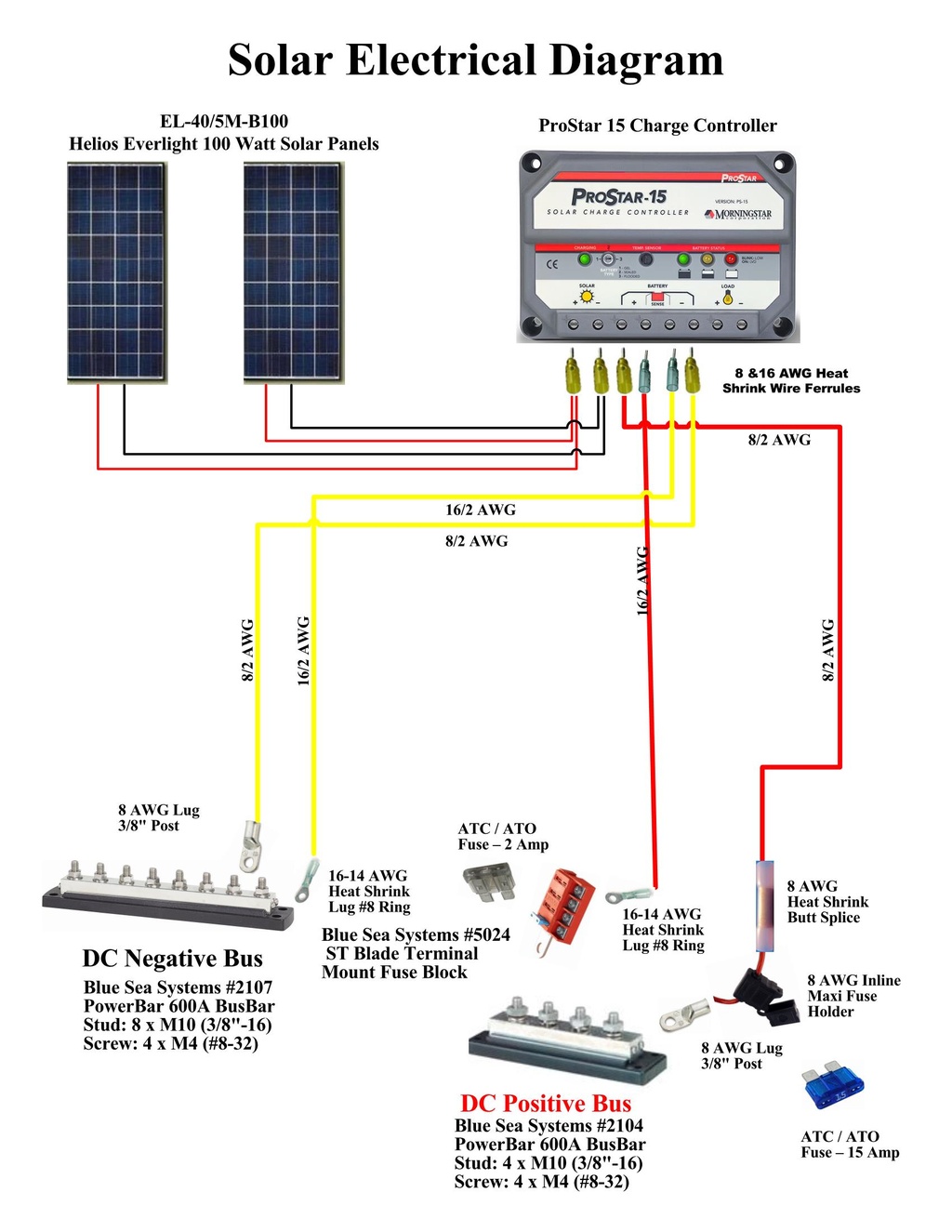
      Based on the approximate distance between the battery and solar controller wire run being less than 15 feet in one direction, used the 3% Critical Voltage Drop Wire Size table to determine 8 AWG wire size should be adequate for the 15 amp power output.  This 8 AWG wire has a conductor circular mil (cm) rating of 16,510, and will replace the two existing under-sized paralleled 12 AWG wires with a total conductor circular mil (cm) rating of 13,060 (6,530cm each).  The solar controller manual also recommended voltage sense wires to be installed, selected 16 AWG wiring to replace the existing non-marine rated wires.

      The solar controller manual stated: "WARNING: Solar and battery fuses or DC breakers are required in the system. These protection devices are external to the Prostar PWM controller, and must be a maximum of 18 amps for the PS-PWM-15/M."  As the existing installation did not have any fuse protection installed, this would also need to be corrected.

      Selected a 15 amp fuse for the power wire and a 2 amp fuse for the voltage sense wires.  The picture below depicts the solar electrical system.

      The following components were ordered and received.

      P/N Item Q Each Total
      16/2 AWG Duplex Tinned Marine Wire - 100 Feet Roll used 20 feet 1 $33.50 $6.70
      8/2 AWG Duplex Tinned Marine Wire 20 $2.10 $42.00
      5024 ST Blade Battery Terminal Mount Fuse Block Kit 1 $28.31 $28.31
      8 GAUGE INLINE MAXI FUSE HOLDER WITH 40 AMP FUSE WITH COVER 1 $5.95 $5.95
      BT-8-HS Red 8 Gauge Heat Shrink Butt Connectors 10 pieces. 1 $18.50 $18.50
      TOTAL $101.46

      Miscellaneous materiel; splices, lugs, heat shrink tubing, fuses, ferrules, and tie straps added about $25.00 in additional cost.


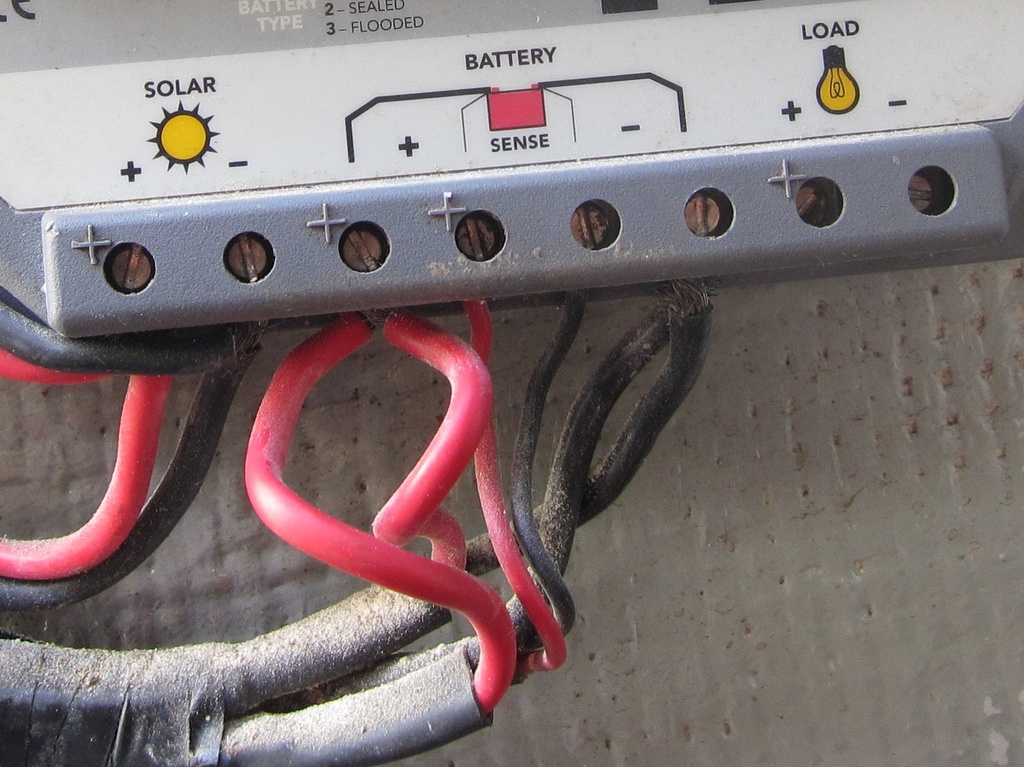
      The wires at the solar controller terminals had many broken strands and were pulling out as the exposed wire ends in the picture below reveals.  The solar controller manual stated: "Stranded wires to be connected to the ProStar terminals should be prepared first with e.g. clamped copper heads, etc. to avoid the possibility of one conductor free out of the connection screw, and possible contact with the metal enclosure."  The meaning of "clamped copper heads" is probably not very descriptive or known to most.  ABYC standard E-11 states: 11.14.3.5 - Connections may be made using a set-screw pressure type conductor connector, providing a means is used to prevent the set-screw from bearing directly on the conductor strands.  The use of wire ferrules, also called pin terminals, would correct these issues.

      Numerous cable tie-straps were cut and removed to free these wires that ran from the solar controller to the batteries.  During removal of these wires, discovered another hidden from sight issue.  These wires should have been an unbroken continuous run to minimize resistance, but there were five inline butt splices on each wire connecting different wire segments together.  On a critical voltage drop circuit as this is, where resistance is suppose to be minimized, each wire butt splice connection increases the overall resistance of the circuit.  As the wire had no identification printed on the insulation,  it was also not marine rated wiring.  It was prudent to replace this wiring for many reasons.  The picture below shows the solar controller with the new 8/2 and 16/2 AWG sheathed duplex marine rated wiring.

      Later, when the BEP Marine DC Meter was rewired, the observed solar output was 12-14 amps during the optimum part of the day.

      Rudder Repair

      Rudder Repair

      • Action: To Do List item A0225 - Repair damage areas on rudder; sand and apply epoxy resin coat.
      • Completed:  9 November 2017
      • Cost: $66.99


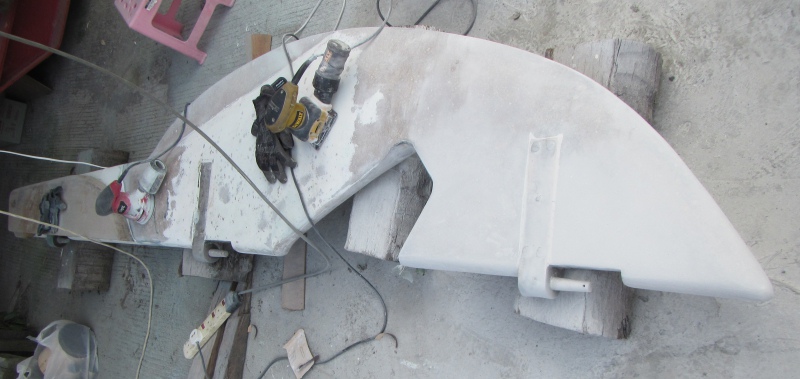
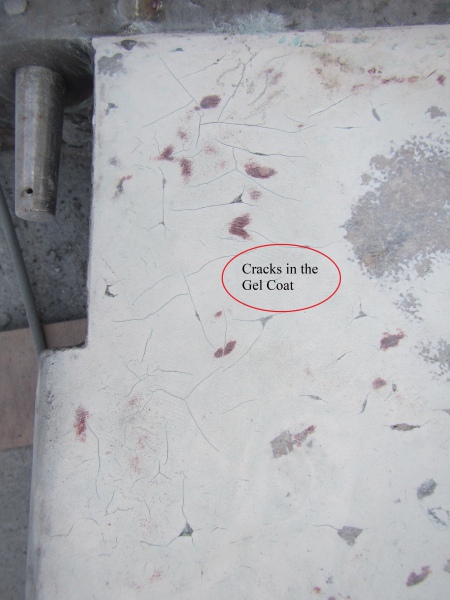
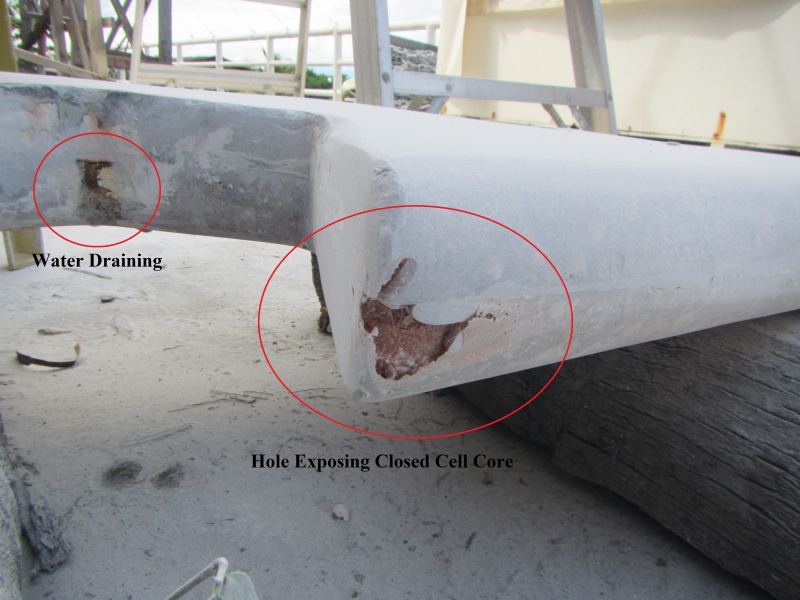
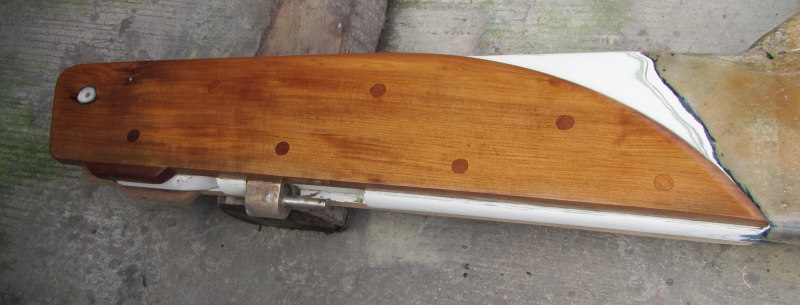
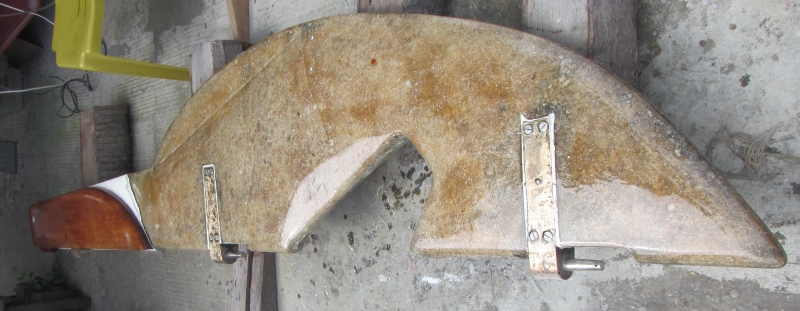
      The rudder was originally removed to enable the removal and replacement of the primary zinc mounted to the aft hull above the propeller.  Since the rudder was on the ground, supported with wood blocks, it was very convenient to sand, as one could sit in a chair while sanding.  As the multiple layers of paint came off, the base gel coat was exposed revealing numerous cracks in this layer.  It was decided to sand down to bare fiber glass.  With the paint removed, found a hole in the rudder exposing the closed cell foam inner core and allowing the intrusion of water inside the rudder.  As the rudder was built in two pieces sandwiched together, the removal of paint exposed this seam, and water was observed oozing out of the rudder.  Two 1/2-inch pilot holes were drilled through the rudder to aid in draining any internal residue water.  However, these holes were dry - the holes were latter closed out with epoxy mixed with silica.  The rudder hole was ground down with a grinder.  Then six layers of fiber glass cloth was layered over the area and epoxied in-place.  The rudder seam also had fiber glass cloth layered over it and epoxied.

      The upper portion of the rudder was made of wood and this was sanded bare removing all previous layers of varnish.  The holes through the wood for the tiller handle 1/2-inch mount bolt had approximately a 1/4-inch depression in the wood on both exterior sides caused by using too small of a washer under the mount bolt head and nut.  This area was sanded clean and then filled with epoxy thickened with silica to bring it back flush with the surface of the wood.  Then three layers of Interlux Schooner Gold Varnish ($41.99) was applied to the wood.  The bare rudder fiber glass surface had two layers of West System 105 Epoxy Resin with 206 Hardener applied as a base coat.  The cost for sand paper, brushes, fiber glass cloth, and epoxy resin is estimated at approximately $25.00.  The final painting and varnishing of the rudder will be accomplished after it is mounted back on the boat.

        The following video shows the mounting of the rudder.  The rudder, which weighs over 400 pounds, was hoisted up by rope run through a block.  Four Filipino workers assisted with the lift while I was up top to guide the upper pin into the gudgeon.

          The three pintle fittings on the rudder slide into gudgeons mounted on the aft hull of the boat.  Theses pintles have a large pin with a hole drilled through them where a cotter pin is inserted to prevent the rudder from lifting up and falling off.  The upper pintle pin had no cotter pin hole.  A cotter pin was installed on the middle and lower pintle pins.

          Battery Box

          Battery Box

          • Action: To Do List item A0214 - Clean, sand, and apply paint to starboard quarter birth area before battery installation.
          • Action: To Do List item A0215 - Apply coat of epoxy and paint to wooden battery box.
          • Action: To Do List item A0216 - Determine method to secure wooden battery box to boat structure.
          • Action: To Do List item A0217 - Determine method to secure engine start battery to boat structure.
          • Completed:  8 November 2017
          • Cost: $168.02


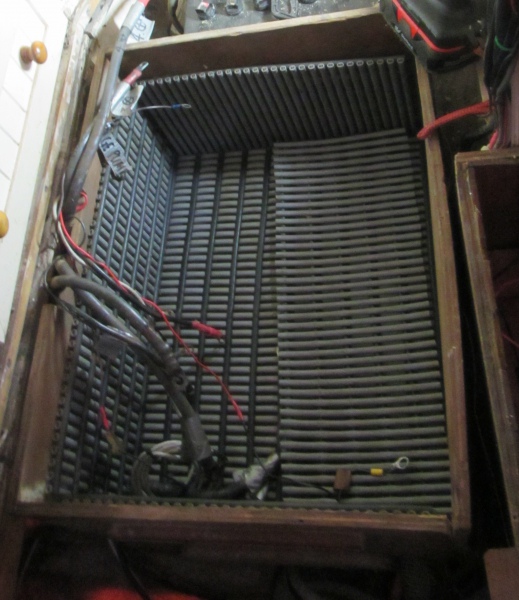
          Prior to installation of the battery box with new AGM batteries, the area below and around the battery box needed to be cleaned up.  To facilitate this, most of the cables and wiring were removed first.  Then the area was lighted sanded with 80 grit sand paper to loosen up years of layers of accumulated dirt/crud, which was then vacuumed clean.  The area was then wiped clean with rags soaked in isopropyl alcohol.  Additional wood supports were added and all exposed wood surfaces were coated with West System 105 Epoxy Resin with 206 Slow Hardener (~$25.00).

          With the area cleaned-up and prepared, it was painted with Interlux InterProtect HS Epoxy primer (~$20.00), which is also recommended as a bilge paint.  A hole was drilled in the low point of each section to allow a path for water to drain into the bilge.

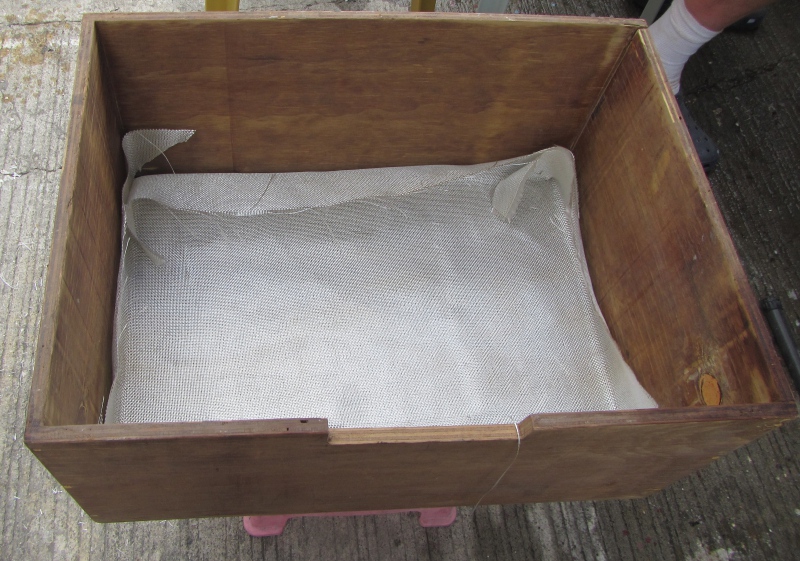
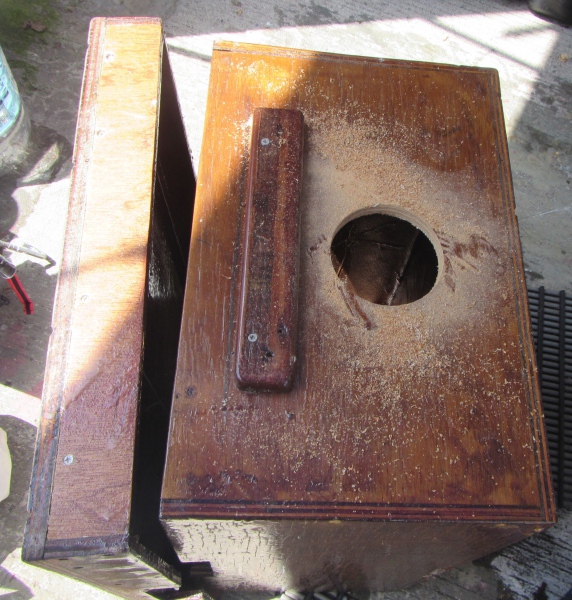
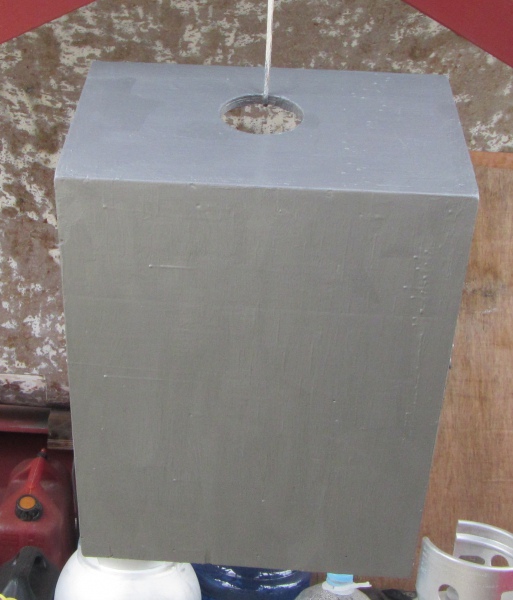
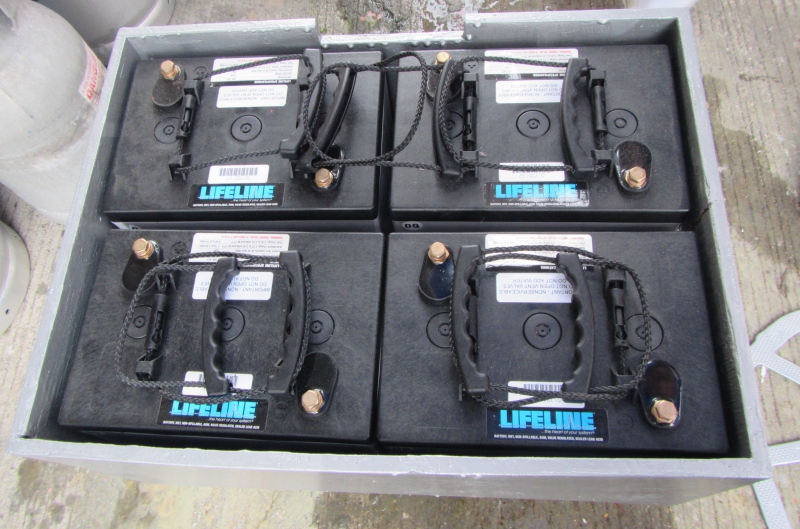
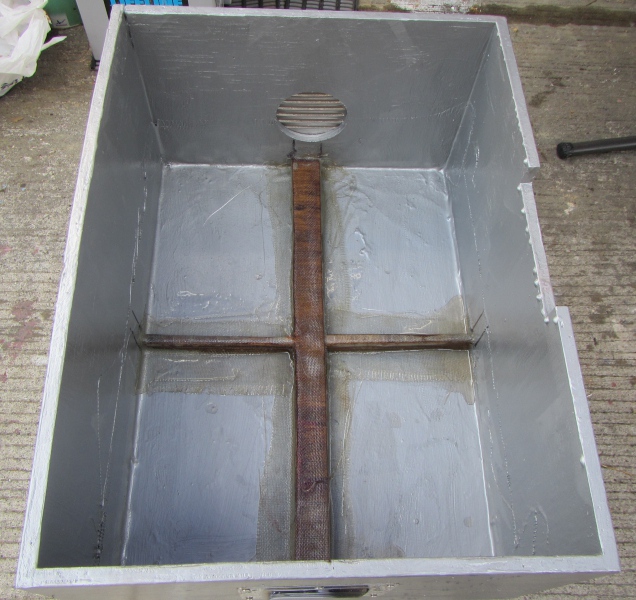
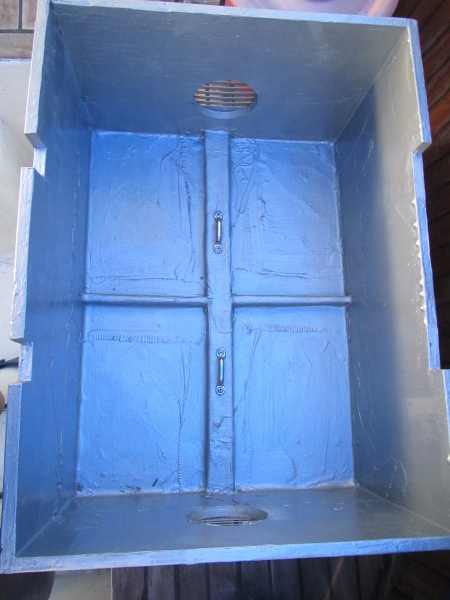
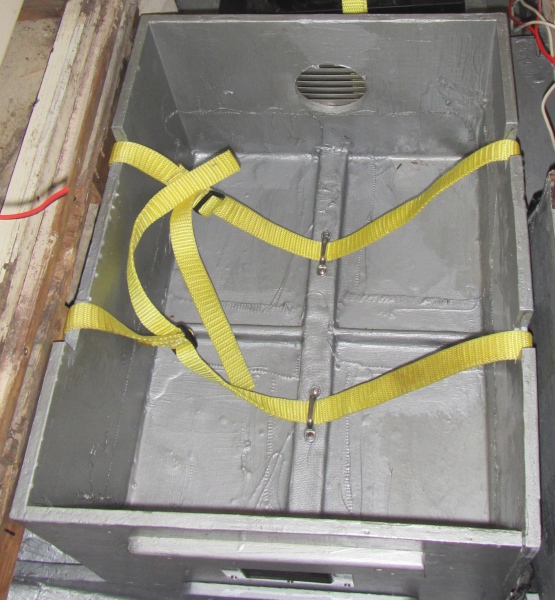
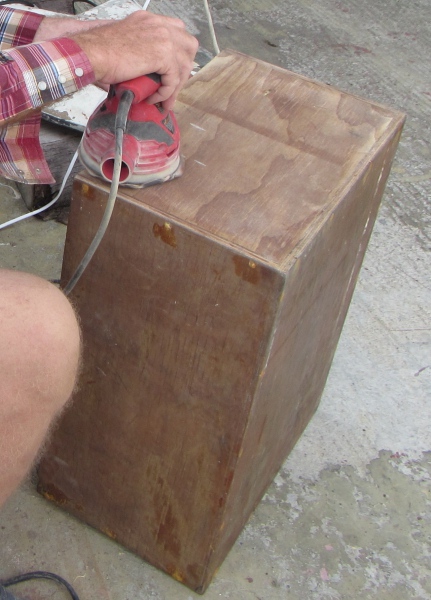
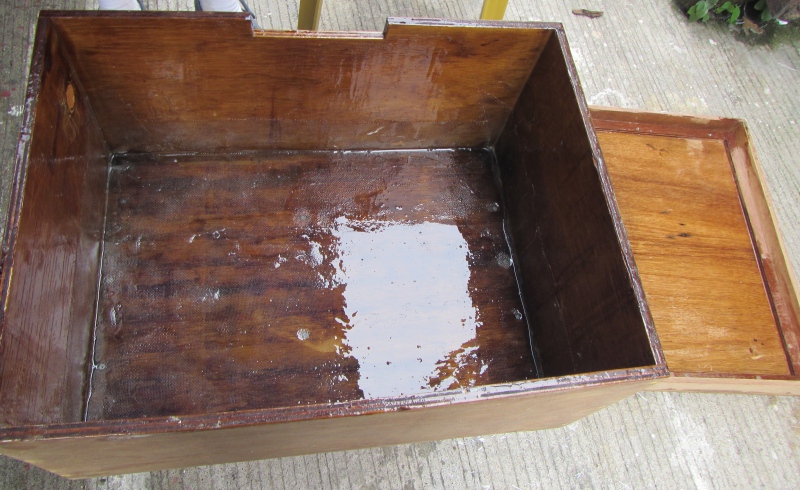
          As the pictures below depict:  The original battery box wood surfaces were not protected by a layer of paint, the batteries were not secured down, and there was no air ventilation path.  The battery box and cover lid were removed from the boat to work on.  All surfaces were sanded with 80 grit sand paper to remove traces of mold/mildew plus general dirt/crud.  The inside top of the battery box lid had excess contamination of black sulfur residue and had a distinct bad smell to it - this was a result of battery acid/fumes leaking from the defective GEL batteries.  After sanding, the wood surfaces were wiped clean with isopropyl alcohol.  A patch of fiber glass cloth (~$3.00) was cut to cover the bottom inside of the box and extend up the sides approximately three inches.  The cloth was then epoxied down and the entire box, inside and out, was coated with epoxy (~$10.00).  Three inch circular holes were drilled in the box for ventilation and the exposed wood was also coated in epoxy.  The box and it's lid was then painted with Interlux InterProtect HS Epoxy primer (~$10.00).  The new AGM batteries were placed in the box for a fit check, but it was discovered that they could shift position as there was additional free space around the base of them.  Wooden spacers were fabricated and secured in the bottom of the box with fiber glass cloth and epoxy.  Additional notches were cut on the top edge of the box to allow the use of web straps to secure the batteries. A final coat of Interlux InterProtect HS Epoxy primer paint (~$10.00) was applied.  Metal vents ($22.40) were installed over the 3-inch circular holes.  Two metal pad eyes ($11.56) were installed and adjustable belts (~$15.00) made of webbing rate at 7,000 pounds break strength were constructed.  The finished box was fit checked in the starboard quarter birth area.
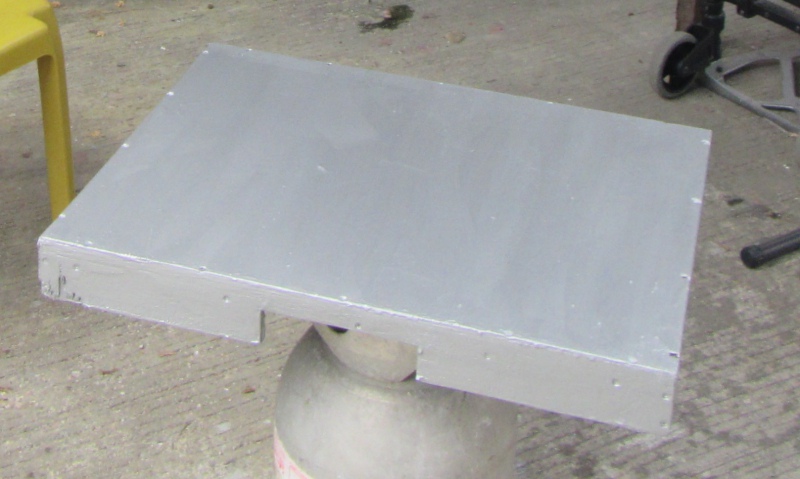
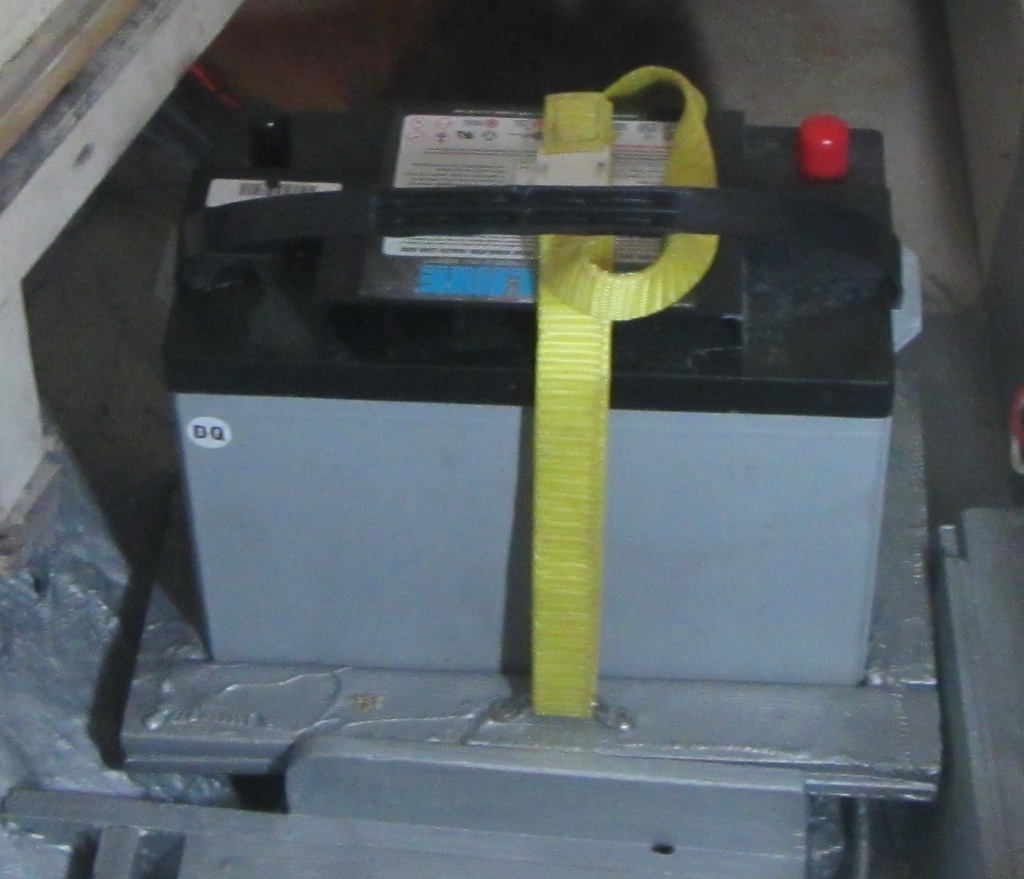
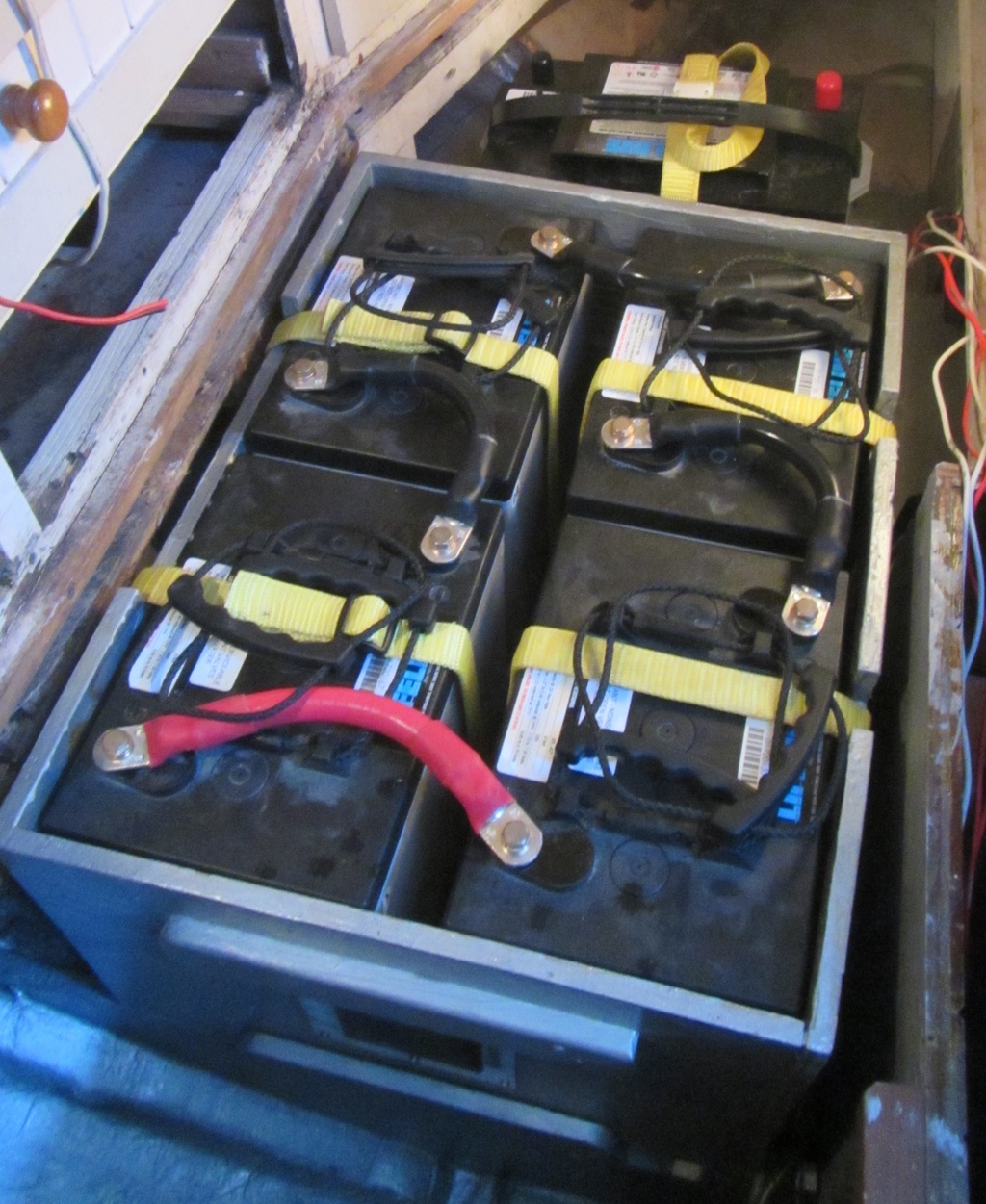
          To hold the engine start battery, a flat tray of wood was constructed, which was also epoxied and painted (~$10.00).  The wood tray was then secured to the wood supports underneath it with large lag screws. Pad eyes ($11.56) and web straps ($7.50) were installed to firmly secure the battery in-place to the wood tray.

          The battery box was also secured to the wood supports underneath it with large lag screws (~$12.00).  The new AGM batteries were installed and secured in-place with web straps.  The web straps were positioned to avoid covering any of the battery over-pressurization vent holes.