

- Action: To Do List item A0193 - Install proper gauged wire with fuse protection for solar controller output.
- Completed: 14 November 2017
- Cost: $126.46
Downloaded and reviewed the ProStar solar controller Installation, Operation, and Maintenance Manual from the Morningstar website. In the manual it essentially did not recommend the ProStar 15 solar controller for use in a marine environment: Paragraph 6.1, "The ProStar uses stainless steel fasteners, an anodized heat sink, and conformal coating to protect from harsh conditions. However, for acceptable service life extreme temperatures and marine environments should be avoided."
The ProStar PS-15 solar controller installed uses a technique called Pulse Width Modulation (PWM) to convert solar energy to 12-volts. More efficient and generally with higher output of 10-15 percent, is a MPPT (Maximum Power Point Tracking) solar charge controllers. As the installed ProStar PS-15 solar controller was maxed out with the existing solar panels, any increase in solar capability would result in its deletion and replacement. Many factors and options to consider. As a desired improvement added to the To Do List item B0288, Upgrade solar output, replace and/or add additional solar panels/controllers.
Based on the approximate distance between the battery and solar controller wire run being less than 15 feet in one direction, used the 3% Critical Voltage Drop Wire Size table to determine 8 AWG wire size should be adequate for the 15 amp power output. This 8 AWG wire has a conductor circular mil (cm) rating of 16,510, and will replace the two existing under-sized paralleled 12 AWG wires with a total conductor circular mil (cm) rating of 13,060 (6,530cm each). The solar controller manual also recommended voltage sense wires to be installed, selected 16 AWG wiring to replace the existing non-marine rated wires.
The solar controller manual stated: "WARNING: Solar and battery fuses or DC breakers are required in the system. These protection devices are external to the Prostar PWM controller, and must be a maximum of 18 amps for the PS-PWM-15/M." As the existing installation did not have any fuse protection installed, this would also need to be corrected.
Selected a 15 amp fuse for the power wire and a 2 amp fuse for the voltage sense wires. The picture below depicts the solar electrical system.
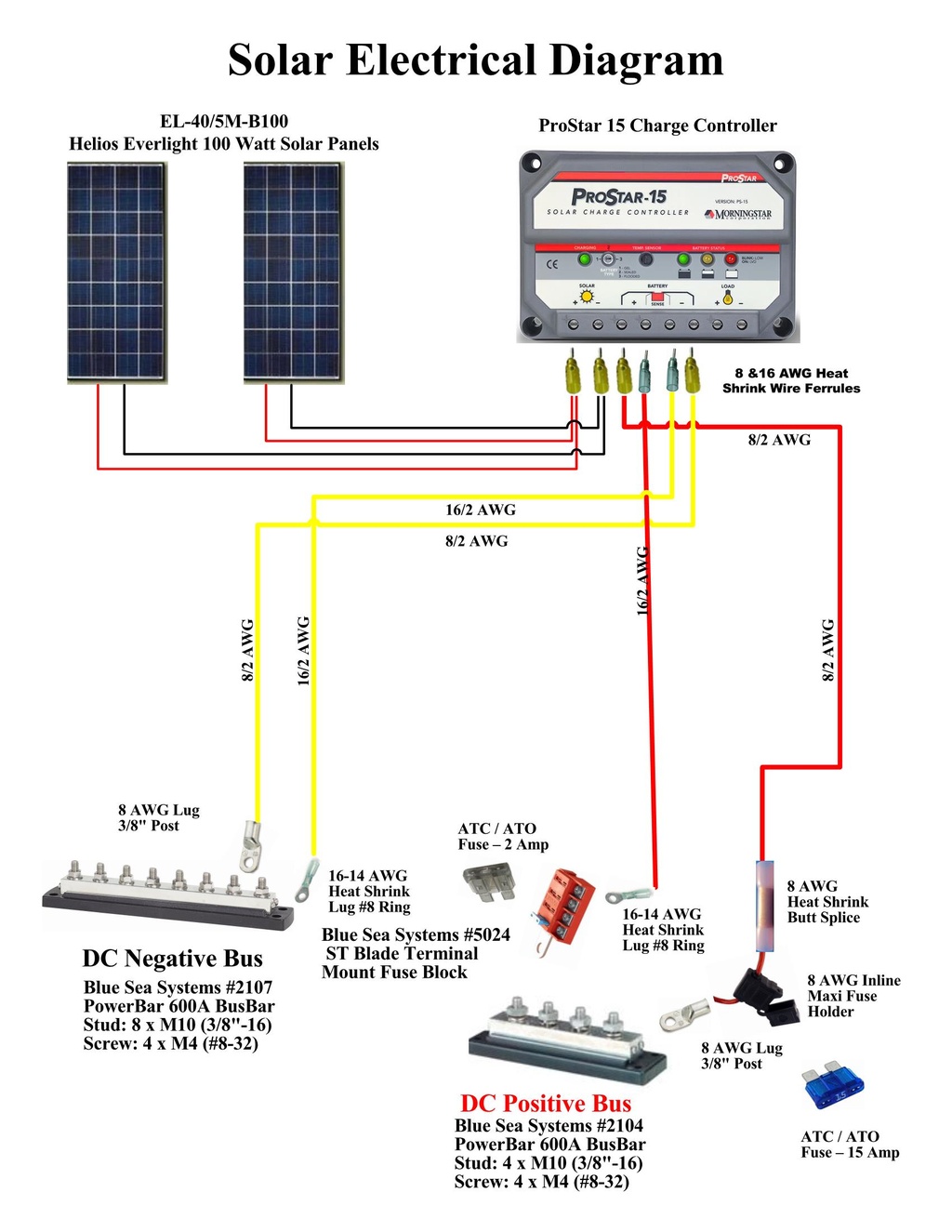
The following components were ordered and received.
| P/N | Item | Q | Each | Total |
| 16/2 AWG Duplex Tinned Marine Wire - 100 Feet Roll used 20 feet | 1 | $33.50 | $6.70 | |
| 8/2 AWG Duplex Tinned Marine Wire | 20 | $2.10 | $42.00 | |
| 5024 | ST Blade Battery Terminal Mount Fuse Block Kit | 1 | $28.31 | $28.31 |
| 8 GAUGE INLINE MAXI FUSE HOLDER WITH 40 AMP FUSE WITH COVER | 1 | $5.95 | $5.95 | |
| BT-8-HS | Red 8 Gauge Heat Shrink Butt Connectors 10 pieces. | 1 | $18.50 | $18.50 |
| TOTAL | $101.46 |
Miscellaneous materiel; splices, lugs, heat shrink tubing, fuses, ferrules, and tie straps added about $25.00 in additional cost.
The wires at the solar controller terminals had many broken strands and were pulling out as the exposed wire ends in the picture below reveals. The solar controller manual stated: "Stranded wires to be connected to the ProStar terminals should be prepared first with e.g. clamped copper heads, etc. to avoid the possibility of one conductor free out of the connection screw, and possible contact with the metal enclosure." The meaning of "clamped copper heads" is probably not very descriptive or known to most. ABYC standard E-11 states: 11.14.3.5 - Connections may be made using a set-screw pressure type conductor connector, providing a means is used to prevent the set-screw from bearing directly on the conductor strands. The use of wire ferrules, also called pin terminals, would correct these issues.
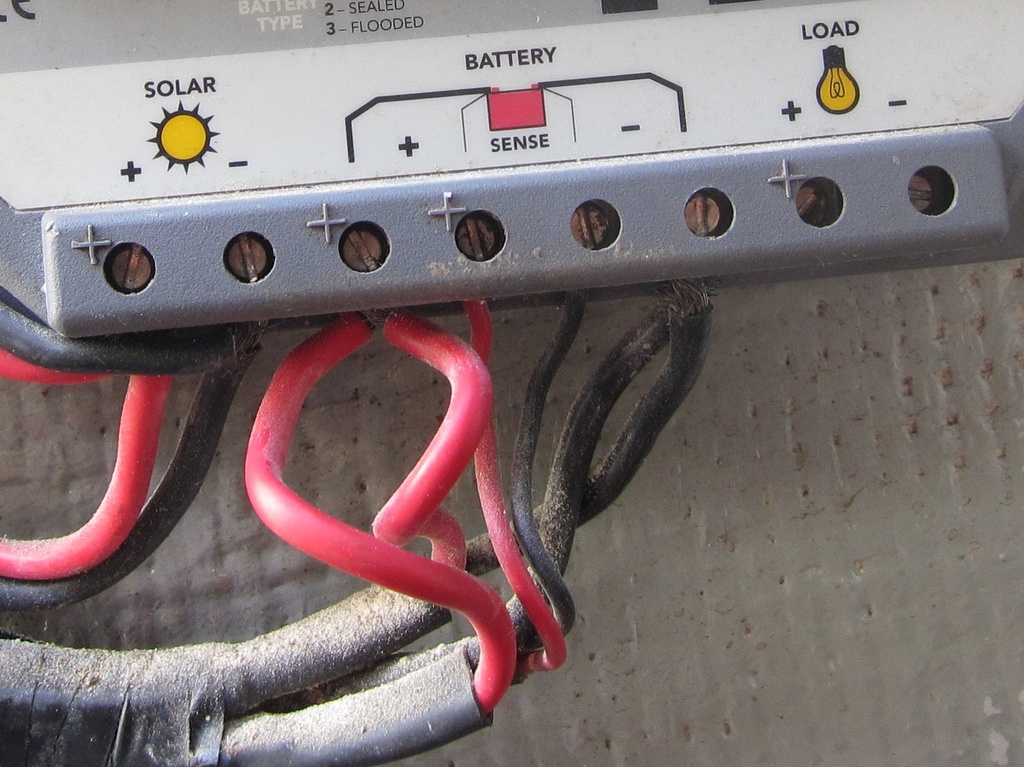
Numerous cable tie-straps were cut and removed to free these wires that ran from the solar controller to the batteries. During removal of these wires, discovered another hidden from sight issue. These wires should have been an unbroken continuous run to minimize resistance, but there were five inline butt splices on each wire connecting different wire segments together. On a critical voltage drop circuit as this is, where resistance is suppose to be minimized, each wire butt splice connection increases the overall resistance of the circuit. As the wire had no identification printed on the insulation, it was also not marine rated wiring. It was prudent to replace this wiring for many reasons. The picture below shows the solar controller with the new 8/2 and 16/2 AWG sheathed duplex marine rated wiring.

Later, when the BEP Marine DC Meter was rewired, the observed solar output was 12-14 amps during the optimum part of the day.