
Initial Inspection - Bottom/Hull
Under our simple inspection categories, Item #2 - Boat no sink, a full inspection of the bottom/hull was needed. Besides the state of the hull, bottom paint, and zincs, this also meant we would look at every item that penetrated the hull integrity - thru hulls, hardware, bolts, wiring, propeller shaft, etc. Additionally, the interior of the hull would be checked for any signs of water intrusions - the noticeable off colored streaks (rust or water stains, etc.) trailing down the interior hull from any hardware installation. We found a good source of general information and inspection categories to expand our own inspection criteria by reviewing the book "Inspecting the Aging Sailboat" by Don Casey.
Indra was pulled out of the water and had its bottom scrubbed on 16 September 2015 under the supervision of Kjartan Sekkingstad, manager of yard work at Oceanview Marina on Samal Island, Davao, Philippines. We arrived from Naga City, Cebu the morning of 21 September 2015 and met Kjartan in person for the first time. First impressions of Kjartan - he had a positive attitude, was willing to assist and help in any way, was extremely friendly, and just an overall nice person. We decided to spend that evening at a hotel just down the road from the marina, since the boat was in a state of disarray. Little did we know that very evening at the marina it would become the target of a terrorist attack and kidnapping - read more here.

Inspection Categories (Quick Links):
Bottom Paint/Hull
The ablative anti-foul bottom paint was literally flaking off like “dead skin” after five days of being on the “hard” and drying out. This anti-foul paint was applied approximately a year earlier and Indra was in the water at the dock slip, idle, for about 11 months before this haul out. The "performance" of this locally acquired paint revealed serious questions as to its reliability and adhesion properties. Questions to the other yacht owners hauled out for bottom paint and Filipino yard workers, revealed that paint selection was limited and you end up using whatever is obtainable within your time schedule and budget. One of the yacht owners in for a bottom paint job proudly showed us his very inexpensive bottom paint acquired by foraging the local commercial shipyards in Davao. His 20 liters of paint was in large square shiny steel containers with no markings, no documentation, and no date of manufacture. He couldn't provide more information other than it is the same "stuff" they use on the cargo ships here, and it might be a Hempel or Chugoku product, but wasn't sure. It was of the similar reddish color of whatever was applied to Indra and when he offered to source some for us, we politely declined for obvious reasons.
As the anti-foul bottom paint literally fell off, the black barrier coat was easy to see/inspect - for some unknown reason it felt grainy, like sand was in the paint. By pure chance, we met the Filipino yard worker that had applied the bottom coat over a year earlier and he revealed that local "uling" (charcoal) was ground to a fine powder and mixed with the bottom barrier paint. The expected benefit or reasoning for this was not discovered. Regardless, made the decision that all the paint was coming off and a new barrier coat and anti-foul paint of known reputation was to be applied.
Found no visible signs of the dreaded blisters or pox diseases, but at the base of the starboard side keel found three areas missing sections of paint - very evident that a minor hit or grounding of the keel had happened in the past. The previous filler used to effect the repairs had cracks throughout and was falling off - probably substandard material or repair, but would reevaluate this issue and further inspect the hull after all the bottom paint was removed.


Added to the To Do List:
- A0057 – Remove all bottom paint.
- A0058 - Research and obtain barrier and anti-foul paint.
- A0059 - Repair and fill-in damaged hull areas.
- A0060 - Apply barrier coat.
- A0061 - Apply anti-foul paint.
Lesson: We observed as a long-time, experienced cruising couple had their aluminum bottom catamaran hauled out for a "quick" bottom job as they needed to depart in less than two weeks. They hired as many local workers as they could get to scrape, sand, and paint their bottom and top sides; as they went out to re-provision, source paint/supplies, and see the sights. Since they were not constantly present to supervise, very little was accomplished in their absence - the cat's away, the mice will play scenario. They finally sourced aluminum compatible paint and had to pay premium for it and its expedited delivery. With a very few days remaining, the paint was applied, even over some areas still encrusted with the remnants of barnacles. They made their splash day and planned departure. We monitored their future website blog posts, and sure enough they had to repeatedly scrub their bottom in the water, beach their catamaran for rework, multiple times as they headed to points further south.
Lesson Learned as a result of these observations: Plan ahead - prior to haul out research material quality and availability for whatever project your contemplating, source it, and have it on hand/on location before being put in the yard/marina. Haste makes waste - allow sufficient time for your projected work and have extra pad time. If you hire local workers, remember you’re the boss and you’re paying for the work, be present at all times and closely monitor their activities. Better yet - participate in the work and set the example of what you expect. If you have to leave the site for any reason, declare a no work day ahead of time. This scenario was an example of the added expense and time wasted of not planning ahead and doing it right the first time.
Update: The dissatisfaction with the paint job was articulated on their website blog post almost 11 months later: "....decided to get into the water to scrub the bottom on the boat. It is very dirty, encrusted with marine life. The anti-foul, done so painstakingly .... is obviously a dud. It promotes rather than discourages marine organisms!!"
Zincs
Indra had the following zincs installed (Quick Links):
Recommendations of inspection criteria for zincs found by internet searches were pretty general. If half the zinc was consumed the general internet consensus was it needed replacement and advice was inspect them often. Most advised that spare zincs should always be carried aboard - no spare zincs were located aboard Indra. The book "Boatowner's Mechanical and Electrical Manual" by Nigel Calder, had significant philosophies about zincs and bonding, and emphasized to have enough installed and make sure they are working - if not, be prepared to suffer the cost of your negligence.
Propeller/Shaft Zinc
What was assumed to be the propeller/shaft zinc was attached to the hull by a single sheet metal screw and its base was sealed in place with an unknown type of black sealant. It was connected by an insulated thick solid copper wire to the propeller shaft cutless bearing housing by a round wire terminal lug positioned under a bolt head (red arrow) that secures the cutless bearing. The zinc needed to be replaced and its method of installation would make an in-water replacement very difficult, if not impossible.

After cleaning and sanding the propeller, pinkish spots were still visible - dezincification of the propeller was occurring. Why?? The propeller shaft cutless bearing housing also made of bronze had no evidence of dezincification.

The zinc attached by the solid copper wire to the propeller shaft bearing housing was making its connection by a wire terminal lug mounted under one of retaining bolts for the cutless bearing. This cutless (also called cutlass or stave) bearing is normally a brass cylindrical tube with an oil resistant nitrile rubber polymer lining with grooves run the entire length of the rubber lining allowing for water lubricating of the shaft. Due to the cutless bearing rubber lining there was no direct "electrical" or "bond" connection from the propeller/shaft to the zinc - the propeller and shaft had no zinc protection! This was confirmed with an electrical multi-meter continuity check which also indicated no electrical continuity.
Added to the To Do List:
- A0062 - Replace existing cutless bearing housing zinc.
- A0063 - Ensure installation of proper zinc with bond path to propeller/shaft.
- A0064 - Sand the propeller and apply protective prop paint.
Primary Zinc
What was assumed to be the primary main zinc was located above the propeller and mounted directly to the aft hull by two 3/8 size bolts with washers. Was successful in loosening the bolts but then discovered that the bolts were of such length (six inches) that they could not be removed without first removing the rudder. This meant to change this zinc the rudder would need removal - did not believe this installation was well thought out or implemented.


When inspecting the other end of these bolts, inside the hull, discovered the nuts were covered in epoxy, probably to stop them from turning. If only the bolt and nut arrangement was reversed, then the zinc could have been replaced without the need to remove the rudder. As the picture below with rust stains reveals, water seepage up the bolt shaft was present. As the nuts were broke free of the epoxy discovered wire terminal lugs underneath the nuts, however, there were no wires present - this zinc was not connected to or providing protection for anything!

Added to the To Do List:
- A0066 - Determine method to mount primary zinc allowing replacement without rudder removal.
- A0067 - Replace existing primary zinc.
- A0068 - Add bonding wires/terminals to mount bolts of primary zinc.
Isotherm Thru Hull Zinc
Another zinc was discovered attached to a nickel-brass thru hull. This thru hull was actually the heat exchanger for the Isotherm 3751 ASU SP sea water cooled refrigeration system aboard and the galley sink discharge. It appeared ok, however, decided to order a replacement and spare zinc.

Added to the To Do List:
- A0069 - Order replacement and spare Isotherm thru hull zinc.
- A0070 - Replace Isotherm thru hull zinc.
Boomkin Stay Zincs
Also discovered zincs on both the boomkin stays?? These appeared to be 3-inch long, 3/8-inch round tubular zincs held in place with two hose clamps mounted on the 1/4-inch wire terminal swage eye shaft. It was assumed this installation was to provide protection to the swage eye terminal and mount bracket, but its effectiveness is severely limited since the zinc is above and out of the water, while the bracket can still be immersed in water - when heeled or depending on where the waterline is. None the less, the zincs did show deterioration so maybe they were partially functional.

Disassembly of the boomkin stay from the mount bracket and cleanup revealed the zincs were not as effective as might have been hoped for. After cleaning up the bracket, corrosive action on the metal surface was clearly evident - the weld seam joining the two pieces of the bracket had excessive corrosion pits compromising its strength, the edge of the flat mount base of the bracket was so pitted it felt like a saw, and there were pits randomly over all flat exposed surfaces. Even the 1/2-inch rig pin that held the stay in was pitted.


Added to the To Do List:
- A0071 - Replace corroded boomkin stay mount brackets.
- A0072 - Replace boomkin stay rigging.
- A0073 - Add ground/bonding path from boomkin stay mount brackets to primary zinc.
- A0074 - Determine if external zinc can be mounted on boomkin bracket's lowest point.
Thru Hulls/Transducers
Indra had the following thru hulls and transducers installed (Quick Links):
On the port side - bow to stern:
- Head Seawater Intake - 3/4-inch plastic
- Head Discharge - 1 1/2-inch plastic
- Galley Sink Seawater Intake - 3/4-inch plastic
- Galley Sink Discharge combined with Isotherm 3751 ASU SP heat exchanger - 1 1/4-inch nickel-brass
- Manual Bilge Pump Discharge - 1 1/2-inch plastic
- Automatic Bilge Pump Discharge - 1 1/2-inch plastic
- Starboard Cockpit Scupper Drain - 2-inch plastic
- Engine Exhaust Discharge - 3-inch steel
On the starboard side - bow to stern:
- Speed Transducer - Primary - 1 1/4-inch plastic
- Speed Transducer - Secondary - 1 1/4-inch plastic
- Depth Transducer - 2-inch plastic
- Engine Seawater Intake - 1-inch bronze
- Port Cockpit Scupper Drain - 2-inch plastic
Internet searches, boating websites, and numerous books placed significant importance on quality installation of "approved and certified" thru hulls and anything that occupied the "holes" in your hull and what was attached to them. Defective material or installations in this area were rated one of the primary reasons for boats sinking - so this area of inspection is very important and worth getting knowledgeable on. Guidance was found in Standard 1121 Marine Through-Hull Fittings and Sea-Valves by Underwriter’s Laboratories (UL), American Boat and Yacht Council (ABYC) publication H-27 Seacocks, Thru-hull Connections, and Drain Plugs, ISO 90931:1994(E), Small craft – Seacocks and through-hull fittings, and ISO 150/188, Seacocks and through-hull fittings, Part 2: Non-Metallic. A review of manufacture websites provided detailed installation requirements for what they offered for sale.
Significant discussions and disagreement were on the internet over what is best, bronze or plastic, the pros and cons of either material are well documented. The requirement for all 300-series or better stainless steel clamps, the debate to double or single clamp hoses, etc. Which type of hose was best to use and what level of rating it needed to comply with. Use of a backing plate or not, flange mounted or not, etc. What was the appropriate sealant to apply on installation, opinions varied widely. It didn't take long to conclude there was not one best source of information or recommendations, even the different regulatory/standards groups lacked consensus - some did not even state a position or recommendation. It was well documented that some professional and very expensive yacht builders disregarded industry "recommendations" or "best practices" and opted for the lowest cost solution to install in their mega dollar yachts.
The lack of common sense of some marine professionals, surveyors, and boat owners was very evident on the double verses single hose clamp discussions. Some strictly and solely based their opinion on standards that mandate double clamping of exhaust and fuel hoses, while a single clamp is all that is needed for water hose. European ISO standards require two clamps for water hose. It defies all common sense and logic to have different standards/criteria on hose clamping based on the content of what is in the hose, when the overall safety intent is the same and equally important - no leak! Lack of consistency in application of standards/recommendations always reveals a problem in logic and is common with bureaucratic organizations - it is important to use your own common sense on issues of this nature. So this inspection area comes back to your opinion and judgement, and what you decide is safe and robust enough, so chose wisely as it is your boat and your life.
Indra had mostly plastic thru hulls of unknown manufacture and plastic Philmac blue handled ball valves for seacocks.

Downloaded the Philmac blue handled ball valve technical information from the Philmac website. The technical information revealed the Philmac blue handled ball valves are not marine rated and are intended for use in rural, irrigation, and plumbing industries. The technical manual has a chemical resistance table which stated the blue handled ball valve was not compatible and not recommend for use in brine (salt/seawater) fluids. Additionally, these blue handled ball valves are not rated or tested for fluid use above 20° Celsius (68° Fahrenheit). Note: Average tropical water temperature varies from about 75° to 86°F (24° to 30°C). They are rated "frost resistant" and are not intended to be used in water conditions that could freeze. Included below is the Philmac blue handled ball valve technical information with pertinent sections highlighted in red. Indra also had a container aboard with six broken Philmac blue handled ball valves - each valve had internal barnacle encrustations that appeared to have split the plastic valve body when the handle was forced to move. Bottom Line: Philmac blue handled ball valves are not built to UL 1121 Standard for Marine Through-Hull Fittings and Sea-Valves. Philmac blue handled ball valves are not intended for marine use and do not belong aboard a boat!!
Head Seawater Intake Thru Hull
The exterior view of the 3/4-inch plastic head seawater intake thru hull revealed that the paint material had cracks (red arrow) completely surrounding the circumference of the thru hull. Interior inspection revealed no evidence of water intrusion, however by firmly holding the seacock and attempting movement, the thru hull did flex enough to further increase exterior paint cracks.

The plastic thru hull was retained to the hull with a plastic nut without a backing plate. Was not able to determine the plastic thru hull manufacture, so was unable to determine the material it was made of. The seacock was a Philmac blue handled 3/4-inch ball valve part number 95500200 - not rated for marine use. It was easily accessed thru the forward head, sink cabinet door. The double clamps on the hose had excessive corrosion present and the hose had no markings to determine if it was suitable for marine use. The plastic hose connection fitting was threaded on the hose side and did not have the typical hose barb fitting style.

Added to the To Do List:
- A0075 - Obtain and replace head seawater intake thru hull, seacock, clamps, and hose.
Head Discharge Thru Hull
The exterior view of the 1 1/2-inch plastic head discharge thru hull revealed that the paint material had cracks completely surrounding the circumference of the thru hull, and some cracks appeared to be large, extending under the head of the thru hull. Interior inspection revealed evidence of prior water intrusion and a significant amount of gray sealant (bottom red arrow next picture) had been applied to stop or minimize the intrusion.

The plastic thru hull was retained to the hull with a plastic nut without a backing plate. Was not able to determine the plastic thru hull manufacture, so was unable to determine the material it was made of. The seacock was a Philmac blue handled 1 1/2-inch ball valve part number 95500500 - not rated for marine use. It was easily accessed thru the head, aft sink cabinet door. Only a single clamp (top red arrow), versus the recommended double clamp, was on the hose and had excessive corrosion present at the clamp screw. The hose had no markings to determine if it was suitable for marine use. The plastic hose connection fitting was threaded on the hose side and did not have the typical hose barb fitting style.

Added to the To Do List:
- A0076 - Obtain and replace head discharge thru hull, seacock, clamps, and hose.
Galley Sink Seawater Intake Thru Hull
The exterior and interior view of the 3/4-inch plastic galley sink seawater intake thru hull revealed no water intrusion integrity issues.

The plastic thru hull was retained to the hull with a plastic nut without a backing plate. Was not able to determine the plastic thru hull manufacture, so was unable to determine the material it was made of. The seacock was a Philmac blue handled 3/4-inch ball valve part number 95500200 - not rated for marine use. It was accessed thru the aft outboard corner, galley cabinet door. Only a single clamp, versus the recommended double clamp, was on the hose and no corrosion was present on the clamp. The 90-degree plastic hose connection fitting was of a hose barb type. The hose had no markings to determine if it was suitable for marine use.

Added to the To Do List:
- A0077 - Obtain and replace galley sink seawater intake thru hull, seacock, clamps, and hose.
Galley Sink Discharge combined with Isotherm 3751 ASU SP Seawater Heat Exchanger Thru Hull
The galley sink discharge 1 1/4-inch nickel-brass thru hull was also the heat exchanger for the Isotherm 3751 ASU SP sea water cooled refrigeration system aboard. The attached zinc was in good condition and visual inspection revealed no issues of water intrusion on both exterior and interior sides. The internal orifices of the thru hull heat exchanger portion showed some barnacle attachments and scale accumulation that would need to be cleaned up.

Interior inspection revealed a 1 1/2-inch hose was attached directly to the 1 1/4-inch threaded portion of the thru hull with two clamps that had corrosion present. The hose had no markings to indicate marine use and was kinked - almost in half.

No seacock was installed for this under the water line location.

Obtained a Isotherm 3751 ASU SP installation and operating manual from the Indel Webasto Marine website. Review of the installation instructions both show and recommend the installation of an optional 1 1/4-inch ball valve seacock and 1 1/2-hose adapter. Note: The installation instructions listed a ball valve and hose adapter kit as part number SFD00008AA, but it did not specify the thread type which I originally assumed would be NPT (US Standard - National Pipe Thread). An email question sent to the manufacture Indel Webasto Marine located in Italy was quickly answered and identify the threads as BSP (British Standard Pipe) and where to obtain the optional kit. To achieve a proper connection and seal between fittings, it is very important to ensure the thread types are the same.

Added to the To Do List:
- A0078 - Obtain 1 1/4-inch BSP threaded bronze ball valve galley sink discharge seacock.
- A0079 - Obtain 1 1/4-inch BSP threaded to 1 1/2-inch bronze hose barb adapter for galley sink discharge seacock.
- A0080 - Obtain 1 1/2-inch marine rated hose and clamps.
- A0081 - Remove, clean-up, add backing plate, reinstall, and reseal the galley sink discharge 1 1/4-inch thru hull.
Manual Bilge Pump Discharge Thru Hull
The exterior and interior view of the 1 1/2-inch plastic manual bilge pump discharge thru hull revealed no water intrusion integrity issues. The plastic thru hull was retained to the hull with a plastic nut without a backing plate. Was not able to determine the plastic thru hull manufacture, so was unable to determine the material it was made of. No seacock was installed for this location even though this area would easily be under the static waterline in a heeled situation. The thru hull was easily accessed thru the cockpit, port side hinged seat locker door. Only a single clamp, versus the recommended double clamp, was on the hose and the hose did not appear to be fully seated down on the fitting. The hose had no markings to determine if it was suitable for marine use. The plastic hose connection fitting was threaded on the hose side and did not have the typical hose barb fitting style.

Added to the To Do List:
- A0082 - Obtain and replace manual bilge pump discharge thru hull, seacock, clamps, and hose.
Automatic Bilge Pump Discharge Thru Hull
The exterior and interior view of the 1 1/2-inch plastic automatic bilge pump discharge thru hull revealed no water intrusion integrity issues. The plastic thru hull was retained to the hull with a plastic nut without a backing plate. Was not able to determine the plastic thru hull manufacture, so was unable to determine the material it was made of. The seacock was a Philmac blue handled 1 1/2-inch ball valve part number 95500500 - not rated for marine use. It was easily accessed thru the cockpit, port side hinged seat locker door. Only a single clamp, versus the recommended double clamp, was on the hose and the hose did not appear to be full seated down on the fitting. The hose had no markings to determine if it was suitable for marine use. The plastic hose connection fitting was threaded on the hose side and did not have the typical hose barb fitting style.

Added to the To Do List:
- A0083 - Obtain and replace automatic bilge pump discharge thru hull, seacock, clamps, and hose.
Starboard Cockpit Scupper Drain Thru Hull
The 2-inch cockpit well starboard scupper drain was routed by a 2-inch Toyox ToyoSpring TS-50 hose to the aft port side 2-inch plastic thru hull that was located about 3-inches above the static water line. Exterior and interior inspection of the thru hull revealed no evidence of water intrusion. The plastic thru hull was retained to the hull with a plastic nut without a backing plate. Was not able to determine the plastic thru hull manufacture, so was unable to determine the material it was made of. It was easily accessed thru the cockpit, port side hinged seat locker door. Interior inspection revealed the 2-inch hose was attached to the thru hull with two clamps with no corrosion present. No seacock was installed for this location which would easily be under the static waterline in a heeled situation. Review of technical data on the Toyox ToyoSpring TS-50 hose website revealed this vacuum hose was made of soft PVC and per their Chemical Resistance table it was rated excellent for salt water use but was not rated/not recommended for seawater use. This PVC vacuum hose was intended for use with factory equipment and was not marine rated. Internet searches did not reveal a plausible explanation for routing the starboard cockpit well scupper drain to drain out on the port side, and vice a versa.

Added to the To Do List:
- A0084 - Obtain and replace starboard cockpit scupper drain thru hull, seacock, clamps, and hose.
Engine Exhaust Discharge Thru Hull
The engine exhaust discharge "thru hull" was a Vetus model TRC75 3-inch steel transom exhaust connection mounted on the port side, almost as far aft as possible. Its location was approximately 12-inches above the static water line which was well above the engine exhaust installation recommended minimum of 2-inches above the static water line. Internally, a marine rated and approved SAE J2006-R2 3-inch wire reinforced hose was attached with two T-bolt style metal clamps. Water intrusion causing rust stains were present originating from the Vetus transom exhaust connection lower mount screws. Suspect this was known previously as the leak area was already marked with an "X" (red arrow).

Installed within 12-inches of the exhaust discharge connection was a Chiu Tong (Taiwan) model 020400 ball valve made of PVC and ABS plastic. It was attached to the marine rated exhaust hose on each end with single T-bolt style clamps instead of the regulatory mandate [46 CFR 182.410 & ABYC P-1-2014 1.7.1.10.1] of two clamps for all exhaust hose connections.

Obtained and reviewed the Yanmar engine installation guide and one of the criteria for exhaust installation was, "the minimum inside diameter at any point of the exhaust system must be the same as the outside diameter of the mixing elbow". The outside diameter of the Yanmar engine exhaust mixing elbow was 3-inches and the ball valve reduced flow to approximately 2.5-inches, so this was in conflict with the installation guide recommendations. The Chiu Tong ball valve was not rated for marine use and had a maximum temperature rating of 140°F (60°C) - not the required SAE J2006-R2 exhaust temperature rating of -20°F to +212°F (-29°C to +100°C) of the marine rated hose that it was attached to.

The reason as to why this ball valve might be installed was possibly found in a review of the previous owner's February 2013 log entries of a suspected exhaust water intrusion to the Yanmar engine which they termed a hydrolock. There was a big note on the engine start panel to ensure this ball valve was open prior to an engine start attempt.

Added to the To Do List:
- A0085 - Remove and delete the Chiu Tong ball valve.
- A0086 - Replace exhaust discharge connection with a exhaust discharge fitting equipped with a flapper valve.
- A0087 - Install a gooseneck system with anti syphon connection as close to exhaust discharge fitting.
Speed Transducer - Primary Thru Hull
The primary or forward speed transducer thru hull installation appeared ok and had no backing plate installed. No evidence of water intrusion was present. It had the plug insert installed in lieu of a transducer. Based on the bottom paint still covering the exterior surface of the thru hull, it was evident that this thru hull was not being used. As identified in the depth transducer thru hull section below, this thru hull was planned to be deleted and the hole sealed.

Added to the To Do List:
- A0088 - Remove forward speed transducer thru hull and close out hole.
Speed Transducer - Secondary Thru Hull
The secondary or aft speed transducer thru hull installation appeared ok and had no backing plate installed. No evidence of water intrusion was present. It had the plug insert installed in lieu of a transducer and a Navman part number AA002150 speed transducer was stowed nearby. A wood bung that fit the thru hull hole size was also stowed nearby. This Navman speed transducer was discontinued and no longer manufactured. As identified in the depth transducer thru hull section below, this transducer and thru hull was planned to be deleted and the hole sealed.

Added to the To Do List:
- A0089 - Remove aft speed transducer thru hull and close out hole.
Depth Transducer Thru Hull
A Navman part number 31357 depth transducer was installed in a section of the hull modified to provide a level mounting location to compensate for the large hull dead rise angle. Access was easily obtained through a floor hatch located outside the forward head. The installation appeared ok and had no backing plate installed. No evidence of water intrusion was present. The installation manual was still obtainable on the Navman Marine legacy website. This Navman depth transducer was discontinued and no longer manufactured and the Navman brand had been absorbed into Lowrance, B&G, and Simrad Marine brands. This meant that a failure of this part would necessitate a purchase from a different manufacture with an interface most likely updated to current industry standards resulting in the concurrent need to change the installed Navman Multi 3100 navigation display instrument and wiring. After a complete review of installed navigational components and current available options, a Raymarine/Airmar retractable DST800 Smart Triducer Multisensor that combines depth, speed, and temperature measurements was selected to replace the current depth sounder. This decision also enabled both speed transducer thru hull holes to be deleted and sealed over.

Added to the To Do List:
- A0090 - Remove and delete depth transducer.
- A0091 - Install a Raymarine/Airmar retractable DST800 Smart Triducer Multisensor.
Engine Seawater Intake Thru Hull
The bronze 1-inch engine seawater intake thru hull was equipped with a fixed, non-removable strainer with properly aft facing slotted intakes. The upper aft mount screw was missing (red arrow). A few barnacles were present both on the outside and inside of the intake strainer. Since the strainer was fixed and non-removable, it would be challenging to clean the interior of the strainer.

On the interior side a Forespar Marelon MF 850 series 1-inch ball valve was installed above a wood backing plate. Access was easy through the aft starboard side, floor hatch. No evidence of water intrusion was noticed but the wood backing plate was "soft" when penetration check was performed. A 1-inch bronze hose barbed adapter was installed opposite end with two clamps with corrosion visible securing a Parker series 7395 E-Z Form SAE J20R2-D1 general service hose.

Research on this Parker heavy duty hose revealed its intended use was for the automotive industry and it is not a marine rated hose - Parker does make marine rated hoses. Review of the Yanmar engine installation guide recommended the thru-hull fitting and intake plumbing be a hose size larger than the water pump intake size to ensure adequate volume of water flow. The installed Yanmar engine water pump intake size is 1-inch, so a 1 1/4 or 1 1/2-inch thru hull fitting size would meet this recommendation. Research on the internet about the mixing of bronze and plastic components was mixed, but the general consensus was don't mix due to the hardness of bronze when a torque is applied could possibly damage the plastic side components threads.
Added to the To Do List:
- A0092 - Obtain and replace with 1 1/2 inch size engine seawater intake thru hull, seacock, clamps, and hose.
- A0093 - Increase intake plumbing size to 1 1/2 inch and add engine seawater intake external hinged lid strainer.
Port Cockpit Scupper Drain Thru Hull
The 2-inch port cockpit well scupper drain was routed by a 2-inch Toyox ToyoSpring TS-50 hose to the aft starboard side 2-inch plastic thru hull that was located about 3.5-feet below the static water line. No seacock was installed for this under the water line location.
Exterior and interior inspection of the thru hull revealed no evidence of water intrusion. Access to the thru hull on the interior side was not easy. The aft starboard side berth floor boards had to be removed first and then had to crawl over the battery bank and engine start battery. The thru hull was located aft of the engine start battery and a difficult reach. The plastic thru hull was retained to the hull with a plastic nut with a backing plate. Was not able to determine the plastic thru hull manufacture, so was unable to determine the material it was made of. Interior inspection revealed the 2-inch hose was attached to the thru hull with two clamps with no corrosion present; the hose did not appear to be fully seated down on the thru hull.
Review of technical data on the Toyox ToyoSpring TS-50 hose website revealed this vacuum hose was made of soft PVC and per their Chemical Resistance table it was rated excellent for salt water use but was not rated/not recommended for seawater use. This PVC vacuum hose was intended for use with factory equipment and was not marine rated. Internet searches did not reveal a plausible explanation for routing the port side cockpit well scupper drain to drain out on the starboard side, and vice a versa. The majority of the cockpit drain installations reviewed emphasized fast drainage of the cockpit and 2-inch size drains was rated good/excellent. However most installations had cockpit thru hull drains mounted above the static water line so these seacocks would remain open when away from the boat - all other seacocks were recommended to be closed on departure, except for the bilge pump.
Added to the To Do List:
- A0094 - Delete port cockpit scupper drain thru hull and close out hole.
- A0095 - Determine a suitable above static water line location for the port cockpit scupper drain thru hull with easier internal access.
- A0096 - Obtain and install port cockpit scupper drain thru hull, seacock, clamps, and hose.
Stuffing Box
Indra had a "traditional" stuffing or packing box aboard to prevent water intrusion from the 1.25-inch propeller shaft external exit hole through the shaft log. This was a water cooled, gland type, flexible stuffing box and was unable to determine the manufacture. Internet searches and marine books indicated that this was a critically important area since if a failure occurred, the subsequent water intrusion had significant potential to sink the boat. Regular and frequent inspections were advised - some advised to inspect during each engine use, others everyday.
The packing gland material was recommended to be changed every "few" years due to a hardening issue; while change of the flexible hose recommendations varied - 5 to 7 years or sooner if inspection warranted. The type of hose for this flexible section was recommended to be of 4 ply or greater construction without wire reinforcement, specifically made for stuffing box use. The hose discovered installed was of the wire reinforcement type. The use of two all 316 stainless steel clamps at both ends of the flexible hose was highly recommended - this installation had only single clamps installed with what appeared to be minor corrosion.
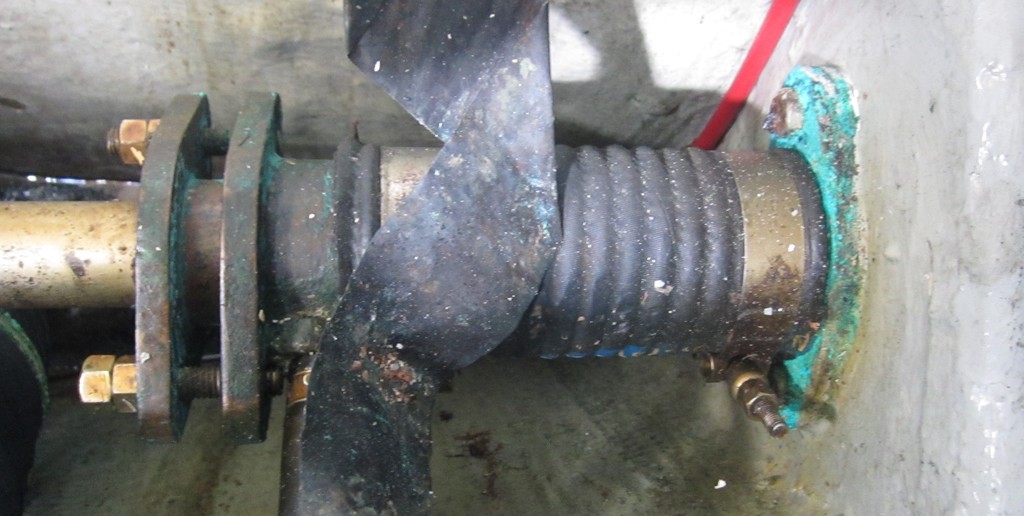
The stuffing box hose clamps were removed for further inspection and discovered that one clamp, a Tridon TTBS64-67P all stainless T-Bolt clamp, was so severely corroded that it was almost broken in half. This area of corrosion was not visible from the top view, as it was located on the bottom side of the hose. Inspection of the 2.25-inch inside diameter hose revealed the internal wire reinforcement was rusted and the hose was beginning to separate.

Observation/Lesson Learned: Internet research on hose clamp placement emphasized that the clamp's mechanism for tightening be offset on installation, especially for installations utilizing double clamps at each end. The failure of the Tridon clamp to corrosion was most likely due to the installation of the clamp band spot welds and T-bolt tightening mechanism at the low point of the hose - water accumulates at this point and can accelerate the corrosion process. The smooth part of the hose clamp should be situated at the low point of any hose with the tightening mechanism and spot welds being position no lower than 50% down each side of the hose.
Measured the diameter of the packing gland cavity - 1.735-inch. So with a 1.25-inch propeller shaft, the packing gland size needed should be (1.735 - 1.25)/2 or 0.25-inch. The packing gland was removed and there were two rings of this material. The internal surface of the packing gland that contacts the propeller shaft was black and glass like hard.

Added to the To Do List:
- A0097 - Obtain roll of stuffing box 1/4 inch packing gland material.
- A0098 - Obtain two (one spare) and install rated and approved stuffing box robust replacement flexible hose with four 316 stainless steel clamps.
Grounding Plate
A bronze ground plate for the installed ICOM IC-718 HF radio system was located on the aft port side of the hull. Exterior inspection revealed numerous barnacle attachments and the harmless greenish color (verdigris) that bronze naturally develops due to exposure. Interior inspection revealed no evidence of water intrusion. No backing plate was used under the steel mount bolts which showed no presence of corrosion. Could not determine the manufacture of the ground plate but it was very similar to the RF ground plate called a Ground Shoe. Another similar ground plate called a Dynaplate also had installation instructions available. Both of these manufactures used bronze bolts, washers, and nuts in their installations versus steel; while only one used a backing plate.

Added to the To Do List:
- A0099 - Clean ground plate exterior surface.
- B0100 - Determine if backing plate and bronze hardware are necessary on ground plate.
Miscellaneous Holes
- Cable Feed Thrus
- Bow Spirit Mount Bracket
- Bow Spirit Bobstay Mount Bracket
- Wind Vane Strut Mount Bracket
- Boomkin Stay Mount Brackets
- Rudder Gudgeon Mounts
- Mystery Hole
Cable Feed Thrus
All the cable feed thrus were installed in the upper portion of the aft hull. The aft side of the cockpit coaming was directly above these installations and should have been the preferred installation location - this option will be considered.
The aft port side hull had cable feed thrus installed for the LPG gas shut off switch wire, LPG gas hose, HF antenna wire, and port solar panel wire. The LPG gas shut off switch wire displayed evidence of water intrusion.


The aft starboard side had one cable feed thru for the starboard solar panel wire and it displayed evidence of minor water intrusion.

Added to the To Do List:
- A0101 - Reseal LPG gas shut off switch cable feed thru.
- A0102 - Reseal starboard solar panel cable feed thru.
Bow Spirit Mount Bracket
The bow spirit wood extension had been replaced at this marina and had the retaining mount bracket installed with a stainless steel backing plate, bolts, washers, and nuts. As Indra had not been sailed since this installation, no evidence of corrosion or water intrusion was discovered.

Added to the To Do List:
- B0103 - Monitor and inspect bow spirit mount bracket for possible water intrusions.
Bow Spirit Bobstay Mount Bracket
The bow spirit bobstay mount bracket also served as the attachment point for the anchor chain snubber line. This installation also appeared to be relatively new and no corrosion or water intrusion was discovered. This mount bracket was installed with a stainless steel backing plate, bolts, washers, and nuts. The location of the bottom of this bracket was about an inch above the static water line and made immersion in water highly likely. No zinc or bond wire protection was discovered. Additionally, the bow spirit bobstay was connected to the same metal fitting as the forestay rigging connected to the top of the mast, so this installation provided a viable electrical path to the water for the mast and all rigging wire connections.

Added to the To Do List:
- A0104 - Add zinc and/or bond wire protection to bow spirit stay mount bracket.
- B0105 - Monitor and inspect bow spirit stay mount bracket for possible water intrusions.
Wind Vane Strut Mount Bracket
The installed Flemming wind vane used mount struts on both sides of the hull for stability. Both strut mount brackets used a stainless steel backing plate, bolts, washers, and nuts. No corrosion or water intrusion was discovered.

Boomkin Stay Mount Brackets
The port side boomkin stay mount bracket was installed with a wood backing block and three bolts, nuts, and washers. Evidence of corrosion was present on both the bracket and mount hardware. Water intrusion through mount bolt holes was evident due to visible interior rust stains. The wood backing block was probed and found soft at rust stain locations.

The starboard side boomkin stay mount bracket had serious corrosion present. Internal access to this mount bracket required the removal of what appeared to be the originally installed when built, thin wood panels and foam insulation. No backing plate was used in this installation. Water intrusion from the mount bolt locations was evident. Reference To Do List items A0071-74 for previous discovered issues with boomkin stay mount brackets.

Added to the To Do List:
- A0106 - Make and install boomkin stay mount bracket stainless steel backing plates with new mount hardware.
Rudder Gudgeon Mounts
The tiller handle controlled outboard mounted rudder was attached to the stern by three sets of bronze pintles and gudgeons. The rudder was removed and all pintles and gudgeons were sanded clean of all paint, which revealed no evidence of bronze dezincification. The lower gudgeon was mounted into the hull with the internals encapsulated preventing further internal side inspection - this was the same case for the cutless bearing housing. The middle and upper gudgeons were mounted into the hull and the mounting hardware was visible in the interior of the hull.

Interior inspection of the upper and middle gudgeons revealed a wood backing block was used and both probed soft. Water intrusion through the mount bolt holes was evident as significant rust stains were visible.

Added to the To Do List:
- A0107 - Make and install rudder upper and middle gudgeons stainless steel backing plates and reseal mount bolt holes.
Mystery Hole
In the interior hull, upper aft starboard side, had evidence of water intrusion originating from what appeared to be the end of a screw, just below the deck. Exterior inspection found no hardware at this location, just the smooth white topsides paint.

Added to the To Do List:
- A0108 - Remove metal object located interior hull, upper aft starboard side and seal area over.