
Initial Inspection - Standing Rigging
Under our simple inspection categories, item #3. Stick no fall down, an assessment of the standing rigging, chain plates, rig attach points, mast, and the mast deck step/support was necessary. One of the email questions asked to the previous owners was when the wire standing rigging was last changed. The response was the mast was pulled and rigging replaced in 2004. This would make the rigging at least 11 years old. Research on the internet revealed that wire standing rigging was recommended to be replaced 8 to 15 years from installation, but there was not a definitive answer or recommendation. Almost all advice indicated that at a minimum, the entire rig should be inspected annually, the turnbuckles cleaned and greased, and any defective, worn, or corroded part replaced. The internet consensus also indicated if a problem is found in just one wire, then all the wire is suspect due to metal fatigue/stress issues, and the entire rig should be changed. Review of how to inspect the wire was extremely basic and simple; look for broken strands, rust, deformations, corrosion, and cracks. Also emphasized was problems could exist that were internal/invisible and not detectable by a visual inspection. So we based our inspection criteria on the simple inspection recommendations and our own common sense. It was important to determine the size of wire, rig pins, and type of connections on each end and what they were attached to. Use of cotter pins to secure the installation was emphasized on internet discussions.
One of the first things we noticed that appeared strange was the bowsprit whisker stays. The turnbuckles were attached to the bowsprit bronze rigging attachment fitting (cranse iron) with 3/8 inch straight D shackles. The shackle screw pins were not secured with seizing wire. Since the bowsprit wood extension was recently replaced, it appeared that this installation was now a bit longer than before, and to compensate for this shackles were used to provide the needed extra length. The shackles had a 0.39 inch screw pin inserted into a 0.5 inch hole on the bow spirit fitting which was in conflict with the common sense advice of, the pin size should match the hole size. The 3/8 inch straight D shackle had a working load rating of about 1,100 pounds whilst the whisker stay 1/4 inch 1x19 stainless steel wire was rated at about 7,000 pounds. This makes the shackle the weak link in this installation. The turnbuckles were almost maxed out in thread length to facilitate this installation possibly to avoid changing the wire rigging length. The primary bowsprit rig wire, the bobstay, had 3/8 inch 1x19 stainless steel wire, was in the same state with maxed out thread lengths of the turnbuckle, but without the addition of a shackle. All three closed face turnbuckles were removed and found extremely difficult to turn. The threads were "galled" up and regardless of the addition of lubricant and running the threaded T-bolts in and out multiple times, smooth and resistant free operation could not be achieved.
Added to the To Do List:
- A0168 – Replace turnbuckles and both whisker and bobstay stay rig wire.

The bowsprit bronze rigging attachment fitting (cranse iron) had evidence of why the correct size pin should be matched with the hole size - the picture below shows elongation/deformation of a stemhead mount hole due to improper use of a smaller diameter pin or bolt.

The forestay (or headstay or jibstay) rigging wire was encapsulated in a Profurl Basic Model B35M manual reefing-furling system. The Profurl installation and parts manual were obtained from the manufacture's website. The picture below reveals a standard bolt with lock washer and nut was used for this installation to the bowsprit bronze rigging attachment stemhead mount hole. The bolt diameter is smaller than the 0.5 inch stemhead mount hole, toggle holes, and extension plate mount holes - see hole elongation pictured above. The picture reveals a plastic washer/spacer on one side while nothing is installed on the opposite side. On the nut side, the turnbuckle T-bolt toggle and Profurl extension plate mount holes are in contact with the threaded portion of the bolt.

The Profurl manual has specific details on how to properly install and mount their unit to a stemhead attach point. They state with caution, that the long link extension plates should NEVER be attached to the stemhead fitting, but only to the top of the toggle as illustrated in picture below.
Added to the To Do List:
- A0169 – Obtain proper hardware to mount Profurl Basic Model B35M manual reefing-furling system per manufactures instructions.

The inner forestay (or staysail stay) rigging wire was encapsulated in a Profurl Classis/Elite Model NC32 manual reefing-furling system. The Profurl installation and parts manual were obtained from the manufacture's website. The pin threaded on both ends with nuts attached is the correct diameter for the stemhead mount hole and appeared to match the pin in the Profurl parts manual. A washer is placed on the left side, inside of the left Profurl extension plate and on the outside of the left toggle; and a similar washer is not installed on the right side. The attachment of the Profurl extension plates directly to the stemhead mount hole violates the Profurl installation instructions.
Added to the To Do List:
- A0170 – Obtain proper hardware to mount Profurl Classis/Elite Model NC32 manual reefing-furling system per manufactures instructions.

Boomkin Stays
The two boomkin stays were checked next. As previously discovered when checking zincs, the boomkin stay hull mount brackets were found corroded and needed to be replaced. Also a 1/2 inch rig pin was found to have a corrosion pit.


On initial turn of the nut that holds the boomkin double toggle triangle bracket to the boomkin, the nut fell apart and the assembly fell to the ground unexpectedly. The nut appeared to have succumbed to corrosion and stress issues.

The two boomkin closed face turnbuckles were removed and found extremely difficult to turn. The threads were "galled" up and regardless of the addition of lubricant and running the threaded T-bolts in and out multiple times, smooth and resistant free operation could not be achieved. One T-bolt was bent and could only be threaded into the turnbuckle about half way before it would lock up.
Added to the To Do List:
- A0171 – Replace both boomkin stay turnbuckles and stay rig wire.
- A0172 - Obtain new boomkin stay double toggle triangle bracket mount bolt nuts.

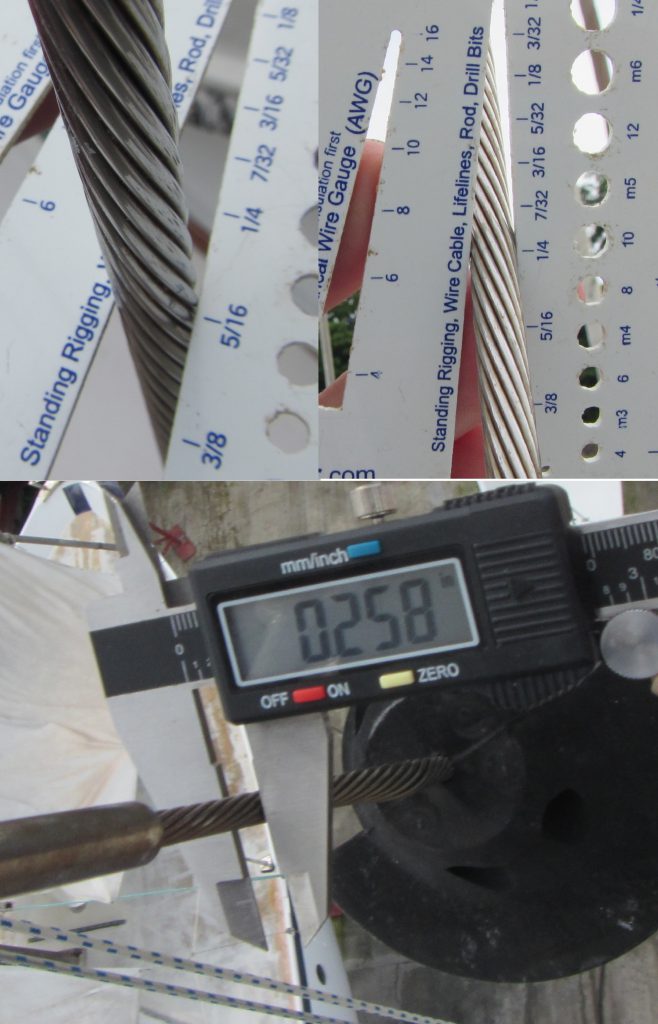
Each of the steel wires were measured for size; all were either 1/4 or 5/16 inch wire except for the bobstay wire that was 3/8 inch. All the rig pins were 1/2 inch wide by 1 inch in length; all had cotter pins installed, though some were not spread open correctly. A patch of cotton was used on the length of each wire and a few snags were found. Only the top exposed wire of the forestay and inner forestay with the Profurl furlers installed was able to be checked. The spreader boots were removed and minor evidence of wear due to rubbing was discovered. The backstay had two insulators installed to support the HF radio antenna. All rigging terminals were of the machined swage type. Overall, the wire was still shiny in appearance with mostly no corrosion present except on the lower swage fittings, were rust signs were very visible at the top of the swage fittings.
The remaining turnbuckles were of open face construction and almost all did not have the recommended cotter pin or clip installed on the threaded studs.

When inspecting the top of the inner forestay wiring, found a section of wire that was un-layed or unraveled - this warranted wire replacement.

Research on the internet suggested this unraveled wire was caused by "halyard wrap", due to improper tension of the halyard, improper lead angle, and/or improper installation of furling swivel and/or foil. Review of the Profurl Classis/Elite Model NC32 manual reefing-furling system installation instructions, clearly showed that the black wrapstop was incorrectly facing aft instead of forward; and the halyard swivel link plate ring was incorrectly located below the wrapstop.

A check of the forestay upper installation revealed the same problems and issues.

Backstay
The lower backstay was connected at the boomkin stemhead mount hole with a jaw-to-swage turnbuckle. The 1/2 inch diameter by 1 inch length rig pin had a cotter pin installed. Removal of this rig pin will require the Flemming wind vane mount strut to be removed first - reversing the location of the head of the rig pin at this mount point will correct this installation oversight. Two Alexander-Roberts backstay insulators model INS-10 are installed on the 5/16 inch wire and connected at the top to a 1/2 inch swage eye terminal with a 1/2 inch diameter by 1 inch length rig pin through a toggle. This toggle is secured to the masthead with a 2 1/4 inch rigging pin with washers and cotter pins on each end.

The back stay turnbuckle threaded studs did not have cotter pins or rings installed.

The rig pin installed at the backstay top swage eye terminal and toggle was installed incorrectly, it was upside down.

The rigging pin just forward of the backstay rigging pin had the port side cotter key incorrectly installed - only one leg of the cotter key was inserted in the rigging pin hole.

Summary of Wire Rig Inspection
Due to the age of the wire rigging; the inner forestay unraveled section of wire needed replacement; rust/corrosion present at the lower machined swage terminals; the need to replace the wire and turnbuckles at both the bow spirit and boomkin; the improper furler mount installations and need to still remove the furler foils for further wire inspection; decide that enough doubt into the integrity of the standing rigging existed, that a complete replacement of all turnbuckles and wire was warranted.
Added to the To Do List:
- A0173 – Replace all turnbuckles and rigging wire.
Mast Base and Support
Indra has a deck stepped mast and under the deck it is supported with a wood beam and wood support base mounted directly to the keel. Visually the wood support base looked ok and the area appeared to be consistently dry. Probes of the wood revealed the wood integrity was good. Had partial access to the top of the wood beam by the mast wiring junction and probe of the wood revealed it remained hard. Externally, the mast is mounted on a metal support plate bolted through the deck. The deck area around the mast base had been recently reworked and repainted and looked in good shape.
