

LED Lights and Wiring
The headliner covering the inside surface of the cabin top had numerous round wooden LED light covers with an opaque lens. We discovered that these light covers were attached to the headliner with some type of adhesive - as the adhesive dried out a few of the light covers fell off.

We removed the headliner and discovered the LED light assembly was a plastic lid glued to the cabin top with a 12-volt G4 LED disc bulb glued to the inside of the plastic lid. The 12-volt G4 LED disc bulb had two metal pins with small wires (estimate 26 AWG) soldered to the pins. These wires were led to the outside of the lid through two small holes drilled in the side of the lid.
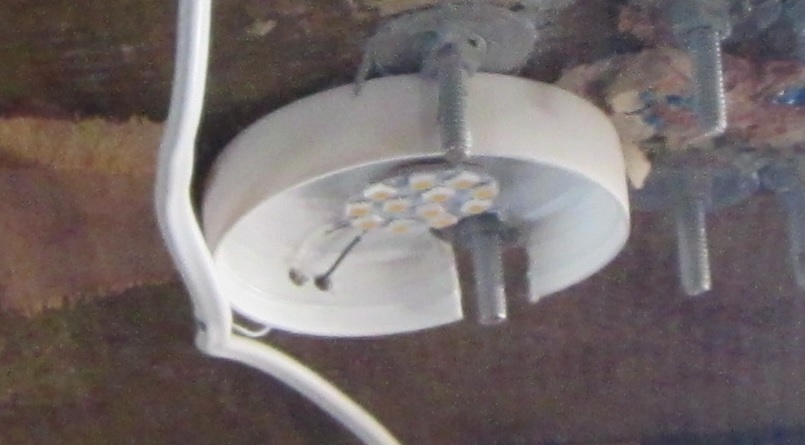
These two wires were then soldered to a pair of 16 AWG sheathed wires by cutting a nick through the plastic sheath and wire insulation. As the picture below illustrates, the ball of solder joining the two wires was left exposed. The picture below also reveals the inappropriate use of two blue plastic automotive-type inline butt splices and the deterioration of the adhesive intended to affix the white cloth-like material to the headliner.

The most significant issue with this installation is the potential fire hazard from the exposed solder connections. Also the four solder connections, two at the 12-volt G4 LED disc bulb and two at the 16 AWG sheathed wires, have the potential to break with the potential to short the wiring, since the wiring has no support to protect it from flexing due to vibrations. Another issue is the small 26 AWG wires have an ampacity rating of 2.2 amps maximum but are connected to a 15 amp circuit breaker - if an electrical short occurred at the 26 AWG wires the real possibility exists that the 15 amp circuit breaker would not trip.
It is common knowledge in marine wiring practices that electrical connections should be mechanically connected, not just soldered. Two sources of this recommended practice are as follows:
The American Boat and Yacht Council (ABYC) standard E-11 AC and DC Electrical Systems on Boats states:
Paragraph 11.14.3.7 - Solder shall not be the sole means of mechanical connection in any circuit. If soldered, the connection shall be so located or supported as to minimize flexing of the conductor where the solder changes the flexible conductor into a solid conductor.
EXCEPTION: Battery lugs with a solder contact length of not less than 1.5 times the diameter of the conductor.
NOTE: When a stranded conductor is soldered, the soldered portion of the conductor becomes a solid strand conductor, and flexing can cause the conductor to break at the end of the solder joint unless adequate additional support is provided.
The National Fire Protection Association (NFPA) 302 Fire Protection Standard for Pleasure and Commercial Motor Craft states:
Paragraph 9.14.7 - Solder shall not be the sole means of mechanical connection in any circuit except in the following situations:
(1) Battery lugs with a solder contact length of not less than 1.5 times the diameter of the conductor.
(2) Conductors contained completely within equipment or enclosures.
Annex A, paragraph A.9.14.7 - If a connection is soldered, the flexibility of the wire is affected and can be subject to failure from movement. If a crimped connection is soldered, it can reduce the mechanical strength of the joint.
As Indra has 28 of these type of light fixtures; all lighting fixtures will be needed to be inspected and modified - or replaced.
Added to the To Do List:
- B0244 - Attach all round wooden LED light covers to headliner with screws.
- A0245 - Inspect all light fixtures and wiring. Delete all plastic inline butt splices and solder connections. Connect wiring with crimped/mechanical connections.