

- Action: To Do List item A0247 – Make replacement wind vane air foil and spares.
- Action: To Do List item A0303 – Inspect, clean, lubricate, and repair wind vane. Replace blocks and ropes.
- Completed: 25 November 2018
- Cost: $157.05
The following items were purchased for this task.
| P/N | Item | Q | Each | Total |
| RF41100 | Ronstan 40 mm Series 40 Block Single Block with Universal Head | 3 | $21.15 | $63.45 |
| NE2100-WH-SP | New England 5/16" Sta-Set White w/ Red x 600ft. Spool, Tensile: 3,850 | 30 | $0.46 | $13.80 |
| 3-Strand 1/4-inch Nylon Rope | 15 | $0.25 | $3.75 | |
| SHC38100 | 3/8”-9mm Black Polyester Shock Cord 100ft | 4 | $0.50 | $2.00 |
| 100297 | Shock Cord Hook With Cleat Black Plastic 3/16" - 5/16" 4 PK5 | 1 | $7.95 | $7.95 |
| 122184 | Boeshield T-9 Waterproof Lubrication 4 oz aerosol | 1 | $11.30 | $11.30 |
| Autosol Metal Polish 75ml tube @ 250 pesos or $5.00 | 1 | $5.00 | $5.00 | |
| TOTAL | $107.25 |
The discovery of the rotted wooden Fleming wind vane air foil that had fallen off to ground, inspired the search on the internet for any information about the Fleming wind vane. Not much was found. Discovered and downloaded a few Fleming manuals of old vintage and found one that appeared to be relatively recent. It mentioned a Fleming website, www.flemingselfsteer.com, however this site was no longer available. On a boating forum website it was revealed that a Australian person named Phil George (0433 982 368) had bought the Fleming company from its originator, Kevin Fleming, and could be contact by email at "flemingmarine@gmail.com" - people had tried but had no response back. It was also reported that the Fleming website had been hacked and was no longer operational. Regardless, this essentially means that the Fleming models are no longer available and this also means the same for replacement parts - not a favorable situation.
The Fleming manuals identified different models so checked the wind vane installed aboard for any identifying marks - only found some vague numbers (see picture) that did not help in identifying the type of model aboard. My interpretation of the discovered number "PN-1-1996" means that it is likely this unit was made in the year 1996.

The Fleming manual contained a table of measurements for different models. Based on the rudder length of 30 inches and shaft length of about 16 inches it appears the model installed aboard would be classified a Fleming Major series, Fleming Global Major 501 series, or Fleming Offshore 501 series depending on what manual was referenced.
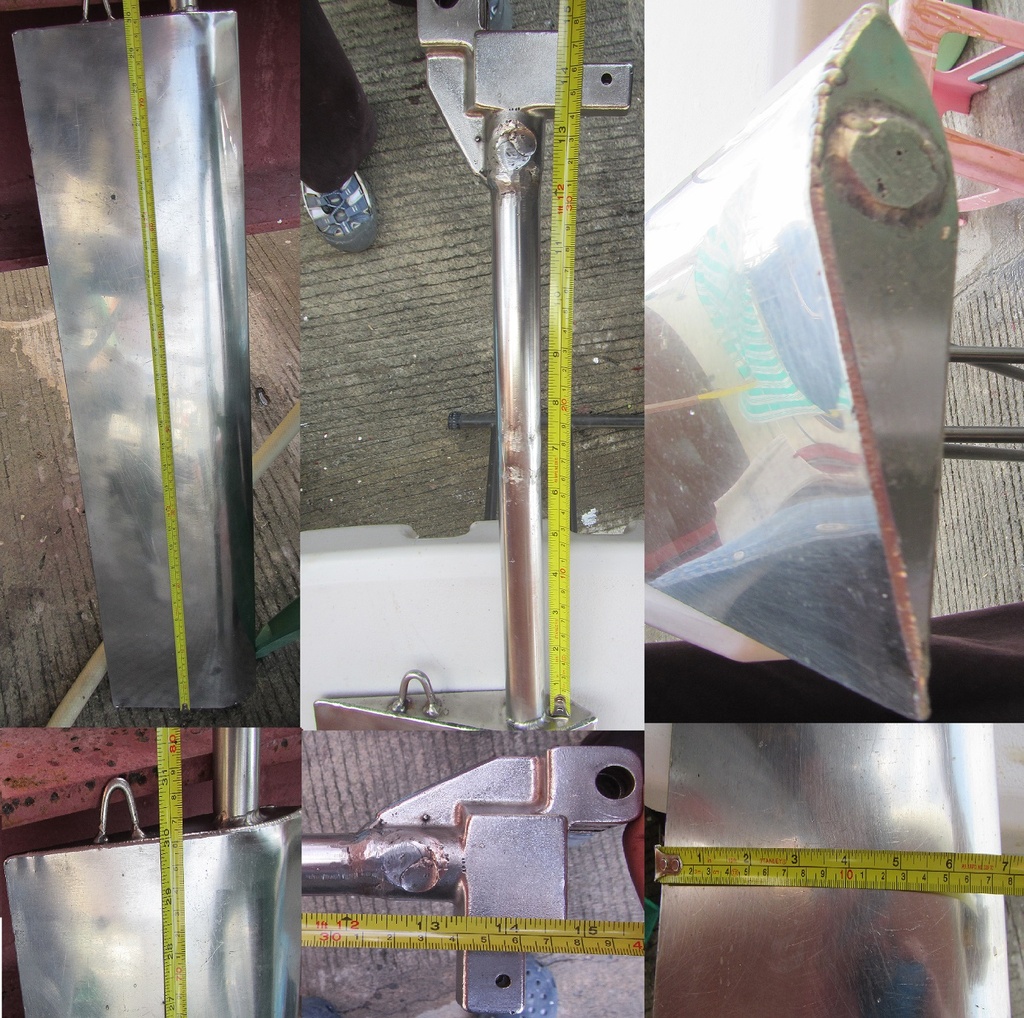
When the Fleming wind vane servo rudder was removed, discovered it was 30-40% full of water. Another unexpected "surprise" - this water intrusion had to been present for a very long time. The Fleming Installation, Operation and Maintenance Manual states, "The servo rudder is hollow and designed to provide some flotation. Check its watertight integrity. Any leak must be patched." Check of the trailing edge of the servo rudder revealed it had crevice corrosion allowing water into the internal cavity in more than one spot.

Used a grinder with a metal cutting wheel and ground out the areas on the servo rudder with crevice corrosion. This allowed a lot of water to drain out. Next heated the servo rudder over our one-burner propane stove to vaporize the residue water left inside.

The local Filipino yard foreman, Tata, welded the Fleming servo rudder aft seam in multiple places (red arrows) to seal up the small holes that allowed water intrusion. Cost for welding was 250 pesos (about US $5.00).

It was also discovered when the Fleming servo rudder was removed, the rudder stainless steel shaft had evidence it was previously damaged and repaired as it had a significant weld band around the 1-inch thick steel shaft.

The Fleming wind vane servo rudder was cleaned and polished with Autosol metal polish and mounted back on its strut. The mounts bolts were wire brushed clean and coated with Lanocote when tightened down.

All the stainless steel tubing and fixtures had rust spots and corrosion that needed attention. Used a wire brush wheel powered by a drill, emery cloth sandpaper, rags, and Autosol metal polish to clean these items - a slow process that took many days.
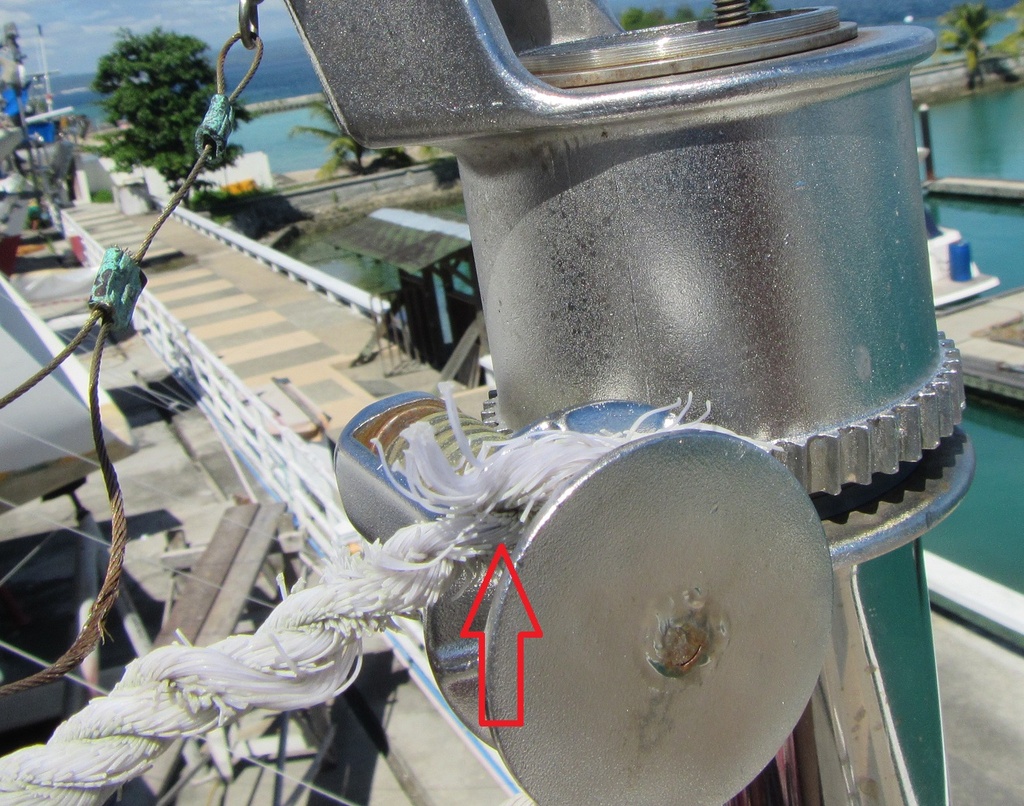
The two 3/8-inch double braid control lines and the 1/4-inch continuous loop course set nylon line were aged and needed to be replaced. The course set line was made of 1/4-inch three strand nylon rope and was at the point of breakage (red arrow) as shown in picture below.
The other end of the course set line was improperly attached to a block held in place by a piece of webbing and string. The Fleming manual recommended attachment of the course set line by using a section of bungee or shock cord to maintain adequate tension. This connection point was changed to a length of 3/8-inch bungee cord as the manual stipulated.
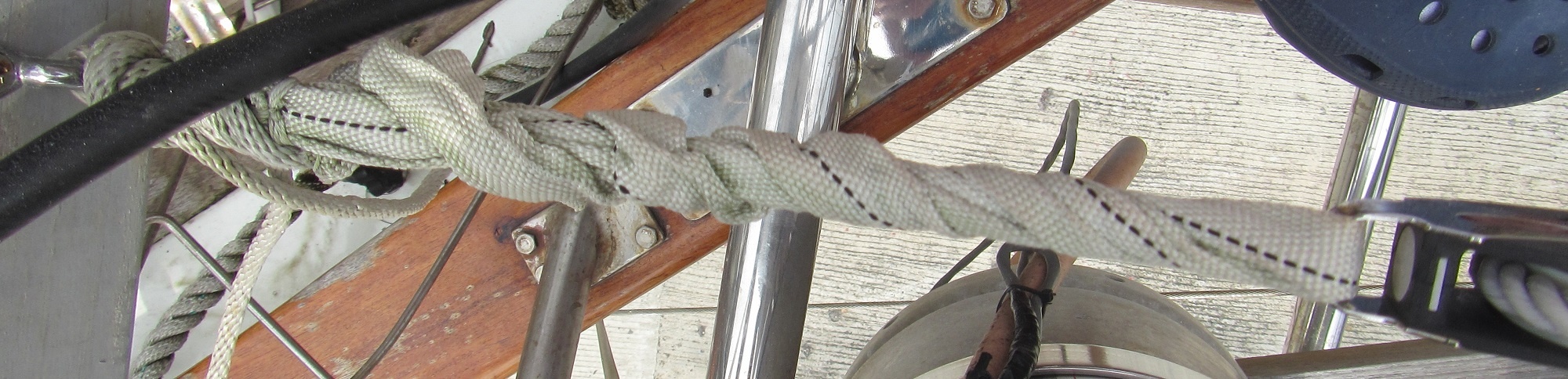
A new continuous loop course set line was fabricated out of 1/4-inch 3 strand nylon rope first routed through a new Ronstan 40 mm Series 40 block. The long splice needed on this line took many attempts to accomplish. The Ronstan 40 mm Series 40 block had a section of 3/8-inch bungee cord attached with the other end attached to a black plastic shock cord cleat with hook. This was then attached to the aft-most point on the boomkin stainless steel tubing. The design of the shock cord cleat allows the tension of the bungee cord to be adjusted easily.
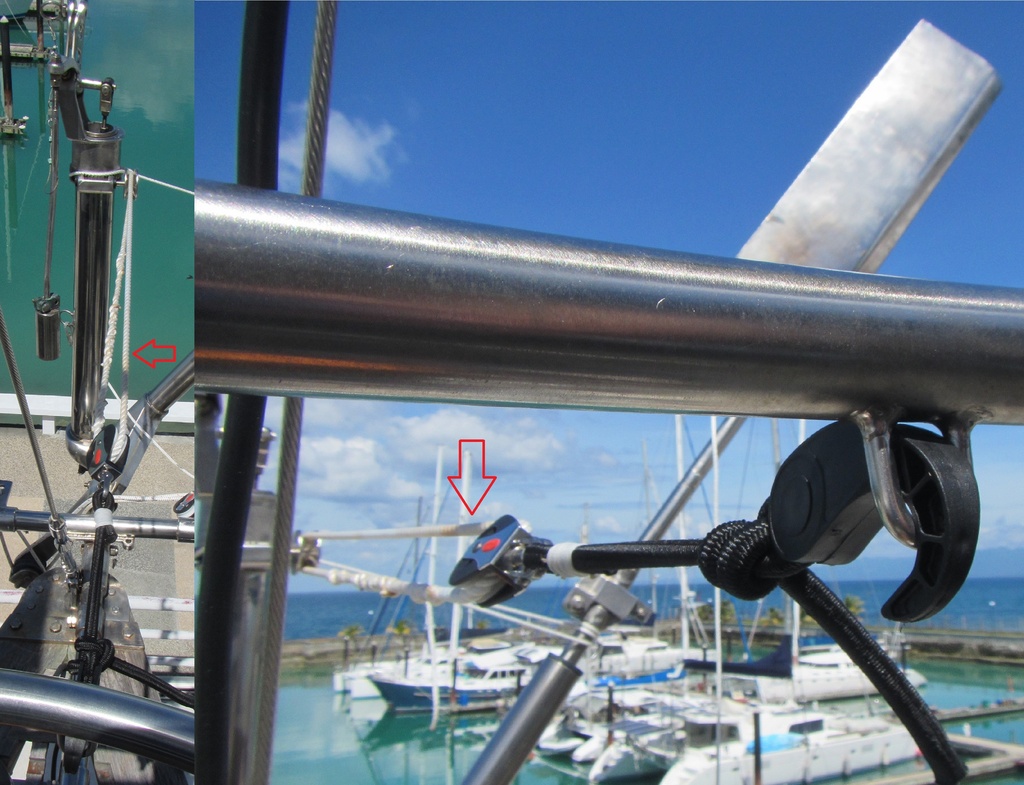
The two control ropes were routed through a series of pulley sheaves (blocks) from the wind vane forward to connect to the tiller arm. The two blocks attached to the wind vane were both defective and did not freely and smoothly rotate. The metal side case block below did not have free 360 rotation (red arrow) and the pulley wheel was loose due to the case metal distortion. The black block below had an indentation in its side case (red arrow) that prevented the pulley wheel from rotating freely. These blocks were replaced with new Ronstan 40 mm Series 40 Single Blocks with Universal Head PN RF41100.

The dual vane servo pulleys also did not rotate freely and were disassembled and inspected. Discovered the pulley bushing and mount bolt were corroded causing the binding and restriction of free movement. They were cleaned up, rotating surfaces smoothed with sandpaper, lubricated with Super Lube synthetic grease, and reassembled. The mount area for the dual vane servo pulleys was also cleaned up.


Discovered loose hardware (red arrow) that needed to be cleaned up and securely torqued down. The yellow arrow points at the control line block that has an indentation rendering the pulley wheel stuck and frozen.

Discovered other pieces of wind vane hardware that needed to be replaced due to deterioration from corrosion (US $2.50).

One of the vintage Flemming manuals had illustrations that were distorted and indistinguishably, but the readable text stated there were oil and grease holes that should be periodically lubricated. A close inspection of the wind vane revealed some of their locations. Each oil and grease hole and every moving part was lubricated with Boeshield T-9 Waterproof Lubrication that comes in an aersol spray can - this allows the oil to be "forced" sprayed into crevices increasing the application and penetration of the lubricant.

Installed New England 5/16-inch Sta-Set White with Red Fleck rope for control lines and two Ronstan 40 mm Series 40 blocks. The opposite end of the control lines, that would attach to the tiller, had a stopper knot tied in them to ensure they would stay in place. Final connection to the tiller by a loop of chain could not be accomplished at this time, as the tiller arm was not installed.

The replacement of the rotted wood wind vane air foil resulted in the purchase of a sheet of about 3/16-inch marine plywood (1,800 pesos or US $35.30). Using the old wood wind vane air foil, traced out its shape on the plywood and cut them out. A mount hole was drilled through the new wood wind vane air foil and it fit check ok when attached to the wind vane assembly.

The wooden wind vane air foils had two coats of West System 105 epoxy resin applied (US $5.00).

Then they were painted with Island Paints COLORQuick Quick Dry Enamel gloss white 900-color series, exterior grade paint (US $2.00).

The completed wind vane air foils are stored underneath the starboard side cabin settee area.