

Review of The Resurrection was not on Sunday
by Herbert W. Armstrong
The following review of “The Resurrection was not on Sunday” by Herbert W. Armstrong is written with the recommendation put forth by Mr. Armstrong himself on page 3 of his book, “Yet the Bible tells us to prove (test) all things.” This recommendation refers to the following Biblical verse, "Prove all things; hold fast that which is good." [1Thessalonians 5:21]
Mr. Armstrong provides another sound recommendation on page 3, "For proof there is but one dependable authority, a sole historical record - the Bible." The Word of God in the Bible is the Truth and stands completely independent of any of Man's records. The basis of any Biblical "proof" should be formulated solely on the True Word of God; as none of Man's knowledge, records, or history is a dependable authority.
A few other sound recommendations:
“Ye shall not add unto the word which I command you, neither shall ye diminish ought from it, that ye may keep the commandments of the Lord your God which I command you” (Deuteronomy 4:2).
"Let no man deceive himself. If any man among you seemeth to be wise in this world, let him become a fool, that he may be wise." (1 Corinthians 3:18)
Disclosure: This review was accomplished as the result of comments from a devote follower of the ideas put forth in Mr. Armstrong's book (and similar plagiarized versions) and the request to read it in full; as the devote follower completely believes and asserts "These men are God's True ministers." The devote follower was correct, in as much we did not read Mr. Armstrong's book due to its promotion of God performing work, the Resurrection, on His Holy and Sanctified Sabbath. We know, without doubt from the Word of God, God would NEVER defile His Holy Sabbath as emphasized in our previous post on this subject and therefore did not read Mr. Armstrong's book. This review is written with hope and prayers that its message of Truth of the Word of God can enlighten and free those trapped in the Chains of Deception.
And Jesus said, the Whole World and All Nations shall be Deceived (Revelation 12:9 Revelation 18:23).
Three Days and Three Nights Starts When?
On page 3, the first sentence Mr. Armstrong begins with is, “Was Jesus three days and three nights in the grave, as He said in Matthew 12:40?” The correct answer should be NO as the question does not accurately reflect the text of the Biblical verse. The actual verse states, "For as Jonas was three days and three nights in the whale's belly; so shall the Son of man be three days and three nights in the heart of the earth." (Matthew 12:40)
Mr. Armstrong has taken the liberty of defining “the heart of the earth” as a “grave” and later in his writings as “the rock-hewn sepulcher”, “in the tomb’, and “inside the earth”. On page 5 Mr. Armstrong further expands his definition of the "grave" when he equates the term "grave" with "belly of the fish" (Jonah 1:17) and "the belly of hell" (Jonah 2:2). Can the phrase “the heart of the earth” mean the same as the "belly of the fish" and "the belly of hell" as Mr. Armstrong considers them to be the same as "grave" which he also equates to mean the same as “the heart of the earth”?
As Mr. Armstrong's definition of the meaning of “the heart of the earth” forms a central basis for his further writings and assertions that the three days or 72 hour timeframe till resurrection, begins and is measured from the time of burial in the grave. The true meaning of the “the heart of the earth” is of significance.
Definitions from Strong's Exhaustive Concordance of the Bible provide another perspective to consider:
- Strong's Definition (G2588) - the heart that is (figuratively) the thoughts or feelings (mind); also (by analogy) the middle.
- Strong's Definition (G1093) - soil; by extension a region or the solid part or the whole of the terrene globe (including the occupants in each application)
From these definitions, it takes creative inventiveness to associate the terms “grave”, “the rock-hewn sepulcher”, “in the tomb’, and “inside the earth” as having the same meaning as the term “the heart of the earth”.
As one reads the Matthew 12:40 verse, understand the differences: Jonas did not die in the "whale's belly" and the "Son of man" died on the cross.
As one reads the Matthew 12:40 verse, understand that what the Word of God and Mr. Armstrong accurately proclaim about "three days and three nights" is correctly interpreted as three (3) complete days, where a day consists of 24 hours, where a day begins with darkness followed by lightness (Genesis 1:1-5), and the total of three days is 72 hours.
As one reads the Matthew 12:40 verse, understand what is common to being inside a "whale's belly" and "the heart of the earth"; darkness. Understand that Jonas's darkness was the darkness of a lightless confined captivity in the "whale's belly"; besides his struggles with the darkness internal to his being. Understand that the "Son of man" darkness was the darkness of death. If one enters and closes the lid on a coffin, closes the door of a crypt tomb while inside, enters a cave into the earth with no light, is not "darkness" common to each? Mr. Armstrong uses the terms, “grave”, “the rock-hewn sepulcher”, “in the tomb’, and “inside the earth” to represent the phrase “the heart of the earth”; they all could be considered to share the common description of darkness, the darkness of death.
As the terms "third day" and "three days and three nights" prophesize the timeframe for the Resurrection, what does “resurrection” mean? The word translated as “resurrection” comes from the Greek a·naʹsta·sis, which means “raising up” or “standing up again.” A person who is resurrected is raised up from death and restored to life.
As stated in 1 Corinthians 15:12-13:
12 Now if Christ be preached that he rose from the dead, how say some among you that there is no resurrection of the dead?
13 But if there be no resurrection of the dead, then is Christ not risen:
It is abundantly clear that "rose from the dead" and "resurrection of the dead" identifies resurrection is measured from the instance of "death" and not by some arbitrary timeframe of burial in the "grave" or entombment.
A review of other Biblical verses that prophesize the timeframe for the Resurrection should be considered to properly determine the point to measure the three days, 72 hours from:
- John 2:19 Jesus answered and said unto them, Destroy this temple, and in three days I will raise it up. {"Destroy this temple" infers death of the body of Jesus, from the point of death to be raised in three days - "grave" does not fit.}
- Matthew 17:23 And they shall kill him, and the third day he shall be raised again. {"kill him" infers the death of Jesus, from the point of death to be raised on the third day - "grave" does not fit.}
- Matthew 20:19 And shall deliver him to the Gentiles to mock, and to scourge, and to crucify him: and the third day he shall rise again. {"crucify" infers the death of Jesus, from the point of death to be raised again on the third day - "grave" does not fit.}
- Matthew 27:64 Command therefore that the sepulchre be made sure until the third day, lest his disciples come by night, and steal him away, and say unto the people, He is risen from the dead: so the last error shall be worse than the first. {"risen from the dead" infers from the point of death to be raised on the third day - "grave" does not fit.}
- Mark 9:31 For he taught his disciples, and said unto them, The Son of man is delivered into the hands of men, and they shall kill him; and after that he is killed, he shall rise the third day. {"kill him" and "killed" infers from the point of death to be raised on the third day - "grave" does not fit.}
- Mark 10:34 And they shall mock him, and shall scourge him, and shall spit upon him, and shall kill him: and the third day he shall rise again. {"kill him" infers from the point of death to be raised again on the third day - "grave" does not fit.}
- Luke 9:22 Saying, The Son of man must suffer many things, and be rejected of the elders and chief priests and scribes, and be slain, and be raised the third day. {"slain" infers from the point of death to be raised on the third day - "grave" does not fit.}
- Luke 18:33 And they shall scourge him, and put him to death: and the third day he shall rise again. {"death" infers from the point of death to be raised again on the third day - "grave" does not fit.}
- Luke 24:7 Saying, The Son of man must be delivered into the hands of sinful men, and be crucified, and the third day rise again. {"crucified" infers the death of Jesus, from the point of death to be raised again on the third day - "grave" does not fit.}
- Luke 24:46 And said unto them, Thus it is written, and thus it behooved Christ to suffer, and to rise from the dead the third day: {"suffer" suffer what?, death. "rise from the dead" both terms infers from the point of death to rise on the third day - "grave" does not fit.}
- Acts 10:40 Him God raised up the third day, and shewed him openly; {"third day" with "shewed" confirms the quantity and length of time till resurrection.}
- 1 Corinthians 15:4 And that he was buried, and that he rose again the third day according to the scriptures: {"buried" could be considered to agree with Mr. Armstrong's term "grave". Both terms, "buried" and "grave" infer prior death - from the point of death to be rose again on the third day - "grave" could fit, but point of death is more accurate.}
The terms "Destroy this temple", "kill", "crucify", "killed", "slain", "put him to death", "crucified", "suffer", "was buried", could be considered to share the common description of darkness, the darkness of death. Each of these verses describe a "point of death" then state on the third day He will rise again - "grave" is not a condition required to be raised again in these verses. Mr. Armstrong's terms, “grave”, “the rock-hewn sepulcher”, “in the tomb’, and “inside the earth” could not be logically applied to these verses as these terms just don't "fit" the context of the verses. If an interpretation or definition can only potentially fit one Biblical text verse, but is in conflict with other Biblical verses of the same meaning, then the interpretation or definition must be discarded as it does not align with the totality of the Word of God. Understanding of the significance of the burial of a dead body, placement in the "grave", "sepulcher”, or "tomb" might be gleamed from this verse: "But Jesus said unto him, Follow me; and let the dead bury their dead." (Matthew 8:22)
Jesus's time on earth culminated at one specific point, His death on the cross on the 14th day of the month of Abib (Numbers 28:16 Deuteronomy 16:1), at approximately the 9th hour (~3 o'clock in the afternoon) (Matthew 27:46), where He proclaimed "It is finished" (John 19:30) and "yielded up the ghost" (Matthew 27:50). Jesus experienced and "yielded" to the "darkness of death" (Matthew 27:45 Mark 15:33 Luke 23:44) at about 3PM. The association of "darkness" with "death" is emphasized in many verses of the Word of God, an example:
Then spake Jesus again unto them, saying, I am the light of the world: he that followeth me shall not walk in darkness, but shall have the light of life. (John 8:12)
The Word of God clearly reveals that Jesus died in fulfillment of all prophecies at about 3PM on the 14th day of the month of Abib, Passover Day. That the beginning of the prophecies of the "third day" and "three days and three nights" commence at the instant of Jesus's death on the cross, as the Resurrection is measured from the point of His death (1 Corinthians 15:12-13).
As I review “The Resurrection was not on Sunday” by Herbert W. Armstrong, I know, beyond doubt from the Word of God, that Mr. Armstrong's assertion of the measurement of the the prophecies of the "third day" and "three days and three nights" from the time of burial in the "grave" is incorrect throughout his entire book. The Word of God and Mr. Armstrong accurately state that "three days and three nights" is correctly interpreted as three (3) complete days or 72 hours.
Prove all things; hold fast that which is good. [1Thessalonians 5:21]
Exaggerations?
On page 5 Mr. Armstrong writes, "As Jonah was in the "grave" (see marginal reference, Jonah 2:2) 72 hours, after which he was supernaturally resurrected by God, by being vomited up, to become a saviour to the people of Nineveh upon proclaiming the warning to them, so should Jesus be 72 hours in His grave, thereupon being resurrected by God to become the saviour of the world."
The verse of Jonah 2:2 states, "And said, I cried by reason of mine affliction unto the Lord, and he heard me; out of the belly of hell cried I, and thou heardest my voice.".
For complete understanding, first read the book of Jonah.
Mr. Armstrong has taken the liberty of substituting the term "grave" for the "belly of the fish" (Jonah 1:17) and "the belly of hell" (Jonah 2:2). How is it possible that "Jonah was in the "grave"" when the prior text verse of the Word of God states "Then Jonah prayed unto the Lord his God out of the fish's belly," (Jonah 2:1). Does the Word of God indicate anywhere that a person in the "grave" can pray "unto the Lord his God ", NO! Mr. Armstrong takes extreme liberties stating Jonah was "supernaturally resurrected by God". The Word of God reveals that only ONE, the Son of God, Jesus, is resurrected by God. The book of Jonah does NOT state that Jonah died, it does NOT state that Jonah was in the "grave", it does NOT state that Jonah was resurrected by God. These statements are exaggerations and falsehoods.
“Ye shall not add unto the word which I command you, neither shall ye diminish ought from it, that ye may keep the commandments of the Lord your God which I command you” (Deuteronomy 4:2).
The Significance of Twelve Hours?
On page 5 Mr. Armstrong writes, "Did Jesus know how much time was in a "day" and in a "night"? Jesus answered, "Are there not twelve hours in a day . .. but if a man walk in the night, he stumbleth" (John 11:9-10).".
The verses of John 11:9-10 states:
9 Jesus answered, Are there not twelve hours in the day? If any man walk in the day, he stumbleth not, because he seeth the light of this world.
10 But if a man walk in the night, he stumbleth, because there is no light in him.
Mr. Armstrong interprets the verses of John 11:9-10 to infer "how much time was in a "day" and in a "night"" - twelve hours as declared by Jesus. The length of daytime varies over the year (summer longer, winter shorter) and is also different dependent upon ones latitude on earth; higher latitudes have shorter days. A daylight period of exactly twelve hours is a rarity, but stated as an average is a common inaccurate and rationalized interpretation. Notice in verse John 11:9, Jesus asked the question, "Are there not twelve hours in the day?" and it is NOT answered by anyone. Jesus did NOT state there were 12 hours in a day, because there are NOT 12 hours in a day, the daylight period, in the majority of cases; He asked a question.
The intent or meaning of these two verse and the unanswered question, "Are there not twelve hours in the day?" is NOT to define the number of hours in a "day" and in a "night". Read the verses prior and after these two verses - these two verses are out of context from the subject of the other verses, they stand alone. The question is directed to YOU, the reader. Jesus instructs the reader that one will "stumbleth not" and the answer can be discovered if the reader "walk in the day"(light) and "seeth the light" {is guided by the Holy Spirit}. If the reader "walk in the night"(darkness), and "there is no light in him" {absent of the Holy Spirit} he will "stumbleth" and the answer will remain unknown.
The question, "Are there not twelve hours in the day?" (John 11:9) actually specifies a set quantity of hours, twelve, and identifies a daylight period "not of twelve hours" to seek (Joshua 10:12-14). This question is directly related to Jesus's Passover, the Crucifixion, and the Resurrection and provides linkage to the answer as why Jesus's Passover day is exactly twelve hours offset from the Passover events of Moses's time.
Most have not realized the different time of events of the two Passovers, example: In Moses’s Passover timeframe, the sacrificial “Paschal” lamb was killed in the early evening (Exodus 12:6) and its blood painted/striked on the houses doorway (Exodus 12:7). In Jesus’s Passover timeframe (offset by 12 hours), this period of time would have been in the hours just after sunrise on the fourteenth day of the first month, when he was delivered to Pontius Pilate (Matthew 27:2). Matthew 27:30 states, “And they spit upon him, and took the reed, and smote him on the head.” Jesus’s blood was let on the ground from the time he was tortured early in the morning to after he “yielded up the ghost” (Matthew 27:50) on the cross.
Example: The death of firstborns (the darkness of death) began at midnight during Moses's time (Exodus 12:29) and the spiritual death of the firstborn of God began at midday during Jesus's time as signified by the "darkness", the "darkness of death". (Matthew 27:45 Mark 15:33 Luke 23:44) The twelve hour offset, is reset/reclaimed at the death of Jesus (earth quake Matthew 27:51) and results in twelve hours of the 72 hour third day prophecy being hidden, unknown to Man (Deuteronomy 29:29). The entire 72 hour period of the third day prophecy remained intact and was fulfilled down to the very last second.
On page 4, Mr. Armstrong cites verses Matthew 12:39-40 and limits its implication to "doubting Pharisees", "Christ-rejecting Pharisees", etc.
The verses of Matthew 12:38-40 state:
38 Then certain of the scribes and of the Pharisees answered, saying, Master, we would see a sign from thee.
39 But he answered and said unto them, An evil and adulterous generation seeketh after a sign; and there shall no sign be given to it, but the sign of the prophet Jonas:
40 For as Jonas was three days and three nights in the whale's belly; so shall the Son of man be three days and three nights in the heart of the earth.
Matthew 12:39 clearly states "there shall no sign be given to" "An evil and adulterous generation" "but the sign of the prophet Jonas". That no sign is given to an evil and adulterous generation applies to the whole of mankind, unto the present. The use of the vague phrase "in the heart of the earth", the significance of the twelve hours and the requirement of the guidance of the Holy Spirit to know the answer, the unrecognized twelve hour shift of the Passover events from Moses's to Jesus's time, the controversies of the meaning of the "third day" and "three days and three nights", how three (3) complete days, 72 hours, will NOT fit any of Man's proper interpretation of Biblical texts that state things like: "Jesus was risen early the first day of the week" (Mark 16:9) and the actual time of crucifixion, all imply that the given sign, "three days and three nights", of the prophet Jonas is only knowable to Man at the appointed time chosen by God. The following could not be True otherwise:
And Jesus said, the Whole World and All Nations shall be Deceived (Revelation 12:9 Revelation 18:23).
Jesus's prophecy of the whole world and all nations to be deceived is True and fulfilled. As I didn't know the Truth and was deceived, it is evident that Mr. Armstrong didn't know the Truth and was deceived, and everyone else in the whole world doesn't know the Truth and remains deceived.
Lastly the symmetry, the order and timeframe of events of both Moses's and Jesus's Passover must match for prophecy to be true. If they don't match the reason must be discovered, and the reason can only be of God's direct action and involvement. The 12 hour difference between Moses's and Jesus's Passover events was of God's origin (Joshua 10:12-14). As this is now known, the events of Jesus's Passover reveal things not known of Moses's Passover - when the darkness of death departed Egypt. Jesus died on Passover Day at ~3PM and the darkness of death departed the earthly realm at that time. Applied to Moses's Passover, offset by 12 hours, this means the darkness of death departed the earthly realm at ~3AM after the death of the very last firstborn of Egypt - Pharaoh's firstborn son {first shall be last; and the last first (Mark 10:31)}. God's instructions to Moses was "...none of you shall go out at the door of his house until the morning." (Exodus 12:22) We now know why Moses, a firstborn, was not killed when he was called by the Pharaoh by night (Exodus 12:31); the darkness of death had already departed Egypt and the earthly realm.
Dependable Authority?
On page 10 Mr. Armstrong writes, "This Sabbath might occur on any day of the week. Frequently it occurs, and is observed even today, on Thursday. For instance, this "high-day" Sabbath came on Thursday in 1962, 1969 and 1972, and will occur on Thursday in 1975, 1979 and 1982."
"And the Hebrew calendar shows that in the year Jesus was crucified, the 14th of Abib, Passover day, the day Jesus was crucified, was Wednesday. And the annual Sabbath was Thursday. (For proof, write for our free booklet The Crucifixion Was Not on Friday.)"
On page 10 Mr. Armstrong further writes, The first investigators, Mary Magdalene and her companions, came to the sepulcher on the first day of the week (Sunday) very early, while it was yet dark, as the sun was beginning to rise, at dawn (Mark 16:2; Luke 24:1; John 20:1).
Did not Mr. Armstrong state on page 3 "For proof there is but one dependable authority, a sole historical record - the Bible."? YES!!
Is the "Hebrew calendar" a dependable authority as Mr. Armstrong will assert by his use of it? No!!
Is the word of Man more dependable than the Word of God? No!!
Does a Biblical proof require words or the records of Man to be validated? No!!
Should a Biblical proof be based solely on the Word of God, the only "dependable authority" and "sole historical record" as Mr. Armstrong originally recommended? YES!!
Did Mr. Armstrong formulate his assertion that the Passover Day, the crucifixion of Jesus was on a Wednesday through use of a "undependable authority", the Hebrew calendar created by Man over the Truth revealed in the Word of God? YES!!
Did Mr. Armstrong designate "Thursday as the annual Sabbath" and "Sunday as the first day of the week" through use of a "undependable authority", the Hebrew calendar created by Man over the Truth revealed in the Word of God? YES!!
Does the Truth of the Word of God declare the year Jesus was crucified? No!!
Does the Truth of the Word of God, solely by itself, reveal the day Jesus was crucified and resurrected? YES!! (See last section - Crucifixion & Resurrection Truth)
As indicated above Mr. Armstrong DID NOT use the Word of God as the basis for his Wednesday crucifixion or Sabbath Saturday resurrection "story", or for the majority of his assertions in his book, “The Resurrection was not on Sunday”. He comingles falsehoods, half-truths, full-truths, and undependable records of Man to create and justify his "story".
As such, I have no doubt based on the Truth revealed in the Word of God, that Mr. Armstrong's Wednesday crucifixion and Sabbath Saturday resurrection "story" is incorrect, a complete falsehood, a deception, a blasphemy unto God. I harbor no ill will, judge, or condemn Mr. Armstrong (or any religion of faith) as he had a significant impact in "spreading the word" and "sowing of the seed". I fervently and naively believe IF Mr. Armstrong was granted the knowledge to recognize the 12-hour difference between Moses's and Jesus's Passovers caused by Joshua's long day (Joshua 10:12-14) and when the 12-hours were reclaimed by God (Matthew 27:51), his story would be entirely different. By the will of God, Mr. Armstrong was unable to decipher the truth of the crucifixion and resurrection, as were ALL others. The following could not be True otherwise:
And Jesus said, the Whole World and All Nations shall be Deceived (Revelation 12:9 Revelation 18:23).
The Third Day?
On page 12-13 Mr. Armstrong writes, “Another passage that might confuse is Luke 24:21: " ... And beside all this, today is the third day since these things were done." "These things" included all the events pertaining to the resurrection - the seizing of Jesus, delivering Him to be tried, the actual crucifixion, and, finally, the setting of the seal and the watch over the tomb the following day, or Thursday. Study verses 18-20, telling of "these things" and also Matthew 27:62-66. "These things" were not completed until the watch was set, Thursday. And the text says Sunday was the third day since these things were done. Sunday truly was the third day since Thursday. But it was not the third day since Friday, so this text could not prove a Friday crucifixion.”
To fully understand, first read all of Luke 24; identify which day of the week is revealed.
Luke 24 verses all describe events on the first day of the week through the second day of the week that begins at sunset:
Luke 24:1 states, "Now upon the first day of the week, very early in the morning, they came unto the sepulchre, bringing the spices which they had prepared, and certain others with them."
Luke 24:6 states, "He is not here, but is risen: remember how he spake unto you when he was yet in Galilee,"
Luke 24:7 states, "Saying, The Son of man must be delivered into the hands of sinful men, and be crucified, and the third day rise again."
Luke 24:13 states, "And, behold, two of them went that same day to a village called Emmaus, which was from Jerusalem about threescore furlongs."
Luke 24:16 states, “But their eyes were holden that they should not know him."
Luke 24:17 states, “And he said unto them, What manner of communications are these that ye have one to another, as ye walk, and are sad?"
Luke 24:18 states, “And the one of them, whose name was Cleopas, answering said unto him, Art thou only a stranger in Jerusalem, and hast not known the things which are come to pass there in these days?"
Luke 24:19 states, “And he said unto them, What things? And they said unto him, Concerning Jesus of Nazareth, which was a prophet mighty in deed and word before God and all the people:"
Luke 24:20 states, “And how the chief priests and our rulers delivered him to be condemned to death, and have crucified him."
Luke 24:21 states, “But we trusted that it had been he which should have redeemed Israel: and beside all this, to day is the third day since these things were done."
Luke 24:29 states, "But they constrained him, saying, Abide with us: for it is toward evening, and the day is far spent. And he went in to tarry with them."
Luke 24:46 states, "And said unto them, Thus it is written, and thus it behooved Christ to suffer, and to rise from the dead the third day:"
From the Word of God revealed in Luke 24 there should be absolutely no confusion, no doubt in anyone's mind that the first day of the week is the third day after the death of Jesus. The first day of the week is the day Christ "rise from the dead."
Luke 24:1 clearly states, " first day of the week".
Luke 24:21 clearly states, "to day is the third day".
Luke 24:46 clearly states, "Christ to suffer, and to rise from the dead the third day:".
To come to any other interpretation or conclusion is to disregard the Truth of the Word of God.
On page 12 Mr. Armstrong writes, “Another passage that might confuse is Luke 24:21:" There is absolutely no confusion, but the confusion Mr. Armstrong attempts to inject by the addition of his own words and opinions, "Making the word of God of none effect" (Mark 7:13).
“Ye shall not add unto the word which I command you, neither shall ye diminish ought from it, that ye may keep the commandments of the Lord your God which I command you” (Deuteronomy 4:2).
Mr. Armstrong defines "These things" "included all the events pertaining to the resurrection - the seizing of Jesus, delivering Him to be tried, the actual crucifixion, and, finally, the setting of the seal and the watch over the tomb the following day." Luke 24:20 clearly states, "delivered him to be condemned to death, and have crucified him" are the ONLY "things" mentioned. Read Luke 24:18-20 above again, does it mention "the setting of the seal and the watch over the tomb" or other "things" as Mr. Armstrong asserts? ABSOLUTELY NOT!! Does any verse of Luke 24 mention any of the content contained in Matthew 27:62-66 as Mr. Armstrong asserts? ABSOLUTELY NOT!!
“Ye shall not add unto the word which I command you, neither shall ye diminish ought from it, that ye may keep the commandments of the Lord your God which I command you” (Deuteronomy 4:2).
Mr. Armstrong writes, ""These things" were not completed until the watch was set, Thursday." Read Luke 24:18-20 above again and again, does it mention, ""These things" as "the watch was set, Thursday" as Mr. Armstrong asserts? ABSOLUTELY NOT!! Luke 24:20 clearly states, "delivered him to be condemned to death, and have crucified him" are the ONLY "things" mentioned.
“Ye shall not add unto the word which I command you, neither shall ye diminish ought from it, that ye may keep the commandments of the Lord your God which I command you” (Deuteronomy 4:2).
Mr. Armstrong writes, "And the text says Sunday was the third day since these things were done." Read ALL of Luke 24 again, does any verse of Luke 24 or any other Biblical "text" say "Sunday was the third day since these things were done" as Mr. Armstrong asserts? ABSOLUTELY NOT!! Luke 24:20 clearly states, "delivered him to be condemned to death, and have crucified him" are the ONLY "things" mentioned. Luke 24:1 clearly states, the day in discussion is "first day of the week" and Luke 24:21 clearly identifies the "first day of the week" with "to day is the third day".
“Ye shall not add unto the word which I command you, neither shall ye diminish ought from it, that ye may keep the commandments of the Lord your God which I command you” (Deuteronomy 4:2).
Mr. Armstrong writes, "Sunday truly was the third day since Thursday. But it was not the third day since Friday, so this text could not prove a Friday crucifixion.” These statements are surely confused and provide no factual basis from the Bible. The Bible, the Word of God does not mention Thursday, Friday, Sunday, or any of Man's Gregorian weekday names. All Bible references in regards to the Resurrection of Jesus and the phrase the "third day" are based from the death of Jesus on the cross, and are ABSOLUTELY NOT based from a Friday, Thursday or when a guard watch is set as Mr. Armstrong asserts.
“Ye shall not add unto the word which I command you, neither shall ye diminish ought from it, that ye may keep the commandments of the Lord your God which I command you” (Deuteronomy 4:2).
So from the "unconfused" and True Word of God in Luke 24, we know with absolute Truth that the "first day of the week" is the "third day", the day Christ rose from the dead.
Crucifixion & Resurrection Truth
So how does one determine the Truth of the Crucifixion & Resurrection solely from the Word of God?
"Prove all things; hold fast that which is good." [1Thessalonians 5:21]
Follow the proven sound recommendations Mr. Armstrong provided from page 3 of his book:
- “Yet the Bible tells us to prove (test) all things.”
- "For proof there is but one dependable authority, a sole historical record - the Bible."
Use the proven truthful concepts and unaltered/unmodified Biblical verses Mr. Armstrong identified from the Word of God. Discard all information and ideas that are not proven true and are not originated from the Word of God.
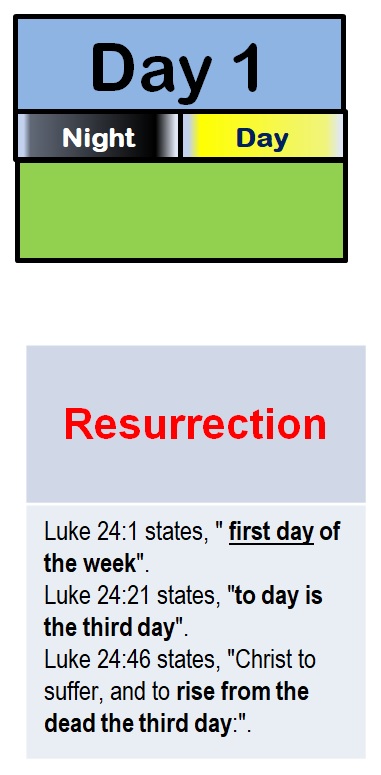
Start with Luke 24, as it was previously discussed immediately above, we know with absolute Truth that the "first day of the week" is the "third day", the day Christ rose from the dead. Understand that this verse and others of the same context that state "first day of the week" are the only verses with direct linkage to the seven day Biblical week; they are the "foundation stone" for the creation of the Biblical weeks and the month of Abib. To understand it fully, illustrate it calendrically, example:
Research the Bible and find other related verses. Prove beyond any doubt the Truth revealed:
Luke 24:1 - Now upon the first day of the week, very early in the morning, they came unto the sepulchre, bringing the spices which they had prepared, and certain others with them.
Luke 24:21 - But we trusted that it had been he which should have redeemed Israel: and beside all this, to day is the third day since these things were done.
Luke 24:46 - And said unto them, Thus it is written, and thus it behooved Christ to suffer, and to rise from the dead the third day:
Mark 16:1 - And when the sabbath was past, Mary Magdalene, and Mary the mother of James, and Salome, had bought sweet spices, that they might come and anoint him.
Mark 16:2 - And very early in the morning the first day of the week, they came unto the sepulchre at the rising of the sun.
Mark 16:9 - Now when Jesus was risen early the first day of the week, he appeared first to Mary Magdalene, out of whom he had cast seven devils.
Matthew 28:1 - In the end of the sabbath, as it began to dawn toward the first day of the week, came Mary Magdalene and the other Mary to see the sepulchre.
John 20:1 - The first day of the week cometh Mary Magdalene early, when it was yet dark, unto the sepulchre, and seeth the stone taken away from the sepulchre.
Review the Truth of the First Day of the Week revealed in Genesis 1:1-5:
1 In the beginning God created the heaven and the earth.
2 And the earth was without form, and void; and darkness was upon the face of the deep. And the Spirit of God moved upon the face of the waters.
3 And God said, Let there be light: and there was light.
4 And God saw the light, that it was good: and God divided the light from the darkness.
5 And God called the light Day, and the darkness he called Night. And the evening and the morning were the first day.
Jesus spiritually died on the cross and was “without form, and void; and darkness” and God created Light; God resurrected Jesus on the First Day of the Week.
Just as Genesis 1:1-5 prophesized the resurrection of Jesus on the First Day of the Week, Jesus proclaimed the same:
I am come a light into the world, that whosoever believeth on me should not abide in darkness. (John 12:46)
There are many other Biblical versus that substantiate that the First Day of the Week is the third day since the crucifixion, and the day Jesus was Resurrected. You should have absolutely no doubt, complete faith in the Word of God that all that has been revealed is the absolute Truth. This is emphasized because a conflict will be revealed which will test your faith in what is the absolute Truth. If you harbor any doubts or disbeliefs, reread and research the Word of God further, pray and request for divine guidance and assistance.
What next? Since we know what the First Day of the Week is, what is the Biblical day of the week that precedes it? If you don't know or have any doubts read all of Genesis 1 and Genesis 2:1-3 to understand the structure of the seven day Biblical week. The day that proceeds the First Day of the Week is the Seventh Day of the Week, the Sabbath.
To understand it fully, illustrate it calendrically, example:
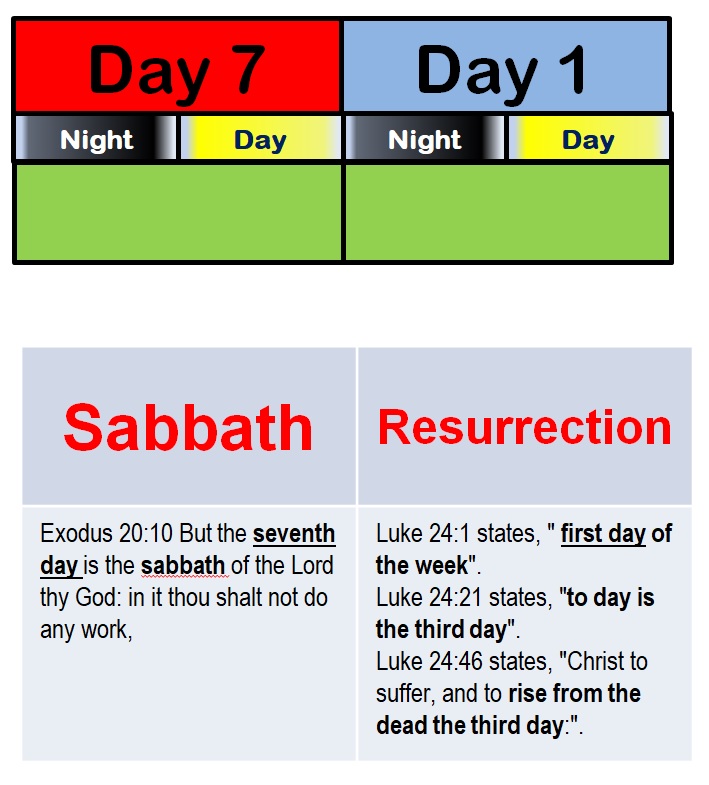
The Seventh Day of the Week, the Sabbath is God's Day. The Bible reveals the very first commandment of the Word of God is contained in the very beginning, in Genesis 2:1-3:
1: Thus the heavens and the earth were finished, and all the host of them.
2: And on the seventh day God ended his work which he had made; and he rested on the seventh day from all his work which he had made.
3: And God blessed the seventh day, and sanctified it: because that in it he had rested from all his work which God created and made.
The emphasis to remember the Seventh Day of the Week, the Sabbath, to keep it Holy, to rest, to bear no burden, to do no work is the most emphasized commandment in the Bible. For a partial list of Biblical versus related to observance of the Sabbath, read this. If you truly comprehend God's reverence for the Seventh Day of the Week, the Sabbath, that he "rested from all his work", it is inconceivable to believe that God would violate His appointed Sabbath, to work, to create Light, to Resurrect Jesus, on the same day he "blessed and sanctified" and prohibited work from.
As the Seventh Day of the Week, the Sabbath is one complete day, then two complete days remain to be identified to fill the three days, third day prophecy. If you read Mr. Armstrong's writings or the Word of God, you know without a doubt, the first day has to be the Passover day and you should be familiar with this verse: Numbers 28:16 - And in the fourteenth day of the first month is the passover of the Lord. The Passover day is also proclaimed a holy day, a "feasts of the Lord" (Leviticus 23:4-5) From this verse we now know a numerical day, the fourteenth day, of a month - what month?
The Truth reveals that the first month of the new year is called Abib (Exodus 12:2 Exodus 13:4). Abib means grain in the ear, just ripening (Exodus 9:31 Leviticus 2:14). The ripening of the grain is associated with springtime in Israel and when associated with the first visible appearance of the New Moon (the crescent moon) as observed from Jerusalem, Israel, it provides a clear sign of the proper New Moon to start the first month in.
From Mr. Armstrong's writings or the Word of God, you should also be familiar with the day that follows Passover in this verse: Numbers 28:17 - And in the fifteenth day of this month is the feast: seven days shall unleavened bread be eaten. Commonly called the first day of the seven day period of the Feast of Unleavened Bread. The first and seventh day of the Feast of Unleavened Bread are proclaimed to be holy convocations, like Sabbath days (Leviticus 23:6-8).
To understand it fully, illustrate both these days information calendrically, example:

You should have noticed that both the Biblical Day of the Week and the numerical day of the month Abib are known for the days identified based solely on the information from verses of the Word of God. You should have absolutely no doubt, complete faith in the Word of God that all that has been revealed is the absolute Truth. This is emphasized because a conflict will be revealed which will test your faith in what is the absolute Truth. If you harbor any doubts or disbeliefs, reread and research the Word of God further, pray and request for divine guidance and assistance.
The next step is to identify the time of Jesus's death on the cross. From Mr. Armstrong's writings or the Word of God, you should be familiar with the following verses:
From Matthew 27:46-50:
-
- 46 And about the ninth hour Jesus cried with a loud voice, saying, Eli, Eli, lama sabachthani? that is to say, My God, my God, why hast thou forsaken me?
- 47 Some of them that stood there, when they heard that, said, This man calleth for Elias.
- 48 And straightway one of them ran, and took a spunge, and filled it with vinegar, and put it on a reed, and gave him to drink.
- 49 The rest said, Let be, let us see whether Elias will come to save him.
- 50 Jesus, when he had cried again with a loud voice, yielded up the ghost.
From Mark 15:34-37:
-
- 34 And at the ninth hour Jesus cried with a loud voice, saying, Eloi, Eloi, lama sabachthani? which is, being interpreted, My God, my God, why hast thou forsaken me?
- 35 And some of them that stood by, when they heard it, said, Behold, he calleth Elias.
- 36 And one ran and filled a spunge full of vinegar, and put it on a reed, and gave him to drink, saying, Let alone; let us see whether Elias will come to take him down.
- 37 And Jesus cried with a loud voice, and gave up the ghost.
From Luke 23:44-46:
-
- 44 And it was about the sixth hour, and there was a darkness over all the earth until the ninth hour.
- 45 And the sun was darkened, and the veil of the temple was rent in the midst.
- 46 And when Jesus had cried with a loud voice, he said, Father, into thy hands I commend my spirit: and having said thus, he gave up the ghost.
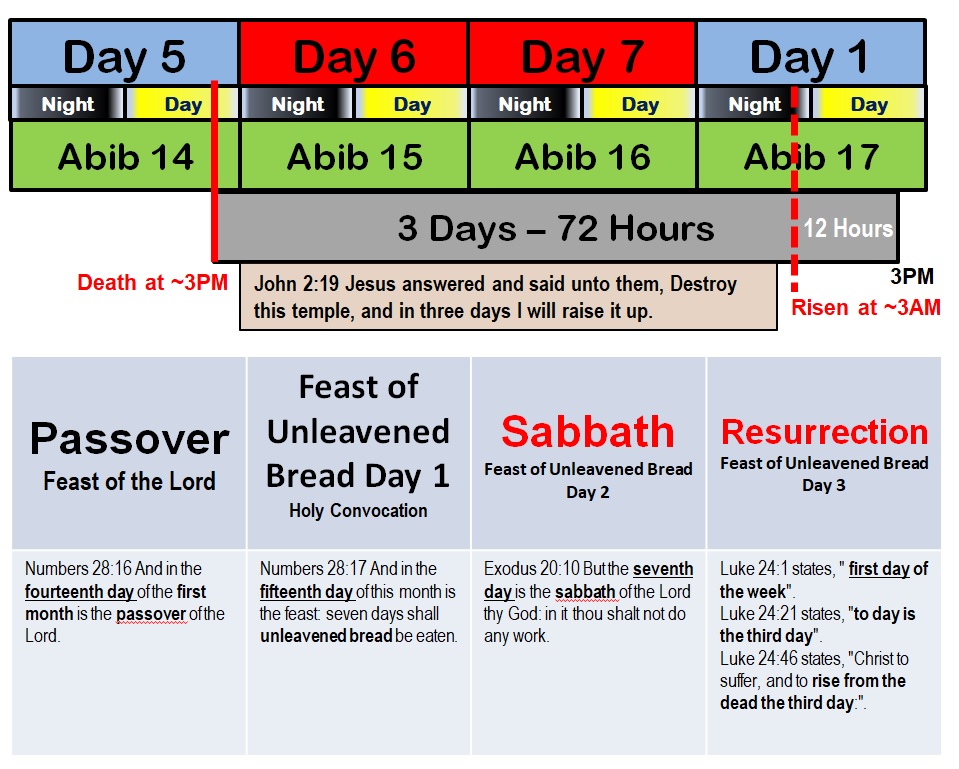
Jesus died soon after "the ninth hour" or three o'clock in the afternoon. Place a 3PM death indicator to illustrate it calendrically.
As previously stated above, when one reads the Matthew 12:40 verse, understand that what the Word of God and Mr. Armstrong accurately proclaim about "three days and three nights" is correctly interpreted as three (3) complete days, where a day consists of 24 hours, where a day begins with darkness followed by lightness (Genesis 1:1-5), and the total of three days is 72 hours.
Therefore, make a rectangular box equal to the length of three (3) days or 72 hours as both Mr. Armstrong's writings or the Word of God accurately state. Place the front side of the rectangular box flush against the 3PM indicator of Jesus's time of death. Label the other end of the rectangular box, 72 hours later at the same time, 3PM.
To understand it fully, illustrate it calendrically, example:

You should immediately notice that the rectangular box equal to the length of three (3) days or 72 hours ends at ~3PM on the First Day of the Week, Abib 17. This projected ~3PM resurrection time directly conflicts with every Biblical verse identified that stated anything similar to "early in the morning" or the first day of the week" and He was risen. How's your absolute faith in the Word of God holding up now? Starting to have doubts? Suspect that something was interpreted wrong?
Mr. Armstrong, along with many other biblical scholars, theologians, and others faced this same crisis of interpretation and crisis of faith. Their choice is evident, they lost faith and disbelieved the Word of God and created their own interpretation. Mr. Armstrong was compelled to attempt to discredit Luke 24:21 "to day is the third day" to justify his created version of events, along with other contradictions of the Word of God.
What is visible to the eye, a undeniable and unresolvable conflict, is still 100% True by the Word of God. If you still maintain absolute faith and belief in the Word of God, you will suspect the Truth is not 100% known or is hidden. In this case, you know without a doubt that disbelief is not the solution, but further review of the Bible and assistance from divine guidance (Holy Spirit) is the only option.
Remember:
And Jesus said, the Whole World and All Nations shall be Deceived (Revelation 12:9 Revelation 18:23).
Matthew 12:39 clearly states "there shall no sign be given to" "An evil and adulterous generation" "but the sign of the prophet Jonas". That no sign is given to an evil and adulterous generation applies to the whole of mankind, unto the present. The sign of Jonas, three days and three nights, was also concealed; only knowable to Man at the appointed time chosen by God with guidance of the Holy Spirit.
Remember from the above discussion, the verse John 11:9, Jesus asked the question, "Are there not twelve hours in the day?" and it is NOT answered by anyone. The question is directed to YOU, the reader. Jesus instructs the reader that one will "stumbleth not" and the answer can be discovered if the reader "walk in the day"(light) and "seeth the light" {is guided by the Holy Spirit}. If the reader "walk in the night"(darkness), and "there is no light in him" {absent of the Holy Spirit} he will "stumbleth" and the answer will remain unknown.
The answer is only obtainable by divine guidance. Inspiration was needed to recognize the 12-hour difference between Moses's and Jesus's Passovers, then discover and find the meaning of verse John 11:9, discover Joshua's long day (Joshua 10:12-14) and realize the 12-hour impact on the heavenly timeline and all prophecies, and finally when the 12-hours were reclaimed by God (Matthew 27:51).
Many will choose to not believe the significance of just 12 hours and its implications, and that is their free-will prerogative. However, they are now aware of the issues and if of faith, must seek their own answers and interpretations. Many if they even choose to read this objectively will be as the seed as stated in Luke 8:11-15.
Those that retain absolute faith in the Word of God, draw a indicator line at 3AM on the First Day of the Week, Abib 17, representing the 12-hours inserted by God on Joshua's long day (Joshua 10:12-14) and reclaimed at the death of Jesus (Matthew 27:51).
Understand with retained absolute faith in the Word of God, that Mr. Armstrong’s assertion that the “three days and three nights” prophecy begins and is measured from the time Jesus is placed in the “grave”, just prior to sunset on the 14th day of Abib, Passover Day, CONTRADICTS the Word of God that Jesus was raised early in the morning on the first day of the Biblical week. Understand that Mr. Armstrong’s assertion that God resurrected Jesus on the Sabbath is ABSOLUTELY FALSE, and blasphemy of the Truth and Righteousness of God.
Her priests have violated my law, and have profaned mine holy things: they have put no difference between the holy and profane, neither have they shewed difference between the unclean and the clean, and have hid their eyes from my sabbaths, and I am profaned among them. (Ezekiel 22:26)
For thus saith the Lord of hosts, the God of Israel; Let not your prophets and your diviners, that be in the midst of you, deceive you, neither hearken to your dreams which ye cause to be dreamed. (Jeremiah 29:8).
But there were false prophets also among the people, even as there shall be false teachers among you, who privily shall bring in damnable heresies, even denying the Lord that bought them, and bring upon themselves swift destruction. (2 Peter 2:1)
To understand it fully, illustrate it calendrically, example:
And, behold, the veil of the temple was rent in twain from the top to the bottom; and the earth did quake, and the rocks rent; (Matthew 27:51)
But of that day and hour knoweth no man, no, not the angels of heaven, but my Father only. (Matthew 24:36)
The secret things belong unto the Lord our God: but those things which are revealed belong unto us and to our children for ever, that we may do all the words of this law. (Deuteronomy 29:29)
The next action is to populate the Biblical seven day week and numerical days of the month of Abib to obtain the first day of the month of Abib. This is necessary to be able to link and overlay the Biblical calendar month of Abib to Man's Gregorian calendar. The common linkage point, or actual day, between the Biblical calendar month and Man's Gregorian calendar is when the first visible appearance of the New Moon (the crescent moon) is observed from Jerusalem, Israel.
To understand it fully, illustrate it calendrically, example:

The first day of the month of Abib of the New Year is on the Sixth Day of the Week – the Day of Man’s Creation by God (Genesis 1:24-31). The beginning of the count of monthly days is from the Sixth Day of the Week.
The final action is to identify all of the month of Abib's Biblical related events to the appropriate day. Then link the Biblical calendar month of Abib and Man's Gregorian calendar when the first visible appearance of the New Moon (the crescent moon) is observed from Jerusalem, Israel.
Example as follows. Man's Gregorian weekday names are at the bottom of the calendar.

All of the information for determining the dates of the Crucifixion & Resurrection and building the month of Abib calendar originated solely from the Word of God. This calendar reflects the absolute Truth of the Word of God and reveals items of profound significance.
The free-will choice of belief or not remains solely yours. May God bless and guide your decision.
I stand in testament of the Truth and Fulfillment of Jesus's prophecy of Deception:
And Jesus said, the Whole World and All Nations shall be Deceived (Revelation 12:9 Revelation 18:23).


0 Comments