USCG Navigation Rules and Regulations Handbook

USCG Navigation Rules and Regulations Handbook

  • Action: To Do List item A0035 – Obtain current up-to-date paper copy of USCG Navigation Rules and Regulations Handbook.
  • Completed: 16 May 2017
  • Cost: $8.99


On 23 February 2017, ordered a paper copy of the 2017 USCG Navigation Rules and Regulations Handbook from Amazon. It was shipped to our balikbayan box consolidator and forwarder Manila Forwarder in Los Angles, California and received there on 1 March 2017. We received them in Naga City, Cebu on 16 May 2017.

This handbook will be kept at Indra's navigation desk.  This book is available freely in PDF format on the internet at the USCG Navigation Center website.

Propeller and Shaft Zinc

Propeller and Shaft Zinc

Propeller and Shaft Zinc


  • Action: To Do List item A0062 – Replace existing cutlass bearing housing zinc.
  • Action: To Do List item A0063 – Ensure installation of proper zinc with bond path to propeller/shaft.
  • Completed: 21 February 2017
  • Cost: $76.38


The issue of dezincification of the propeller due to no zinc protection caused by the cutlass bearing rubber insert isolating the shaft from the cutlass bearing housing zinc had us stymied until we noticed "something missing" when we removed the propeller shaft to access the stuffing box hose.   To remove the propeller shaft the stuffing box was opened up exposing the packing gland cavity, the hose clamps were removed, and the hose removed from both fitting ends.  Next removed the lock wire from the propeller shaft transmission coupling set screws, remove the two set screws, and removed the four coupling mount bolts.  The propeller shaft was moved aft to mount a puller on the 4 inch diameter coupling and remove it.  The shaft was then pulled aft and removed with the propeller still mounted on the shaft.

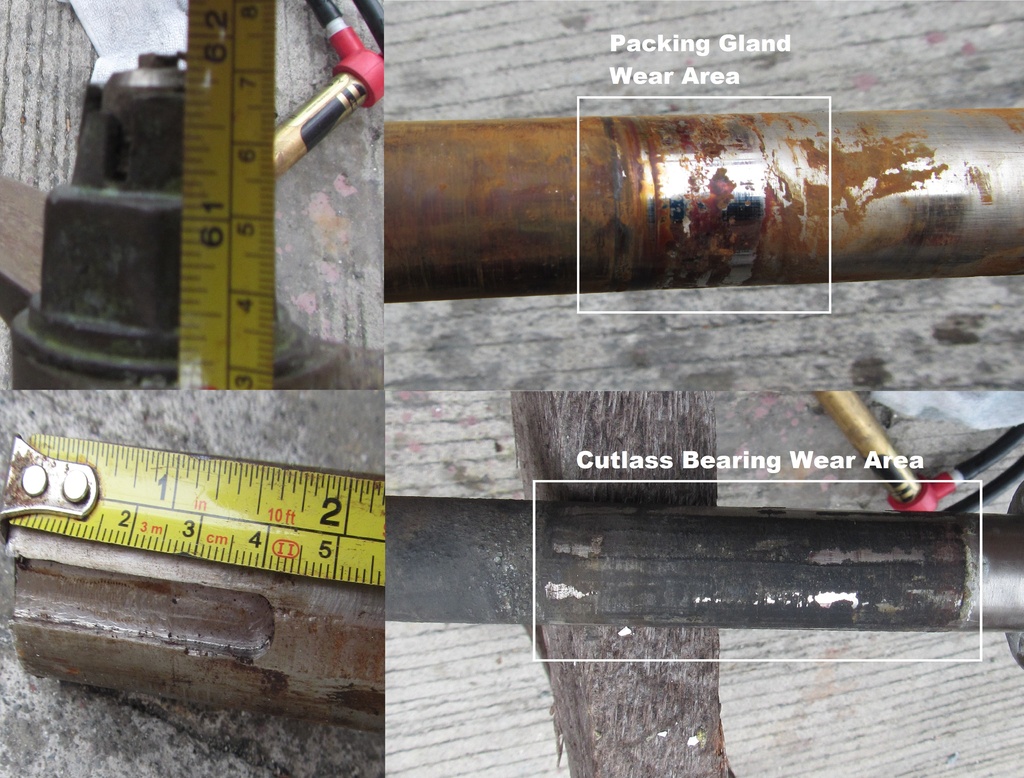
The 1.25 inch propeller shaft measured 62 inches long and exhibited corrosion and wear at both the packing gland and cutlass bearing areas.

Used sandpaper and sanded the propeller shaft which removed the corrosion and other surface contaminations.

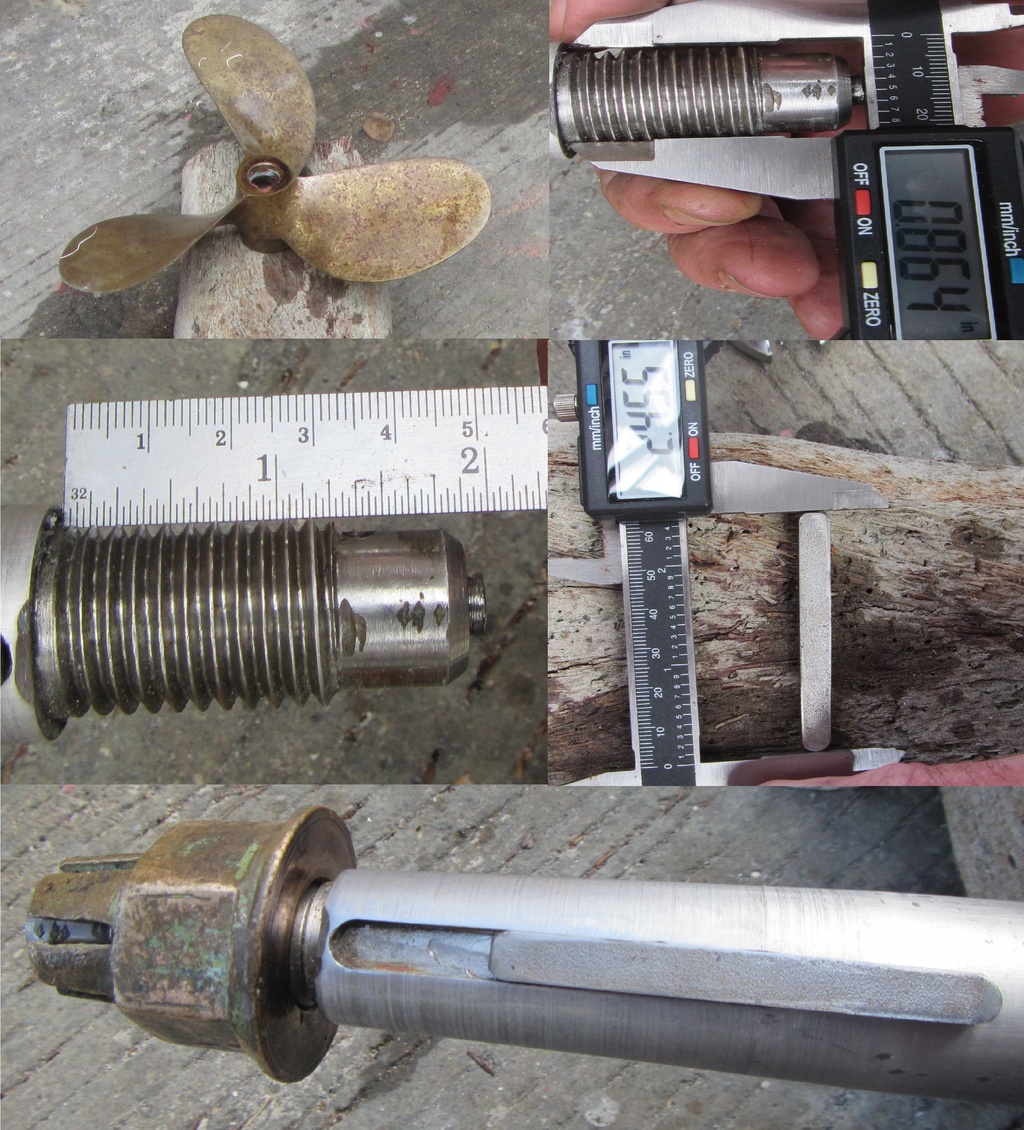
Removed the 2 inch long cotter pin from the propeller nut and the nut was removed without much effort.  Using the same puller that was used to remove the transmission coupling, unsuccessfully attempted to remove the propeller.  The additional use of a 5 pound sledge hammer with the puller freed the propeller from the shaft.  Measurement of the shaft threads indicated the thread size as 7/8 inch with 9 threads per inch.  The shaft cotter key measured 2.45 inch long by 0.30 inch wide by 0.234 inch high.

Closer inspection of the bronze propeller nut revealed that one of the six tangs used to secure the cotter pin was shorter, most likely broken off.  While researching the internet, it was discovered that only one image of bronze propeller nuts matched the nut shape and six tangs exactly - it was a Bronze Propeller Nut With Zinc Anode Model D as found on BoatZincs.com website.   However this also meant that a larger portion of the bronze nut had broken off at sometime in the past.   A check of old logs of previous owners confirmed this - the Musiaks, who owned the boat from February 1996 through July 2001, spare parts log listed a "Propshaft Zinc - Size D".  Additionally, an old picture of Indra from 2004 showed a propeller shaft zinc was installed.  A propeller nut D with zinc anode (1-1/4"), two spare replacement zinc anodes, and three spare mount screws were ordered from BoatZincs.com website for a cost of $76.38.  The To Do List item A0062 – Replace existing cutlass bearing housing zinc, was no longer needed and the zinc and bond wire were deleted.

Since the propeller shaft was removed, decided it would be beneficial to order and replace the cutlass bearing.  To determine the length of the 2 inch outer diameter cutlass bearing, it was removed.  Attempts to turn or pull the cutlass bearing out failed, so a chisel was use to cut it and remove it.  The cutlass bearing measured 4 inches long, was made by Duramax Marine, and was the DORIS composite model for 1.25 inch shafts, 2 inch outer diameter, and was 4 inches long.

Added to the To Do List:

  • A0195 – Order replacement and spare cutlass bearing and install.


Boomkin Stay Mount Brackets

Boomkin Stay Mount Brackets

  • Action: To Do List item A0071 – Replace corroded boomkin stay mount brackets.
  • Action: To Do List item A0073 - Add ground/bonding path from boomkin stay mount brackets to primary zinc.
  • Action: To Do List item A0074 - Determine if external zinc can be mounted on boomkin bracket’s lowest point.
  • Action: To Do List item A0106 - Make and install boomkin stay mount bracket stainless steel backing plates with new mount hardware.
  • Completed: 11 February 2017
  • Cost: $281.13


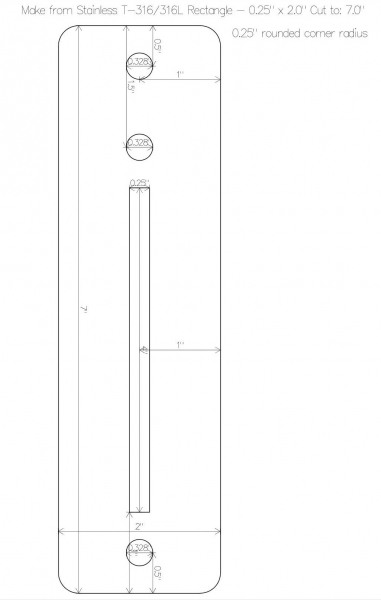
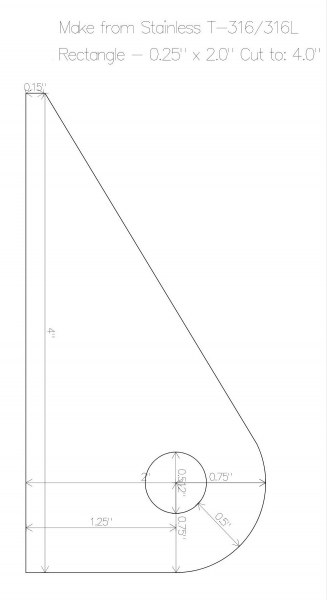
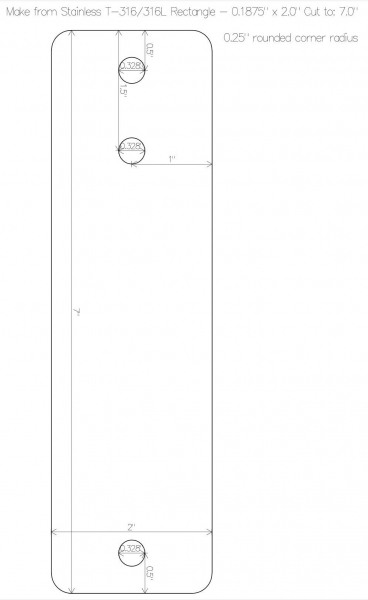
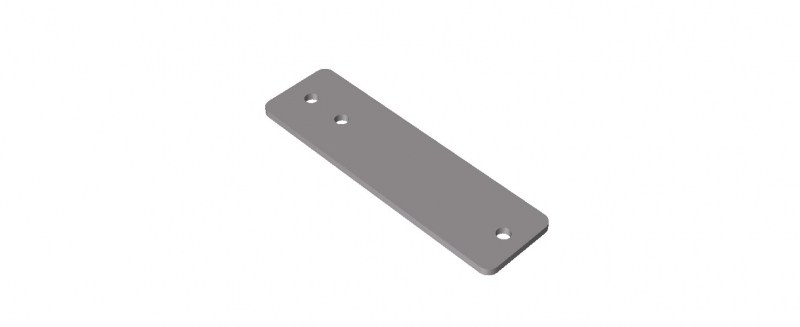
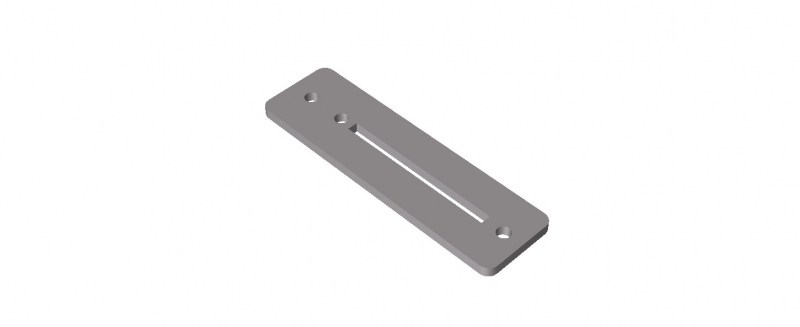
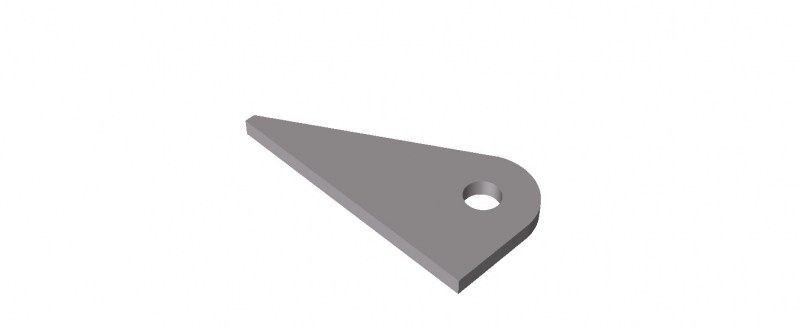
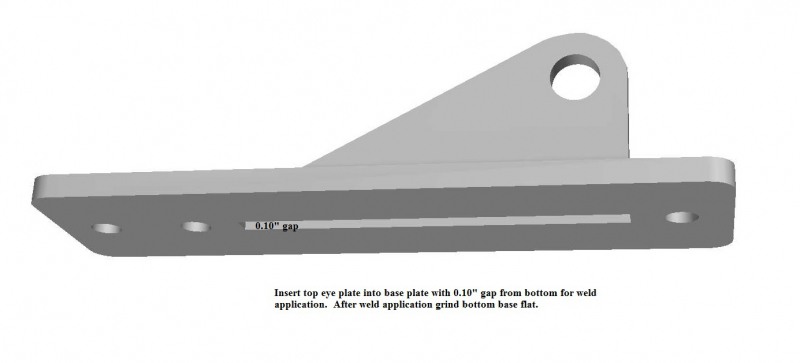
The first step was to measure and duplicate the existing mount bracket design and new backing plates on paper as shown below.  The original mount brackets were suspected to be made of 304-series steel as they were magnetic and the base was 1/8 inch thick.  The new material chosen was 316-series stainless steel 0.25 inch thick for the brackets and 0.1875 inch thick for the backing plates.

Based on the design ordered the 316-series stainless steel material precut to 4 and 7 inch long by 2 inch wide pieces from OnlineMetals.com at a total cost with shipping of $141.98.  For mount hardware selected 5/16"-18 x 2" Grade 316 stainless steel hex cap screws, nylon insert lock nuts, and flat washers from the Fastenal Company website at a cost of $14.61.  Purchased a box of 50 316L welding rods locally for Peso 915 (US $19.06).  When the material arrived 2 months later, selected a local Filipino machine shop to fabricate the four sets of mount brackets - two sets are reserved for spares.  It took them over 2 weeks to complete at a charge of Peso 4,000 (US $83.33).

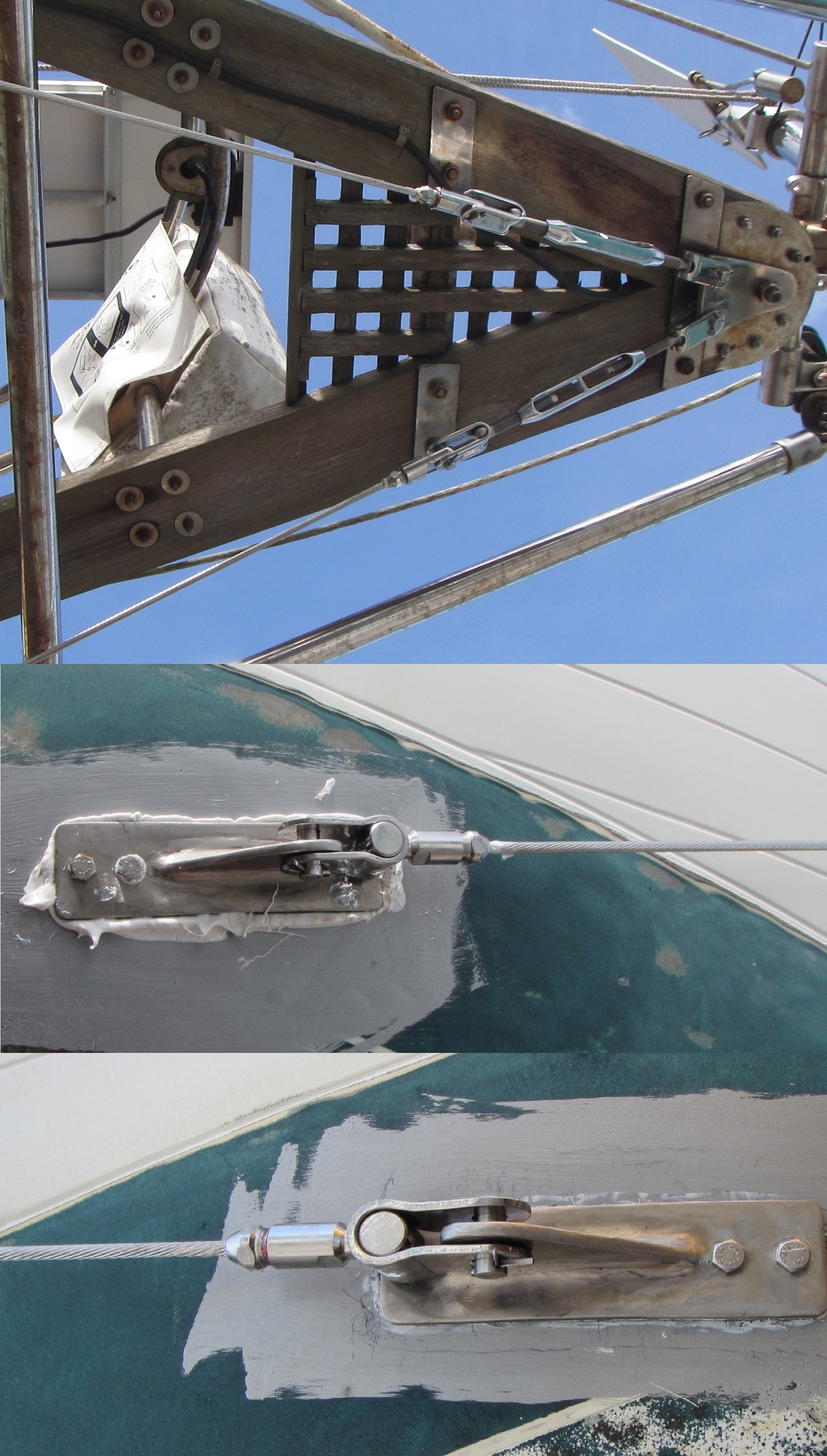
Prior to installation of the mount brackets, both the exterior and interior mount surfaces were sanded with 80 grit and cleaned.  The brackets and mounting hardware were test installed and had to re-drill a few holes to achieve proper alignment for the backing plates to the mount brackets.  Then applied two coats of Interlux InterProtect HS Epoxy Primer YPA420/422 Gray to both exterior and interior mount surfaces.  Used a cartridge of 3M Marine Adhesive Sealant Fast Cure 4200FC White ($22.15) to seal the brackets and bolt holes on final installation.  After the sealant had cured used a razor blade to trim off the excess sealant on the exterior mount brackets.

In the pictures above, a 10 gauge green wire is attached on the lower mount bolt.  This wire is routed aft and attaches to a bolt the secures the installation for the aft primary zinc; the wire run is approximately 4.0 feet long.  This wire serves as the ground/bonding path from boomkin stay mount brackets to primary zinc and exterior metal point-to-point continuity check with electrical meter showed a 0.001 level of resistance.  This fulfills To Do List item A0073 - Add ground/bonding path from boomkin stay mount brackets to primary zinc, and also To Do List item A0074 - Determine if external zinc can be mounted on boomkin bracket’s lowest point.  It was decided not to attach an externally mounted zinc to the mount bracket lowest bolt since the electrical meter continuity check had extremely low resistance and "should" minimize any future corrosive action to the mount brackets.


Boomkin Stay Rigging

Boomkin Stay Rigging

  • Action: To Do List item A0072 - Replace boomkin stay rigging.
  • Action: To Do List item A0171 – Replace both boomkin stay turnbuckles and stay rig wire.
  • Action: To Do List item A0172 – Obtain new boomkin stay double toggle triangle bracket mount bolt nuts.
  • Completed: 11 February 2017
  • Cost: $482.28


The problems of bent turnbuckles and corrosion were the principal reasons for changing the boomkin stay rigging, besides the age of the rig.  As we had previously changed the whisker and bobstay stay rigging, we felt confident in this task.  First we did the recommended pin-to-pin measurements which for the starboard stay was 9′ 2″ and the port stay was 9' - the difference of two inches between the stays was attributed to the difference in the position of the stay mount brackets on the aft hull.   The rigging was removed and placed on the ground for further measurements.

When the rig was placed on the ground, noticed another rig pin with pit corrosion.

The boomkin stay mount bracket bolts had corrosion present and two nuts had no bolt threads showing - the bolt lengths were to short.  Replaced five of the six bolts with 5/16"-18 x 2-1/2" Grade 316 stainless steel hex cap screws and nylon insert lock nuts obtained from the Fastenal Company website at a cost of $8.75.  Also obtained  three 5/8"-11 Grade 316 stainless steel nylon insert lock and three regular nuts from the Fastenal Company website at a cost of $16.77 for the triangle stay bracket primary attach bolt stud - the previous nut had disintegrated on removal due to excessive corrosion and metal fatigue stress.

A Sta-Lok Swageless Terminal toggle fork was attached to the end of 1/4 inch 316 stainless steel wire.  Regular pliers were used to unravel the outer wire strands with a simple single twist.  The slide wedge cone was placed on the inner wire strands and positioned for initial assembly.   The assembly was screwed together and then disassembled revealing correct bend of the wire ends.  Applied  a little Forespar LanoCote anti-corrosive paste to the wire ends, applied 3M Marine Adhesive/Sealant Fast Cure 4200 ($19.14) into the fitting cap, and red thread locker on the threads, prior to final tightening.  The desired result was obtained as the sealant oozed up and out the terminal end sealing off the wire from possible water intrusion.

With the toggle fork attached to the 1/4 inch wire, it was held in place with a large screw driver with the end of the old original rigging stay, so final measurement could be performed.  The length of wire for the port stay was cut at 7' 8.5"  and the starboard stay was cut at 7' 10.5".  Next attached the Sta-Loc 1/2 inch pin eye terminal to the end of the wire.  The eye terminals were attached to the new Hayn Marine turnbuckles, and then were attached to the triangle mount bracket.

The rig assembly was installed and tightened.

The cost for each assembly is listed below:


  Boomkin Shroud - Starboard - 1/4" 1x19 316 SS cable (94.5in)    
150-06 Sta-Lok Toggle Fork 1/4 wire 1/2 pin 1 $73.34
141x19316 1/4" 1x19 type 316 stainless 9 $15.75
133-06 Sta-Lok Eye - 1/4" wire X1/2" pin 1 $38.95
12TFBJ Jaw To Jaw TFB 1/2" Jaw 1/2" Pin 1 $90.77
      $218.81
  Boomkin Shroud - Port - 1/4" 1x19 316 SS cable (92.5in)    
150-06 Sta-Lok Toggle Fork 1/4 wire 1/2 pin 1 $73.34
141x19316 1/4" 1x19 type 316 stainless 9 $15.75
133-06 Sta-Lok Eye - 1/4" wire X1/2" pin 1 $38.95
12TFBJ Jaw To Jaw TFB 1/2" Jaw 1/2" Pin 1 $90.77
      $218.81
LPG Stove BSP-SAE Adapter

LPG Stove BSP-SAE Adapter

  • Action: To Do List item A0141 – Obtain 1/4 inch BSP male to 3/8 inch SAE male union adapter.
  • Completed: 2 February 2017
  • Cost: $38.04


The search on the internet for a 1/4 inch BSP male to 3/8 inch SAE male union adapter for the stove connection yielded potential sources in Australia and New Zealand.

    However, each Australia and New Zealand dealer's online web page stated they did not ship internationally.  Their local cost for this adapter ranged from US 2 to 4 dollars.  Was not able to locate this item at a US based dealer.  By chance found it on a E-Bay site based in Australia, with international shipping, and ordered it from there.  The cost of the adapter was $13.91, with shipping charge of $21.89, plus local Philippine Custom charge of $2.24 - all costs converted to US dollars.  Item was received two weeks after ordering.


    Personal Flotation Devices (PFD)

    Personal Flotation Devices (PFD)

    • Action: To Do List item A0008 – Obtain one manually activated PFD with harness. ($136.15)
    • Action: To Do List item A0009 – Obtain one automatically activated PFD with harness.  ($156.39)
    • Action: To Do List item A0010 – Obtain four spare CO2 cartridges. ($99.32)
    • Action: To Do List item A0012 – Obtain three personal life jacket water activated distress lights. ($66.93)
    • Completed: 10 January 2017
    • Total Cost: $458.79


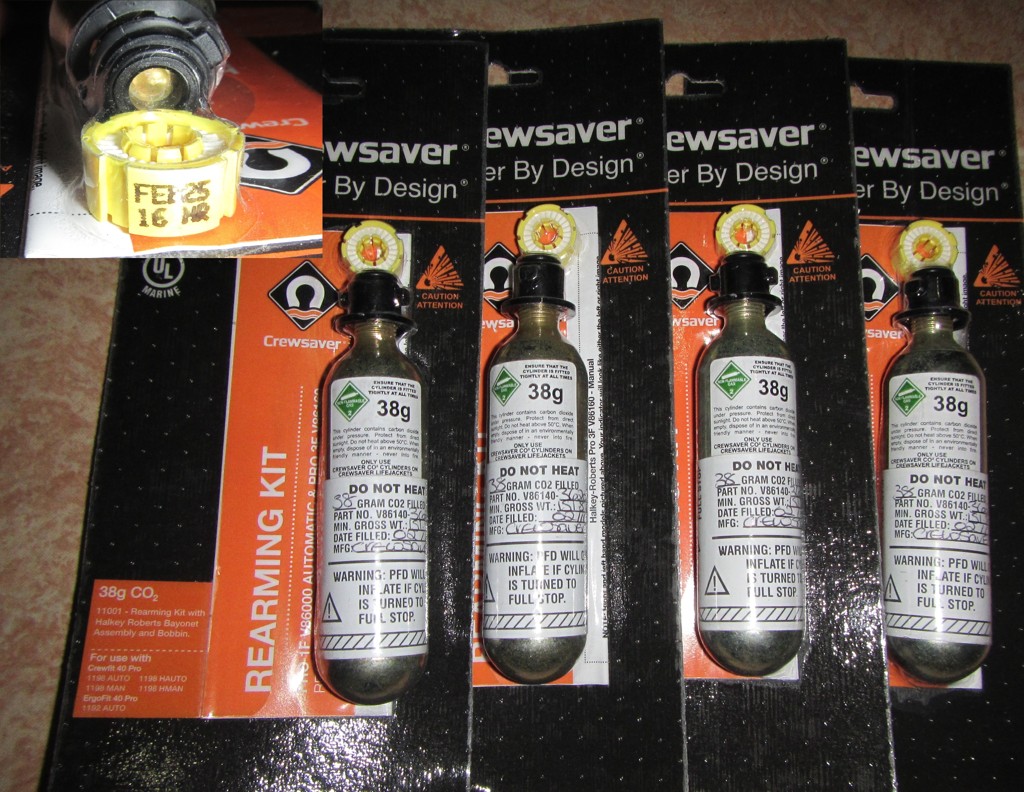
    The Personal Flotation Device (PFD), more commonly called a life vest or lifejacket, we selected are the Crewsaver Crewfit 40 Pro USCG PFDs - one automatic PFD with harness cost $156.39 and one manual PFD with harness cost $136.15.  We also ordered four spare CO2 cartridges rearm kits at a cost of $24.83 each.  These were ordered on 17 October 2016 and shipped to our balikbayan box consolidator and forwarder Manila Forwarder in Los Angles, California and received there on 25 October 2016. We received them in Naga City, Cebu on 7 January 2017. 

      Review of the PFD owners manual revealed inspections were recommended for three time frames:  1. Before Each Use.  2.  Every Two (2) Months.  3.  Annually.  The Before Each Use inspection was to simply verify the status indicator was green and perform a visual inspection for any damage.  The Every Two (2) Months inspection required oral inflation followed by a minimum 16 hour leak check and a leak check of the oral inflation valve.  Then perform a PFD repack followed by the Before Each Use inspection.  The Annual inspection only added to the Every Two (2) Months inspection, a check of the automatic inflator bobbin to verify date of manufacture was not over three years old; this check does not apply to a manually inflated PFD.  The Every Two (2) Months and Annual inspection requirements were added to our master tracking list of Periodic Maintenance Requirements.


        The Crewsaver Crewfit 40 Pro USCG PFDs website contained a downloadable brochure for this PFD but does not have the owners manual available for download.  The paper copy of the owners manual has a color scheme and small font size that actually makes it difficult to read.  It has a section labeled "WHY ARE PFDS REQUIRED SAFETY EQUIPMENT?" where it states the USCG recommendation:  "Since you should replace the bobbin each year, the U.S. Coast Guard recommends you test the automatic inflation system in-the-water at the beginning of each boating season."  This statement "should replace the bobbin each year" is not consistent with the manufacture's statement "Replace if the bobbin is over three years old."  Something in these two statements does not pass the common sense/consistency test. 

          At issue is the manufacture Crewsaver inspection instructions "requires" only an oral inflation test every 2 months while the USCG "recommends" an annual actual CO2 cylinder inflation of the PFD. "Recommends" and "should" used by the USCG are not mandatory phrases, so to heed the USCG PFD inspection recommendations is voluntary. Common sense would dictate that a CO2 cylinder inflation is a more robust test of the PFD to determine its reliability and serviceability versus a benign oral inflation test. We are opting to use the annual USCG recommendation and it was added to our master tracking list of Periodic Maintenance Requirements.

          Prior to purchase, sent an email to Crewsaver and requested a copy of the Crewfit 40 Pro USCG owner’s manual and identified it was not available for download on their website.  A week later they responded and sent a PDF file containing the Ergofit Pro 40 UL Owners Manual - it was not the correct or same manual that was furnished with the PFDs purchased.  The Crewfit 40 Pro USCG PFD owners manual that came with the PFD was scanned to a PDF file for retention, as paper copies of anything in a boat environment are at risk.

          Inspected both PFDs and performed both oral inflation and valve leak checks which passed.  The automatic inflator bobbin installed in the automatic PFD with harness had a date of manufacture of 3 Nov 2015.

           

            Selected three ACR C-Strobe H2O Personal Distress Strobe Lights at a cost of $19.31 each.  These required two AA 1.5 volt batteries each and were not included.  Bought two packages (one spare set) of eight AA batteries in the Philippines which cost about $9.00.  Manufacture recommended the batteries be changed annually - this was added to our master tracking list of Periodic Maintenance Requirements.


              Next installed two AA batteries in the ACR C-Strobe H2O Personal Distress Strobe Light and verified it's operation.  Check of batteries for corrosion and operation of strobe light was added to the Every Two (2) Months inspection requirements of the PFD.  The strobe light was then attached to the PFD oral inflator tube.  The PFDs came equipped with a whistle and lanyard already attached to the oral inflator tube.  The PFDs were repacked per manufacture instructions and are ready for use. 

                The rearm kits automatic inflator bobbins all had a date of manufacture of 25 Feb 2016.  This means about 1/3 of it's shelf life had already passed when purchased and finally received.  Based on the manufacture's specified service life of 3 years, it would be prudent to verify the date of manufacture before purchasing rearm kits.  The purchase of four rearm kits at the same time, without knowing the date of manufacture and it's 3 year service life, appears to be a wrong choice/decision.  For spare provisions added the requirement to purchase two rearm kits annually. All the automatic inflator bobbins date of manufacture were added to our master tracking list of Periodic Maintenance Requirements with projected expiration dates.  The rearm kits were placed/stowed in a Ziploc plastic bag to provide some level of environmental protection.