
- Action: To Do List item A0008 – Obtain one manually activated PFD with harness. ($136.15)
- Action: To Do List item A0009 – Obtain one automatically activated PFD with harness. ($156.39)
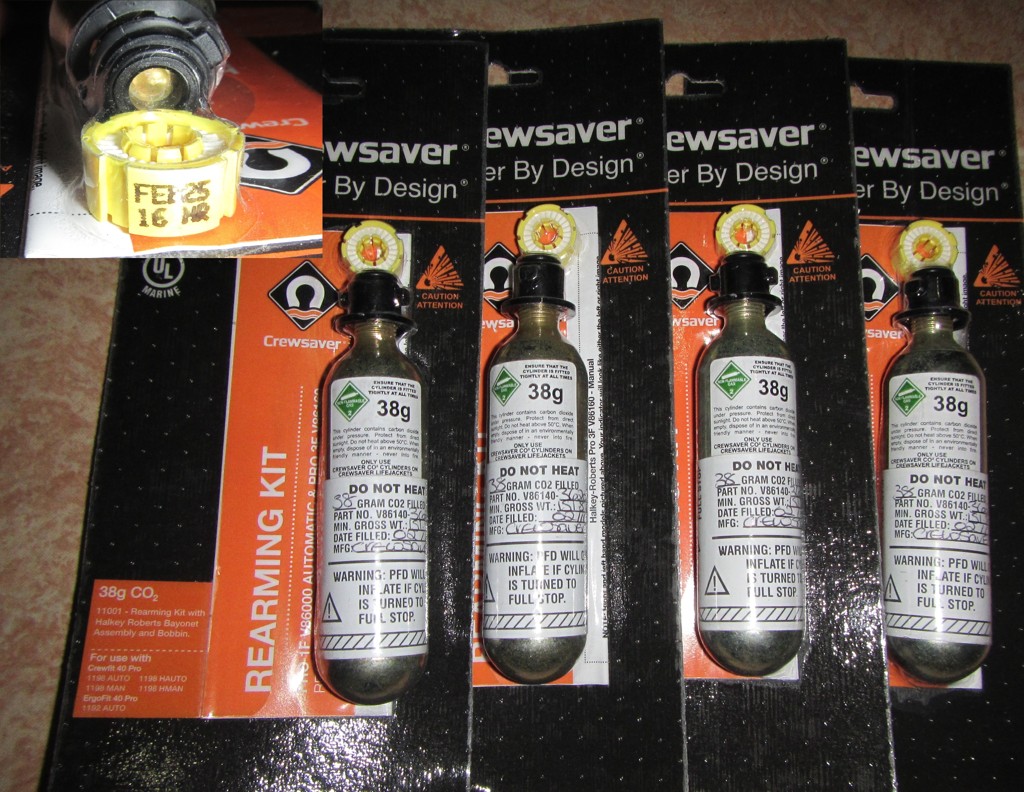
- Action: To Do List item A0010 – Obtain four spare CO2 cartridges. ($99.32)
- Action: To Do List item A0012 – Obtain three personal life jacket water activated distress lights. ($66.93)
- Completed: 10 January 2017
- Total Cost: $458.79
The Personal Flotation Device (PFD), more commonly called a life vest or lifejacket, we selected are the Crewsaver Crewfit 40 Pro USCG PFDs - one automatic PFD with harness cost $156.39 and one manual PFD with harness cost $136.15. We also ordered four spare CO2 cartridges rearm kits at a cost of $24.83 each. These were ordered on 17 October 2016 and shipped to our balikbayan box consolidator and forwarder Manila Forwarder in Los Angles, California and received there on 25 October 2016. We received them in Naga City, Cebu on 7 January 2017.

Review of the PFD owners manual revealed inspections were recommended for three time frames: 1. Before Each Use. 2. Every Two (2) Months. 3. Annually. The Before Each Use inspection was to simply verify the status indicator was green and perform a visual inspection for any damage. The Every Two (2) Months inspection required oral inflation followed by a minimum 16 hour leak check and a leak check of the oral inflation valve. Then perform a PFD repack followed by the Before Each Use inspection. The Annual inspection only added to the Every Two (2) Months inspection, a check of the automatic inflator bobbin to verify date of manufacture was not over three years old; this check does not apply to a manually inflated PFD. The Every Two (2) Months and Annual inspection requirements were added to our master tracking list of Periodic Maintenance Requirements.

The Crewsaver Crewfit 40 Pro USCG PFDs website contained a downloadable brochure for this PFD but does not have the owners manual available for download. The paper copy of the owners manual has a color scheme and small font size that actually makes it difficult to read. It has a section labeled "WHY ARE PFDS REQUIRED SAFETY EQUIPMENT?" where it states the USCG recommendation: "Since you should replace the bobbin each year, the U.S. Coast Guard recommends you test the automatic inflation system in-the-water at the beginning of each boating season." This statement "should replace the bobbin each year" is not consistent with the manufacture's statement "Replace if the bobbin is over three years old." Something in these two statements does not pass the common sense/consistency test.

At issue is the manufacture Crewsaver inspection instructions "requires" only an oral inflation test every 2 months while the USCG "recommends" an annual actual CO2 cylinder inflation of the PFD. "Recommends" and "should" used by the USCG are not mandatory phrases, so to heed the USCG PFD inspection recommendations is voluntary. Common sense would dictate that a CO2 cylinder inflation is a more robust test of the PFD to determine its reliability and serviceability versus a benign oral inflation test. We are opting to use the annual USCG recommendation and it was added to our master tracking list of Periodic Maintenance Requirements.
Prior to purchase, sent an email to Crewsaver and requested a copy of the Crewfit 40 Pro USCG owner’s manual and identified it was not available for download on their website. A week later they responded and sent a PDF file containing the Ergofit Pro 40 UL Owners Manual - it was not the correct or same manual that was furnished with the PFDs purchased. The Crewfit 40 Pro USCG PFD owners manual that came with the PFD was scanned to a PDF file for retention, as paper copies of anything in a boat environment are at risk.
Inspected both PFDs and performed both oral inflation and valve leak checks which passed. The automatic inflator bobbin installed in the automatic PFD with harness had a date of manufacture of 3 Nov 2015.

Selected three ACR C-Strobe H2O Personal Distress Strobe Lights at a cost of $19.31 each. These required two AA 1.5 volt batteries each and were not included. Bought two packages (one spare set) of eight AA batteries in the Philippines which cost about $9.00. Manufacture recommended the batteries be changed annually - this was added to our master tracking list of Periodic Maintenance Requirements.

Next installed two AA batteries in the ACR C-Strobe H2O Personal Distress Strobe Light and verified it's operation. Check of batteries for corrosion and operation of strobe light was added to the Every Two (2) Months inspection requirements of the PFD. The strobe light was then attached to the PFD oral inflator tube. The PFDs came equipped with a whistle and lanyard already attached to the oral inflator tube. The PFDs were repacked per manufacture instructions and are ready for use.

The rearm kits automatic inflator bobbins all had a date of manufacture of 25 Feb 2016. This means about 1/3 of it's shelf life had already passed when purchased and finally received. Based on the manufacture's specified service life of 3 years, it would be prudent to verify the date of manufacture before purchasing rearm kits. The purchase of four rearm kits at the same time, without knowing the date of manufacture and it's 3 year service life, appears to be a wrong choice/decision. For spare provisions added the requirement to purchase two rearm kits annually. All the automatic inflator bobbins date of manufacture were added to our master tracking list of Periodic Maintenance Requirements with projected expiration dates. The rearm kits were placed/stowed in a Ziploc plastic bag to provide some level of environmental protection.