Standing Rigging Replacement – Summary

Standing Rigging Replacement – Summary

Standing Rigging Replacement - Summary

  • ActionTo Do List item A0169 – Obtain proper hardware to mount Profurl Basic Model B35M manual reefing-furling system per manufactures instructions.
  • Action: To Do List item A0170 – Obtain proper hardware to mount Profurl Classis/Elite Model NC32 manual reefing-furling system per manufactures instructions.
  • Action: To Do List item A0173 – Replace all turnbuckles and rigging wire.
  • Completed: 25 August 2018
  • Cost: $5,851.84


The invoice totals for all standing rigging material came to $5,851.84. This total includes taxes and shipping, sealants, and some spare material which is not accounted for in the individual posts - thus the differences. The cost for ocean freight shipment is not included, but for the size and volume of all the rigging material this would be about one box at $140.00, with a two-to-three month delivery estimate.

Individual posts on rigging replacement are as follows:


Post Date Cost
Bowsprit Whisker and Bobstay Rigging 4 November 2016 $822.80
Boomkin Stay Rigging 11 February 2017 $482.28
Lower Shrouds 4 April 2017 $952.68
Intermediate Shrouds 26 April 2017 $412.14
Running Backstays 26 April 2017 $274.80
Inner Forestay Shroud 19 March 2018 $409.94
Cap Shrouds 20 March 2018 $761.66
Backstay Shroud 21 March 2018 $738.67
Forestay Shroud 25 August 2018 $442.92
  $5,297.89


General impression overall - rigging replacement is really not that complex or hard to do - definetly a Do-It-Yourself (DIY) project.


Standing Rigging Replacement – Summary

Standing Rigging Replacement – Forestay Shroud

Forestay Shroud

  • Action: To Do List item A0169 – Obtain proper hardware to mount Profurl Basic Model B35M manual reefing-furling system per manufactures instructions.
  • Action: To Do List item A0173 – Replace all turnbuckles and rigging wire.
  • Completed: 25 August 2018
  • Cost: $442.92


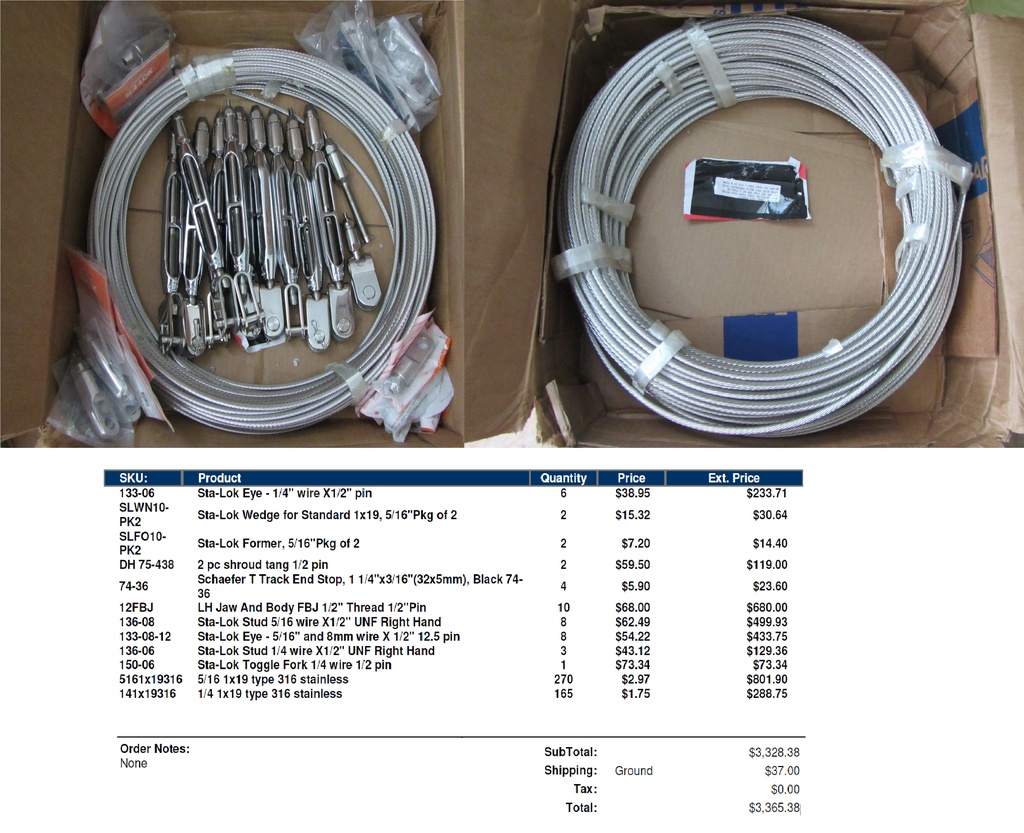
Ordered and received the following items for the forestay shroud:

Forestay Shroud - 5/16" 1x19 316 SS cable Q Cost
5161x19316 5/16" 1x19 type 316 stainless 50 $148.50
12FBJ Hayn Jaw Body Only Turnbuckles - Pin Diameter: 1/2", Wire Diameter: 5/16" Turnbuckle Length: 6.5", Thread size: 1/2-20 L.H 1 $68.00
136-08 Sta-Lok Stud 5/16 X1/2" UNF Right Hand 1 $62.49
133-08-1/2 Sta-Lok Eye - 5/16" and 8mm wire X 1/2" 12.5 pin 1 $54.22
12ERLH Threaded Eye 1/2 pin and thread left 1 $19.65
12-323 Double Jaw Toggles 1/2 pin 1 $53.88
P039212 Profurl THREADED CLEVIS PIN -32 10MM 1 $8.19
50010 PIN WASHER D=10 C32 2 $6.30
00094 LOCKNUTS M12 FOR P40 SYTEMS AND 35 AND 42 CLEVIS PINS 2 $7.14
50011 12mm PLASTIC WASHER FOR 35, 42 CLEVIS PIN 2 $6.52
RP122 Rigging Pin 1/2" DIA. X 2" Grip 1 $8.03
$442.92


The forestay shroud was encapsulated by a Profurl Basic Model B35M manual reefing-furling system. However, the attachment of the Profurl extension plates directly to the cranse iron mount hole violates the Profurl installation instructions.  The additional parts to correct this improper installation were also ordered and received as the parts table above illustrates.

The furler rope was removed from the reefing-furling system drum. The nuts were removed from the clevis pin at the lower attach point and the Profurl extension plates slid off allowing the reefing-furling assembly to attempt to be lifted up along the forestay shroud wire. The swaged end of the old turnbuckle was jammed into base of furler which was extremely difficult to remove - this furler was NOT installed correctly. After the turnbuckle swaged end was freed, was able to loosen the threads of the turnbuckle and free it from the assembly so it could slide up the wire path.

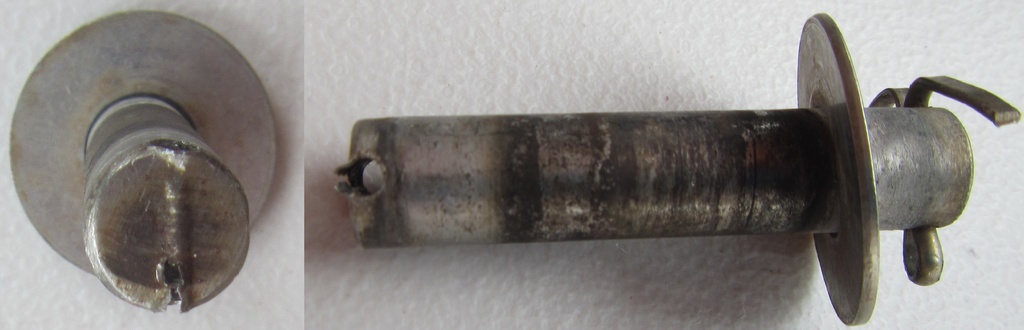
Next, climbed the mast and removed the upper clevis pin securing the forestay furler shroud top. Removal of the rig pin that supports the double jaw toggle revealed its cotter pin had almost pulled through the metal as shown below.

Using a spare halyard rope, lowered the furler assembly to the ground. Another halyard was used to secure the mast upright.

The following pictures illustrate the connection points of the aluminum extrusions.  Each connection point was fixed with four Allen head set screws.  Each connection point needed to be disassembled and split apart to feed the new 5/16-inch 316 stainless steel wire through.  It was extremely challenging to break the set screws free as they were most likely set in place with some type of adhesive sealant.

The original wire eye-to-eye length was about 47 feet 3 inches.  The wire cut length was about 46 feet 1 inches.

With the Sta-Loc Eye terminal attached at the top of the wire, threaded the wire down through each of the aluminum extrusion connection points and used red Loctite to secure the set screws.  The wire was them connected to the turnbuckle. The entire assemble was then hoisted aboard using a halyard and the top eye terminal attached to the new rig pin with new washers and cotter pins that holds the new double jaw toggle. 

The cranse iron mount hole was de-burred and sanded smooth. The new double jaw toggle with 1/2 inch rig pin fit checked ok and moved without binding. The base of the furler assembly was attached to the cranse iron with a double jaw toggle and new 1/2-inch clevis and cotter pin.  The top portion of the double jaw toggle had the threaded clevis pin and nuts attached with the Profurl extension plates; correcting the original improper installation - the Profurl reefing-furling system now had full articulation of movement minimizing stress loading of the installation. 

Caframo Bora Fan

Caframo Bora Fan

Caframo Bora Fan


  • Action: To Do List item B0289 - Replace fan on starboard side of the forward main cabin wall.
  • Completed: 12 April 2018
  • Cost: $66.45


A black Caframo model 747 Ultimate 12 Volt DC fan was installed on the starboard side of the forward main cabin wall; its manual is available on manufactures new website.  It was electrically connected by a 12 volt cigarette-lighter style plug inserted into a 12 volt receptacle.  On more than one occasion as we passed by it, our arm was struck by the rotating fan blades - ouch! - this would have to change.  Added to the To Do List item B0289 to replace this fan.  The existing fan would be retained and relocated to a different location.


Researching the internet yielded many options, but Practical Sailor reviews and a large base of customers comments narrowed our decision to a model 748CAWBX Caframo Bora fan as the replacement.  This fan had a protective fan blade grill enclosure so it would reduce the chance of the fan blade hitting us. Also this fan was touted for its quality construction, low noise, low power consumption, and longevity.  As this fan was reviewed by "knowledgeable experts" and had widespread use for a long time, any potential negative issues should have already surfaced.  A few negative reviews were found claiming inoperative switches, noise due to warped plastic, burnt semiconductors on speed control board, smoked motors, brittle wire, short life span, etc., but most reviews were favorable.

We downloaded the Caframo Bora Operating Instructions manual from the internet, as it was not available at the original Caframo website (https://www.caframolifestylesolutions.com/) - this seemed very strange.  The Caframo Bora Operating Instructions manual is now available on their new "Seekr" website. The installation instructions stated:  "Requires a 3 amp fused circuit. Use the two supplied machine screws to attach the fan base. Connect the wire marked (+++) to a positive wire and connect the other wire to a negative ground wire. If the fan does not rotate in a clockwise direction, reverse polarity to correct." The original specifications stated: "(3 Speeds) - 12 volts: 0.14, 0.19, and 0.25 amps."

Something did not seem right - a 3 amp protective fuse for a maximum current draw of 0.25 amps.  A 3 amp fuse is twelve (12) times larger than the normal expected maximum current draw.  Rechecked the internet and found no issues raised related to the use of a 3 amp fuse.  However, found a few cases of fans that "smoked" with a burnt speed control circuit board or motor - strange - not one case of a blown fuse or popped protective device was reported.  Some folks stated they had wired this fan into existing 15/20 amp lighting circuits without additional fuse protection considerations - probably not a wise decision.  The general fuse protection recommendations for electric motors varies from 1.5 - 2.0 times the Full-Load-Amperage (FLA) rating of the motor depending on the over current, short circuit, or overload conditions protection desired.   The 3 amp fuse rating could be due to a high starting current, but without the DC motor specifications, could only guess as to the rationale.  As we had a 12 VDC fan motor in our Dickinson Marine Diesel Heater rated at 0.17 amp current draw with recommended 1 amp fuse protection, this added to our suspicions that the 3 amp protective fuse might be a bit too large.  The 3 amp fuse rating could have also been chosen based on the current carrying capacity of the wire, but the wire size was not disclosed.


When we received the Caframo Bora fan we noticed that the provided length of wire attached to the fan was 5-6 feet long, however the wire was pretty small.  The wires were printed with: "AWM 2468 VW-1 80C 300V E108485 22AWG REI HSING CSA AWM I A/B 80C 300V 22AWG LL84687 FT-1 -F- ROHS REACH".  From the information printed on the wire, the following was obtained from the internet.


Cable Marking Information Decoded:

AWM - Appliance Wiring Material.

2468 - UL AWM Style 2468 - Reprinted from the Online Certifications Directory with permission from UL - © 2018 UL LLC. 

VW-1 - Vertical Wire (VW) Flame Test 1 - indicates tested per Section 1080 of UL 1581.

80C - Dry temperature rating in degrees Celsius.

300V - Voltage rating - is the highest voltage that may be continuously applied to a wire/cable per applicable standard or specification.

E108485 - UL designation of the wire manufacture - E108485 is identified as REI HSING WIRE CO LTD, 56-5 JIUN-ING ST, SHUH-LIN, TAIPEI HSIEN 238 TAIWAN.  Manufacture wire data sheet states UL2468 Flat Ribbon Wire 80 C 300V with Application: For use in Internal wiring of applications computer.

22AWG - Identifies wire conductor as 22 American Wire Gauge (AWG) wire size.

REI HSING - Wire manufacture company name.

CSA - Canadian Standards Association.

AWM I A/B - CSA AWM Specifications. Class I - internal wiring of equipment. Group A - not subject to mechanical abuse. Group B - potentially subject to mechanical abuse.  Note: Wire IS NOT designated Class II - External/interconnecting wires.

LL84687 - CSA designation of the wire manufacture - 84687 is identified as Rei Hsing Wire Co., Ltd., No 56-5, Juin-Ing St, ShuLin City, Taipei Hsien, Taiwan 238.  This wire equates to CSA Class Number 5851-01 which states under section Coverage, "These wires are not for use for connecting to the source of supply of electricity (branch circuits), but may be used for interconnection between pieces of equipment when permitted by a Canadian electrical code."

FT-1 - CSA Vertical Flame Test per CSA C22.2 No. 0.3-92 Para 4.11.1.

-F- - Abbreviation meaning Fixture wire, standard stranding.

ROHS - Restriction of Hazardous Substances (ROHS) - Indicates compliance with Directive 2002/95/EC that restricts the use of specific hazardous materials found in electrical and electronic products.

REACH - Registration, Evaluation, Authorization and Restriction of Chemicals (REACH) - Indicates that a product is compliant with the EU REACH regulation (EC) No 1907/2006.


The Caframo Bora fan wire was a flat white ribbon style cable made of two 22 AWG wires.  The Appliance Wiring Material (AWM) style was 2468 which stated its intended use as "internal wiring".  The "internal wiring" designation usually infers it is intended for use in internal electronic enclosures; not the open spaces of a boat in a marine environment.  The interpretation of the information printed on the wire was very clear, "These wires are not for use for connecting to the source of supply of electricity (branch circuits)....", yet the fan wires were intended for this exact purpose by the manufacture.

The Caframo website, brochures, and manuals conveniently do not disclose the wire type or size - wonder why?  As part of the planning process for installation, I really want to know the wire size so I can determine if wire splices to accomplish the installation need to be ordered.

The Caframo website, brochures, and manuals show only two conformity logos.


CE marking is a certification mark that indicates conformity with health, safety, and environmental protection standards for products sold within the European Economic Area (EEA).


The RCM (Regulatory Compliance Mark) is used to indicate compliance with both electrical safety requirements and EMC requirements per the Australian Communications and Media Authorities EMC labelling notice.


Clearly lacking from Caframo website, brochures, and manuals is a conformity logo of US origin, US standards organization, or of any boating organization. The Caframo Bora fan advertisement, "The quietest and most powerful marine fan in its class!" states the fan is intended for the marine environment, but does not claim compliance with any applicable US or worldwide marine standards.  Somehow we missed this discrepancy when we researched the internet - lesson learned - look for the facts of what is and is not claimed versus the generalized reviews/opinions by magazines and consumers.


On the new Seekr website FAQs page, Question 16. Do your fans have a CSA or UL rating?  Answer: "Our Marine fans are low voltage fans that do not plug into the grid, therefore they do not require CSA or UL certifications." This says and reveals all about standards and certifications compliance!


So what guidance do the US regulatory and standards organizations provide in this case?


  • 33 CFR §183.425 Conductors: General.  Subsections (d) Each conductor in a multiconductor sheath must be at least a No. 18 AWG conductor.  (e) Each conductor installed separately must be at least a No. 16 AWG conductor. (f) Each No. 18 AWG conductor in a multiconductor sheath may not extend out of the sheath more than 30 inches.  (g) This section does not apply to communications systems; electronic navigation equipment; electronic circuits having a current flow of less than one ampere; conductors which are totally inside an equipment housing; resistance conductors that control circuit amperage; high voltage secondary conductors and terminations that are in ignition systems; pigtails of less than seven inches of exposed length and cranking motor conductors. [Note:  33 CFR §183.401 Purpose, applicability, and effective dates. Subsections (a) This subpart applies to all boats that have gasoline engines, except outboard engines, for electrical generation, mechanical power, or propulsion.]


  • 46 CFR §183.340 Cable and wiring requirements.  Subsections (c) Conductors in power and lighting circuits must be No. 14 American Wire Gauge (AWG) or larger. Conductors in control and indicator circuits must be No. 22 AWG or larger. (d) Cable and wire for power and lighting circuits must:(1) Meet Section 310-13 of NFPA 70 (incorporated by reference; see 46 CFR 175.600) except that asbestos insulated cable and dry location cables may not be used; (2) Be listed by Underwriters Laboratories (UL), as UL Boat or UL Marine cable; [Note: 46 CFR §183.130 Alternative standards. Subsections(a) A vessel, other than a high speed craft, of not more than 19.8 meters (65 feet) in length carrying not more than 12 passengers, may comply with the following requirements instead of complying with the requirements of this part in their entirety: (1) Section 183.420; and (2) The following American Boat and Yacht Council (ABYC) Projects where applicable:  (i) E-8, “Alternating Current (AC) Electrical Systems on Boats;” (ii) E-9, “Direct Current (DC) Electrical Systems on Boats;” and (iii) A-16, “Electrical Navigation Lights.”]


  • The American Boat and Yacht Council (ABYC) standard E-11 AC and DC Electrical Systems on Boats states:  Paragraph 11.14.1.1.2 Conductors shall be at least 16 AWG.  EXCEPTIONS: 4. Conductors on circuits of less than 50 volts having a current flow of less than one amp in communication systems, electronic navigation equipment and electronic circuits.


  • The National Fire Protection Association (NFPA) 302 Fire Protection Standard for Pleasure and Commercial Motor Craft states:  Paragraph 10.13.7 Conductors, other than those contained completely within equipment or enclosures, shall be at least No. 16 AWG.  Paragraph 10.13.8 All conductors shall meet UL 1426, Standard for Safety for Electrical Cables for Boats, and shall be so labeled.


  • NFPA National Electrical Code (NEC) 70 states: Paragraph 402.6 Minimum Size. Fixture wires shall not be smaller than 18 AWG.  Paragraph 402.12 Uses Not Permitted. Fixture wires shall not be used as branch-circuit conductors except as permitted elsewhere in this Code.


Both the 33 CFR §183.425 and ABYC E-11 have an exception of does not apply to electronic circuits having a current flow of less than one ampere.   The Bora fan has a current draw of 0.25 amps at highest speed – seems to meet the exception rule, but the manufacture recommends a protective fuse of 3 amps – seems to not meet the exception rule.  The NFPA 302 standard identified no exceptions, but its applicability is voluntary.  The requirements of 33 CFR §183.425 are not applicable to our situation as we don't have a gasoline engine, ours is diesel.  The requirements of 46 CFR §183.340 are mandatory and enforceable by law, but allow substitution of compliance with ABYC E-9 in this case.  Since ABYC E-8, E-9, and A-16 are incorporated into the CFR by law their requirements are mandatory and enforceable by law also.  ABYC E-11 is not incorporated into the CFR even though it supersedes ABYC E-8 and E-9, so E-11 compliance is not enforceable - but advisable to review, as incorporation is just a matter of a CFR revision and time.

The wire specifications for low amperage circuits are not addressed in current standards/laws as all the regulatory wire data tables go no smaller than 18 AWG – maybe this needs improvement in light of today’s available low amperage electrical options. For wire specifications smaller than 18 AWG, we used the Tables of AWG wire sizes available on the internet at Wikipedia's website.

So in our situation, the official requirement enforceable by law is per ABYC E-9, Direct Current (DC) Electrical Systems on Boats dated May 28, 1990, incorporated into 46 CFR §183.340(b), paragraph E-9.16 Installation, subsection (h.) Conductors shall be at least 16 gauge.  EXCEPTION: 18 gauge conductors may be used if included with other conductors in a sheath and do not extend more than 30 inches outside the sheath.

So what does all this mean in regards to the Caframo Bora fan wires?  The wire size of 22 AWG is not compliant with the law - ref ABYC E-9.16.h.  The wire insulation is also not compliant with the law - reference ABYC E-9 paragraph E-9.14.b - The construction of insulated cables and conductors shall conform with the requirements of SAE J378, J1127, J1128 or UL1426 "Boat Cable".

It is interesting to note: UL 758 Standard for Appliance Wiring Material paragraph 1.7 states "The final acceptance of AWM is dependent upon its use in complete equipment that conforms with the standards applicable to such equipment".  As the Caframo Bora fan wires were built to be in compliance with UL 758, the final acceptance is dependent upon if it conforms to the standards of the complete equipment - in this case the complete equipment is a boat and the standards are the ABYC standards incorporated into the CFR which are enforceable laws - the wiring does not met the required standards.

Tried to seek an answer from the manufacture, so sent the following email to them at contactus@caframo.com.

Just purchased three Caframo Bora fans model 748CAWBX for use on our boat.  When we received (3 month transit via ocean freight) and inspected the Caframo Bora fans we noticed that the provided length of wire attached to the fan was 5-6 feet long, however the wire seemed pretty small.  The flat white ribbon cable wires were printed with: "AWM 2468 VW-1 80C 300V E108485 22AWG REI HSING CSA AWM I A/S 90C 300V 22AWG LL84687 FT-1 -F- ROHS REACH".

As this wire does not appear to meet the size (ABYC E-9.16.h – 16 AWG) and insulation specifications (E-9.14.b – UL1426) for compliance with the US CFR (46 CFR §183.430/.130) for marine/boat use, plan on replacing it with approved wiring.

Would like to know the Full-Load-Amperage (FLA) rating of the electric fan motor to determine proper fuse size requirement.  Believe the recommended use of a 3 amp fuse might be based on the wire ampacity rating of 22 AWG which is 3 amps per the NEC.

_____________________________________________________________________________

A Caframo's representative responded as follows:

Thank you for your email regarding your 748 Bora model fans.

Caframo meets many standards, and our Engineering team has determined that this wire is adequate. We sell to Marine stores worldwide, this has never been an issue. I’m sorry but I am unable to provide any information that would involve modifications for our products.

_____________________________________________________________________________

Sent the following reply back to Caframo:

First, thanks for providing a response.

In regards to your statement, “I’m sorry but I am unable to provide any information that would involve modifications for our products”, there must be some confusion as I requested no information on modifications – I just asked what the Full-Load-Amperage (FLA) rating of the electric fan motor was.  Regardless, I have already obtained that information from the manufacture’s DC motor datasheet.

In regards to your statement, “Engineering team has determined that this wire is adequate…”, I am not of the same opinion as your engineering team for the following reasons.  Please inform them of the following for their further evaluation and maybe product improvement.

The information printed on the wire states:

AWM 2468 – This is Underwriters Laboratories (UL) Appliance Wiring Material (AWM) Style 2468 which designates USE as “Internal Wiring”.

CSA AWM I A/B – This is Canadian Standards Association Appliance Wiring Material (AWM) specifications: Class I - internal wiring of equipment. Group A - not subject to mechanical abuse. Group B - potentially subject to mechanical abuse.  Note: Wire IS NOT designated Class II – External or interconnecting wires.

LL84687 - CSA designation of the wire manufacture - 84687 is identified as Rei Hsing Wire Co., Ltd., No 56-5, Juin-Ing St, ShuLin City, Taipei Hsien, Taiwan 238.  This wire equates to CSA Class Number 5851-01 which states under section Coverage, "These wires are not for use for connecting to the source of supply of electricity (branch circuits), but may be used for interconnection between pieces of equipment when permitted by a Canadian electrical code."

Rei Hsing Wire Co., Ltd datasheet states it is UL2468 Flat Ribbon Wire 80C 300V with Application: For use in Internal wiring of applications computer.

Based on the information printed on the wire, the wire is not intended for use in the marine environment of a boat as external power conducting wire.

As the Caframo Bora fan only bears the CE and RCM (Regulatory Compliance Mark) logos, it is the consumer (me) that must ensure compliance with applicable regulations for its use – installation on a boat means compliance mandated by the Code of Federal Regulations which includes incorporated by reference standards – ABYC, UL, NEC, etc.

From the Electronic Code of Federal Regulations (e-CFR):

46 CFR §183.340 Cable and wiring requirements.  Subsections (c) Conductors in power and lighting circuits must be No. 14 American Wire Gauge (AWG) or larger. Conductors in control and indicator circuits must be No. 22 AWG or larger. (d) Cable and wire for power and lighting circuits must:(1) Meet Section 310-13 of NFPA 70 (incorporated by reference; see 46 CFR 175.600) except that asbestos insulated cable and dry location cables may not be used; (2) Be listed by Underwriters Laboratories (UL), as UL Boat or UL Marine cable; [Note: 46 CFR §183.130 Alternative standards. Subsections(a) A vessel, other than a high speed craft, of not more than 19.8 meters (65 feet) in length carrying not more than 12 passengers, may comply with the following requirements instead of complying with the requirements of this part in their entirety: (1) Section 183.420; and (2) The following American Boat and Yacht Council (ABYC) Projects where applicable:  (i) E-8, “Alternating Current (AC) Electrical Systems on Boats;” (ii) E-9, “Direct Current (DC) Electrical Systems on Boats;” and (iii) A-16, “Electrical Navigation Lights.”]

As ABYC E-9, Direct Current (DC) Electrical Systems on Boats, dated May 28, 1990, is also incorporated into the CFR by reference; it states the following in regards to wiring:

  • E-9.14.b The construction of insulated cables and conductors shall conform with the requirements of SAE 1378, J1127, 11128 or UL1426 "Boat Cable".
  • E-9.14.e.(2) Conductors, if used for bilge blowers, electronic equipment, navigation lights and other circuits where voltage drop must be kept to a minimum, shall be sized for a voltage drop not to exceed 3% (see Table VII).
  • E-9.16.(h) Conductors shall be at least 16 gauge.  EXCEPTION: 18 gauge conductors may be used if included with other conductors in a sheath and do not extend more than 30 inches outside the sheath.


National Electrical Code (NEC) National Fire Protection Association 70 states,

  • 402.6 Minimum Size. Fixture wires shall not be smaller than 18 AWG.
  • 402.12 Uses Not Permitted. Fixture wires shall not be used as branch-circuit conductors except as permitted elsewhere in this Code.


Based on the information printed on the wire and regulatory requirements mandated by law the Caframo Bora fan wiring is not the correct wire size and insulation type for use in a marine environment on a boat.

I would also recommend that you update your manual to identify the AWG wire size.  It will aide your customers by enabling them to know the size of the wire splice needed for installation, and if needed, purchase it at the same time.

_____________________________________________________________________________

Did not receive any further response from Caframo about the wiring issue.


As the Caframo Bora fan wiring was not of the proper size or insulation type, the markings on the wire clearly indicated it was not to be used in a power conducting circuit, and the wire was intended for use only in an electronic enclosure - not the open marine environment of a boat; the only viable option left was to replace the fan wiring.  We decided to use UL1426 16/2 AWG duplex wiring as we had it available; we could have used 18/2 AWG as it meets regulatory requirements, but we did not have any on hand.

The following picture depicts the wiring diagram.

 

The following items were purchased to support this installation.

P/N Item Q Each Total
 748CA-WBX Caframo Bora 748 Fan 1 $63.99 $63.99
 16/2 AWG Duplex Tinned Marine Wire, Red/Yellow (250 Feet - $91.95) 4 $0.37 $1.48
16-14 AWG #8 Ring Heat Shrink Splice 2 $0.25 $0.50
5235100 Blue Sea Systems ATO/ ATC Fuses - Pack of 25 - $17.11, 1A fuses 1 $0.18 $0.18
Cable/Tie Straps 3 $0.10 $0.30
TOTAL $66.45


The fan was disassembled (see here for example on how to take apart - original website discontinued see PDF file of same here.), existing wire leads removed for the internal circuit board, and new wires attached with solder.  The wire were routed through a hole in the starboard forward cabin wall where the fan was mounted.  The wires were then attached to the fuse block with a protective 1 amp fuse in the circuit.


Battery Installation Observations

Battery Installation Observations

As our own sailboat had battery problems (dead) and wiring connection issues requiring the replacement of essentially the entire setup, it was beneficial to research the internet for regulatory requirements, recommendations, and best practices.  A review of different battery manufacture's websites, their battery types, and their installation manuals increased our perspective of what might constitute a proper system and installation.  The USCG/CFR regulations were reviewed, ABYC recommendations (E-10/11) were reviewed, and numerous self-proclaimed marine electrical guru websites were checked for pertinent information. Books and magazine articles were read.  The amount of information and advice freely available is staggering. It was interesting to discover what these sources all agreed upon and what they emphasized to different degrees - it was also telling to discover what they didn't discuss versus another site that did.  Opinions here varied widely from what type of battery was the "best" and was cheapest in the long run, to almost every detail to support the battery installation.  It was easy to spot the natural manufacture's biases and the bias of people's experience - you can't teach old dogs new tricks philosophy.  What required thought, was the attempt to separate the facts from fiction, opinions, and biases.

A few websites of currently cruising folks were reviewed for how they approached their battery installation, maintenance, and how often they needed replacement.  Each website came across with their own assertion of expertise in this area of knowledge and backed-up their assertions with how long their batteries lasted under their maintenance regimes.  Hard to challenge what worked for them based off of years of experience and their satisfaction with their results.  The confidence in their knowledge and pride of workmanship was portrayed in pictures and videos posted to their website, social account, or video channel.  Their comment sections, in almost all cases, had praise and accolades flowing from folks that took the time to comment and exhibited arm-chair admiration for the website, persons, and/or the concept of sailing/cruising. Some of the comments with praise came from folks claiming electrical/engineering degrees, marine certifications, certified surveyors, or XX-plus years of been-there-done-that experience.   Based on what was narrated on the website with pictorial evidence and the praise and concurrence of suspected knowledgeable and experienced readers, one would most likely "assume" the information and knowledge divulged was gospel - reliable.

However, a detailed review of the factual pictorial evidence presented as gospel yielded surprising insights and revelations. The following pictures are from a cruising website with 30-plus years of out there, doing it, hands-on experience.  And yes, I actually enjoy and respect their perspective - but sitting aside egos, pride, and admiration, the pictorial facts reveal another story.  These folks are die hard advocates of the keep-it simple-stupid philosophy and assert the more involved and complex systems are a drain on the cash balance sheet.  They are strong advocates of the time tested, liquid lead acid battery technology; and it has satisfied their desires and needs; and they claim over time for the least outlay of cash.  A check on the price of the Trojan T-105 revealed they could cost $125.00 with core exchange, so six of these could run a total of $750.00.  They weigh 62 pounds (28 kilos) each, so this battery bank weighs about 372 pounds (168 kilos) in total. The 225 Ah batteries are connected in series-parallel for a total of 675 amps house battery bank.  A picture from there website dissertation showing use of Trojan T-105 6-volt batteries that last 9 to 10 years on average is shown below.

To objectively evaluate their installation of Trojan T-105 6-volt batteries the Trojan Battery User's Guide was downloaded and reviewed.

The picture above clearly reflects noncompliance with the manufacture's instructions below.

The battery orientation in this installation is bow-to-stern.  Advice on the internet for flooded batteries is to orient the battery installation port-to-starboard, to minimize electrolyte leakage and exposure of the positive and negative plates at angles of heel.

Almost all sources reviewed agreed on the principal that heat degrades all the different types of batteries available; and adequate ventilation and airflow was extremely important to minimize the negative effects of heat on battery lifespan. Adequate ventilation was also important in removing the corrosive, toxic, and potentially explosive hydrogen gas that batteries emit particularly for flooded batteries while charging or deeply discharging, but still applicable to GEL or AGM - but to a lessor degree.  What was surprising on the issue of ventilation was the inconsistencies of what adequate airflow meant - some advised passive airflow (vents, holes, etc.) was sufficient; while a very few advised active airflow (fans) was needed - not one source provided factual requirements of the amount of airflow needed to achieve "adequate".  Additionally, since the battery gases emitted during states of charging and higher levels of discharging are corrosive, toxic, and potentially explosive (hydrogen), some advised these gases should be channeled outside the boat via a hose and vent system, while others stated the passive venting into other compartments was sufficient - as most boats strive to achieve a structure that is watertight (and therefore almost airtight) this advice did not seem well thought out from a safety point of view.  A percentage of the sources advised to keep these gases away from electrical devices due to corrosive issues, ensure the gases are not routed to living spaces due to its toxicity, and many strongly advised to keep the gases away from any potential sources that could spark an explosion due to hydrogen gas issues.  Strict regulatory guidelines mandating forced and passive airflow schemes were established for boats with gasoline engines to reduce potential explosions/fires from gas fumes and these rules had the unintended added benefit of providing a path for the dispersion and exit of any battery gas emissions; but these regulatory guidelines were not applicable to diesel engine equipped boats. Something didn't pass the commonsense test here - why such a stringent standard for gas fumes, but no clear definition addressing battery hydrogen gas or even propane - are standards based on potential safety issues or bureaucratically experienced tombstone catastrophes.

A check of boating accident statistics for fire related causes yield zero cases attributed to lack of venting battery hydrogen gases - not one!  Maybe this is truly a nonissue.  Per these statistics, about 35  percent of fires were attributed to the 12-volt DC system and over half of these were related to both the engine and battery compartments of which almost all were attributed to faulty wiring and connections.  A further review of a few of the specific boat fire accident insurance reports revealed most causes were not really factual but "suspected" as the fire destroyed any definitive evidence.  So in most of these cases the opinion of the investigator was taken as plausible and factual, based on their years of experience and training.  What was interesting in many of these suspected faulty wiring or connection related fires was the lack of evidence if proper overcurrent protection was even utilized or not.  After reviewing these reports, really could not counter the conclusions, as they were possible, but equally so, in many of the cases, could not rule out the possibility that battery hydrogen gas emissions were not a contributing factor.

The National Electric Code (NEC) Handbook (Note the NEC is not applicable to watercraft ref 90.2.B.1) says that mechanical ventilation is not required for enclosures of battery systems. Convection ventilation is permitted. Hydrogen disperses rapidly and requires little air movement to prevent accumulations. Unrestricted natural air movement in the vicinity of the battery, together with normal air changes for occupied spaces or heat removal, will normally suffice. If the space is confined, mechanical ventilation may be required in the vicinity of the battery. Hydrogen is lighter than air and will tend to concentrate at ceiling-level, so some form of ventilation should be provided at the upper portion of the structure. Ventilation can be a fan, roof ridge vent, or louvered area.  In most cases, battery storage boxes and battery installation locations on boats can be reasonably classified as confined spaces.

ABYC standards for section E-10 Storage Batteries states:  10.7.9 - A vent system or other means shall be provided to permit the discharge from the boat of hydrogen gas released by the battery.  10.7.10 - Battery boxes, whose cover forms a pocket over the battery, shall be vented at the uppermost portion of the cover.

None of the sources reviewed provided a clear, definitive answer to the question of how much airflow is needed to remove heat or explosive gas (particularly during a equalize charge condition) to an adequate level.  By sheer chance, found a internet page with a Hydrogen Gas Ventilation Calculator for Battery Rooms.  Also a website with the computation formulas was found. Using the picture above with Trojan T-105 6-volt liquid lead acid batteries, input the following into the calculator:

  • Step 1 - Number of Cells in Battery = 3 and 6-Hour Rated Capacity of battery in Ampere-Hours = ~190 revealed Volume of Hydrogen produced per hour during recharge = 0.42 cubic feet.
  • Step 2 - Room Volume (for a room with a flat roof - used estimated measurement of battery box above) - Width = 2 feet, Length = 2 feet, and Height = 1 feet revealed Total Volume of Room = 4 cubic feet.
  • Step 3 - Hydrogen Gas Produced per Hour = Volume of Hydrogen = 0.42 ft. (Result from Step 1) and Number of Batteries Stored in Room = 6 Trojan T-105s revealed Hydrogen Gas Produced per Hour = 2.52 cubic feet.
  • Step 4 - Ventilation Requirement = Volume of Room = 4 cubic feet (Result from Step 2) and Hydrogen Gas Produced per Hour = 2.52 cubic feet (Result from Step 3) and Max. percentage of hydrogen gas allowed = 1% (Industry Standard) revealed Complete Air Exchange Required Every 0.95 minutes.
  • Step 5 - Fan Requirement = Volume of Room = 4 cubic feet (Result from Step 2) and Complete Air Exchange Every = 0.95 minutes (Result from Step 4) revealed Fan Requirement = 4.2 cubic feet per minute.
  • Step 6 - Percentage of Hydrogen Gas = Hydrogen Gas Produced Per Hour = 2.52 cubic feet (Result from Step 3) and Total Volume of Room = 4 cubic feet (Result from Step 2) revealed Percentage of Hydrogen Gas = 63.01 %

In step 2 above, the room (battery box) volume empty is 4 cubic feet, but with 6 Trojan T-105s actual air volume is closer to about 1.2 cubic feet.  The above calculator was rerun with the reduced air volume and the Complete Air Exchange Required was every 0.29 minutes and Percentage of Hydrogen Gas was 210.05 % with the other values remaining the same. While this computation is not 100% accurate since it is based on many assumptions and estimated values, it is probably not far off from realistic requirements, and is a bit more informative than just stating adequate airflow.  It also leads to the conclusion that batteries mounted in a battery box and/or installed in a confined space with just passive ventilation might not be sufficient to circulate airflow to sufficiently minimize hydrogen gas emissions levels during charging and equalizing operations.  This computation does not address adequate airflow for heat dissipation issues, but more airflow is definitely better than none or less (passive) in this case.

Back to the website dissertation showing installation of Trojan T-105 6-volt batteries.  The battery box they use has four holes on the front side for airflow entry - however the battery installation does not appear to have the recommended 0.5 inch clearance and most likely the batteries forward side location being almost directly against the wood structure is restricting airflow entry from these holes.  The battery box cover is not fully closed as the aft edge is exposed to allow room for the inverter and cable routing - not ideal as this could allow entry of water and objects that could potentially short the unprotected exposed battery terminals.  The entryway ladder rests on top of the battery box cover, so this installation is potential exposed to water intrusion from the companionway entrance located directly above - not an ideal location.  The battery box airflow is dependent upon passive airflow and its exit point is directly below the inverter - not ideal as corrosive fumes can degraded electronic components.  Additionally this exit point for potentially toxic fumes is into living spaces - not an ideal healthy situation.

The Code of Federal Regulations (CFR), 33 CFR 183.420.(a) - Batteries states: "Each installed battery must not move more than one inch in any direction when a pulling force of 90 pounds or twice the battery weight, whichever is less, is applied through the center of gravity of the battery...".   While the CFR requirement is an enforceable law, the applicability as stated in 33 CFR 183.401, states this requirement applies to all boats that have gasoline engines, except outboard engines, for electrical generation, mechanical power, or propulsion - this boat only has diesel engines; so the CFR requirement is really not applicable.  The ABYC standards which are supposedly voluntary, E-10 Storage Batteries, section 10.7.4, recommends this same requirements.  Check of the manufacture's manual states battery must be kept in an upright position but does not include guidelines for secure battery mounting practices.  The picture above showing the Trojan T-105 6-Volt Battery House Bank reveals the batteries are only positioned in the battery box without any means to secure them in place.  In the event of extreme boat heel angles, a knockdown, or a capsize this installation and lack of method to secure the batteries in place, most likely will lead to making an already bad situation an extremely hazardous situation.

Next, a very detailed look at the battery cables and terminal connections revealed another set of issues.

In the following picture (lower right red arrow pointing upwards) highlights where the cable enters the lug terminal; the color of the wire reveals it is plain stranded copper wire.  While plain stranded copper meets the requirements of 33 CFR 183.425.(a), accepted marine best practices/recommendations advise use of tinned (silver color) stranded copper wire due to its corrosion resistance properties.  The middle red arrow pointing down highlights a poorly executed hammer type crimp and lack of adhesive lined heat shrink to seal the terminal to cable connection from corrosion.  The left red arrow pointing down highlights a greenish material caused by battery acid caustic effects - the terminal lug needs cleaning.  This terminal connection is also lacking the application of corrosion prevention spray as recommended in the manufacture's manual.

ABYC standard, E-10 Storage Batteries, section 10.8.3 states, Battery cables and other conductors size 6 AWG (13.3 mm²) and larger shall not be connected to the battery with wing nuts.  In the picture below, the top red arrow pointing downward highlights the ill-advised use of a wing nut.  The middle red arrow pointing left highlights a greenish colored battery lug in need of cleaning and corrosion prevention spray.  Also the position of the aft portion of the terminal lug with the metal circular entrance for the cable appears to be positioned over the battery circular terminal "dam" which potentially would make it difficult to obtain proper flat contact of the terminal lug under the wing nut.  The bottom red arrow pointing right highlights the lack of  adhesive lined heat shrink to seal the terminal to cable connection from corrosion.  Lastly, this cable terminal lug does not appear to be crimped, but possibly a solder only connection.

The manufacture's manual under the Safety section states: Always use largest cable size of shortest length to minimize voltage drop.  In the Cable Size section it further states: In series/parallel battery banks, it is preferable for all series cables to be the same length, and all parallel cables to be the same length.  In the picture below the two red arrows highlights that the battery series interconnect cables are not the same length as recommended.  A close inventory of the battery cable lugs reveals they are of different size, material, and crimp/solder connections - almost all are in need of cleaning and corrosion prevention treatment.  As the black battery cables have none of the required manufacture identification markings and they are also non-tinned copper strand type wire, it is reasonable to suspect the cables are not rated for the marine environment or in compliance with USCG or ABYC recommendations.  CFR, Title 33, Chapter I, Subchapter S, Part 183.420.(b) states: Each battery must be installed so that metallic objects cannot come in contact with the ungrounded battery terminals. No provisions to comply with this requirement is evident in the pictures shown.

Another experienced long time cruiser posted a picture of their battery installation to their social account.  They had purchased four Lifeline GPL-8DL 12-volt, 255AH batteries.  These weigh 156 pounds (70.2 kilos) each with combined weight about 624 pounds (283 kilos).  Check of pricing showed they cost about $586.00 each, or total cost of about $2,344.00.  The four 255 AH batteries were connected in parallel for a total bank size of 1,020 amps.  Their issue was after being installed for about 5 months and in constant daily use, their charge capacity appeared diminished, and they were asking if equalizing might help.  They stated their last Lifeline battery bank of 660 Ah lasted more than five years and they never had to equalized them.  When queried if they were fully charging the batteries back up, they stated they were on top of it. Yet on another query, they stated they had charging issues with their solar/wind charge controller potential affecting the batteries, and they had to use their portable 2000 watt generator to compensate. Lastly a reader commented that another very experienced and knowledgeable cruiser had two different sets of Lifeline AGM batteries that died after 2 short years. This cruiser obtained a third set of Lifeline batteries and with direct Lifeline support guidance learned the value of following the manufacture's instructions on equalization - the battery bank was reported to have lasted 5-plus years.

We wanted to know more about the story of this very experienced and knowledgeable cruiser that had two different sets of Lifeline AGM batteries that died after 2 short years. We read the following excerpt from the Lifeline website.

We followed the website link "www.morganscloud.com" and it open up a site called "Attainable Adventure Cruising" - a pay to access content website.  As we wanted to "know more" we signed up for a year and had access to the content - in reality the content is a series of blog posts organized by subject matter, some into what they term online books. We read the online book section on Battery Installation & Maintenance, all 19 chapters, but the "root" cause of two sets of AGM battery bank failures was not clear. We posed a very direct and blunt question: "Was part of the battery issues experienced here simply a failure to follow manufacturer’s printed instructions?" We did not get a direct yes or no answer, just a statement, "...I have certainty never claimed I did not make mistakes." The Lifeline battery manual instructions were not followed - just as mentioned above for the other cruiser; there is a stubborn resistance by many to just simply read and follow instructions - why?  It was dumbfounding as to why Lifeline provided a customer another set of new AGMs knowing full well there was negligent in the required maintenance of the batteries as stipulated in the manual. We were equally unimpressed on the dirty secrets of alternators blog post – evil factory default settings.  Each alternator we have used comes with a manual that in detail explains how to customize it for your unique conditions on your boat – but only if you’re willing to READ and FOLLOW the instructions – again this was not the case.  A separate post showed a newly installed Maus fire extinguisher (not USCG approved) next to their existing Badger model 5MB-6H standard ABC multipurpose dry chemical extinguisher. The Bager (2005) and all his other extinguisher (2004) were overdue mandatory replacement due to being over 12 years old [NFPA 10 7.3.6.3]. When we commented on this, again it was not directly addressed.  We did not renew our subscription on this site - not our cup of tea.


Downloaded the Lifeline Technical Manual from the internet and reviewed it. The Lifeline manual installation instructions paragraph 5.2 stated: "Be sure there is adequate ventilation in the area where the batteries are to be installed.  Refer to section 6.1 for specific safety hazards associated with the emission of hydrogen gas. The space surrounding adjacent batteries should be at least 0.25 inch to permit airflow around each battery."  The manual stated its battery capacity ratings were based on use at an optimum temperature of 77 F degrees (25 C) and battery lifespan decreases by 50% for every 10 C degree rise in temperature - i.e. 95 F degrees (35 C).  Just like the Trojan manual, the Lifeline manual does not elaborate on what adequate ventilation means, but emphasizes increased heat degrades battery life.

The picture below depicts the installation of their four Lifeline GDL-8DL AGM 12-volt batteries.  While the quality of the picture doesn't allow for expanded zoom to clearly view the installation in detail, certain observations can still be made.

  • The arrangement of the batteries does not appear to provide the recommended spacing for proper airflow.  No airflow entry points are visible on the sides and the slatted wooden berth rack with mattress on top is not conducive for airflow.  Loose pieces of wood and a cutlery board stowed on top of batteries will not aid airflow and stowage of other items with batteries is not recommended.
  • The batteries are not secured down in place as required by USCG and ABYC recommendations.  The slatted wooden berth rack has no visible method to secure it down to the structure below.  Imagine what 624 pounds (283 kilos) would do if a knockdown or capsize happen - would you want to be on that berth in that situation?
  • The ungrounded battery terminals are not protected or isolated to prevent potential shorts. The slatted wooden berth rack with mattress on top still provides a possible entry point for objects.
  • The battery cables are connected in parallel but are not all the recommended same length to reduce imbalance conditions.
  • Two red cables are connected to positive terminals and appear to lack the overcurrent fuse protection per the 7"/40"/72" ABYC E-11 rules.
  • The two red and one yellow cables that provide external connection are not properly secured to prevent movement/chaffing and no cable strain relief is provided at the battery L-blade terminal which could result in terminal or case breakage.


While the issues with the physical installation of the batteries are not optimum, they do not really account for the reported problem of capacitance loss.  Review of Lifeline's Technical Manual section 5.4 Charging, did state a reason that mimicked the problem reported:  If the recharge is insufficient, the battery's state of charge will gradually "walk down" as it is cycled, resulting in sulfation and premature failure.  The manual contained very detailed instructions on how to recharge the batteries and also steps to ensure the full charge state was obtained.  In the event full charge was not being obtained, the manual provided a method to compensate for this, a conditioning or equalization charge. The manual Rev E, page 21 recommended routine conditioning charge is applied approximately every two to four weeks if batteries are not fully recharged each cycle. The battery charge rate had very detailed and specific instructions for temperature compensation, this coupled with temperature sensors on most modern chargers of all types, seems to emphasize that "adequate airflow" for heat dissipation might be just a little more important than assumed.

In Lifeline's Owner Manual, Document No. 6-0104 Rev B, a brief 4-page booklet that is included with each battery sold; in section Conditioning/Equalizing Charge it states:  "Charge at 15.5 volts for 8 hours.  Conditioning/equalizing should only be done when the battery is showing symptoms of capacity loss. If conditioning/equalizing is necessary, first go through the normal charge cycle. Once the battery is fully charged, start the conditioning/equalizing charge.  NOTE: For maximum life, the batteries must be periodically recharged to 100% capacity. Continually recharging to less than 100% may result in premature capacity loss. It is recommended that batteries be recharged to 100% at least every 5-10 cycles."

The Lifeline Technical Manual also alluded at "other factors" that degrade lifespan:  "The charging current during the Bulk stage should be set as high as practical; higher current levels mean faster recharge time and less time for the plates to become sulfated."  "...Lifeline batteries can tolerate in-rush current levels as high as 5C (500A for a 100Ah battery)."    So for a battery bank size of 1,020Ah made of 255Ah batteries and in-rush current of 5C, theoretically 1,275 amps input would be ideal.  Did not find one source on the internet that had installed a charging system with this level of charge capacity.

The Lifeline Technical Manual alludes even further:  "For repetitive deep cycling applications (deeper than 50% DOD), chargers should have an output current of at least 0.2C (20 Amps for a 100Ah battery). If the output current is less than this value, the cycle life of the battery may be negatively affected."  So for a battery bank size of 1,020Ah made of 255Ah batteries and minimum charge rate of 0.2C, theoretically a charger with 51 amps minimum charge rate is needed.  Did not find on the internet a solar array or wind generator system installed on boats that would consistently meet this minimum charge requirement.

It is reasonable to conclude that the charging system requirements for use with AGM batteries needs to be considered and with an increase in the amp hour size of a AGM bank of batteries, the charging system capacity needs to increase to meet the increased charging current requirements to achieve maximum AGM battery lifespan.  As this cruiser had a previous 660 Ah AGM Lifeline battery bank that lasted "just shy of 6 years" and admitted they never equalized them as required by Lifeline's maintenance instructions that would have added more to their lifespan;  it is reasonable to assume that it is very likely their charging system or method is not up to par to handle their new 1,020 Lifeline AGM battery bank.

As the Lifeline batteries had been installed and used for 5 months, and were exhibiting adverse symptoms with an equalization charge just now being considered, one can reasonably conclude the Lifeline's Technical Manual instructions were not being followed. As advised by many, proper maintenance is very important, and detailed record keeping is more than just written dates and facts, if properly done, it allows you to detect adverse trends early and correct them.  Detailed record keeping on battery performance indicators might be a valuable practice.  If the battery full charge status was determined by diligently performing/recording the recommended open circuit voltage measurement, a minor change in diminished capacitance could be detected and corrective conditioning/equalizing charge applied to maximize the reduction of plate sulfation.

These revelations of the benefit of high amp charge rates and charging systems have other implications.  The size of the battery interconnect cables was recommended to be designed for the max load of the system, it seems this is not clearly defined, as load can be interpreted as discharge provided amps.  The size of the battery cables should be as large as practical to support an adequately designed charging system, seems a more clearly defined requirement.  As the 4/0 AWG cable is the most common large cable size available and has an average ampacity of 360 amps, this might become the limiting size for charging capacity design, at least for the most common 12 volt systems.

There are many considerations one must negotiate to determine the ideal battery system to install aboard.  One must review the regulatory requirements and manufacture recommendations closely.  Also there is ample lessons to learned by critically reviewing what others have done - right or wrong.


Holiday Oceanview Marina – April 2018 Summary

Holiday Oceanview Marina - April 2018 Summary


  • April 1

Removed the last pictures from the main cabin forward bulkhead wall.  Numerous screws had to be cut and drilled out.  As the "After" picture below reveals, many of the pictures were attached to the teak wall with adhesive sealant and it's residue remained.  The teak wall will need to be sanded and re-varnished to restore its appearance - added to the To Do List item B0282.

Removed the reading light from the forward bulkhead wall - To Do List item A0245.

Applied gloss white paint to the interior cabin top side walls - To Do List item B0280.


  • April 2

Started sanding the teak rails and trim pieces - To Do List item B0281.

Local HOV marina workers changed the old, semi-rotted wood blocks supporting Indra's cradle at the request of Marilyn.

  • April 3

Varnished the teak rails and trim pieces - To Do List item B0281.


  • April 4

Removed more headliner panels above starboard settee. Continued rewire of LED lights - To Do List item A0245.

Remove false panel covering wire terminal block above star board settee.

Remove headliner in head - To Do List item A0245.


  • April 5

Marilyn and Mary Ann ride the "free" HOV marina van to visit Davao City G-Mall.

    Varnished the teak rails and trim pieces - To Do List item B0281.

    Washed headliners to remove mold/mildew and let the sun bake them dry.

      Removed wiring located above water and diesel tanks.


      • April 6

      Removed old AC outlet at forward starboard settee bulkhead wall and install new outlet - To Do List item A0175/176.

      Mounted radio at forward starboard settee bulkhead wall.

      Installed new Canfamro fan.


      • April 7

      Attempted to remove water and oil from bilge.

      Discovered manual bilge pump inop due to defective inlet non-return valve retaining screw rusted away.


      • April 8

      Cleaned bilge scupper fitting - temp repaired with new bolt and nuts.

      Wired up new small bilge pump.


      • April 9

      Replaced two T-bolt clamps on 3-inch exhaust exit hose from water muffler.

      Installed T-bolt clamps on 3-inch exhaust hose attached to goose-neck muffler.

      Installed temp repaired bilge scupper fitting on new bilge hose and installed - opposite end installed to Gusher 30 manual bilge pump.  Installed new bilge hose from Gusher 30 manual bilge pump to anti-siphon valve.

      Fit checked new small bilge pump mount on wood support.


      • April 10

      Marilyn and Mary Ann climb the HOV marina hillside steps (121 steps up) - again for exercise!

      • April 11

      Installed power wires for radio, 12VDC socket, and fan to fuse block.

      Remove four old radio speakers.  Enlarge mount holes and mounted four new speakers.

      Installed speaker wiring.


      • April 12

      Added new power wire to diesel heater fan.

      Removed more old wires.


      • April 13

      Added main power wire to circuit breaker panel.

      Added new ground terminal block.

      Ran power wire from circuit breaker panel to fuse block in hanging locker.

      Ran power wire from fuse block in hanging locker to forward berth star board side reading light and 12VDC socket.

      New radio turned on.


      • April 14

      Marilyn and Mary Ann attend birthday party at the Heavenly Beach resort, right next to HOV Marina on the southern side.

        Wires attached to circuit breaker panel DC Monitor panel.


        • April 15

        Marilyn and Mary Ann re-visit friends at the Heavenly Beach resort.

        Wires attached to circuit breaker panel Tank Monitor panel - discovered Tank Monitor panel inoperative.

        Discovered 12VDC circuit breaker panel has inoperative LED circuit breaker ON indicators and one segment of night lighting.

        Added wires from VAC input isolation transformer to Xantrex Freedom SW 2012 Pure Sine Wave Power Inverter and Charger.

        Added output VAC wires from Xantrex Freedom SW 2012 Pure Sine Wave Power Inverter and Charger.

        Rains this evening revealed leak from forward port light above star board settee.


        • April 16

        Removed port light above star board settee - discovered outside flange was not installed with proper screws.

        Removed and cleaned out old defective sealant.

        Reinstalled with stainless steel screws and sealed with butyl tape.


        • April 17

        We cooked in the galley stove oven for the first time - chocolate cake and brownies.

          Installed DC wire and switch for Xantrex Freedom SW 2012 Pure Sine Wave Power Inverter and Charger.

          Installed new plug on shore cable.


          • April 18

          Installed 230 AC outlet at AC inlet panel.

          Installed 120 AC outlet at navigational desk.

          Initial power on and functional check of Xantrex Freedom SW 2012 Pure Sine Wave Power Inverter and Charger.


          • April 19

          Marilyn and Mary Ann visit Davao Crocodile Park.

          • April 20

          Installed Raymarine AIS and antenna spliter.


          • April 21

          Assembled new navigational desk front panel - installed 12VDC switch panel, Tricolor Light panel, and ACR control switch.

          Installed Raymarine ACU autopilot unit.

          Connected Raymarine chart plotter.

          Powered on Raymarine system and updated software via chart plotter.

          Updated software to Raymarine AIS via SD card.


          • April 22

          Temporarily connected new AIS/VHF antenna and connected to Raymarine antenna spliter.

          Verified Raymarine AIS and antenna spliter operational.


          • April 23

          Routed and installed new wires and connector for auto pilot tiller drive unit.


          • April 24


          • April 25


          • April 26

          Marilyn and Mary Ann ride the "free" HOV marina van to visit Davao City G-Mall.

            Temporarily connected Raymarine radar unit, loaded software, and verified wired and wireless communication.

            Removed headliners in forward berth for access to bow navigational lights and windless foot switch wiring.

            Added wires to Tricolor Light panel to mast terminal block located in head.


            • April 27

            Clean-up and pack stuff away for departure tomorrow morning.


            • April 28

            Departed HOV marina at about 05:30 in the morning to return to Naga City, Cebu.

            Raymarine ACU-100 Autopilot

            Raymarine ACU-100 Autopilot

            • Action: To Do List item A0261 – Install Raymarine Evolution ACU-100 Actuator Control Unit at outboard wall of navigation desk area.
            • Action: To Do List item A0262 – Install Raymarine Tiller Drive connector at aft starboard cockpit wall and route power cable.
            • Completed:  23 April 2018
            • Cost: $769.36


            The manuals for the Raymarine Evolution ACU-100 Actuator Control Unit (ACU) autopilot and Tiller Drive were downloaded from the Raymarine website and reviewed.  As a result of the review, added additional items to the To Do List.

            Added to the To Do List:

            • Item A0291 - Mount and install Raymarine Tiller Drive.
            • Item A0292 - Perform Raymarine autopilot initial set-up and commissioning.


            The pertinent information gleamed from the documentation was:

            • Maximum motor power output - 7 Amps.
            • Internal power fuse - 10 Amp ATC type.
            • RF Ground connection - Run of < 3 feet use #10 AWG or greater.
            • Tiller Drive Cable Size - 23–32.8 ft use 12 AWG.


            Per the manual, the total wire length for voltage drop calculations needed to be from the power source to the tiller drive connector.  The length of wire from the circuit breaker panel to the ACU-100 was estimated to be 4-feet and from the ACU-100 to the tiller drive was estimated to be 11-feet, therefore the total estimated wire length was 15-feet. To determine the actual size of the wire needed we used the following formula (ref 46 CFR §183.340.(p) and ABYC E-9.14.e.(4)):

            CM = (K x I x L)/E

             Where:
            CM = Circular mil area of conductor.
            K = 10.75 (constant representing the resistivity of copper).
            I = Load current in amperes.
            L = Length of conductor from the positive power source connection to the electrical device and back to the negative power source connection, measured in feet.
            E = Maximum allowable voltage drop at load in volts (For a three percent voltage drop at 12V, E= 0.03 x 12 = 0.36).

            We used the value of 10.75 for K, 7 amps current draw at 12 V for I, 30 feet (15ft x 2) for L, and 0.36 as the 3% voltage drop for E.

            CM = (10.75 x 7 x 30)/0.36 = 6,270.8 which equates to 12 AWG which has a CM of 6,530; ref ABYC E-11 (7/15) Table XI.

            The following picture illustrates the electrical installation diagram.

              The following items were purchased to support this installation.


              P/N Item Q Each Total
              E70098 ACU-100 Actuator Control Unit 1 $355.99 $355.99
              A06043 Raymarine SeaTalk NG Spur Cables White / Stripped End 1m 1 $28.99 $28.99
              Q047 Tiller Drive 1 $352.00 $352.00
              D236 Tiller Drive Mount Socket 1 $19.98 $19.98
              12/2 AWG Duplex Tinned Marine Wire  (100 Feet - $59.00) 15 $0.59 $8.85
              12-10 AWG #8 Ring Heat Shrink Splice 2 $0.25 $0.50
              12-10 AWG #10 Ring Heat Shrink Splice 1 $0.25 $0.25
              10GR100FT 10 AWG Tinned Marine Wire  (100 Feet - $40.00) 2 $0.40 $0.80
              Cable/Tie Straps 20 $0.10 $2.00
              TOTAL $769.36


              The location chosen to mount the Raymarine ACU-100 autopilot was at the navigation desk outboard wall. The starboard side of the hull at this location only had a thin 1/8-inch piece of plywood covering approximately 1/2-inch of insulating foam. A 1/2-inch piece of plywood was cut, epoxied, and attached to the starboard side of the hull to provide a solid mount surface.  The Raymarine SeaTalkng spur cable was attached first to the ACU-100 autopilot and the plug on the opposite end was connected to a SeaTalkng 5-way connector block located in the same area.  Routed 12/2 AWG duplex wire from the 12V DC circuit breaker panel 10 amp circuit breaker to the ACU-100 autopilot.  Installed a 10 AWG RF ground wire from the ACU-100 autopilot to a negative busbar located about a foot away.  Then routed 12/2 AWG duplex wire from the ACU-100 autopilot to the tiller drive connector mounted on the aft starboard cockpit sidewall.

                It was discovered that on the ACU-100 autopilot label the maximum amperage was identified as 7.5A, see picture above circled in red.  The 7.5A rating was higher than the 7.0A rating listed in the manuals.  Rechecked the wire calculations with I = 7.5A instead of previous value of 7A.   CM = (10.75 x 7.5 x 30)/0.36 = 6,718.8 which now equates to 10 AWG which has a CM of 10,380 since 12AWG has a CM of 6,530 - just below the calculated CM value by 189 CM; ref ABYC E-11 (7/15) Table XI.  While the calculated CM value is now slightly larger than the 12 AWG rating, it was too late to upgrade to 10 AWG as the 12 AWG was already laid in.

                The ACU-100 autopilot will be powered on as part of the software loading action of To Do List item A0271.