Does Your Inflatable PFD Actually Work?

Does Your Inflatable PFD Actually Work?

As discovered in our initial inspection of safety items, Indra had aboard two SECUMAR ULTRA X 150 Personal Flotation Devices (PFDs) with integrated safety harness and were manually activated CO2 cartridge inflatable PFDs. Both of these PFDs were deemed unserviceable due to physical defects and since they were past the manufactures 10-year lifespan. 

We intended to toss these PFDs in the garbage but Mary Ann asked if they still worked despite the known defects. So we did a manual inflation via the oral inflation tube and a full day leak check and surprise - they both passed and did not leak.  Both PFDs were re-packed and we verified the CO2 inflation device indicated in the "green".

Mary Ann "donned" (put on) the SECUMAR PFD labeled "Margie" and adjusted the straps for a good fit. As she never had actuated a inflatable PFD, we prepped her by explaining it would inflate rapidly and might shock her. She nervously pulled the hand release rip cord actuating the CO2 cartridge and the PFD Velcro closures popped open but the vest did not fully inflate. The rush of air from the CO2 cartridge had split open a 3-4-inch gap in the right side seam of the yellow vest chamber allowing all the air to escape. What a "dude" was her reaction.


Next, she "donned" the SECUMAR PFD labeled "Robert" and pulled the hand release rip cord actuating the CO2 cartridge. The vest partially opened, but the CO2 inflation device with cartridge separated from the vest, shot onto the concrete ground, and scooted around like a bottle rocket. Another "dude".


Both manufactures, SECUMAR and Crewsaver (our new PFDs), only "require" an oral inflation test to verify PFD serviceability per their inspection requirements. The US Coast Guard "recommends" you test the automatic inflation system in-the-water at the beginning of each boating season.


The SECUMAR PFDs passed an oral inflation test but failed during inflation by a CO2 cartridge actuation. This means if your life depended upon these PFDs in a adverse situation, well your situation is about to get a lot worse. These SECUMAR PFDs were cut apart and disposed of.

These results confirmed our commitment to annually test our new Crewsaver Crewfit 40 Pro USCG PFDs per USCG "recommendations", by CO2 cartridge actuation.

 

Lofrans Tigres Horizontal Anchor Windlass

Lofrans Tigres Horizontal Anchor Windlass

  • Action: To Do List item A0188 - Obtain sufficient quantity of SAE90-140 gearbox oil.
  • Action: To Do List item A0189 - Perform Lofrans windlass periodic maintenance requirements per instruction manual.
  • Action: To Do List item A0190 - Obtain Lofrans windlass 12 VDC line circuit breaker of correct amperage rating.
  • Action: To Do List item A0191 - Rewire Lofrans windlass positive and negative windlass cables to main house bank batteries with proper inline fuse protection.
  • Completed: A0188 - 18 May 2016.  A0189 - 3 September 2018. A0190 - 8 October 2018. A0191 - In-progress.
  • Cost: $148.19


Review of old receipts discovered aboard revealed the Lofrans 600018 Windlass Control Box was replaced December 2012 while the boat was located at Kudat Industrial Estates, Kudta, Sabah, Malaysia.  No indication as to the reason why it was replaced or failed was discovered.

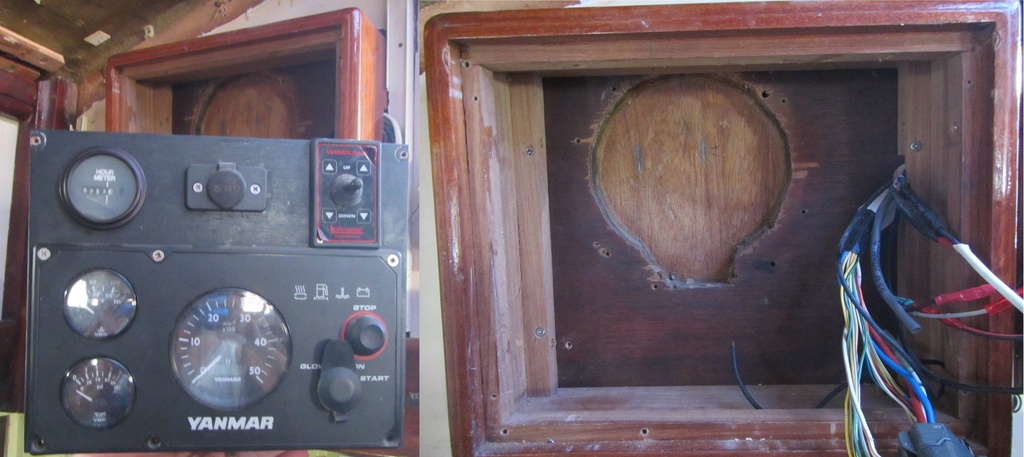
The Yanmar engine control panel was removed to access the backside of the Lofrans windlass control switch to determine how it was wired.  With the engine control panel removed, noticed the hole cut into the wood bulkhead that had been hidden from view. It is very likely that at one time in the past the engine controls were viewable from the cockpit, but not in this current configuration as they are located inside the cabin.  This did not seem well thought out or practical, so added to change this arrangement to the To Do List.

Added to the To Do List:

  • A0294 - Relocate Yanmar engine control panel so it is viewable from the cockpit.

    With the engine control panel removed, discovered the Lofrans windlass control switch input power was obtained from a jumper on the 12-volt DC plug without the recommended inline 5 amp protective fuse. The 12-volt DC plug power wire originated from the main BEP 12-volt circuit breaker panel.  Did not find this circuit arrangement intuitive or proper, so it would be rewired to correct this shortfall.

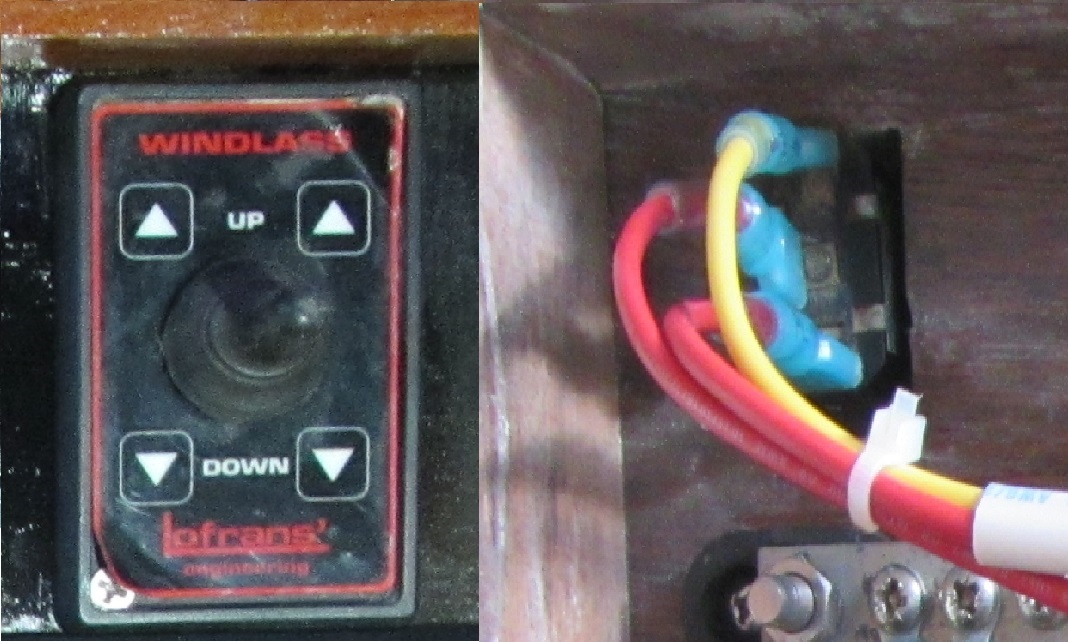
      In the forward berth, starboard side, removed a section of headliner to inspect the windlass foot switch wiring.  Discovered, the foot switch was sealed in place without first removing the blue masking tape - definitely not quality workmanship.  As the picture below reveals, corrosion had built up on the terminals and the cheap plastic insulation on improperly sized ring terminals had cracked exposing the bare wire - these ring terminals would be replaced along with the non-marine rated wires.

        Downloaded the current manuals for each individual piece that is part of the Lofrans Tigres windlass installation from two sources; the Lofrans Windlass and Imtra Corporation websites.  Overall found the manufacture's manuals too generalized and lacking in specific details - all the terminal stud sizes were not disclosed to determine wire ring terminal size, did not find the mount bolt size  for the windlass, control switch wiring size was not discussed, type of gear oil and amount not identified, etc.  Random internet searches revealed some older Lofrans Tigres windlass manuals that contained more detailed information than current versions -see these - manual 1, Gearbox Oil Capacity Guide, and one website had a very detailed Lofrans Tigres Windlass Overhaul blog.

        Review of the Lofrans Windlass Wiring Diagram for 3 Terminals Electric Motor, shown below, revealed the windlass switch control power was derived separately from the main windlass power source. This design means that when the main windlass circuit breaker is disengaged that the control circuit remains "hot".  This did not make any rationale sense and would be changed.  It would be informative if the reason for a 5 amp protective fuse was disclosed - most likely due to the windlass control box solenoid relay coil being activated which requires a certain amount of amperage to activate - could only speculate that the actual control circuit current draw should be considerably less than 5 amps.  It would have been beneficial if Lofrans had listed the maximum current draw for the control circuitry.  It is interesting to note that the Lofrans Installation And User's Manual - Foot Switch, page 3, section 2 Installation, states, "Usually opened contact 4 amps, 12/24Volts". If the foot switch is rated at 4 amps it makes no sense to have a larger control circuit protective fuse of 5 amps - something is not right.

          The part number placards on the windlass identified the Lofrans Tigres Windlass as a 1200 watt 12 volt model - current Tigres Windlass are equipped with a 1500 watt motor. Concerning was the placard on the 1200 watt motor that identified the potential current draw as 145 amps - this was not disclosed in any of the Lofrans manuals.  The equation for determining amps from watts is amps = watts divided by volts - 1200 watts divided by 12 volts should be 100 amps. The voltage drop on the wire, the actual load on the windlass, and the resistance inherent in electrical connections have the potential to increase the amperage levels significantly and these issues should be considered to determine the size of the protective circuit breaker and wire size. As the 1200 watt motor identified current at 145 amps and if it needed replacement in the future, a 1500 watt motor would most likely be purchased, decided on a 150 amp protective circuit breaker.

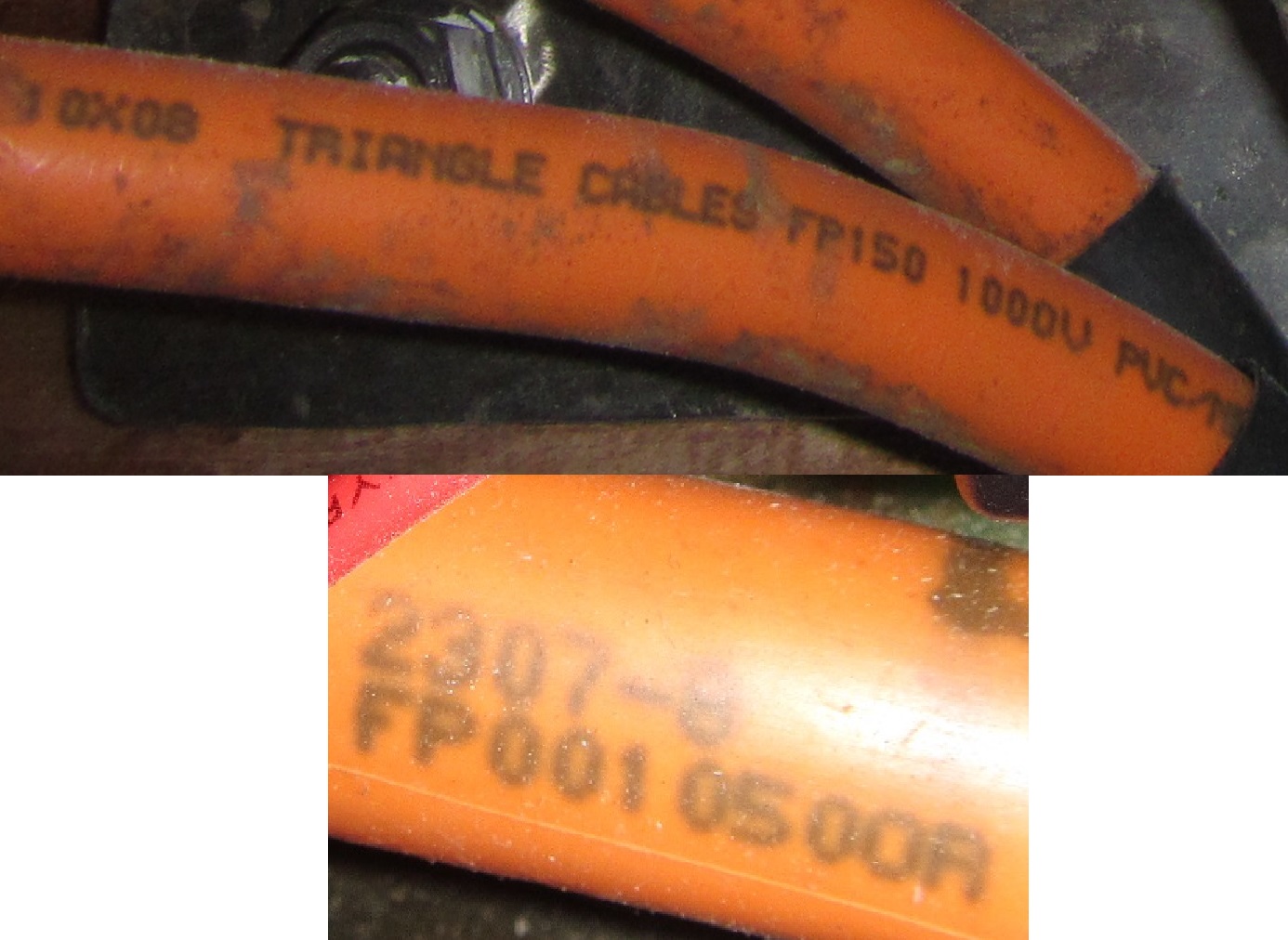
            One of the early Lofrans Tigres Windlass manuals identified the recommended wire size for the windlass as 50mm^2 (1 AWG) but also stipulated the size should be 30-50% larger if the length of wire run is greater than 29 feet (10m). Installed aboard Indra was non-tinned, non-marine rated, Triangle Cables FP150 cables which were incorrectly assumed to be 150mm^2 or larger than 4/0 AWG wire.  Physical inspection revealed the wire size was 50mm^2 about the same size as 1 AWG and the length of wire run was greater than 29 feet (10m) - the wire used was not of the correct size for the length of the actual wire run.

              Lofrans wire size recommendations appear to be based on an allowable 10-percent voltage drop to operate the windlass motor. Any appreciable voltage drop at the windlass motor can result in a significant reduction of windlass anchor and chain retrieval power. We choose to minimize the maximum allowable voltage drop to increase motor efficiency, lifespan, and reduce motor heating effects by using wire sized less than the 10-percent voltage drop wire size tables and calculations.

              To determine the recommended size of the wire needed we used the following formula (ref 46 CFR §183.340.(p) and ABYC E-9.14.e.(4)):

              CM = (K x I x L)/E

              Where:
              CM = Circular mil area of conductor.
              K = 10.75 (constant representing the resistivity of copper).
              I = Load current in amperes.
              L = Length of conductor from the positive power source connection to the electrical device and back to the negative power source connection, measured in feet.
              E = Maximum allowable voltage drop at load in volts (For a three percent voltage drop at 12V, E= 0.03 x 12 = 0.36).

              We used the value of 10.75 for K, 100 amps current draw at 12 V for I, 60 feet (30ft x 2) for L, and 0.36 as the 3% voltage drop for E.  Where the CM = (10.75 x 100 x 60)/0.36 =179,167 which equates to 4/0 AWG which has a CM of 211,600; ref ABYC E-11 (7/15) Table XI. If 150 amps is used in lieu of 100 amps to solve for CM, the CM value equals 268,750 which means a wire larger than 4/0 AWG would be needed.  Wire size 4/0 AWG is usually the largest size available for purchase at most online stores, so 4/0 AWG wire is the preferred size in this case - but very expensive at $9 to $12 per foot. An additional consideration is 4/0 AWG sized wire would not easily fit into the windlass wire route cavity or be able to have the steep bend radius to connect to the windlass motor terminals - so a combination of wire sizes would be needed or a wire size less than 4/0 AWG.

              Another consideration was the actual voltage level of the battery circuit at the time the windlass would be used. Our AGM 12 volt batteries usually indicate about 13.7 volts at full charge (440 amps - battery 1 and 100 amps - battery 2).

                During windlass operation, we would normally plan on having the engine running which is equipped with a 150 amp alternator that would be in a charge state at a voltage level of about 14.2 volts. So theoretically, the voltage level at the windlass should be 14.2 volts minus the voltage loss for circuit resistance - which should be well above the minimum 12 volt threshold for efficient windlass motor operation.  Note - a 1200 watt motor at 14.2 volts should use about 84.5 amps, a considerable drop from 100 amps at 12 volts. If a windlass is operated at a 12 volt battery circuit level, this would mean the battery system is depleted by approximately 50 percent based on battery state of charge discharge tables - not a likely or desirable situation.   It is curious that all the voltage drop tables for determining wire size are based on a nominal 12 volt value, which is about the same value for a depleted battery at 50 percent capacity. Internet discussions and books published by self-proclaimed marine electrical experts on the subject of windlass motor voltage drop and optimum wire size all base the initial voltage level at 12 volts and stress the importance of minimizing circuit resistance - strange they did not state that a 12 volt level means the battery system is almost depleted or disclose a normal, healthy battery system should be at a voltage level above 12 volts.

                To illustrate the voltage drop for different wire size choices developed the following table based on a 60 feet round-trip wire run - the choice of wire sizes that provide less than the 10-percent voltage drop criteria can be easily evaluated.

                  The existing 50mm^2 Triangle Cable had a max amp rating of 175 amps and a nominal outside diameter of 14.4mm/0.57in. The 2/0 AWG marine rated wire we were considering had a 4-percent voltage drop, a max amp rating of 330 amps, and a nominal outside diameter of 16.0mm/0.63in - so it should fit in the tight confines of the windlass motor case.

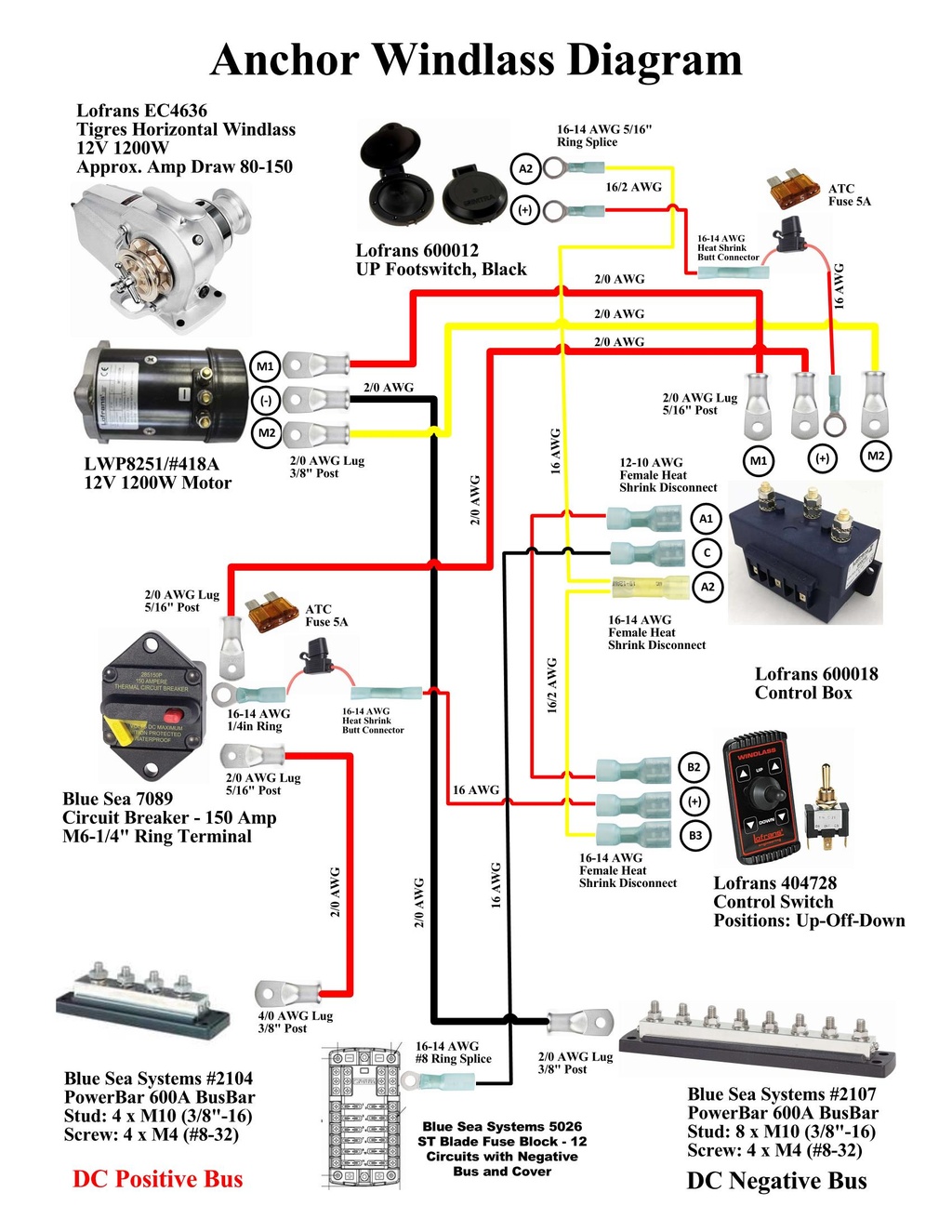
                  The following depicts the electrical diagram for the Lofrans Tigres Windlass.  Power for the windlass control switches is derived from the output side of the windlass circuit breaker and is disabled with its deactivation.  Both windlass control switches have a inline 5 amp fuse. The source of 12 VDC was changed from the engine start battery to the 440 amp house batteries.  The defective windlass circuit breaker was replaced and relocated to an accessible location on the top of the main 12 volt circuit breaker panel.
                    The following items were purchased to support this task.


                    P/N Item Q Each Total
                    7089 Blue Sea Systems 285-Series Circuit Breaker - 150 Amp 1 $41.28 $41.28
                     16/2 AWG Duplex Tinned Marine Wire, Red/Yellow (250 Feet - $91.95) 50 $0.37 $18.50
                    Qunqi 10Packs Add-A-Circuit Blade Type Inline Fuse holder 16 Gauge with cover ($9.49) 2 $0.95 $1.90
                    Blue Sea Systems ATO/ ATC Fuses - 5A fuses 2 $0.18 $0.36
                    16-14 AWG Heat Shrink Butt Connector 2 $0.25 $0.50
                    16-14 AWG #8 Ring Heat Shrink Splice 1 $0.25 $0.25
                    16-14 AWG 3/8 Ring Heat Shrink Splice 3 $0.25 $0.75
                    16-14 AWG 1/4 Ring Heat Shrink Splice 1 $0.25 $0.25
                    16-14 AWG Female Heat Shrink Disconnect 5 $0.50 $2.50
                    Cable/Tie Straps 40 $0.10 $4.00
                    4/0 AWG Tinned Seamless Marine Lugs Post Size 3/8" 8 $2.39 $19.12
                    4/0 AWG Tinned Seamless Marine Lugs Post Size 5/16" 2 $2.39 $4.78
                    4/0 AWG Tinned Marine Battery Cable - Red 4 $8.70 $34.80
                    1" Dual-Wall Adhesive Heat Shrink 3:1 Ratio - Red 3 $2.70 $8.10
                    1" Dual-Wall Adhesive Heat Shrink 3:1 Ratio - Black 3 $2.70 $8.10
                    TOTAL $145.19


                    There was much confusion on internet discussions about what type of oil was used in the Lofrans Tigres Windlass.  The current manufacture's windlass manual did not identify it; older windlass manuals stated, "SAE 90 long life oil"; and Imtra's Gearbox Oil Capacity Guide stated, "Oil Type: SAE90-140".  Some asked what "long life oil" meant in regards to the SAE 90 designation - there was no rational association, these were just superfluous adjectives. Others stated there is no oil designated SAE90-140, which there is not, however the "-" hyphen is probably meant to mean a range of SAE90 to SAE140, but this was not figured out by most.  Still others advocated the current oil technology benefits of API ratings of GL4/GL5/GL5+ or synthetic variants, completely missing the manufacture's obvious simple designation of SAE 90 without any qualifiers. We kept it simple and purchased locally in the Philippines, 90 weight gear oil for about US $3.00.

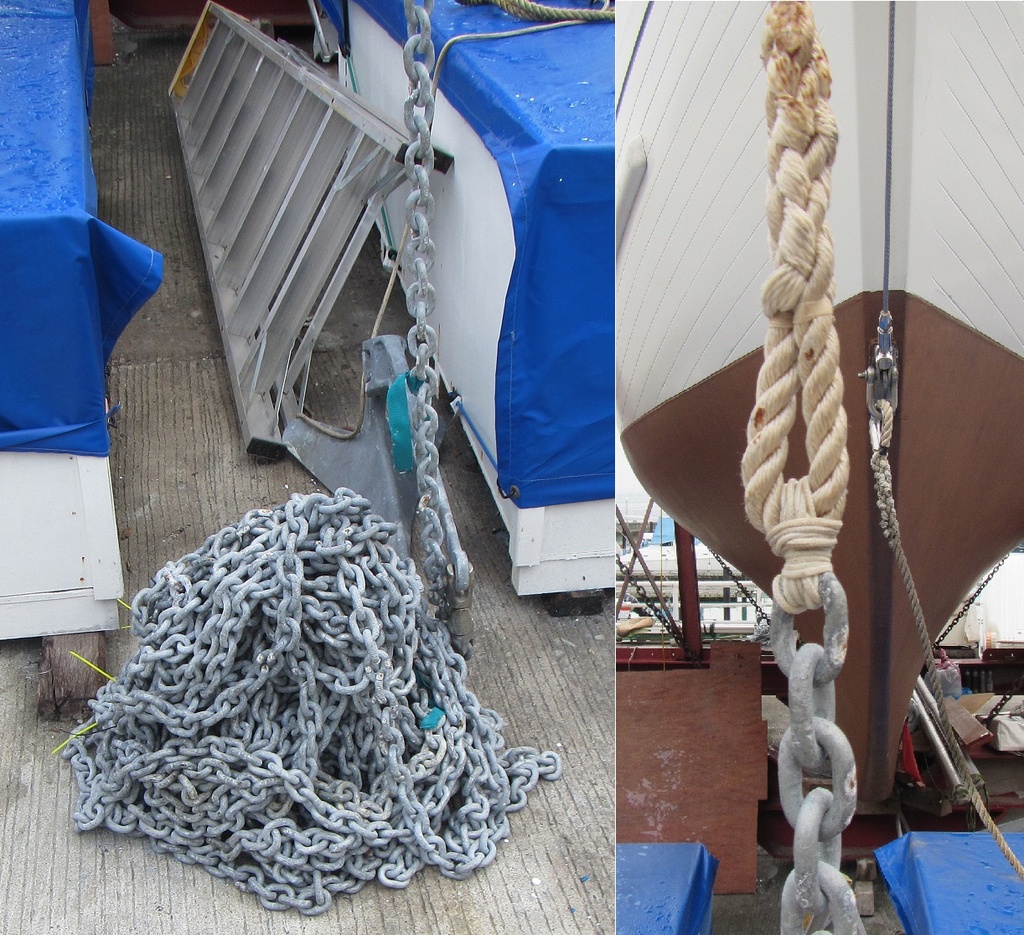
                      When we returned to Indra, August to December 2018, we manually lowered the anchor chain to the ground in preparation of windlass maintenance and to paint the chain locker. As the chain was allowed to free-fall, it formed a pile of chain that was just shy of 2-feet in height. We discovered the chain had a section of nylon rope attached to it and a pad eye located in the chain locker. The purpose of the nylon rope is so the chain can be quickly detached in a emergency situation simply by cutting the rope - a smart idea.

                        Removed the UV degraded, worn-out brown cloth windlass cover (this would be replaced) and inspected the exterior of the windlass. Corrosion was present on almost all of the windlass surfaces. The oil sight glass revealed that the internal oil was black in color, and as there was no air bubble visible, the oil level was most likely over filled.

                          The starboard-side main shaft was missing the rubber O-ring (Lofrans part number 316).

                            On the motor cover noticed that two nylon washers (Lofrans part number 241) were missing and not installed under the metal washer and cap nuts. Electrolysis degradation of the aluminum case in contact with the steel washers had started and was discovered when the cap nut and steel washers were removed.

                              The windlass motor terminals had significant corrosion buildup and it was removed with a wire brush wheel powered by a hand drill.

                                Used this opportunity to fit check some 2/0 AWG cable to determine if it would fit and be able to make the steep bends necessary - determined it could fit, but it would be tight.  Also discovered that the existing cables were "extended" by over a foot to reach this new windlass location as a result of the PO's bowsprit modifications resulting in the windlass being moved further aft on the deck.  It appears the existing cables were cut and additional cable was added, then covered and insulated with black heat shrink tubing. This adds two additional connection points within the cable that can only increase circuit resistance and is the "weak link" in the cable - this confirmed that the existing cables definitely need replacement.

                                  Removed the two bolts that held the chainstripper in-place with difficulty, then removed the chainstripper which revealed significant electrolysis degradation of the aluminum case in contact with the steel bolts. Almost two complete bolt threads worth of the aluminum case had deteriorated away.  Attempted to remove the bolt that attaches the gypsy stopper or pawl, but the bolt is securely frozen in the aluminum case - did not want to break it free by shear force as it had the potential to break the aluminum case. Next, removed the wingnut, outer clutch cone, and the 3/8-inch BBB chain gypsy but could not remove the inner clutch cone as it would not slide over the steel key in the keyway. As it was very hot on top of the boat, moved the removed parts to our shaded work area on the ground and began cleaning and removing the built up corrosion from the parts.

                                    Attempts to remove the inner clutch cone with a gear puller and large screwdrivers used as pry bars were not successful. This was strange as the inner clutch cone was not jammed on the shaft, but still had free-play to move, it would just not pass over the steel key in the keyway. About 50-percent of the steel key was visible, so used a grinder with a metal cutting wheel to cut a section of it off. It was still difficult to remove, but with both the gear puller and large screwdrivers prying, it final popped off.  The side of the inner clutch cone that faces the windlass aluminum case was severely blackened due to corrosion - this part had not been removed in a very long time, maybe never - a strong indicator that routine maintenance had been neglected.

                                      Next removed the rope drum, dog clutch, and emergency wheel from the left side of the windlass without much difficulty. The visible grease was very old and dirty - another indicator that routine maintenance had not been performed in a very long time.

                                        As it was very hot on top of the boat, moved the removed parts to our shaded work area on the ground and began cleaning and removing the built up corrosion from the parts. Used kerosene with an old tooth brush to break-up and remove the old dirty grease. Then used the wire brush wheel powered by a drill to knock off a large amount of the corrosion.  Metal files were used to remove burrs in the metal and then surfaces were sanded with 400 grit sandpaper.

                                          It took considerably time to clean-up the parts, but the effort paid off as they looked almost like new again.

                                            With the parts cleaned up it was clearly visible that the inner (Lofrans part number 277) and outer (Lofrans part number 318) clutch cones had elongated keyways and needed to be replaced.

                                              The exterior surfaces of the windlass were cleaned up with the wire brush wheel powered by a drill and then polished with Autosol metal polish. Removed the oil fill plug (Lofrans part number 474) and its rubber O-ring was discovered split and deteriorated - this would need to be replaced. The oil was so over filled, that it was visible in the oil fill plug cavity.  Our oil suction hand pump did not work, so we would capture the oil as we removed the case left side cover plate.  We spread out oil absorbent mats and placed rectangular plastic containers below the cover plate.  We used a hammer and impact driver to break free the cover plate Allen head screws which were frozen in-place.

                                                As the screws where removed from the cover plate, the oil gushed out but manage to capture about 1.5 liters in the plastic containers. A lot of oil ended up on the oil absorbent mats.

                                                  Used a sponge and oil absorbent mat to remove the rest of the oil from inside the windlass. Discovered the bottom of the windlass cavity had a layer of oil sludge on it that was thoroughly clean out which took a lot of time and effort. Concluded that "whoever" had added the oil did not use the recommended SAE 90 weight gear oil specified by the manufacture, but instead had filled it improperly with old used engine oil which caused the layer of oil sludge inside the windlass.

                                                    Cleaned up the side cover and replaced the cover plate O-ring (Lofrans part number 480).  Also replaced the two main shaft oil seals (Lofrans part number 319).  Applied Lanocote to the new cover plate screws (Lofrans part number 482) and installed the cover plate.

                                                      On the left side of the windlass installed the black plastic washer, emergency wheel, dog clutch, new steel key (Lofrans part number 209), and rope drum - all were lubricated with Super Lube grease.

                                                        On the right side of the windlass installed the new steel key (Lofrans part number 209) and lubricated all the parts with Super Lube grease. The inner clutch cone slide easily over the new steel key, followed by the 3/8-inch BBB chain gypsy, the outer clutch cone, and wingnut. Installed the chainstripper with two new washers (Lofrans part number 226) and bolts (Lofrans part number 217) coated with Lanocote. Installed a new rubber O-ring (Lofrans part number 316) on the end of the right main shaft.

                                                          The motor electrical cables were secured to the motor terminals. A new motor housing rubber gasket (Lofrans part number 463) was installed and the cover was installed with new nylon washers (Lofrans part number 241), steel washers (Lofrans part number 226), and cap nuts (Lofrans part number 242).

                                                            Added 0.5 liter of 90-weight gear oil to the windlass as specified by the Imtra's Gearbox Oil Capacity Guide. As the new gear oil was a clear/golden color it was difficult to see the level in the oil sight gauge - but the sight gauge did reveal a level about 3/4 full through the glass.

                                                              With the windlass reassembled and serviced the Lofrans windlass periodic maintenance requirements were complete. We did not remove the windlass from the deck to inspect, clean, and reseal its base as recommended. This was deemed not practical as one of the windlass's mount bolt nuts was covered by the stainless steel anchor chain pipe under the deck - to remove this chain pipe would result in partial destruction of its supporting structure. Our next focus was to get the windlass electrically connected so we could verify it actually worked. As we did not have the new 2/0 AWG wire on hand, we would attempt operation with the old existing undersized Triangle Cables. The deterioration of the aluminum gear case (Lofrans part number 475 - estimated replacement cost $750.00) was not deemed severe enough to warrant replacement yet, as the chainstripper steel bolts were still able to be properly torqued down. As a result of the inspection of the windlass, added the following to the To Do List.

                                                              Added to the To Do List:

                                                              • A0296 - Make new anchor windlass cover.
                                                              • A0297 - Obtain and install inner clutch cone (Lofrans part number 277), outer clutch cone (Lofrans part number 318), and oil fill plug (Lofrans part number 474). For spares, obtain windlass motor electrical brushes.

                                                              The windlass deck mounted UP control switch had a cracked plastic cover. This cracked cover was replaced using a cover from a spare switch located on board.  Used 3M 4200 marine sealant to seal it in place.

                                                                Removed the existing substandard wires and ring terminals from the windlass deck mounted UP control switch. Routed new 16/2 AWG duplex wires from the windlass control box area to the windlass deck mounted UP control switch and installed new terminals.

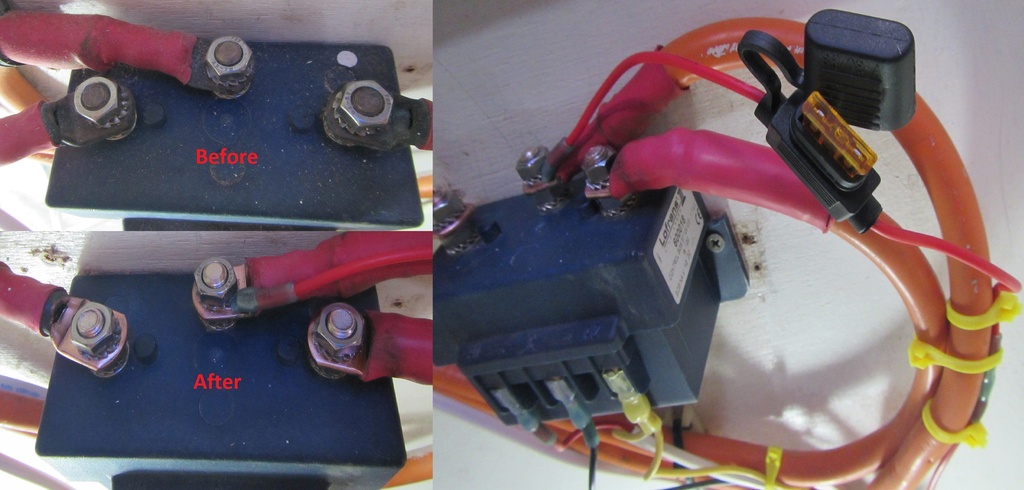
                                                                  Cleaned up windlass control box terminals and cable lugs. Installed a 5 amp fuse inline with power output wiring to windlass deck mounted UP control switch.

                                                                    Installed the windlass UP/DOWN control switch wires at engine control panel (14 September).

                                                                      The "accessible" location to mount the windlass circuit breaker took awhile to figure out. With the decision to delete both the old BEP DC and Tank monitors from the top of the main 12 volt circuit breaker panel, decided the windlass circuit breaker would occupy that location along with the bilge pump control panels.  Modified the top metal structure of main 12 volt circuit breaker panel and mounted a piece of wood to it that would hold the windlass circuit breaker (8 October). Connected a 2/0 AWG cable from the house battery bank positive bus bar to the input side of the windlass circuit breaker. Connected the old existing undersized Triangle Cable to the output side of the windlass circuit breaker with a new terminal lug - the opposite end of this cable is connected to the windlass control box input power terminal.  Also connected a inline 5 amp fuse to the output side of the windlass circuit breaker that provides power to the windlass UP/DOWN control switch mounted on the engine panel. Connected the old existing undersized Triangle Cable negative return cable to the main negative bus bar - the opposite end of this cable is connected to the windlass motor negative terminal.

                                                                        With everything now installed and electrically connected for windlass operation, we ensured the anchor nylon rope was clear of the windlass gypsy, engaged the circuit breaker, and tested the windlass deck UP switch and windlass UP/DOWN control switch mounted on the engine panel - the switches worked correctly as the windlass spun smoothly in both directions!!

                                                                        We next fed the nylon rope into the chain pipe until the anchor chain links were correctly positioned on the windlass gypsy, tighten the clutch wingnut, and activated the windlass deck UP switch, the chain was pulled up from the ground and being dumped into the chain locker. With approximately 30-40 feet of chained passed through into the chain locker, the chain jammed on the inlet hole, and we had to swiftly stop the windlass before it was damaged.  We looked into the chain locker and the chain was not sliding down the incline.

                                                                          We manually moved the chain aft and again attempted to bring the chain in using the windlass - the chain stacked up on the incline and jammed up again. We repeated this with the same results until all the chain was back in the locker and the anchor stowed on the bow - it took 7, SEVEN, manual rakes of the chain to get it all aboard.

                                                                            Disenchanted, disheartened, frustrated, and extremely pissed off barely describes our emotions at this point, fully realizing the implications of this problem - the need to move the windlass further aft on the deck and/or modify the chain locker structure. Took a break to calm down and confirm the original position of the anchor chain before we purchased Indra and moved it out from the anchor locker - the picture below reflects its original position.  It shows the anchor chain had to be manually arranged in the chain locker to be situated in a neat pile against the aft wall of the locker. This implies that "whoever" relocated the windlass further aft on the deck as a result of the bowsprit rework and modified the anchor locker with the steel plate incline - was fully aware the modifications did not work and support anchor chain retrieval and stowage. This is deceitful and dishonest, as we were also informed the windlass was completely overhauled and serviced in 2014 as part of this modification effort and everything worked ok - the factual information and pictures above prove that this was a complete lie.
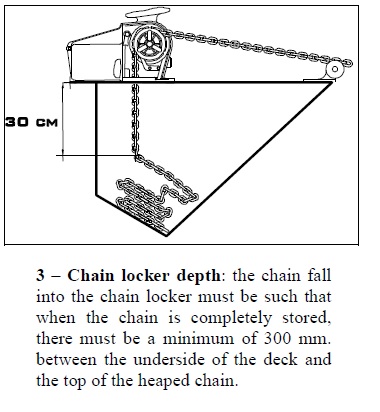
                                                                              I was also really pissed off at myself, as I should have recognized the incline and anchor chain position, and realized at first look that something was amiss, but I failed to put the visual indicators together to determine this. Even the Lofrans windlass installation instructions, see below, clearly state the requirements for chain locker depth and clearances, but as with so many issues aboard Indra, the manufacture instructions and maintenance recommendations were totally disregarded and ignored.  The common expression, buyer beware, is so appropriate in this case.

                                                                                Added to the To Do List:

                                                                                • A0298 - Determine and fix anchor chain retrieval lock-ups and jams.


                                                                                Gusher 30 Bilge Pump New Hose Strainer

                                                                                Gusher 30 Bilge Pump New Hose Strainer

                                                                                • Action: To Do List item A0283 – Clean the bilge.  Remove excessive accumulation of engine oil and miscellaneous debris. ($82.05)
                                                                                • Action: To Do List item A0284 – Obtain and install replacement manual bilge hose scupper fitting. ($32.98)
                                                                                • Completed: A0284 – In-progress. A0283 – 22 September 2018
                                                                                • Cost: $82.05


                                                                                On 22 April 2018 we ordered a Whale Water Systems SB5865 Top Entry Strainer with Non-Return Valve from Amazon's website at a cost of $25.64 plus shipping of $7.34. This item was shipped to our balikbayan box consolidator and forwarder Manila Forwarder in Los Angles, California and received there on 25 April 2018. We received this item in Naga City, Cebu on 9 August 2018.

                                                                                  When we removed the manual bilge pump hose with the old scupper fitting discovered we had more oil in the bilge. This was getting very frustrating as we thought we had removed "all" the oil when we cleaned this up last time.

                                                                                    As the water with oil on top was not very deep we removed this mess with the rag and bucket method again. We did not spray and rinse the bilge with water this time.

                                                                                      We installed the new strainer on the bilge hose and secured with double clamps. As the picture below reveals, the new strainer will sit much lower in the bilge compared to the old one, and should be able to remove most of any standing water in the bilge.

                                                                                        The hose with new strainer was positioned down in the bilge. The hose was secured to the hull sides with tie strap clamps. As the picture below shows a washer and other debris on the bilge floor, we still have to put more effort into cleaning up the bilge.

                                                                                        Fresh Water Pump Replacement

                                                                                        Fresh Water Pump Replacement

                                                                                        • Action: To Do List item A0155 – Obtain replacement water pump.
                                                                                        • Completed: 17 September 2018
                                                                                        • Cost: $177.90


                                                                                        The criteria for the replacement water pump was very simple - we wanted a pump of the same capacity with positive reviews/reputation.  After researching the internet, we selected a SHURflo 4048 High Flow Water Pump part number 4048153E75 ($154.49).  This new pump was identified as being designed to replace the 4900 Smart Sensor series product - the old defective pump. Downloaded the Installation & Operation Manual from the manufacture's website and reviewed it.

                                                                                        The pertinent information gleamed from the documentation was:

                                                                                        • Flow Rate: GPM/LPM 4.0 GPM [15 LPM] - same as old pump.
                                                                                        • Shut-Off Pressure: 55 PSI [3.8 BAR] - same as old pump.
                                                                                        • Leads: 14 AWG, 14 ¾” [37 cm] Red +, 13” [33 cm] Black - kudos to manufacture for disclosing this - important for wire splice size selection.
                                                                                        • Fuse: 15 Amp Recommended - same as old pump.
                                                                                        • Amps (Max.): 10 - important for determining connecting wire size.

                                                                                        As the pump power wire was to run from the 12V DC circuit breaker panel to essentially the same location under the galley sink - the estimated length of the wire run was about 12 feet plus 1 foot for the pump wiring pigtail.  We decided to replace the old wiring since the old wires were not marine rated, not the correct size, and were assembled from three separate pieces of wire joined together with butt splices - this increases overall circuit resistance.  We would use a continuous run of UL1426 marine rated wire.

                                                                                        To determine the actual size of the wire needed we used the following formula (ref 46 CFR §183.340.(p) and ABYC E-9.14.e.(4)).  The 3% allowable voltage drop, instead of 10%, was selected since DC motors operate more efficiently at their rated voltage.

                                                                                        CM = (K x I x L) / E

                                                                                        Where:
                                                                                        CM = Circular mil area of conductor.
                                                                                        K = 10.75 (constant representing the resistivity of copper).
                                                                                        I = Load current in amperes.
                                                                                        L = Length of conductor from the positive power source connection to the electrical device and back to the negative power source connection, measured in feet.
                                                                                        E = Maximum allowable voltage drop at load in volts (For a three percent voltage drop at 12V, E= 0.03 x 12 = 0.36).

                                                                                        We used the value of 10.75 for K, 10 amp current draw at 12V for I, 26 feet (13ft x 2) for L, and 0.36 as the 3% voltage drop for E.

                                                                                        CM = (10.75 x 10 x 26)/0.36 = 7,763.9 which equates to 10 AWG since it has a CM of 10,380; ref ABYC E-11 (7/15) Table XI. Note - 12 AWG has a CM of 6,530 which is smaller than the calculated value, so the next larger AWG size is needed.

                                                                                        The following picture illustrates the electrical installation diagram.

                                                                                        The following items were purchased to support this installation.


                                                                                        P/N Item Q Each Total
                                                                                        4048153E75 Shurflo 4048153E75 Electric Water Pump 1 $154.49 $154.49
                                                                                        10/2RY50FT 10/2 AWG Duplex Tinned Marine Wire, Red/Yellow 50 Feet 12 $1.12 $13.44
                                                                                        320203 16-14 to 12-10 AWG Step-Down Heat Shrink Butt Connector (3 each) 1 $6.17 $6.17
                                                                                        12-10 AWG #8 Ring Heat Shrink Splice 1 $0.25 $0.25
                                                                                        12-10 AWG #10 Ring Heat Shrink Splice 1 $0.25 $0.25
                                                                                        2-inch Stainless Steel Screws 4 $0.45 $1.80
                                                                                        Cable/Tie Straps 15 $0.10 $1.50
                                                                                        TOTAL $177.90


                                                                                        On 17 September 2018, removed the old wiring and the defective pump. 
                                                                                        Installed the new water pump, under the galley sink against the vertical wall with four Philips head wood lag screws. Routed 10 AWG duplex wiring from the 12V DC circuit breaker panel, 15 AMP circuit breaker, to the water pump and connected the wires with marine rated splices. New water hose and clamps were also installed. Pump worked quietly and shut off automatically under pressure properly.

                                                                                        Isotherm Refrigerator Rewire

                                                                                        Isotherm Refrigerator Rewire

                                                                                        • Action: To Do List item A0290 – Replace 25 Amp with 15 Amp circuit breaker and replace wiring to Isotherm 3751 ASU Refrigerator.
                                                                                        • Completed: 17 September 2018
                                                                                        • Cost: $10.95


                                                                                        The Isotherm 3751 ASU SP Water Cooled Refrigeration Installation and Operating Manual was downloaded and reviewed.  Additional documentation from their online parts store was also reviewed.

                                                                                        The pertinent information gleamed from the documentation was:

                                                                                        • Fuse: 15 Amp Recommended
                                                                                        • Amps (Max.): High speed - approx. 6.2 Amps - important for determining connecting wire size.


                                                                                        As the refrigerator power wire was to run from the 12V DC circuit breaker panel to essentially the same location under the galley sink - the estimated length of the wire run was about 15 feet.  We decided to replace the old wiring since the old wires were not marine rated and were assembled from three separate pieces of wire joined together with butt splices and a plastic screw terminal connector - this increases overall circuit resistance.  We would use a continuous run of UL1426 marine rated wire.

                                                                                        To determine the actual size of the wire needed we used the following formula (ref 46 CFR §183.340.(p) and ABYC E-9.14.e.(4)).  The 3% allowable voltage drop, instead of 10%, was selected since DC motors operate more efficiently at their rated voltage.

                                                                                        CM = (K x I x L) / E

                                                                                        Where:
                                                                                        CM = Circular mil area of conductor.
                                                                                        K = 10.75 (constant representing the resistivity of copper).
                                                                                        I = Load current in amperes.
                                                                                        L = Length of conductor from the positive power source connection to the electrical device and back to the negative power source connection, measured in feet.
                                                                                        E = Maximum allowable voltage drop at load in volts (For a three percent voltage drop at 12V, E= 0.03 x 12 = 0.36).

                                                                                        We used the value of 10.75 for K, 6.2 amps current draw at 12V for I, 30 feet (15ft x 2) for L, and 0.36 as the 3% voltage drop for E.

                                                                                        CM = (10.75 x 6.2 x 30)/0.36 = 5,554.2 which equates to 12 AWG since it has a CM of 6,530; ref ABYC E-11 (7/15) Table XI. Note - 14 AWG has a CM of 4,110 which is smaller than the calculated value, so the next larger AWG size is needed.

                                                                                        Rechecking the manual, it stated, "For a 12 Volt system, the minimum area of the cable from the battery to compressor must be: 2.5 mm² if the length is less than 2.5 meter; 4 mm² if up to 4 meter; and 6 mm² if up to 6 meter. USA wire size: 12 gauge for 10 ft and under and 10 gauge for lengths over 10 ft." This did not agree with the calculated 12 AWG wire size, why?  Using the same formula, solved for I = (CM x E)/(K x L) using the CM value of 6,530 for 12 AWG and L = 20 (10feet x 2).  So, I = (6530 x 0.36)/(10.75 x 20) = 10.93 Amps - this value does not agree with the stated maximum 6.2 Amps at high speed.  Their recommended wire size and lengths are not accurate.

                                                                                        The recommended fuse size of 15 Amps seemed a bit high for a maximum current draw of 6.2 Amps.  Downloaded the Danfoss BD50F compressor datasheet and it also recommended a 15 Amp fuse.  Based on the 6.2 Amp max current draw and 150% over current protection being 9.3 Amps, decided a 10 Amp protective fuse is sufficient.

                                                                                        To remedy the incorrect use of the 25 Amp circuit breaker for the Isotherm 3751 ASU SP Water Cooled Refrigeration, it would be swapped with an existing 10 Amp circuit breaker from within the 12V DC circuit breaker panel.

                                                                                        The following picture illustrates the electrical installation diagram.

                                                                                        The following items were purchased to support this installation.

                                                                                        P/N Item Q Each Total
                                                                                        12/2 AWG Duplex Tinned Marine Wire  (100 Feet - $59.00) 15 $0.59 $8.85
                                                                                        12-10 AWG #8 Ring Heat Shrink Splice 1 $0.25 $0.25
                                                                                        12-10 AWG #10 Ring Heat Shrink Splice 1 $0.25 $0.25
                                                                                        12-10 AWG Female Heat Shrink Disconnect 2 $0.30 $0.60
                                                                                        Cable/Tie Straps 10 $0.10 $1.00
                                                                                        TOTAL $10.95


                                                                                        On 17 September 2018, removed the old wiring for both the Isotherm 3751 ASU SP Water Cooled Refrigeration and the fresh water pump as they followed the same wire route. Installed new 12 AWG duplex wiring from the 12V DC circuit breaker panel, 10 AMP circuit breaker, to the refrigerator and connected the wires with marine rated terminal disconnects.

                                                                                        Momentarily powered on the refrigerator and the control panel while in the manual position - the green light illuminated indicating the power was on and the compressor started running. Switched the control panel to automatic and both green and amber lights illuminated. As the boat is out of the water "on the hard", we shut it off after just a few minutes of running.

                                                                                        Navigation Running Lights Replacement

                                                                                        Navigation Running Lights Replacement

                                                                                        • Action: To Do List item B0006 – Replace section of wood that contained Australian Ship’s markings above the companionway entrance.
                                                                                        • Action: To Do List item B0007 – Remove Indra name at the mast pulpits.
                                                                                        • Action: To Do List item A0026 – Remove wiring and both port/starboard Hella Marine 2984 series 2 NM Navigation Lamps from masthead pulpit.
                                                                                        • Action: To Do List item A0027 – Route new wiring and install navigational side lights at bow spirit rails.
                                                                                        • Action: To Do List item A0028 – Replace Aqua Signal Series 25 Classic Stern light.
                                                                                        • Completed:  B0006 - 16 March 2018, B0007 – 17 March 2018, A0026 – 30 March 2018, A0027 – 9 September 2018, A0028 – 15 March 2018
                                                                                        • Cost: $467.05


                                                                                        We decided that the port, starboard, and stern navigation lights would be replaced with new LED navigation lights.  After research on the internet, selected and purchased Hella Marine 3 NM NaviLED PRO Navigation Lamp lights: port P/N 2LT 959 900-201 ($136.08), starboard P/N 2LT 959 908-201 ($136.08), and stern P/N 2LT 959 909-201 ($133.42).  The LED power consumption was listed as 0.14 amps at 12.0 VDC for each LED light.

                                                                                        Downloaded the NaviLED PRO 2 or 3 NM Port, Starboard, Stern Instruction Sheet from the Hella Marine website and reviewed it - some items it stated appeared to be wrong or incomplete.

                                                                                        • The Instruction Sheet stated recommendations for port and starboard light placement that do not agree with the USCG Navigation Rules and Regulations Handbook and the Convention on the International Regulations for Preventing Collisions at Sea, 1972.
                                                                                        • The Instruction Sheet stated, "Hella recommends wire connections be soldered, and heat shrink tubing applied to seal the joint."  This recommendation conflicts with ABYC E-11 paragraph 11.14.3.7 which states, "Solder shall not be the sole means of mechanical connection in any circuit."
                                                                                        • The Instruction Sheet stated "Lamp must be protected by a fuse rated at 5 amperes maximum".  A fuse of 5 amps appears to be a bit high as the current draw is listed as only 0.14 amps. Since port, starboard, and stern navigation lights are required to be turned on/off from a single switch operation (ABYC A-16 16.6.6); the power consumption at 12.0 VDC for all three lights (0.14 amps x 3) is 0.42 amps - again a 5 ampere fuse appears to large.  We will use a maximum fuse size of 2 amps for this circuit.


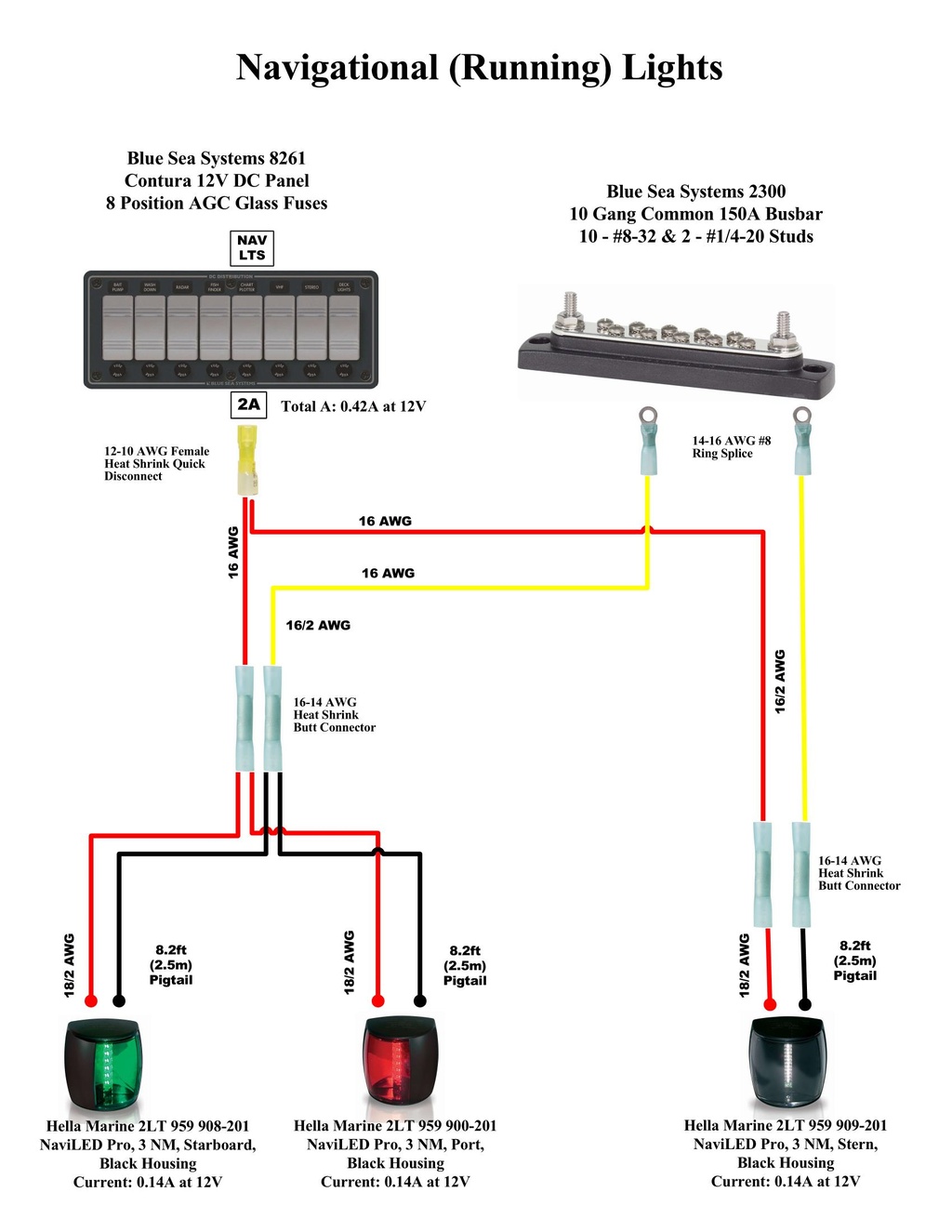
                                                                                        This issue with fuse size for the new LED lights was significant.  Indra previously had the port and starboard navigation lights fused by a 15 amp circuit breaker and the stern light powered by a separate 15 amp circuit breaker on the 12 VDC circuit breaker panel - this was not in compliance with a single switch for operation of these lights per ABYC standard A-16 16.6.6.  The 12 VDC circuit breaker panel did not support the small fuse requirements of less than 5 amps, so another solution was needed.  We decided on a new 12 VDC AGC glass fused panel to meet these lower fuse requirements not supported by traditional magnetic latched circuit breakers as illustrated in the diagram below.

                                                                                          To mount the new LED lights on the bow and stern stainless rails a piece of wood would be needed.  Ordered and received a 3/4" x 5" x 24" long piece of teak wood ($21.98).

                                                                                          On 13 March 2018, we removed the stern navigational light and deleted all its associated wiring.  This deleted wiring was run along the outsides of the aft stainless steel tubing and entered the boat through a feed thru located on the aft starboard deck - this deck feed thru was leaking water into the lazarette and was deleted and sealed with epoxy.

                                                                                            With the teak wood, cut three pieces to mount the new navigational lights to the stainless steel tubing.  These were sanded and multiple layers of Interlux Schooner Gold Varnish were applied (13-15 March).

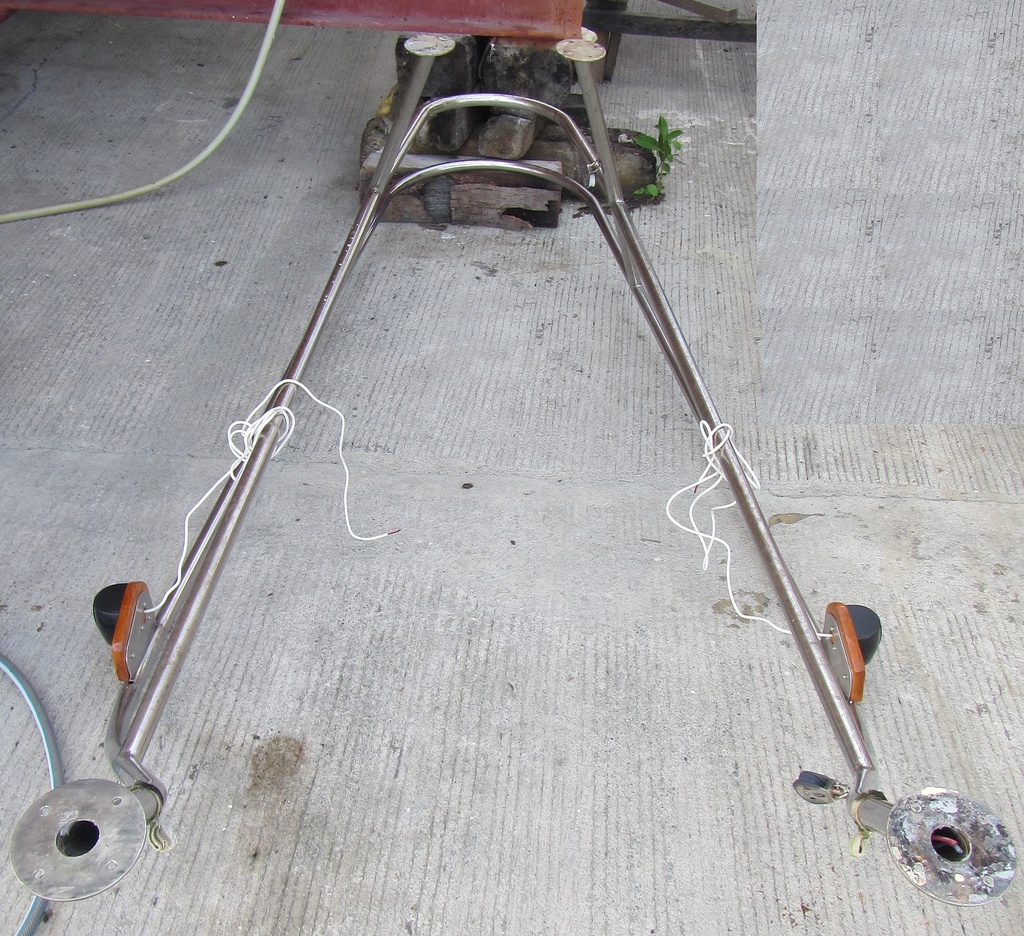
                                                                                              We then mounted the new navigational lights to the bow spirit and stern stainless steel tubing (15 March).

                                                                                                The old Hella Marine 2984 series 2 NM Navigation Lamps port and starboard navigational lights were mounted on a wooden nameplate attached to both masthead pulpits.  These lights were removed, along with the wooden nameplate (17 March).

                                                                                                  Also took the opportunity to remove the Indra nameplate from the entryway hatch by drilling out some wood bungs and removing the screws beneath them (16 March).

                                                                                                    The removal of the port and starboard navigational lights from the masthead pulpits highlighted the need to remove their wires routed into the cabin top area through the inside of the masthead pulpits stainless steel tubing. This would require the removal of the cabin top headliner to access the bolts/nuts that secure the masthead pulpit stainless steel tubing base, but to do this, the long teak rails on both sides of the interior cabin top would also need to be removed. The scope and magnitude of this supposedly simple task was expanding significantly - also, the removal of the cabin top headliners would reveal several other hidden issues/problems.

                                                                                                    With the headliners removed, the old navigational light wiring was visible.  The wires pulled out easily as the entry into the cabin top was a 0.5 inch hole that had no sealant applied - the visible plywood in the hole was not even coated with epoxy to prevent water intrusion into the wood.

                                                                                                      The old navigational light wiring was butt spliced to a single 12 VDC power wire input that extended back to the 12 VDC circuit breaker panel.  The navigational lights ground wires were butt spliced together to a single wire that was then "wrapped" around a exposed piece of the LED lighting return ground wire - it was then covered in electrical tape.  All this defective wiring was removed and deleted.

                                                                                                        Covered the exposed holes in the backing plates with a piece of plastic tape. From the cabin top, outside, filled the holes with epoxy mixed with silica. Then the base of the masthead pulpits were layered with butyl tape sealant and the bolts and nuts reinstalled and torqued down.  The holes in the masthead pulpits stainless steel tubing where the old navigational light wiring entered the tubing was sealed closed with 3M 4200 Marine sealant.

                                                                                                          Instead of routing the stern navigational light wiring along the exterior of the aft stainless steel tubing as was done previously (see picture below), we opted to run the wires inside the stainless steel tubing as there were entry and exit holes present (see red arrow in picture below) for this purpose.

                                                                                                            Using 0.32-inch steel wire, we routed it aft inside the stainless steel tubing.  After numerous failed attempts, we finally were able to pull the steel wire out of the entry hole in the stainless steel tubing (see red arrow in picture above).  We then  attached the electrical wire cable from the new Hella Marine 3 NM NaviLED PRO Stern Navigation Light to the 0.32-inch steel wire and gently pulled the other end of the steel wire back out of the stainless steel tubing. We had successfully routed the stern navigational light wiring through the stainless steel tubing.

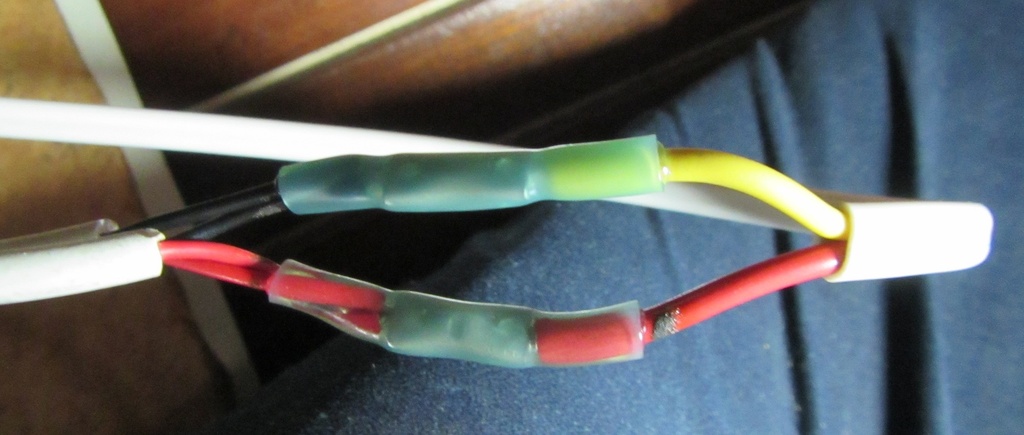
                                                                                                            Next we routed 16/2 AWG duplex sheathed electrical cable ($8.00) from the navigational desk, where the new 12 VDC AGC glass fused panel was located, to the aft area below the starboard cockpit.  We drilled a hole in the aft starboard cockpit exterior sidewall and installed a Blue Sea Systems #1001 CableClam ($15.99) to weather proof the passage of the electrical cable.  The 16/2 AWG duplex electrical cable was joined to the stern navigational light wiring with inline butt splices ($2.00).  This connection point was then wrapped with black electrical tape and secured with tie-straps.

                                                                                                              The routing of the port and starboard navigational light wiring was desired to be internal to the bow spirit stainless steel tubing and at its base pass through the forward deck.  We removed the headliners in the forward berth to reveal the backing plates and bow spirit stainless steel tubing mount bolts/nuts.  It was not a surprise to find the old unused wiring still present - this will be removed and deleted.

                                                                                                                When we returned again to Indra, mid August 2018, we removed the bowsprit stainless steel rails to the ground to enable routing electrical wires for the navigation lights (21 August).

                                                                                                                  We removed the old non-marine rated wiring from inside the stainless steel tubing and discovered it had a inline splice on both wires to extend their length.  It is usually common sense and a good practice to never install a wire splice in an area with restricted access. Using 0.32-inch steel wire, we routed it inside the stainless steel tubing and were able to fish it out the small hole by the base of the navigation lights.  We then  attached the electrical wire cable from the new Hella Marine 3 NM NaviLED PRO Navigation Lights to the 0.32-inch steel wire and gently pulled it back out of the stainless steel tubing. We had successfully routed the navigational light wiring through the bow stainless steel tubing.

                                                                                                                    Secured the wire navigational light wiring with a small nylon clamp. Next since this fixture was already on the ground and in the shade, used the opportunity to remove corrosion and polish the stainless steel rails with Autosol metal polish.

                                                                                                                      Routed 16/2 AWG duplex sheathed electrical cable ($12.00) from the navigational desk, where the new 12 VDC AGC glass fused panel was located, to the area in front of the v-berth - the previous location of the chain locker (31 August). Both the bow port and starboard navigational light wiring was connected by splices ($0.50) to the 16/2 AWG electrical cable (3 September).  The wiring routed in front of the v-berth was secured with clamps and the wire splice was secured and positioned in front and below the old chain locker access door.

                                                                                                                        The 16/2 AWG electrical cable from both the bow and stern navigation lights was connected to the new 12 VDC AGC glass fused panel at the navigational desk with a 2 amp fuse for circuit protection ($1.00 for wire terminals & fuse). 

                                                                                                                        Checked the navigation (running) lights and they worked a-ok (9 September)!!!