Raymarine Initial Software Update

Raymarine Initial Software Update

  • Action: To Do List item A0271 – Update all Raymarine components with latest software.
  • Completed:  23 April 2018
  • Cost: $26.67


The Raymarine website has a page that contains links to obtain software updates for each applicable component. To organize and track the different updates a spreadsheet was created with the following information.


Item Software Version Boot FW Release Date
a98 v19.03 1-Apr-17
 i70 v3.11 v1.01 1-Nov-17
ITC-5 v1.12 v1.14 1-Aug-14
Evolution EV1 v2.18 1-May-17
p70 v3.07 1-Aug-16
ACU100 v2.23 1-Apr-17
Quantum Radar v1.51 1-Jan-17
AIS650 v2.02 (040200.02.02.00) 1-Jun-17
AIS650 USB Driver v2.00 1-Jun-17
proAIS2 v1.10 1-Mar-18


Each software item was downloaded onto a laptop computer and organized into separate folders.  Purchased two SanDisk Ultra 32GB microSDHC UHS-I Card with Adapter ($21.18) to load the software on for use in the Raymarine a98 MFD chartplotter.  A 6 foot USB 2.0 cable ($5.49) was also obtained to interface the laptop to the Raymarine AIS650 unit.

In April 2018, we partially installed and electrically connected most of the Raymarine navigational system. With the flip of the new Blue Sea DC Distribution panel switch, its LED ON light illuminated, the Raymarine a98 MFD chartplotter powered on, and the two i70 and one p70 navigation instruments screens illuminated.

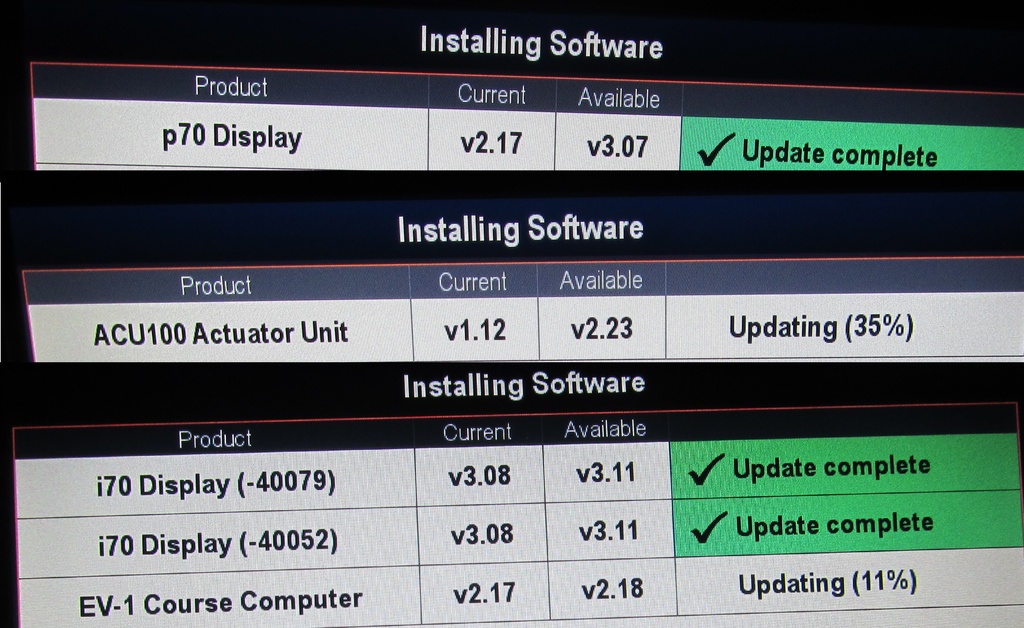
The Raymarine a98 MFD chartplotter was powered off, the SD card containing the software updates was installed, and the MFD powered back on.  The software loading process was fully automatic and only needed to wait until it completed.

Next, selected and loaded software into the other units.
The Raymarine AIS650 unit was loaded with an SD card inserted directly into the unit and then it was powered on individually.  The expected flicker of lights described in the manual appeared and the software load was complete.  The entire system was powered back on and confirmed the AIS650 software load was good.

Connected the laptop computer to the Raymarine AIS650 unit and using the proAIS2 software setup the vessel's details and GPS antenna location.

Ran the proAIS2 diagnostics on the Raymarine AIS650 unit and all indications were good.

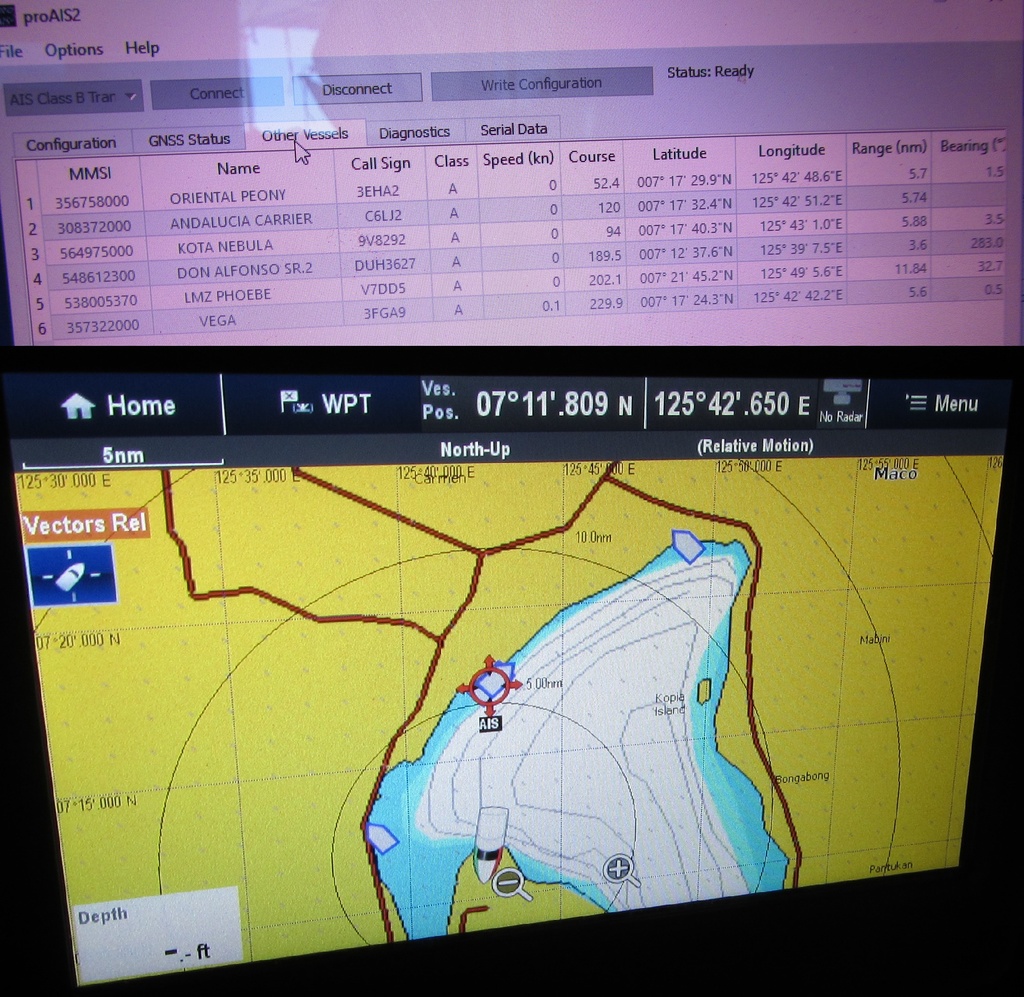
Checked the Automatic Identification System (AIS) and the operational map displayed on the a98 MFD chartplotter mirrored the vessels shown on the proAIS2.
The DST800 Triducer was connected to iTC-5 Converter, however noticed no depth indication was displayed on the i70 instrument display.  Verified the DST800 Triducer temperature output on the Raymarine a98 MFD chartplotter was good.  Next rotated the DST800 Triducer speed wheel and obtained a 7 knot indication on the i70 instrument display.  Temporarily connected the CPT-120 Thru-Hull sensor to the Raymarine a98 MFD chartplotter which showed a detailed depth display and the i70 instrument displayed 19.3 feet, as shown below.  Powered off the system and rechecked all the DST800 Triducer wiring connections at the iTC-5 Converter but found no deficiencies. There was a strong possibility that the new DST800 Triducer was defective for depth indications - this was added to the To Do List, item A0295 - Obtain replacement DST800 Triducer.

The new Raymarine Quantum Q24C CHIRP Radome was still in its box, but decided to jury rig its connections to enable its software to be updated.  Located the radar unit in the cockpit and made all the appropriate electrical connections including the data cable.  The radar was powered on and came right up in Standby mode.  The software loaded successfully.  The display indicated a Quantum Wired Adapter version 1.16 was successfully loaded, however this was unexpected as this adapter was not identified in any of the Raymarine documentation.

To confirm the Quantum Wired Adapter was a result of the data cable being connected, powered the system off and disconnected the data cable.  Repowered the system on and the Quantum Wired Adapter was no longer listed as a software device.  Enabled the Raymarine Quantum settings to operate in wireless data mode and the wireless connection was successfully established as indicated in picture below.

The system was powered off, the radar unit disconnected and stowed back in its box.  All Raymarine components were successfully updated with the latest available software.


Portlight Leak – Above Forward Starboard Settee

Portlight Leak – Above Forward Starboard Settee

  • Action: To Do List item A0277 - Fix water leak at forward port light above the starboard settee.
  • Completed:  16 April 2018
  • Cost: $15.00 - estimate of materials used - new screws, sandpaper, and butyl tape sealant.


During a rainstorm on 26 March, Marilyn discovered water leaking in from the forward portlight above the starboard settee.  We opened the portlight hatch and checked the rubber gasket seal.  The seal was old and compressed, it probably should be replaced on all the portlights.  We added to the To Do List item B0285 - Obtain and replace all portlight rubber gasket seals. Believing the leak was only at the seal, we cinched the hatch down extra tight.

Another heavy rainstorm on 15 April resulted in more water leaks from the forward portlight above the starboard settee.  We looked closer, and found the water was not getting past the portlight rubber gasket seal, it was leaking through the bronze portlight frame and dribbling down the interior cabin top side wall underneath the mica panel. As old paperwork found aboard Indra revealed that the cabin top sides were replaced previously due to water leaks causing the wood to rot (more on this issue below), we decided to investigate this leak first thing the next day.

When removing the bronze screws from the outside portlight frame, each screw head just twisted off and fell out.  Not one complete full length screw was installed, as the picture below, bottom left inset picture confirms with all the very short screw heads accounted for.  Based on how the screw head just twisted and fell out, we suspect they were sealed in the holes with a dab of epoxy or sealant.  There was nothing applying any force to the outside bronze portlight frame to retain it securely to the cabin top wall - this totally incompetent installation was a facade to conceal poor workmanship.

The top right inset picture below with the outside bronze portlight frame removed shows the path the water was following - the dark and dirty trails on the top edge of the portlight.  This mess, along with what little sealant that was used, was removed - used a razor blade to cut and remove about a 1/4-inch of the black sealant around the inner bronze portlight frame.  The exterior bronze frame was wire brushed and sanded clean with 80 grit sandpaper to increase the adhesion to the sealant.

    The groove that was cut out of the sealant around the inner bronze portlight frame, had butyl tape sealant forced into the crevices.  Two strips of butyl tape sealant was layered on the exterior bronze portlight frame.  The exterior frame was then mounted and secured to the cabin top side wall with 316 stainless steel screws.  As the bottom inset picture below illustrates, the compressed butyl tape sealant oozed out around the frame - a good indicator of a now water tight seal. The excess butyl tape sealant was trimmed clean using a razor blade.

      Now knowing that this portlight water leak was a result of incompetent workmanship and lack of use of proper mounting hardware -- did this imply that the other 11 portlights were in the same state - a facade/fake installation?  The discovery of this deceitful type of workmanship irritated and pissed me off, to no end!  A disturbing trend was developing with all the problems we were discovering about the true state of Indra - she was extremely neglected and incompetently maintained.  Due to this ##@## situation, we added to the To Do List item B0286 to inspect and reseal all portlights after enough new screws, butyl tape, and sealant was obtained.

      Still irritated with this situation, we reviewed again the old paperwork found aboard Indra, mentioned above, in an attempt to discover who and where this shoddy work was performed.

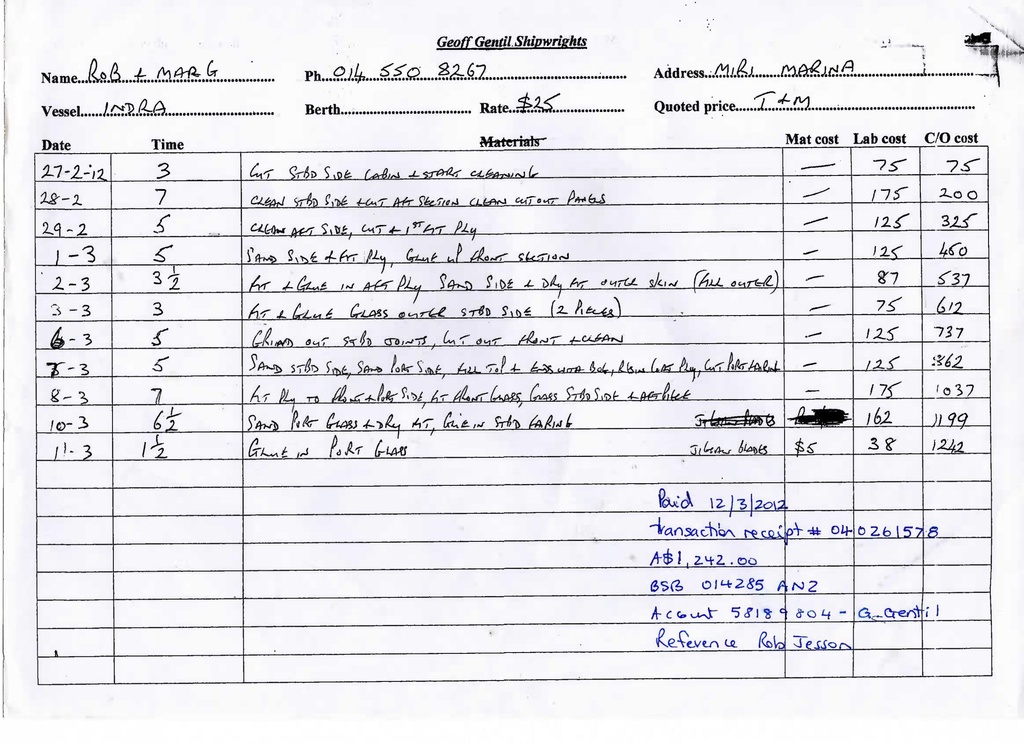
      The bill shown below indicates both the starboard and port side cabin tops were "repaired" during February/March 2012 while located at Miri Marina, Sarawak, Malaysia.

        The following inspection report reveals other issues Indra had, but there was no indication this additional work was done at Miri Marina, Sarawak, Malaysia.  This inspection report did confirm the starboard and port side cabin tops were "repaired", as pictures of them were included in this report.  This report also stated, "At your request the cabin sides were cut out and new ply let in and glassed, filled, faired and painted."  This also implies that all of the cabin top portlights had to be re-installed as part of this effort.  It is also reasonable to conclude this was the most likely place the incompetent installation and poor workmanship discovered above occurred. It is also reasonable to conclude if the above leaky portlight was installed so incompetently than the same is most likely true for the other 11 portlights.

        As to the other issues mentioned in the above report, it is "assumed" that these were corrected while at Holiday Oceanview Marina, Samal Island, Mindanao, Philippines.  The for sale advertisement claimed "...newly laid decks and new hardware, newly-spray painted hull and deck..." and the above issues by all "appearances" were resolved.  However, based on the significant number of problems discovered aboard Indra, we do not trust or believe anything about Indra, unless we confirm it ourselves.

        As to whether the starboard and port side cabin tops were "repaired" - we know definitively.  The picture below shows holes and the wood core removed from the cabin top side wall for new AC shore power inlet receptacles.  While it shows relatively new and a dry plywood core, voids are visible in the epoxy and paint layers indicating the workmanship and/or material used was of poor quality.

        Newport Diesel Heater Draft Assist Fan

        Newport Diesel Heater Draft Assist Fan

        Newport Diesel Heater Draft Assist Fan


        • Action: To Do List item A0153 - Rewire diesel heater circuit and include proper rated protective fuses.
        • Completed: 12 April 2018
        • Cost: $7.60


        The Dickinson Marine Natural Draft Diesel Heater Operating and Installation Instruction Manual was reviewed for manufacture recommendations and instructions.  It stated in section 8, "Whenever possible, ensure a weatherproof connection between wires with solder or the appropriate connectors with 18awg wire."

        The manufacture recommended use of solder is counter to National Fire Protection Association (NFPA) paragraph 9.14.7 and American Boat & Yacht Council (ABYC) standard E-11 AC and DC Electrical Systems, paragraph 11.14.3.7 – "Solder shall not be the sole means of mechanical connection in any circuit."   The manufacture recommended use of 18 AWG wire is counter to ABYC standard E-11, paragraph 11.14.1.1.2 - "Conductors shall be at least 16 AWG." and NFPA paragraph 10.13.7 -  "Conductors, other than those contained completely within equipment or enclosures, shall be at least No. 16 AWG."

        The following diagram depicts the wiring installation using 16 AWG wires and heat shrinkable mechanical splices.

        First, the old wires to the diesel heater fan were removed.  A piece of teak wood trim held in place by four screws was removed that surrounded the diesel input and return copper tubing lines; as it also had a hole for the routing of the wire. 

        The new 16/2 AWG sheathed duplex wire, about 10 feet  ($3.60) was routed from the fuse block in the hanging locker opposite the head, down through the floor boards, across the top of the water tank, through a hole in the floor support brace, following the routing of the copper tubing.  A piece of stiff wire was used to fish it up through the floor boards and then it was threaded through the hole in the teak wood trim piece.

        The 16/2 AWG sheathed duplex wire was connected to the diesel heater input wiring with two heat shrinkable inline butt splices ($1.00) and secured to the base of the heater drip trap with tie straps.

        The opposite end of the 16/2 AWG sheathed duplex wire was connected to the fuse block with two #8 ring heat shrinkable splices ($1.00) with a 1 amp protective fuse ($2.00).  Final clamping and securing the wire harnesses will be accomplished after all additional circuits are connected.

        The diesel heater fan operation was checked and it still worked, both on/off and variable speed.


        Engine Exhaust Gooseneck System

        Engine Exhaust Gooseneck System

        • Action: To Do List item A0087 - Install a gooseneck system with anti syphon connection as close to exhaust discharge fitting.
        • Completed: 9 April 2018
        • Cost: $348.68


        The need and the reason to add a gooseneck component to the engine exhaust system are explained on To Do List item A0085 - Remove and delete the Chiu Tong ball valve.  As part of the exhaust system modification, a new exhaust discharge thru hull with a flapper valve was installed on To Do List item A0086.

        The gooseneck component selected was a Vetus NLPG75 Gooseneck Muffler ($215.99).

        A Trident Marine 3-inch Hump Hose with 4 stainless steel T-bolt clamps ($49.99) was also ordered to connect the gooseneck muffler to the new exhaust discharge thru hull fitting.  An additional ten Trident 720-3000L Series Stainless Steel T-Bolt Exhaust Hose Clamps ($82.70) were ordered to replace the existing exhaust hose corroded clamps and have spares available.

        The Vetus NLPG75 Gooseneck Muffler was attached to the Trident Marine 3-inch hump hose and then the hump hose was connected to the new Centek 3-inch exhaust thru hull fitting.  Each connection point had two stainless steel T-bolt clamps installed.

        The 3-inch exhaust hose from the Foreshore Marine water-lock muffler, located at the bottom of the bildge, was connected with double stainless steel T-bolt clamps to the input side (top) of the Vetus NLPG75 Gooseneck Muffler.  The Vetus installation manual stated, "Fit the gooseneck with the ty-raps supplied. The gooseneck has slots in which the ty-raps should be fitted."  The gap between the gooseneck and the hull does not support the installation method recommended.  Added to the To Do List item A0287, Fabricate wooden supports glassed to the hull to support gooseneck muffler.

        At the Foreshore Marine water-lock muffler in the bottom of the bilge, two new stainless steel T-bolt clamps were installed on it's water inlet side (yellow arrow in picture below).  The corroded clamps on the outlet side of the water-lock muffler, were extremely difficult to access and remove (red arrow in picture below).

        After nearly two hours in the hot, steamy, closed-confines of the bilge, was finally successful in removing the two clamps.

        The installation of the two new stainless steel T-bolt clamps was accomplished, after another hour had passed.

        The last exhaust hose connection at the engine mixing elbow also had new clamps installed.


        Manual Bilge Hose Replacement

        Manual Bilge Hose Replacement

        • Action: To Do List item A0039 – Replace manual bilge hoses and all corroded clamps; install double clamps at all hose ends.
        • Completed: 9 April 2018
        • Cost: $90.96


        On 11 December 2017 we ordered 30-feet of 1.5-inch Trident #147-112 Vac XHD Bilge/Live Well Hose ($4.19 per foot) and eight AWAB #316044 Marine Grade Smooth Band Hose Clamps SAE Size: 20 ($2.99 each) from Defender's website. These were shipped to our balikbayan box consolidator and forwarder Manila Forwarder in Los Angles, California and received there on 16 December 2017. We received them in Naga City, Cebu on 23 February 2018.

        The bilge hose was removed as part of the work perform on To Do List item A0283 - Clean the bilge, where the bilge hose scupper fitting was also discovered broken, To Do List item A0284.

        The removed sections of bilge hose were measured to determine cut lengths for the new hoses with small added allowances. We used about 16-feet of new hose at a cost of $67.04.

          The bilge pump was then reinstalled with new double clamps at each end.  Used four new AWAB 316 Stainless Steel Marine Grade Hose Clamps at $3.14 each, total cost $12.56.

            To Do List item A0039 - Replace manual bilge hoses and all corroded clamps; install double clamps at all hose ends; still remains to be accomplished as replacement hoses have yet to obtained.


            Added to the To Do List:

            • B0200 – Obtain spare Whale AK3051 service kit for Gusher 30 bilge pump.
            • B0201 – Obtain Whale Gusher 30 bilge pump AS3016 Handwheel & Stud Kit and install missing handwheel.
            • A0202 - Drill hole in deck plate and bilge pump handles, secure with lanyard, and stow on cockpit coaming.


            Oil In The Bilge

            Oil In The Bilge

            • Action: To Do List item A0283 – Clean the bilge.  Remove excessive accumulation of engine oil and miscellaneous debris.
            • Completed: In-progress.
            • Cost: $82.05


            During our initial inspections of Indra, we noticed the bilge had engine oil on top of a layer of water.  We initially thought this was not a major issue, as "most" responsible boat owners do not allow oil to accumulate in bilge, since it would eventually get pumped out and harm the ocean and its inhabitants.  Also, if observed by authorities, pumping oil contaminated bilge water into the ocean could result in a citation and hefty fines, potentially a jail term.  Our assumption (we assumed wrong) was this was probably a small amount of oil and could be easily cleaned up once we had some oil absorbent material.  Besides, we had inspected the bottom of the engine and found no oil leaks.

            On 19 October 2015 we ordered two MDR Oilzorb Bilge Mini Booms ($13.99 each) and five 3M Marine Oil Sorbent Pads ($1.89 each) from Defender's website. These were shipped to our balikbayan box consolidator and forwarder Manila Forwarder in Los Angles, California and received there on 23 October 2015. We received them in Naga City, Cebu on 28 December 2015.

            On the next and subsequent trips to visit and work on Indra, we would stuff some of the oil absorbent material down into the bottom of the bilge tied to a string to retrieve it.  Each subsequent trip, we would pull out the oil absorbent material and it was thoroughly oil saturated. Strange? We stuffed some more of the oil absorbent material down into the bottom of the bilge and next visit, same result - thoroughly oil saturated.  As we had used up all the oil absorbent material we had ordered, decided we needed more.

            On 10 December 2017 we ordered two Starbrite Bilge Oil Pads 5 Pack ($8.69 each) and three Buffalo Industries 5" x 15" Bilge Booms ($9.08 each) from Amazon's website. These were shipped to our balikbayan box consolidator and forwarder Manila Forwarder in Los Angles, California and received there on 12 December 2017. We received them in Naga City, Cebu on 23 February 2018.

            In March/April 2018, when we returned to Indra, we pulled out the oil absorbent material and it was again thoroughly oil saturated.  That was it, we were PISSED OFF! No more oil absorbent material - we would pump out all the liquid from the bilge, rinse, and repeat, until the bilge was clean.

            We first attempted to use our hand pump to suck the oil and water up, out of the bilge and into a empty plastic water jug.  This did not work very well, as the suction hose diameter was too small and quickly clogged up due to small debris mixed with the oily liquid.  As we had previously removed the old defective Shurflow fresh water pump, we rigged it up with electrical power and sections of old 1/2-inch hose, to use it to pump the oily bilge water into empty plastic water containers.

              Initially, this was successful, but the pump ceased to pass water, as it too succumbed to pieces of debris and clogged up.  But we did managed to get some of the oily mess into the plastic jug.

                We used our garden water hose to blow out the pump diaphragm and hoses, reassemble, and then it would work again for a short period of time before it clogged up again. But we managed to get more of the oily water out.

                  The process of cleaning out the clogged pump was repeated, and again we got more of the oily water out.

                    Finally, it appeared no more liquids could be pumped out of the bilge.  Yet the bilge still appeared blackened with presence of oil.

                      We used a cloth rag attached to a wooden pole and scrubbed the mess - the rag absorbed the oily mess.  Lots of small miscellaneous debris and garbage would stick to the rag and were shaken out into a bucket.  The rag was then squeezed out into the bucket to deposit the oil. Then we would use the rag again to gather more oil.

                        Once the bilge was emptied of all liquid and the rag would not absorb more oil, used the water hose to squirt lots of water under the engine area and around the water lock muffler. The installation location of the water lock muffler impeded the free flow of water back to the deeper parts of the aft bilge.

                          The squirted water resulted in more oily sludge being exposed and mixed with the water.  With the bilge re-filled with about 2-feet of water, then began the process of pumping the oily water to the plastic jugs with the old water pump, which still required constant flushing with fresh water to clear the clogs caused by the debris.  When the liquid was removed we would use the rag to wipe the area and remove as much oily sludge and debris.  Then we repeated the flushing of the bilge with fresh water and its removal.  After the removal of over a hundred of the 10 liter plastic jugs filled with the bilge water - the water coming out was starting to clear up.  We repeated the flushing of the bilge with fresh water and not-surprising, the pump overheated and quit running. The only thing left that could pump more water out was the Gusher 30 manual bilge pump.  As we had repaired the Gusher 30 manual bilge pump and installed all new seals, we were confident it would do the job (we were wrong again).

                          After pumping the Gusher 30 manual bilge pump for about five minutes, we had removed ZERO amount of the oily bilge water. Frustrated and more pissed off, we questioned what else is broke on this boat?  We removed the tie straps securing the manual bilge pump hose to the interior sides of the bilge and then removed the section of hose with the scupper fitting on that end. The scupper fitting was coated in the oily sludge and the hose clamps were corroded.

                            Upon opening the scupper fitting, found the problem preventing the manual bilge pump from removing water. The non-return rubber valve (red arrow in picture below) was no longer held in place by its spring-loaded retaining screw - the screw had literally rusted away into nothingness. The non-return rubber valve was being sucked up against the hose fitting with the pump action of the manual bilge pump and blocking the flow of any water. The interior pieces of the scupper fitting were thoroughly coated in oily sludge. The build-up and accumulation of oily sludge had deposited itself on the inside walls of the scupper fitting and 1.5-inch bilge hose. As the picture below illustrates, the 1.5-inch diameter of the hose end of the scupper fitting and the bilge hose, was reduce by about 50-percent also impeding the flow of water. The presence of this much accumulation and oil contamination indicted this "oil in the bilge" issue had been caused and neglected by the previous owners for a very long time.

                              The scupper fitting pieces were cleaned up to remove all traces of the oily sludge.  A machined threaded screw with two nuts and a washer were obtained to serve as a temporary replacement fix for the original, old rusted away screw.  Added item A0284 to the To Do List - Obtain and install a replacement manual bilge hose scupper fitting.

                                The scupper fitting pieces were reassembled and was very careful on the amount of tension the spring applied on the screw, pulling the rubber non-return valve to its closed position. Two nuts were tightened together to lock the length of the screw and spring in-place.

                                  The scupper fitting non-return valve side was reassembled to the hose barb side and tightened down - the interior of the hose bard side did have all the oily sludge deposits removed from its interior side walls. New 1.5-inch bilge hose and double 316 stainless steel hose clamps were installed on the hose bard side as part of To Do List item A0039.

                                    The bilge scupper fitting and hose was positioned in its prior location in the base of the bilge. The picture below illustrates the bilge water was essentially clear of the oily contamination, but the brownish pieces in the water indicate that some of the debris and garbage remained. It was also evident that the length of the strainer on the old scupper fitting, required the water level in the bilge to be above these entryways in order to pump out water - this meant that a level of 3-4-inches of bilge water were not removable due to the length of the scupper strainer entrances.

                                      To facilitate the removal of as much bilge water as possible, we temporarily installed a small Rule 1100gph bilge pump - part of To Do List item A0044. The Rule bilge pump was installed on a wood extension to reach the deepest part of the bilge and the outlet hose was routed upward and exited a port side thru hull hole.

                                        We again squirted lots of water under the engine area and around the water lock muffler. The Rule automatic bilge pump turned on and successfully pump the water out of the boat.

                                        Feeling confident that we had a reliable way to remove water from the bilge (we were wrong again), we routed the water hose inside the boat to wash down the bilge from bow to stern.  We started at the chain locker area and thoroughly squirted water to push the debris and sediment in the aft direction. We then removed the floor board outside the head entryway and continued squirting water - pushing more debris, sediment, and garbage aft under the water tank. The water level in this area was rising as we suspected there were blockages under the water and diesel tanks slowing the flow of water aft. We opened the floor boards by the cabin table floor-way and continued squirting water in between the water and diesel tanks - it appeared there was so much debris, sediment, and garbage that it was forming a dam severely restricting the flow of water aft. Positioned the hose down and underneath the tanks and used the pressure of the marina water system to break up some of the restrictions. We could hear the Rule bilge pump running and thought our plan was proceeding pretty well. Then we discovered the bilge hose that exited the boat had no water exiting from the running Rule bilge pump. We removed the power from the Rule bilge pump and pulled it up and out of the bilge - the water level in the bilge was just shy of 3-feet in depth restricting the flow of water in the aft direction.

                                        Upon inspecting the Rule bilge pump strainer installed on the units base, we found it completely blocked by the debris, sediment, and garbage. We cleaned out the strainer and reposition the Rule bilge pump back down in the bilge and turned it back on. It immediately started pumping water out and overboard. In less than two minutes, the flow of water exiting out the boat ceased, but the Rule bilge pump kept running. Again, we found the strainer clogged by debris. We cleaned the strainer out, reinstalled it in the bilge, and started the pump again. It quickly clogged up and water ceased to exit the boat. We tried to reduce the debris and crap in the water by manually collecting and fishing out as much as possible. This help a little, but as the water level in the bilge decreased, more debris, sediment, crap, and garbage flowed aft from the forward bilge. We were finally able to remove as much water from the bilge as possible by persistently cleaning the pump strainer. We checked the rest of the bilge forward and discovered standing water remained forward in the bilge. The exposed areas of the forward bilge all had debris, sediment, crap, and garbage still. This bilge clean up would take more time and effort, but not now, next trip.