Design and Install AC Electrical System

Design and Install AC Electrical System

  • Action: To Do List item A0175 - Design and install 110 VAC electrical system with marine rated battery charger/inverter.
  • Action: To Do List item A0176 - Remove unused AC outlets and any associated wiring.
  • Completed:  A0176 - 6 April 2018
  • Cost: $3,532.50


Indra was not equipped with a shore based Alternating Current (AC) electrical input receptacle and used extension cords to bring 230VAC 50Hz electrical power aboard.  Its GYS CT180 battery charger designed for recharging only lead acid batteries was deleted with the selection of new AGM batteries to replace the defective GEL batteries. A marine rated battery charger was needed to provide a charging capability for the new AGM batteries. The deletion of the existing 800 watt PACO power inverter that output very limited 230VAC would also be replaced by a new marine rated power inverter.  The decision to use 230 versus 120 VAC needed to be considered.

As we worked on Indra, located on the hard at Holiday Oceanview Marina, Samal Island, Philippines, we observed different boats arrive and attempt to connect their boat to the electrical system the marina used.  The local power was 230VAC 60Hz 16 Amp service but the receptacles were Hubble Twist-Lock labeled 30A 125V.  Some boats came prepared, as they broke out a box of assorted electrical connectors and attached the matching connector to their shore power cable.  Others, not prepared, made the day-long trip to Davao to attempt to locate the desired connector or buy new electrical extension cables with power transformers as their boat and stash of electrical power tools were not compatible with the local electrical service.

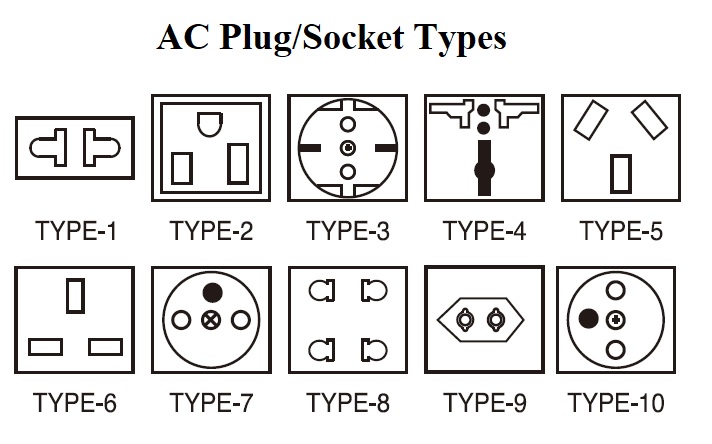
A simple action like plugging in a laptop 3-prong connector required a 3- prong to 2-prong adapter to work.  More than once, we witnessed (and experienced ourselves) the frustration of folks as they fried/smoked an electrical item by plugging it into incompatible electricity.  There were a variety of AC plugs and sockets found aboard Indra on tools, extension cords, fans, and transformers, as the picture below illustrates.
All these electrical issues were considered as we researched the internet to determine what type of AC electrical system would work for us.  Our basic goals were a marine rated battery charger (necessity for AGM battery charging and equalization), a DC to AC power inverter (computer printer for customs paperwork and miscellaneous charging devices), a few well placed electrical outlets (convenience items), and provisional secondary power for a future hot water heater.  It was also desired to be an isolated system (no galvanic/stray current issues) and dual compatible with both 230 and 120 volt 50/60hz input power service.  We would also still need access to 230VAC as some of the electrical items aboard worked off that voltage.

For our marine rated battery charger/inverter we selected the Xantrex Freedom SW 2012 Pure Sine Wave Power Inverter/Charger P/N: 815-2012 and accessories.  It specifications rated it as 2000 watts of 120VAC 60Hz and battery charge capability of 100 amps.

To provide for an isolated AC system we selected a Charles Marine Iso-G2™ 3.8 kVA Isolation Transformer P/N: 93-ISOG2/8-A {No longer made/discontinued as of March 2021}. A unique feature of this transformer was it could use either 120 or 230 VAC electrical input power.

Next, was to figure out how and what else was needed to support this installation.  The goal to be able to use either 120 or 230 VAC electrical input power meant separate inputs were needed to accommodate the different amperage and fuse protection circuits. Additionally, a way to switch or select the 120 or 230 VAC electrical input power was needed that would also properly configure the input circuit requirements to the Charles Marine isolation transformer.  A pictorial diagram to illustrate this was made.

The following items were ordered to support this installation.


P/N Item Q Each Total
815-2012 Xantrex Freedom SW 2012 Pure Sine Wave Power Inverter / Charger 1 $1,389.99 $1,389.99
809-0921 Xantrex Freedom SW Xanbus Remote Control Panel 1 $189.99 $189.99
808-9003 Xantrex Freedom SW Ground Fault Circuit Interrupter (GFCI) Kit 1 $26.99 $26.99
809-0940 Xantrex Network Cable 25 Ft 1 $22.99 $22.99
 93-ISOG2/8-A Charles Marine Iso-G2 3.8 kVA Isolation Transformer 1 $629.99 $629.99
2675 THOMAS & BETTS - 2675 - 3/4 BLACK BEAUTY CORD FIT .660-.780 STRAIN RELIEF 2 6.48 12.96
303SSEL-B Marinco 30 Amp 125 Volt Shore Power Inlet 1 $79.88 $79.88
303SSEL-BXPK MARINCO Stainless-Steel 16A/220 Volts 50 Hz Power Inlet 1 $119.99 $119.99
8077 Blue Sea Systems 120 volts AC Main Circuit Breaker Panel 1 $79.99 $79.99
8177 Blue Sea Systems 230 Volt AC Main Circuit Breaker Panel 1 $87.29 $87.29
8386 Blue Sea Systems, Panel, AC, Rotary Switch, 120 Volt, 30A, 2 Positions + Off, 4 Pole 1 $230.31 $230.31
8043 Blue Sea Systems AC Main & 3 Position Circuit Breaker Panel 1 $210.88 $210.88
131110 Ancor Marine Grade Flat Triplex Electrical Cable 10/3 - Wire Gauge 40 $1.89 $75.60
124102 Ancor Marine Grade Flat Duplex 10/2 Wire Color: Red / Yellow 25 Foot Roll 1 $39.99 $39.99
6006 Blue Sea Systems, m-Series, Battery Switch, Single Circuit, On - Off 1 $24.11 $24.11
5005 Blue Sea Systems ANL Fuse Block with Insulating Cover - 35 - 300A 1 $17.47 $17.47
5125 Blue Sea Systems ANL Fuse - 100 Amp 2 $16.03 $32.06
7899-W Leviton 7899-W 20 Amp 125 Volt, SmartlockPro GFCI, with Indicator Light, Nylon Wallplate and Screws Included, White 3 $14.45 $43.35
B120R Thomas & Betts #b120r Sg Old Work Box 3 $5.06 $15.18
50048219 SeaSense 800 Piece Screw Assortment, Stainless Steel 1 $56.51 $56.51
15MSPPXP 16 Amp PowerCord Plus® Cordset with Female Connector, 15m 1 $112.99 $112.99
305CRPN.VPK Marinco 30 Amp 125 Volt Locking Male Plug With Cover 1 $33.99 $33.99
$3,532.50


Indra had the "decomposed remains" of two National (Panasonic) WF3002 single 15 amp 125 volt AC outlets still installed in the forward berth area and forward wall of starboard settee.  These AC outlets were not enclosed in the required protective box (ABYC E11 11.13.3.1) and the AC outlets did not have the required ground (green wire) terminal (ABYC E11 11.13.3.2). The wire still attached to the old AC outlets was connected with prohibited twist-on wire nuts (ABYC E-11 11.14.5.6).  While these old AC outlets were not connected to a live AC circuit, they were extremely corroded, no longer usable, and unsightly - they "begged" to be removed and deleted. Shown below in the first picture is the old corroded AC outlet with a new AC outlet of the same type for comparison.

We installed three new AC outlets, Leviton 7899-W 20 Amp 125 Volt, SmartlockPro GFCI outlets, with Thomas & Betts plastic AC outlet enclosure boxes to replace the old outlets; and installed one additional AC outlet at the navigation desk - as the following pictures illustrate.

Holiday Oceanview Marina – March 2018 Summary

Holiday Oceanview Marina – March 2018 Summary

Holiday Oceanview Marina - March 2018 Summary


  • 11 March - 16:30 - Arrived at Holiday Oceanview Marina from Naga City, Cebu.

We opened the boat hatches and ports - noticed the slight smell of mold/mildew. Removed our tables and plastic chairs and set them up on the concrete next to the boat.  As per previous trips, there were no available hook-ups for our water hose - no problems - we connected our one-to-two hose adapter and were operational.  Found only one available electrical hook-up, almost 250 feet away that used almost the full length of all our extension cords - we would notify the HOV marina staff they needed to install additional electrical hook-ups in the morning.  We arranged the stuff inside the boat to allow space for three to sleep.  Had a quick diner of instant noodles and turned in.


  • 12 March

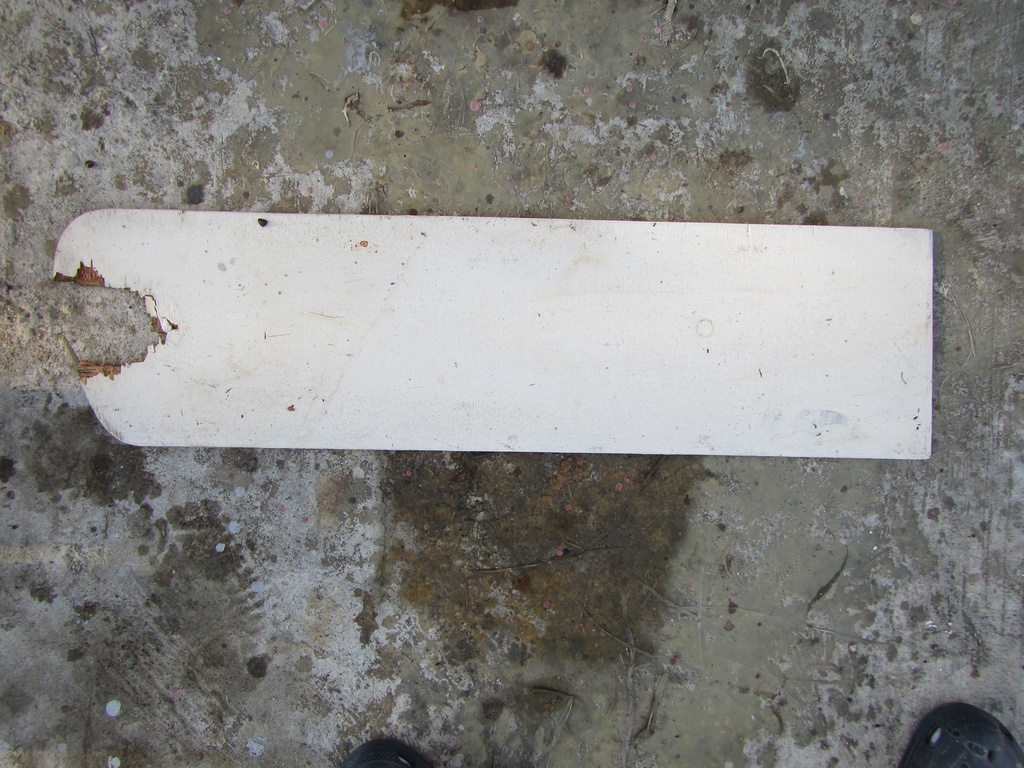
Up before the sun, the first thing we noticed were the wooden stairway for the boat were spongy and weak - they would need to be replaced.  Marilyn talked with local workers to arrange the purchase of lumber and materials for the new steps. One of our storage boxes was seriously decomposing and would not last much longer - we needed at least two more large boxes to store items from inside the boat to facilitate interior work. Our tarps were still secure providing some protection to the deck, cabin top, and cockpit areas - but there were still numerous presents from the birds.  The forward deck had numerous seeds and sticks dropped by the birds, besides their poop, and the growth of algae on parts of the deck was present.  Notice that the red ants were still invading the boat, used the bug spray to kill as many as possible.  On the ground we found a piece of wood that had rotted through and fell off due to the winds - it was the remains of our wind vane (To Do List item A0247).  The wooden wind vane probably should have been removed and stored when Indra initially was pulled out and put on the hard.

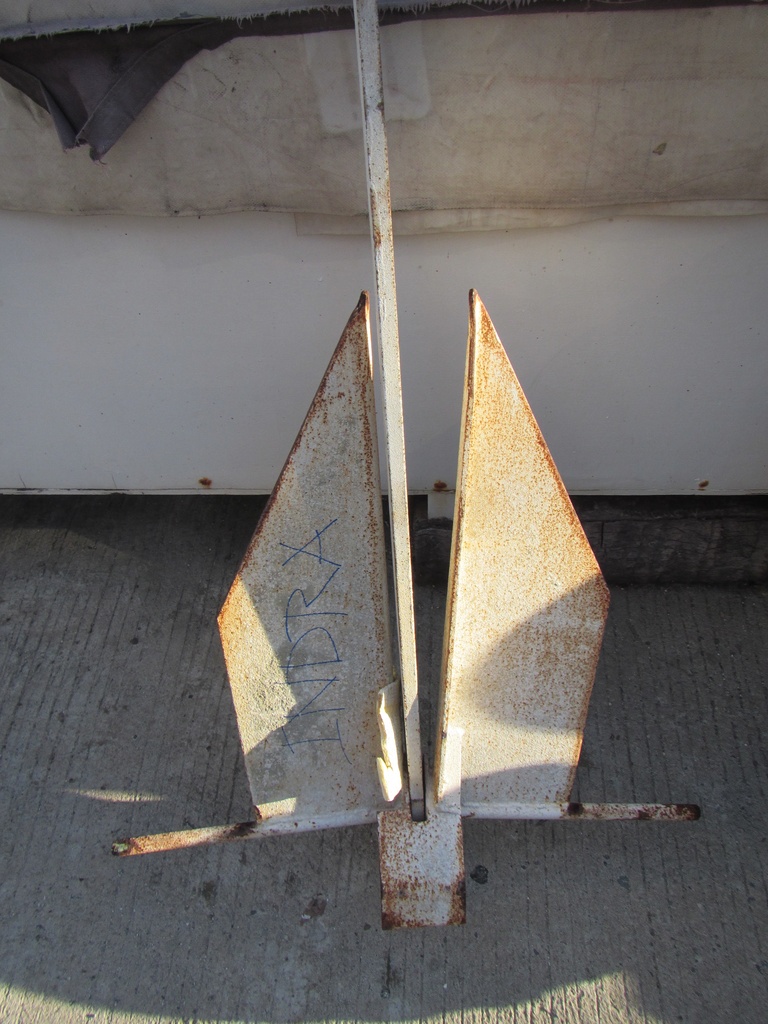
When inspecting the Flemming wind vane for pieces of the rotted wood vane, noticed the stern mounted Danforth anchor had a significant accumulation of rust/corrosion on it; so it was removed to the ground for work - To Do List item A0248. The Danforth anchor appeared to have been painted white in the past and the paint was really thinned out no longer protecting the metal from rusting. Found the painting of an anchor very "strange" since if the anchor is actually used, the paint would likely be removed very quickly as it is dragged and set on the ocean floor - why wasn't the anchor re-galvanized instead of painted? The Danforth anchor's stock or fluke attach bar was also bent - it might be prudent (less costly) to replace this anchor instead of having it bent back to original shape and properly galvanized. The Danforth anchor's rusted mounting bracket would also need to disassembled and cleaned up. As this Danforth anchor was mounted on the boomkin starboard side stainless steel railings, assumed for quick deployment, could not figure out the method for anchor rode or chain attachment - there was NOT a anchor chain deck pipe in this area - will consider adding one. Used the grinder on the Danforth anchor which quickly revealed their were more problems than surface rust.

Also noticed our "newly replaced" LifeSling2 stowage bag had significant mold/mildew all over it.  It too was removed for cleaning.  Add to the To Do List item B0249 to replace this stowage bag with one made of Sunbrella material since the new bag material is so prone to promote the growth of mold/mildew.

Installed LPG tank warning/safety labels on our two new LPG tanks - To Do List item A0224.

Installed temporary wiring so a few fans and lights would be operable aboard.

Marilyn talked with the HOV marina staff in the morning and they installed two additional electrical AC outlets that afternoon.

  • 13 March

Removed the stern navigational light - To Do List item A0028.  Cut and sanded three teak wood pieces for the mounting of the new stern and bow navigational lights.

Local HOV marina workers removed the old wooden stairs and built new stairs out of coco (coconut) lumber and plywood.  Marilyn's design included the "traditional" Filipino dirty kitchen into the new steps - only one of its kind at the marina - Marilyn was happy!

    Marilyn made agreement with SV Rainbow Chaser to purchase their air conditioner for 4,000.00 pesos (about US $80.00) as they planned to depart the marina within the next few days.


    • 14 March

    Applied layers of varnish to wood pieces for navigational lights - To Do List item A0026/27/28.

    Applied another layer of varnish to rudder wood sections.

    • 15 March

    Waved goodbye to SV Rainbow Chaser that departed the marina at about 10:30.

      Removed Ritchie SuperSport SS-2000 compass and replaced LED light assembly - To Do List item A0219.

      Removed forward berth old AC electrical outlet and installed new one - To Do List item A0175/0176.

      Installed Raymarine Evolution EV-100 Sensor Core in dodger hardtop - To Do List item A0253.

      Installed new stern and bow navigational lights - To Do List item A0026/27/28.


      • 16 March

      Worked on galley sink drainage hose and couplings - To Do List item A0274.

      Removed section of wood that contained Australian Ship’s markings above the companionway entrance - To Do List item B0006.


      • 17 March

      Removed port/starboard Hella Marine 2984 series 2 NM Navigation Lamps from masthead pulpit - To Do List item A0026.

      Removed mast pulpit Indra nameplate - To Do List item B0007.

      Removed stay sail roller furler and rig wire - To Do List item A0173.

      Watched as Soggy Paws re-entered the water at 16:30.

        Rose of Valhalla also gets new wood steps. Now know why she was so interested and watched our new steps being built.

        • 18 March

        Worked AC electrical panel - To Do List item A0175.

        Installed air conditioner in cabin top hatch opening and wired it up for operation.  Mary Ann was overjoyed.

        • 19 March

        Installed stay sail roller furler with new rig wire - To Do List item A0173.

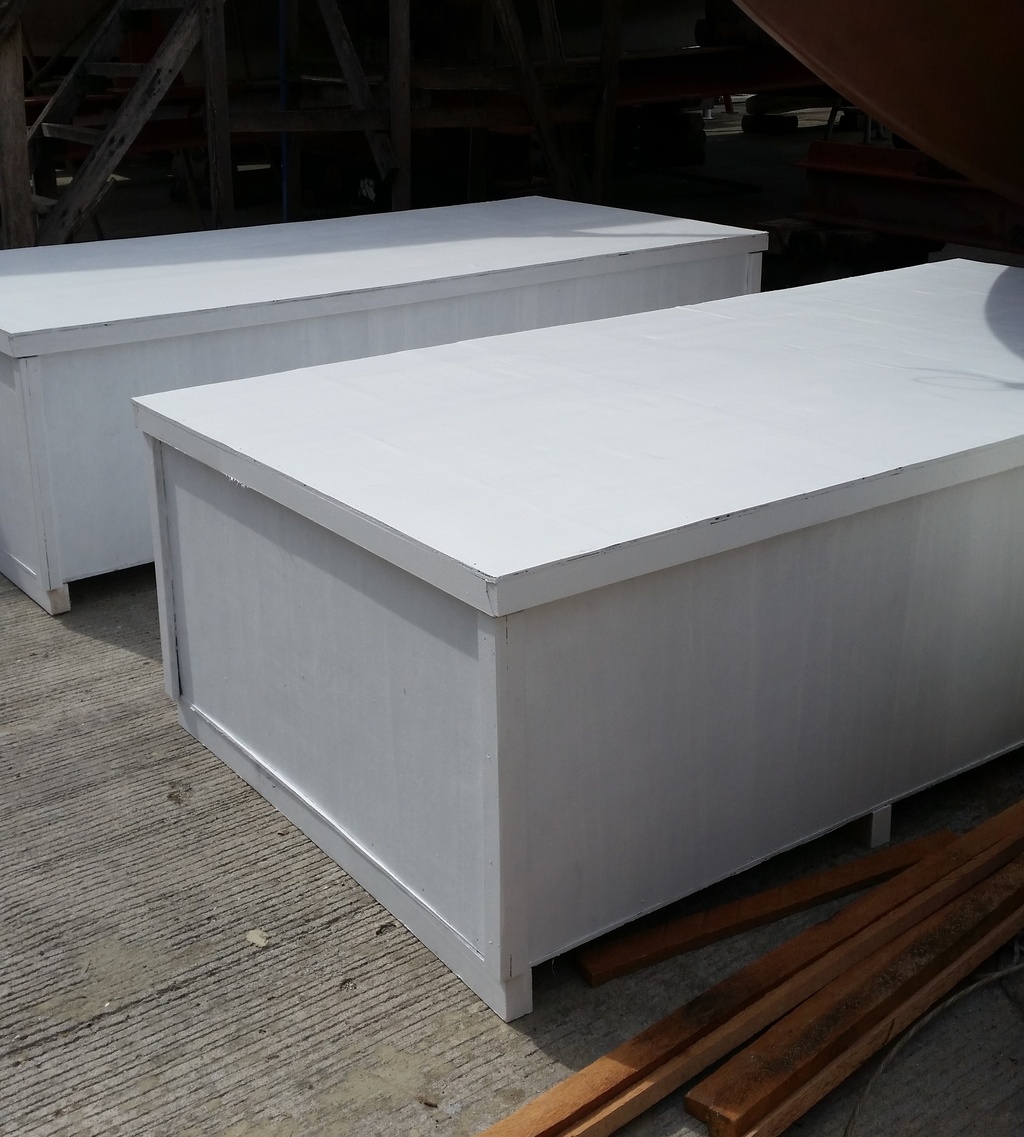
        Local workers begin building our two new storage boxes.


        • 20 March

        Removed and installed both cap shrouds - To Do List item A0173.

        The finished two new storage boxes are located in front of Indra.

        • 21 March

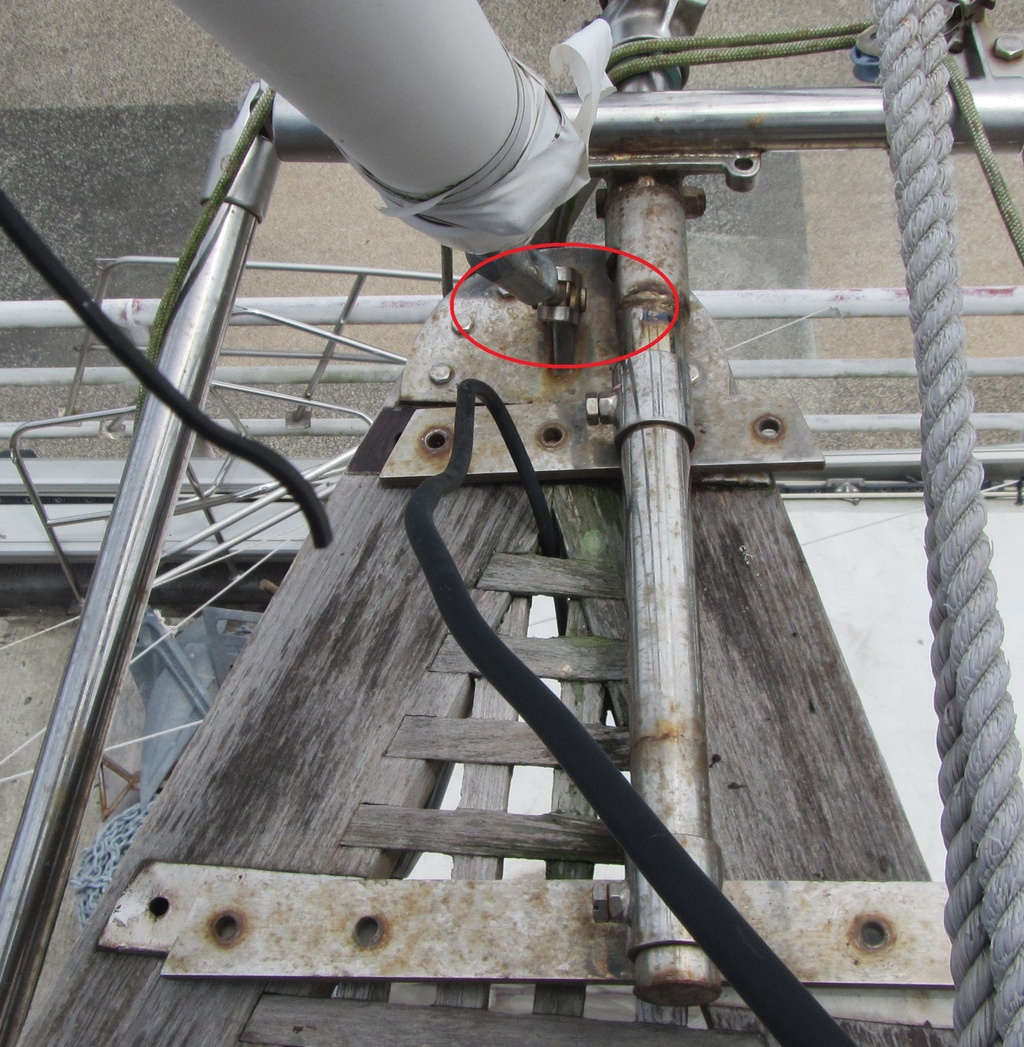
        Removed wind vane mount bolts to access back stay turnbuckle pin - To Do List item A0173.

        Removed and installed new back stay - To Do List item A0173.

        Marilyn and Mary Ann climb HOV marina hillside steps (121 steps up) - for exercise!

        • 22 March

        Worked AC electrical panel - To Do List item A0175.

        Started moving more "stuff" out of Indra and into the new storage boxes.


        • 23 March

        Cleaned and oiled the Sailrite LSZ-1 sewing machine.

        Sewed tarps for the two new storage boxes.

        • 24 March

        Started cleaning galley stove - To Do List item B0196/197/198.


        • 25 March

        Washed throw rugs.

        Installed Discharge of Oil Prohibited placard - To Do List item A0032.

        Installed Discharge of Garbage placard - To Do List item A0033.

        Had lunch at Virtu Trattoria restaurant.  After lunch, we drove and explored southern Samal Island.

        • 26 March

        Cleaned galley stove and cooked on it for the first time - To Do List item B0196/197/198.

          Significant rain storm reveals leaks at both rectangular bronze deck prism lights at galley area overhead - added to the To Do List item A0276. Marilyn sets up cooking pots on galley stove and counter top to catch the rain drops leaking in. Another leak is discovered at the forward port light above the starboard settee - added to the To Do List item A0277.  Also discovered in the head, at the mast wiring conduits entrances, significant water leaking in - added to the To Do List item A0278.


          • 27 March

          Removed both bronze deck prism lights at galley area and applied fiberglass epoxy - To Do List item A0276.


          • 28 March

          Drove to Davao City - went shopping at S&R (food stuff) and Citi Hardware.


          • 29 March

          Removed more head liner panels.  Start rewire of LED lights - To Do List item A0245.

          Resealed and installed both bronze deck prism lights at galley area - To Do List item A0276.

          Mary Ann's 15th birthday. She had Alaskan King Crab, New Zealand rib-eye steak, cake, and ice cream - what a feast.

          • 30 March

          Removed more head liner panels. Continue rewire of LED lights - To Do List item A0245.

          Removed navigational light wiring from pulpit stanchions and seal holes with epoxy - To Do List item A0026.


          • 31 March

          Removed more head liner panels. Continue rewire of LED lights - To Do List item A0245.


          LED Lights and Wiring

          LED Lights and Wiring

          LED Lights and Wiring


          The headliner covering the inside surface of the cabin top had numerous round wooden LED light covers with an opaque lens.  We discovered that these light covers were attached to the headliner with some type of adhesive - as the adhesive dried out a few of the light covers fell off.

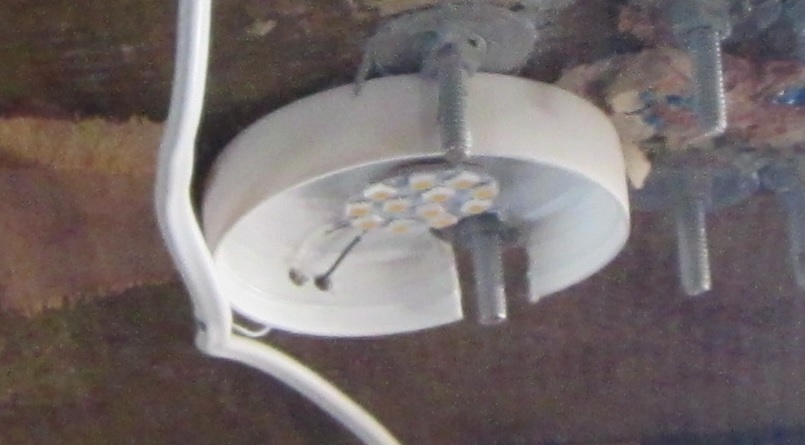
          We removed the headliner and discovered the LED light assembly was a plastic lid glued to the cabin top with a 12-volt G4 LED disc bulb glued to the inside of the plastic lid.  The 12-volt G4 LED disc bulb had two metal pins with small wires (estimate 26 AWG) soldered to the pins.  These wires were led to the outside of the lid through two small holes drilled in the side of the lid.

          These two wires were then soldered to a pair of 16 AWG sheathed wires by cutting a nick through the plastic sheath and wire insulation. As the picture below illustrates, the ball of solder joining the two wires was left exposed.  The picture below also reveals the inappropriate use of two blue plastic automotive-type inline butt splices and the deterioration of the adhesive intended to affix the white cloth-like material to the headliner.

          The most significant issue with this installation is the potential fire hazard from the exposed solder connections.  Also the four solder connections, two at the 12-volt G4 LED disc bulb and two at the 16 AWG sheathed wires, have the potential to break with the potential to short the wiring, since the wiring has no support to protect it from flexing due to vibrations.  Another issue is the small 26 AWG wires have an ampacity rating of 2.2 amps maximum but are connected to a 15 amp circuit breaker - if an electrical short occurred at the 26 AWG wires the real possibility exists that the 15 amp circuit breaker would not trip.


          It is common knowledge in marine wiring practices that electrical connections should be mechanically connected, not just soldered. Two sources of this recommended practice are as follows:

          The American Boat and Yacht Council (ABYC) standard E-11 AC and DC Electrical Systems on Boats states:

          Paragraph 11.14.3.7 - Solder shall not be the sole means of mechanical connection in any circuit. If soldered, the connection shall be so located or supported as to minimize flexing of the conductor where the solder changes the flexible conductor into a solid conductor.

          EXCEPTION: Battery lugs with a solder contact length of not less than 1.5 times the diameter of the conductor.

          NOTE: When a stranded conductor is soldered, the soldered portion of the conductor becomes a solid strand conductor, and flexing can cause the conductor to break at the end of the solder joint unless adequate additional support is provided.

          The National Fire Protection Association (NFPA) 302 Fire Protection Standard for Pleasure and Commercial Motor Craft states:

          Paragraph 9.14.7 - Solder shall not be the sole means of mechanical connection in any circuit except in the following situations:

          (1) Battery lugs with a solder contact length of not less than 1.5 times the diameter of the conductor.
          (2) Conductors contained completely within equipment or enclosures.

          Annex A, paragraph A.9.14.7 - If a connection is soldered, the flexibility of the wire is affected and can be subject to failure from movement. If a crimped connection is soldered, it can reduce the mechanical strength of the joint.


          As Indra has 28 of these type of light fixtures; all lighting fixtures will be needed to be inspected and modified - or replaced.


          Added to the To Do List:

          • B0244 - Attach all round wooden LED light covers to headliner with screws.
          • A0245 - Inspect all light fixtures and wiring.  Delete all plastic inline butt splices and solder connections.  Connect wiring with crimped/mechanical connections.


          Serada Stove

          Serada Stove

          • Action: To Do List item B0196 – Clean and de-carbonize stove and burners.
          • Action: To Do List item B0197 – Investigate and repair overhead stove hob/grill burner refusal to remain lighted.
          • Action: To Do List item B0198 – Investigate and repair non-functional Serada stove internal lighter circuit.
          • Completed:  26 March 2018
          • Cost: $3.00


          The Nelson Serada Gas Quip 2 Burner, Griil & Oven Model 1506 S/N: 2003025535 stove was in need of repair and cleaning.  This stove was built in the year 2003 and had seen better days.  The pan holder adjustable support had a mount screw missing from the outboard side, while the inboard side was extremely loose. The cast iron pieces of both burner assemblies were removed and cleaned with a wire wheel brush turned at a high rate by a electric drill.

          The top burner orifice cavities had an accumulation of burnt residue. This was removed with a chisel and small Dremel powered wire wheel brush.  The small orifice for LPG entry was cleaned out using a very small drill bit.

          The aft pan support needed one stuck screw drilled out.  Both ends of the aft pan support had new machined screws and nuts installed to restore the integrity of the mount support brace.

          The entire stainless steel surface was polished with Autosol Metal Polish cream ($3.00) to remove all old residue and restore the luster of the stainless steel surface.

          With the stove top reassembled, the LPG was turned on, bled out, and the burners lighted satisfactorily.

          The interior of the grill and oven area was thoroughly cleaned and polished to a mirror finish with the Autosol Metal Polish cream.  The oven burner also lite successfully.

          The grill burner assembly forward mount screw was essentially corroded away resulting in the front side of the grill burner assembly hanging freely down.  The grill burner assembly could be lite by holding the control knob pushed in, but as soon as it was released, the flame would extinguish.  Numerous attempts to achieve a sustainable light of grill burner assembly, by propping up the front section to ensure the thermocouple was heated failed.  It was believed to fix this problem both a replacement thermocouple and grill burner assembly would be needed.  Three separate inquiries to different British and Australian stove parts suppliers remained unanswered as to parts availability and cost.

          This stove had no internal lighter circuit, requiring the use of an external fire source to light all burners.

          All the mount hardware, screws, and bolts on this stove were frozen in place due to corrosion.  Any attempt to remove a screw instantly resulted in its head stripping out, necessitating the use of a drill to remove them.

          As a result of no response to parts replacement inquiries, the corroded hardware, the inoperative grill burner assembly, the decision to use the stove with only the top and oven burners was deemed an acceptable interim solution.  The replacement of the entire stove was decided as the ultimate solution and was added to the To Do List as a low priority item.

          Added to the To Do List:

          • B0275 - Research, obtain, and replace galley stove.


          Discharge of Oil Prohibited and Garbage Placard

          Discharge of Oil Prohibited and Garbage Placard

          • Action: To Do List item A0032 – Obtain and install a Discharge of Oil Prohibited placard. ($10.28)
          • Action: To Do List item A0033 – Obtain and install a Discharge of Garbage placard. ($6.99)
          • Completed:  25 March 2018
          • Cost: $17.27


          On 15 April 2015, a Bernard Marine Discharge of Oil Prohibited ($4.29) and Discharge of Garbage Placard ($6.99) was ordered from the Defender's website. These were shipped to our balikbayan box consolidator and forwarder Manila Forwarder in Los Angles, California and received there on 24 April 2015. We received them in Naga City, Cebu on 23 June 2015.

          We unfortunately discovered the Bernard Marine Discharge of Oil Prohibited Placard was not a placard, but a flimsy stick-on label. On 14 October 2015, we reordered a Bernard Marine Discharge of Oil Prohibited ($5.99) from the Defender's website. This was shipped to our balikbayan box consolidator and forwarder Manila Forwarder in Los Angles, California and received there on 22 October 2015. We received this in Naga City, Cebu on 28 December 2015. This error in ordering the incorrect placard highlights the logistical time delay encountered here in the Philippines - not an idea location to attempt a refit of a boat.

          These placards were not installed until the cabin top sides were repainted.

          The Discharge of Oil Prohibited placard was installed on the port-side cabin top wall by the galley.


            The Discharge of Garbage placard was installed on the aft cabin top wall of the galley area.


            Standing Rigging Replacement – Backstay Shroud

            Standing Rigging Replacement – Backstay Shroud

            Backstay Shroud

            • Action: To Do List item A0173 – Replace all turnbuckles and rigging wire.
            • Completed: 21 March 2018
            • Cost: $738.67


            Ordered and received the following items for the backstay shroud:


            Backstay Shroud - 5/16" 1x19 316 SS cable  Q  Cost
            143-08 Sta-Lok Swageless Insulator - Terminal to Terminal - Wire Size: 5/16" 2 $387.64
            5161x19316 5/16" 1x19 type 316 stainless 56 $166.32
            12FBJ Hayn Jaw Body Only Turnbuckles •Pin Diameter: 1/2", Wire Diameter: 5/16" •Turnbuckle Length: 6.5", Thread size: 1/2-20 L.H 1 $68.00
            136-08 Sta-Lok Stud 5/16 X1/2" UNF Right Hand 1 $62.49
            133-08-1/2 Sta-Lok Eye - 5/16" and 8mm wire X 1/2" 12.5 pin 1 $54.22
            $738.67


            To access and remove the lower backstay turnbuckle clevis pin, the Flemming wind vane mount base bolts/nuts were removed and the wind vane base shifted to the port side.  The HF/SSB antenna wire was removed from the backstay shroud.  A spare halyard was routed from the top of the mast aft, over the boom gallows, and secured to a aft port side cleat. The the lower backstay turnbuckle was disconnected, then a trip up the mast to remove and lower the backstay shroud top end.

            The original backstay shroud wire eye-to-eye length was about 51 feet 7 inches.  The backstay shroud had insulators installed for the HF/SSB system and this resulted in the need to cut three separate lengths of stainless steel wire.  The following pictures illustrate the measured distances of the original backstay shroud.  The two sections of white ABS plastic tube was used to store the man overboard pole and they were not reinstalled.  The last picture shows the lower backstay turnbuckle adjusted fully closed, with no further capability to tighten the backstay wire - this was how it was found when originally installed.

            We first installed a Sta-Loc Eye terminal on the 5/16-inch spool of wire and measured it for length against the old wire where the old insulator was installed.  The wire was cut about the 4-foot length mark and the new Sta-Loc insulator was installed on that segment.  The end of the 5/16-inch spool of wire was then installed on the other end of the Sta-Loc insulator.  Again using the old wire to measure length, the next cut was made at a length of about 40.5 feet and another Sta-Loc insulator was attached. The end of the 5/16-inch spool of wire was then installed on the other end of this Sta-Loc insulator.  Again using the old wire to measure length, the next cut was made at a length of about 5 feet, where it was attached to the turnbuckle stud.  The overall length was kept about the same but the turnbuckle was adjusted so the studs were at their 50 percent adjustment range when the measured wire cut was made.

            The end of the backstay shroud with the Sta-Loc Eye terminal was attached at the top of the mast with new clevis and cotter pin installed.  The turnbuckle end was then installed on the boomkin mount plate, also with a new clevis and cotter pin.